
Foreign News
Far right in Austria ‘opens new era’ with election victory


Austria’s far-right Freedom Party (FPÖ) has opened the door to a new era, its leader Herbert Kickl has told supporters, as they celebrated an unprecedented election victory.
Kickl’s party won 29.1% of the vote according to provisional results – almost three points ahead of the conservative People’s Party (ÖVP) on 26.4%, but far short of a majority.
Kickl’s victory is only the latest in a string of far-right election successes in Europe and he praised voters for their “optimism, courage and trust” in delivering a “piece of history”.
The FPÖ has been in coalition before, but the second-placed ÖVP has refused to take part in a government led by Kickl.
Kickl’s main rival, incumbent Chancellor Karl Nehammer of the ÖVP, has said it was “impossible to form a government with someone who adores conspiracy theories”.
There was a high turnout of 74.9% as Austrian voters took part in an election dominated by the twin issues of migration and asylum, as well as a flagging economy and the war in Ukraine.
As half the map of Austria turned dark blue, FPÖ general secretary Michael Schnedlitz said “the men and women of Austria have made history today”, although he refused to say what kind of coalition his party would try to build.
Postal votes were still being counted on Monday morning, but an analysis of voters suggested those aged 35-59 were most likely to back the far right, and marginally more women than men.
Kickl’s party has won 56 seats in the 183-seat parliament, with the conservatives on 52 and the Social Democrats on 41, according to projected results.
The Freedom Party’s fiery leader had promised Austrians to build “Fortress Austria”, to restore their security, prosperity and peace.
The party wants firm rules on legal immigration and it has promoted the idea of remigration, which involves sending asylum seekers to their original countries. It also wants a bar on the right to asylum as a step towards citizenship.
Herbert Kickl has aligned himself closely with Hungarian Prime Minister Viktor Orban and his self-styled “illiberal democracy”. On Sunday night, Social Democrat leader Andreas Babler warned that Austria must not follow the same path as Hungary.
Kickl had also spoken of becoming Volkskanzler (people’s chancellor) which for some Austrians carries echoes of the term used to describe Adolf Hitler in Nazi Germany.
The FPÖ was founded by former Nazis in the 1950s. Two days before the vote some of its candidates were caught on video at a funeral where an SS song was sung.
As the party’s victory became clear, a small group of protesters appeared outside parliament carrying anti-Nazi banners. One read “Nazis, get out of parliament”, while another said, “Don’t let Nazis govern, and never [let them] march”.
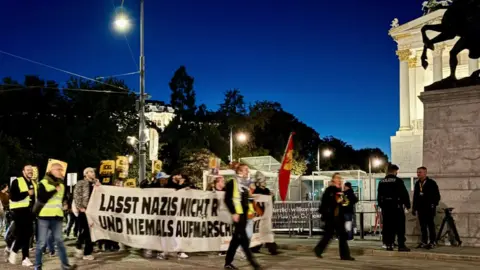
Forming a coalition is likely to prove complicated for Kickl, who is a divisive figure.
The Social Democrats, Greens and Neos have all ruled out a partnership with the far right. The only possible coalition Kickl’s party could form is with the conservatives, although the FPÖ would have to find a solution to the ÖVP’s refusal to have Kickl as chancellor.
When Geert Wilders’ Freedom Party won the Netherlands’ election last November, he dropped his bid to become prime minister so that three other parties would agree to form a coalition. However, Kickl is keen to lead his country, promising Austrians to act as their “servant and protector”.
Political analyst Thomas Hofer told the BBC it was by no means clear that Austrian President Alexander Van der Bellen, who oversees the formation of government, would give Kickl a “direct mandate to form a coalition”.
The ÖVP could in theory scrape together a coalition with the Social Democrats if the latest projections are correct, and could attract the liberal Neos party or the Greens.
Equally, Karl Nehammer may come under pressure from within the ÖVP to drop his objection. One leading FPÖ figure said after such a historic defeat he should resign, although that was rejected by the general secretary of Nehammer’s party.
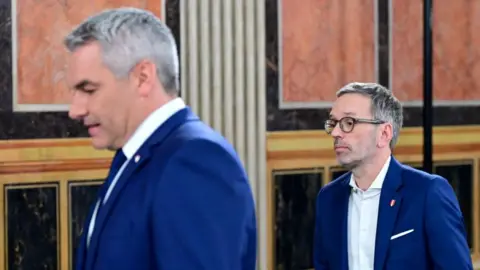
President Van der Bellen has voiced reservations in the past about the FPÖ because of its criticism of the EU and its failure to condemn Russia’s invasion of Ukraine. The party opposes EU sanctions on Moscow, citing Austria’s neutrality, and many of its MPs walked out of a speech to the parliament in Vienna last year by Ukraine’s Volodymyr Zelensky.
On Monday, Austrians had mixed feelings about the election results.
“I find it really sad that people get so close to radical right-wing ideas and ignore history,” Nikolai Selikovsky, a resident of Vienna – which predominantly voted for the Social Democrats – told AFP. “It also shows the failure of the other parties that they can’t talk to each other constructively.”
“I’m asking myself what we did wrong in the past 75 years,” Karin Grobert, a commuter, told Reuters. She expressed concern that Austria will shift further to the right if coalition talks fail.
But Josef Binder, a 57-year-old carpenter who voted for FPÖ, said there was no reason other parties could not cooperate with Kickl. “They also have to realise, the other parties, that if they negate 29% of voters, that that’s actually not okay, it’s undemocratic,” he added.
Some worried about what the FPÖ’s policy of remigration could mean for them.
Berat Oeztoprak, a 22-year-old kebab seller in Vienna, told Reuters: “What I might fear is that many will no longer be allowed to stay here.”
He added: “I was born in Austria and I know that I belong here. I also did two years in the army and I have a badge. And I also served for the state for two years, I pay my taxes, I’m nice to the people here, they’re just as nice to me.”
Kickl’s victory is the latest in almost a year of vote successes for radical right-wing parties in Europe.
Italy’s Giorgia Meloni heads a right-wing coalition as leader of the far-right Brothers of Italy party and Germany’s AfD topped the polls in the eastern state of Thuringia last month. France’s National Rally won the vote in European elections last June.
Unlike Kickl, Italy’s prime minister has given her full backing to the EU’s defence of Ukraine in the face of Russia’s full-scale invasion.
AfD co-leader Alice Weidel congratulated Kickl, posting a picture of the two together, and Marine le Pen of the National Rally said “this groundswell carrying the defence of national interests”, after the votes elsewhere in Europe, confirmed the “people’s triumphs everywhere”.
Geert Wilders said times were changing, and that “identity, sovereignty, freedom and no more illegal immigration/asylum” was what millions of Europeans were longing for.
Kickl has tapped into fears about immigration in Austria and he has made the most of anger at the government’s handling of the Covid pandemic, embracing conspiracy theories about obscure treatments for the virus.
For Kickl and his party, Sunday’s election victory represents a significant recovery from 2019, when they came a distant third in the wake of a video sting scandal that engulfed their former leader.
[BBC]


The co-owner of a Colorado funeral home where nearly 200 decaying bodies were found has been sentenced to 40 years in prison for corpse abuse.
Before Jon Hallford was sentenced, he apologised in court and listened to family members describe having nightmares about their loved ones decomposing in his care. They called him a “monster” who should rot in jail.
His ex-wife and co-owner Carie Hallford has pleaded guilty to similar charges and is awaiting sentencing.
The Return to Nature home, in the town of Penrose, Colorado, had given fake ashes to grieving relatives instead of their loved-ones’ remains. Prosecutors said 189 bodies were improperly stored in the building over four years.
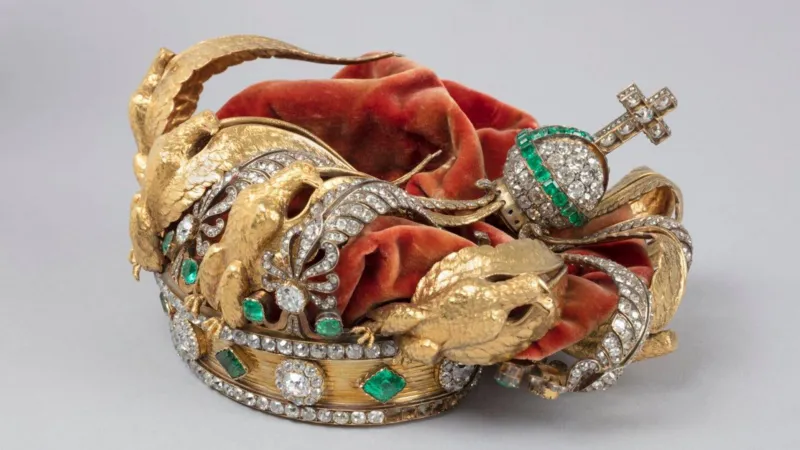
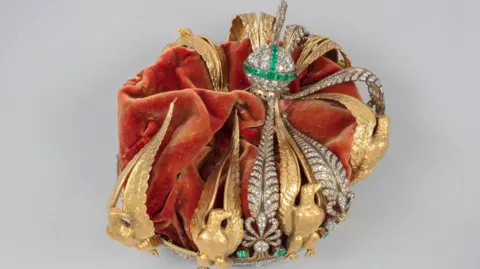
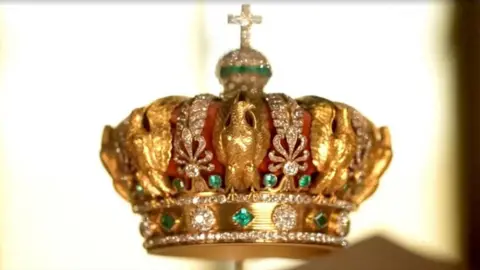
The crown of French Empress Eugenie was left crushed after being dropped by fleeing thieves during the raid at the Louvre last October – but is “nearly intact” and can be fully restored, the museum has said.
Raiders stole an estimated 88 million euros (£76m, $104m) in jewels, but left the diamond-studded headpiece belonging to the wife of Napoleon III on their escape route.
The museum has issued the first photographs of the crown since the theft, saying it had been left “badly deformed” after the thieves tried to remove it through a narrow hole they sawed in its glass display case.
The crown is missing one of eight golden eagles that adorned it but retains its 56 emeralds and all but 10 of its 1,354 diamonds.
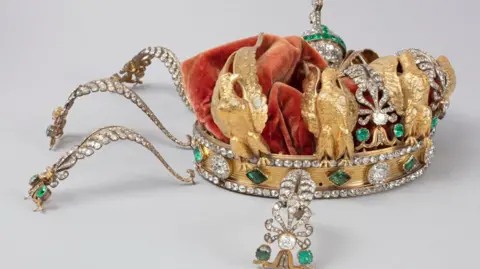
It added the 19th Century crown would be restored to its original state “without the need for reconstruction”.
An expert committee led by the museum’s president Laurence des Cars had been selected to supervise the restoration.
The heist took place on 19 October and saw the gang use a stolen vehicle-mounted mechanical lift to gain access to the Galerie d’Apollon (Gallery of Apollo) via a balcony close to the River Seine.
Two of the thieves got inside by cutting through the window with power tools. They then threatened the guards, who evacuated the area, and cut through the glass of two display cases housing jewellery that once belonged to French royalty or its imperial rulers.
Prosecutors said the thieves were inside for less than four minutes before making their escape on two scooters waiting outside.
Police have arrested four male suspects who prosecutors allege are the thieves – but the mastermind behind the raid has not been tracked down.
The seven other items of jewellery taken, including a diamond-studded tiara that belonged to Eugenie and necklaces, ear-rings and brooches remain missing.
[BBC]

Gunmen have killed nearly 200 people in western and northern Nigeria, officials and residents said, as survivors buried the dead and security forces hunted the attackers.
In western Kwara State, gunmen stormed the community of Woro on Tuesday evening, killing at least 170 people, according to a local lawmaker, while in northern Katsina State, at least 21 people were shot dead by attackers who moved from house to house, residents said.
The killings in Kwara marked the deadliest attack recorded in the region in recent months.
They come amid a complex security crisis in Nigeria, with violent groups linked to Boko Haram and the ISIL (ISIS) group in the northeast, alongside a surge in kidnappings for ransom by gunmen across the northwest and north-central regions over recent months.
No group has claimed responsibility for the assault in Kwara.
Saidu Baba Ahmed, the lawmaker for the area, told the Reuters news agency that the gunmen rounded up residents, bound their hands behind their backs and executed them.
Villagers fled into the surrounding bushland during the attack, while the attackers went on to torch homes and shops, he said.
“As I’m speaking to you now, I’m in the village along with military personnel, sorting dead bodies and combing the surrounding areas for more,” Ahmed said.
Several people were still missing on Wednesday morning, he said.
Police said “scores were killed”, without giving an exact figure.
Kwara police spokesperson Adetoun Ejire-Adeyemi said that the police and military have been mobilised to the area for a search-and-rescue operation.
Footage from Woro on local television shows bodies lying in blood on the ground, some with their hands tied, as well as burning houses.
Amnesty International said in a statement that the gunmen killed more than 170 people, razed homes and looted shops.
“The security lapses that enabled these attacks are unacceptable,” the rights group said, adding that the gunmen had been sending “warning” letters to the villagers for more than five months.
In Kwara, the Nigerian military recently carried out operations against what it called “terrorist elements”, while authorities also imposed curfews in some parts and closed schools for several weeks.
Kwara State Governor Abdul Rahman Abdul Razaq described the attack as a “cowardly expression of frustration by terrorist cells” in response to ongoing military operations against armed groups in the state.
The military said last month that it had launched “sustained coordinated offensive operations against terrorist elements” and achieved notable successes. According to local media, the military killed at least 150 fighters in the operation.
Al Jazeera’s Ahmed Idris, reporting from the Nigerian capital Abuja, said residents of Woro believe the attack was by groups linked to Boko Haram.
“We understand these gunmen stormed the village at 6pm local time on Tuesday [17:00 GMT] and circled these communities and started firing at random, killing – initially, the numbers we got were around 40.” he said.
“Then, as the day wore on, the number increased from 40 to 70. And now we are hearing that at least 170 people have been killed. It’s not clear how many people have been abducted yet,” he said.
Idris added that such killings take place in Nigeria “whenever there is increased military activity in areas where these armed groups are strong – either bandits, or Boko Haram or ISIL”.
In Katsina, meanwhile, residents and police said gunmen killed at least 21 people, moving from house to house to shoot their victims.
The attack broke a six-month peace pact between the community and the armed gang.
It also highlighted the dilemma faced by residents in Nigeria’s remote north, where some have sought peace with armed gangs that terrorise them. Residents typically pool money and food, which they give to bandits so they are not attacked.
Kabir Adamu, a security analyst at the Abuja-based Beacon Security and Intelligence Consulting, said the response from the Nigerian security forces has been insufficient to contain armed groups across the region.
“In simple terms, [the attacks] say more is required,” he told Al Jazeera.
“The operations have been effective in killing some of the bandit commanders. We also know some of their leaders have been arrested, and they are currently being prosecuted. But the law enforcement component that would dominate the environment and prevent this group from moving around and operating is missing,” he said.
Nigeria is also under pressure to restore security since United States President Donald Trump accused it last year of failing to protect Christians. Authorities, however, denied there is systematic persecution of Christians, while independent experts say Nigeria’s security crises claim the lives of both Christians and Muslims, often without distinction.
Nigeria’s government, meanwhile, has stepped up cooperation with Washington to improve security.
In late December, US forces struck what they described as “terrorist” targets in Nigeria, and on Tuesday, the American military said it sent a small team of officers to the country to assist in the response to the security crisis.
[Aljazeera]

Colorado funeral home director sentenced to 40 years for corpse abuse

Scotland opt to field against West Indies

Faheem Ashraf drags unconvincing Pakistan over the line after big scare

Trump threatens tariffs for countries trading with Iran

Advisory for Severe Lightning for the Western and Sabaragamuwa provinces and Galle and Matara districts

Decisions and judgments of the Supreme Court are a reflection of justice in the country – PM

‘Dates have the highest sugar content to fight Coronavirus’

Sunday Island 27 December – Headlines

#SundayIsland 17th December – Headlines

Sunday Island – 28th March

Sunday Island Headlines – 21 March

Sunday Island – 21st February – Headlines
-

 Business4 days ago
SLIM-Kantar People’s Awards 2026 to recognise Sri Lanka’s most trusted brands and personalities
-

 Business6 days ago
Altair issues over 100+ title deeds post ownership change
-

 Business6 days ago
Sri Lanka opens first country pavilion at London exhibition
-

 Business5 days ago
All set for Global Synergy Awards 2026 at Waters Edge
-

 Business4 days ago
API-first card issuing and processing platform for Pan Asia Bank
-

 Business6 days ago
ESOFT UNI Kandy leads the charge in promoting rugby among private universities
-

 Editorial2 days ago
All’s not well that ends well?
-

 Features2 days ago
Phew! The heat …