
News
FAO introduces innovative technologies to build resilience in Sri Lanka’s fisheries sector

SL’s average Fish Loss and Waste (FLW) is 41.4%
The Food and Agriculture Organization of the United Nations (FAO), with funding from the government of Norway, has taken a step towards enhancing resilience and sustainability in Sri Lanka’s fisheries sector by handing over a multi-day fishing boat equipped with advanced cooling technology and a fuel-saving bulbous bow.
In a statement the FAO said this initiative promotes the adoption of new technologies to reduce post-harvest losses, lower operational costs, and improve the quality of fish for both local and export markets.
The FAO said Sri Lanka’s multi-day fishing vessels, essential for deep-sea fishing, especially in the tuna export industry, often rely on ice to preserve fish during long voyages. However, this practice frequently compromises quality, leading to post-harvest losses. The Fish Loss and Waste (FLW) Assessment conducted by FAO in 2022–2023 found an average quality loss of 41.4% in the catch from Sri Lanka’s multi-day fisheries.
To address this challenge, FAO has installed an advanced cooling system on a newly constructed multi-day fishing vessel to ensure fish are kept at optimal temperatures throughout the voyage. This technology strengthens the resilience of fishing operations, ensuring higher-quality fish products reach the market while reducing waste and spoilage.
Fuel efficiency is critical for Sri Lanka’s fisheries sector, as multi-day boats consume between 8,000 and 11,000 liters of diesel per trip, costing operators three to four million LKR per voyage. To ease this burden, FAO provided technical expertise for the installation of bulbous bow technology on the vessel. This innovation minimizes wave resistance, delivering a 13% reduction in fuel consumption.
This innovation not only helps offset the additional fuel required by the cooling system but also brings long-term economic benefits to boat owners. The cost of installing the bulbous bow—approximately one million LKR—was borne by the boat owner with FAO’s technical support, highlighting the private sector’s role in adopting sustainable practices.
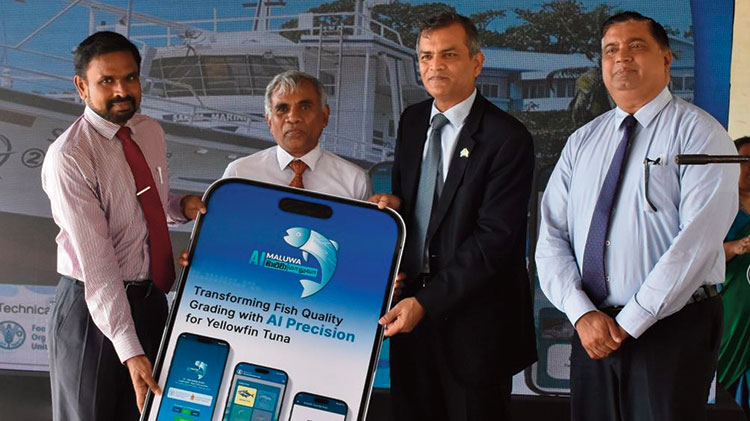
A key challenge faced by fishermen is securing fair prices for their catch. Middlemen often exploit gaps in quality knowledge, leaving fishermen with reduced profits. To address this, FAO developed an AI-powered mobile app, enabling fishermen to assess the quality of their fish in real-time based on Yellowfin Tuna export standards.
The app provides immediate feedback through a simple photo upload, giving fishermen the power to negotiate better prices. This tool enhances the resilience of fishing communities by ensuring more equitable market access and fairer pricing.
These initiatives, handed over to the Department of Fisheries and Aquatic Resources, is part of FAO’s broader commitment to build resilience in Sri Lanka’s fisheries sector by promoting sustainable practices, reducing post-harvest losses, and empowering fishing communities. By integrating modern cooling systems, fuel-efficient technologies, and AI-based tools, FAO is driving a transformation that supports the economic and environmental sustainability of the sector.

Latest News
Heat index likely to increase up to ‘Caution level’ at some places in the Northern, North-central, North-western, Western, Sabaragamuwa, Southern and Eastern provinces and Monaragala district


Warm Weather Advisory
Issued by the Natural Hazards Early Warning Centre at 3.30 p.m. on 11 April 2026, valid for 12 April 2026
The Heat index, the temperature felt on the human body is likely to increase up to ‘Caution level’ at some places in the Northern, North-central, North-western, Western, Sabaragamuwa, Southern and Eastern provinces and Monaragala district.
The Heat Index Forecast is calculated by using relative humidity and maximum temperature and this is the condition that is felt on your body. This is not the forecast of maximum temperature. It is generated by the Department of Meteorology for the next day period and prepared by using global numerical weather prediction model data.

Effect of the heat index on human body is mentioned in the above table and it is prepared on the advice of the Ministry of Health and Indigenous Medical Services.
ACTION REQUIRED
Job sites: Stay hydrated and takes breaks in the shade as often as possible.
Indoors: Check up on the elderly and the sick.
Vehicles: Never leave children unattended.
Outdoors: Limit strenuous outdoor activities, find shade and stay hydrated.
Dress: Wear lightweight and white or light-colored clothing.
Note: In addition, please refer to advisories issued by the Disaster Preparedness & Response Division, Ministry of Health in this regard as well. For further clarifications please contact 011-7446491.
Latest News
Sun directly overhead Cheddikulam, Kebithigollewa, Gomarankadawala and Nilaveli about 12:11 noon. today [12]

On the apparent northward relative motion of the sun, it is going to be directly over the latitudes of Sri Lanka from 05th to 15th of April in this year.
The nearest areas of Sri Lanka over which the sun is overhead today (12th) are Cheddikulam, Kebithigollewa, Gomarankadawala and Nilaveli about 12:11 noon.

The Ceylon Electricity Board (CEB) has directed owners of large-scale rooftop solar systems to temporarily disconnect their installations for a 10-day period beginning from Friday (April 10), citing growing concerns over grid stability amid low electricity demand and high solar generation.
The directive applies to rooftop solar systems exceeding 300 kW capacity, which are required to remain switched off until April 20. The move coincides with the extended holiday season, during which national electricity demand typically declines, alongside prevailing sunny weather conditions that significantly increase solar output.
Senior electrical engineers told The Island that the decision, though exceptional, was necessitated by operational risks posed to the national grid.
“We are seeing a pronounced imbalance between supply and demand,” a senior CEB system control engineer said. “With industries and commercial establishments operating at reduced levels during the holidays, demand drops. At the same time, solar generation remains high, creating excess power that the grid struggles to absorb.”
He explained that such imbalances could lead to fluctuations in system frequency, potentially threatening the stability of the grid. “If generation exceeds demand, frequency rises beyond acceptable limits.
This can trigger automatic protection mechanisms or, in extreme cases, lead to partial outages.”Another senior engineer attached to the transmission division noted that managing distributed solar generation remains a technical challenge.
“Unlike conventional power plants, rooftop solar systems are not centrally dispatchable. We cannot directly control their output in real time. This limits our ability to balance the system during periods of excess generation,” he said.
He added that the country’s grid infrastructure is still adapting to the rapid growth of renewable energy. “We lack sufficient large-scale battery storage and advanced grid management systems to effectively handle these fluctuations. Until such capabilities are enhanced, temporary curtailment becomes necessary.”
Engineers also pointed out that conventional thermal plants cannot be abruptly shut down or adjusted to compensate for sudden surges in solar generation.
“These plants require minimum stable operating levels. When solar floods the grid during low demand, it creates operational constraints that are not easy to manage,” one official said.
The CEB, in its statement, expressed appreciation for the cooperation of solar system owners affected by the measure, stressing that it is a short-term intervention aimed at ensuring uninterrupted and stable electricity supply across the country.
Energy experts say the development underscores the urgent need for grid modernization, including investment in battery energy storage systems, smart grid technologies, and improved demand-side management.
“This is part of the transition challenge,” an independent analyst noted. “As solar penetration increases, the grid must evolve to become more flexible. Otherwise, curtailment will remain a recurring necessity.”
Despite the temporary shutdown, CEB engineers reaffirmed their commitment to expanding renewable energy.
“Solar power is a key pillar of Sri Lanka’s future energy mix,” a senior engineer said. “But integration must be carefully managed. Grid stability cannot be compromised.”
The temporary disconnection order, which took effect yesterday, marks a critical moment in Sri Lanka’s energy transition—highlighting both the progress made in renewable energy adoption and the technical hurdles that remain.
By Ifham Nizam

Sanju Samson and Jamie Overton deliver first points for Chennai Super Kings

Arya, Prabhsimran and Shreyas help Punjab Kings ace another 200-plus chase

Beauty of Sri Lanka in focus: Global showcase blends art, diplomacy and conservation

Showers expected in the Western, Sabaragamuwa, Central, Southern, North-western and Uva provinces and in Ampara, Batticaloa and Polonnaruwa districts after 1.00 p.m.

Heat index likely to increase up to ‘Caution level’ at some places in the Northern, North-central, North-western, Western, Sabaragamuwa, Southern and Eastern provinces and Monaragala district

Sun directly overhead Cheddikulam, Kebithigollewa, Gomarankadawala and Nilaveli about 12:11 noon. today [12]

‘Dates have the highest sugar content to fight Coronavirus’

Sunday Island 27 December – Headlines

#SundayIsland 17th December – Headlines

Sunday Island – 28th March

Sunday Island Headlines – 21 March

Sunday Island – 21st February – Headlines
-

 News6 days ago
Lankan-origin actress Subashini found dead in India
-

 News4 days ago
AG: Coal procurement full of irregularities
-

 Business3 days ago
Israeli attack on Lebanon triggers local stock market volatility
-

 Business4 days ago
Hayleys Mobility introduces Premium OMODA C9 PHEV
-

 Business3 days ago
HNB Assurance marks 25 years with strategic transformation to ‘HNB Life’
-

 Sports4 days ago
DS to face St. Anthony’s in ‘Bridges of Brotherhood’ cricket encounter
-

 News6 days ago
UN Regional Director launches SL’s first Country Gender Equality Profile during official visit
-

 News6 days ago
Dialog Launches ‘GanuDenu QR’, Making Cashless Transfers Free for All with eZ Cash and Dialog Finance