
News
Extremist ideology posed serious challenge-PM Rajapaksa tells Inter-faith forum

Calls for eternal vigilance against all forms of terrorist action
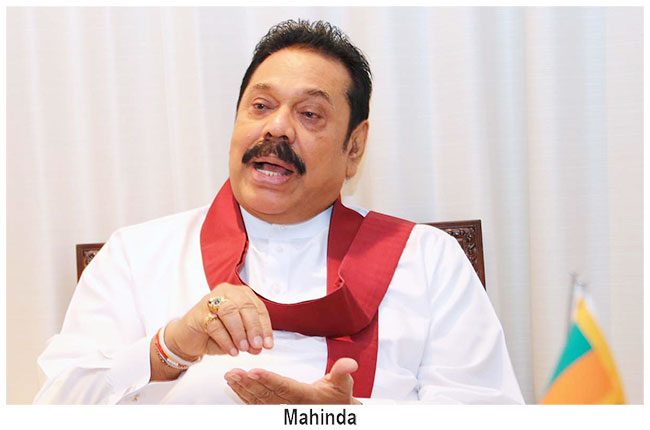
Prime Minister Mahinda Rajapaksa yesterday (12) said that extremist ideology, and violence associated with it, represented one of the most serious challenges of our time.
Addressing the G 20 Interfaith Forum in Bologna, Italy, PM Rajapaksa said: “It is appropriate to recall the tragic events of 09/11, exactly 20 years ago, and to share our deep sense of grief with the families of victims of this outrage and, indeed, with all humankind. This is a reminder of the need for eternal vigilance against all forms of terrorist action, whoever be the offenders and whatever be their professed aims and purposes.”
The following is the text of PM Rajapaksa’s speech: “A prominent feature of our region is ethnic, religious and cultureral diversity. Our countries are home to people from diverse ethnic backgrounds, professing different religions and nurtured by an array of cultures. And yet, rising above these differences, we have responded to the challenge of building a sense of mature nationhood, uniting all the different communities. Our future as one nation depends very much on this idea of unity and solidarity which is absolutely essential to achieve our economic, political and social goals.
It is especially fitting that this prestigious event should take place in Bologna, a city which has rightly established its reputation as a world leader in culture, in the arts and in all fields of intellectual activity. This enchanting city enshrines for all time the spirit of the Italian Renaissance, and its remarkable contributions to the growth of civilization. The world has certainly been enriched by the genius and creativity of the great Italian masters of that period in history.
I observe from the conference documents, prepared with great clarity, that you have placed a sharp focus on the areas in which peace and harmony among cultures play a vital role in our time. I have no hesitation in identifying education as the most important of these areas. Young minds are impressionable, and it is during the childhood years that there is the greatest chance to develop the right attitudes and values. While there are, clearly, differences embedded in the substance of different religions; there is also a core of beliefs and convictions that are common to all religions.
It is the duty of policy makers and educationists, through the curriculum and methods of teaching in our schools and universities, to emphasize what all religions share in common, the areas of consensus rather than the points reflecting differences. Youth in our educational institutions have the unique opportunity to build bridges rather than walls and to forge friendships which last through life. The government in my own country is giving priority right now to reform the content of education to bring it in line with modern requirements and to equip our youth to secure satisfying livelihoods which will sustain them in life.
The grave heath crisis which the world is experiencing at this time, serves to underline the bonds which unite us all: COVID-19 makes no distinction among religions, nationalities and civilizations. It strikes a deadly blow at all humanity. In order to survive the pandemic and resume our lives once more, international cooperation needs to be strengthened. Vaccines and other protection, made possible by modern medicine, must be available across the globe, with firm arrangements in place for less affluent nations to be assisted by international organizations and by countries with stronger economies. It is a battle that has to be won, not by some, but by all. While it may be legitimate for countries to close their borders temporarily to contain the virus, isolation is not the answer. One of the realities of the world, in which we live, is the free movement of goods, services and people across national frontiers. Migration in search of a better life is challenged by conditions prevailing today, but employment opportunities on an equitable basis must continue to be available freely.
This is a field in which gender equality and dignity is of special importance. Gautama the Buddha, in his final sermon, The Maha Parinibbana Sutra, declared that the moral quality of a society is to be assessed by the kindness and compassion shown to its more vulnerable members.
Our government is very much preoccupied with the protection of women and children against exploitation and all forms of discrimination at home, in places of employment and in society at large. Outdated laws relating to marriage, custody and inheritance are being currently updated by the Parliament of Sri Lanka. Our attitude is one of zero tolerance of human trafficking.
Climate change and other environmental issues are in the forefront of our minds. Sri Lanka is trying its best to adopt a balanced approach to human development. While progress on economic issues is necessary to support rapidly growing populations, this cannot be done at the expense of the environment.
Arahat Mahinda, the son of Emperor Dharmasoka of India, who brought the cherished gift of Buddhism to our shores, addressing King Devanampiyatissa of our country, said, “O, King, you are not the absolute owner but only the temporary trustee of our mountains and forests, our rivers and streams, the fauna and flora of our land: you are duty bound to hand over these assets to future generations in the condition in which you inherited them from your forefathers”. These words, an integral part of our culture, continue to define our policy towards the environment.
Reconciliation is a critical need of our time. Conflicts and escalating tensions are all too evident around us. Peace and stability come from healthy relationships with all who live in our countries, including those with whom we have deep disagreements. Here, again, our religion teaches us that hatred is not conquered by hatred but by love alone. Rather than dwell on grievances derived from the past, we must focus on the present, the need for harmony with points of view different from our own, and the inspiring new frontier which awaits us all if we forge the urgently needed links of brotherhood and understanding.”

Investigations have revealed that the government’s controversial easing of environmental regulations appears closely aligned with the interests of a small but powerful coalition of politically connected investors, environmentalists have alleged.
The move weakens key Environmental Impact Assessment (EIA) requirements and accelerates approvals for high-risk projects, has triggered a storm of criticism from environmental scientists, civil society groups and even sections within the administration, they have claimed.
Environmental Scientist Hemantha Withanage, Executive Director of the Centre for Environmental Justice, told The Island that the policy reversal “bears the fingerprints of elite political financiers who view Sri Lanka’s natural assets as commodities to be carved up for profit.”
“This is not accidental. This is deliberate restructuring to favour a specific group of power brokers,” he told The Island. “The list of beneficiaries is clear: large-scale mineral extraction interests, luxury hotel developers targeting protected coastlines, politically backed hydropower operators, industrial agriculture companies seeking forest land, and quarry operators with direct political patronage.”
Information gathered through government insiders points to four clusters of projects that stand to gain substantially:
Several politically shielded operators have been lobbying for years to weaken environmental checks on silica sand mining, gem pit expansions, dolomite extraction and rock quarrying in the central and northwestern regions.
High-end tourism ventures — especially in coastal and wetland buffer zones — have repeatedly clashed with community opposition and EIA conditions. The rollback clears obstacles previously raised by environmental officers.
At least half a dozen mini-hydro proposals in protected catchments have stalled due to community objections and ecological concerns. The new rules are expected to greenlight them.
Plantation and agribusiness companies with political links are seeking access to forest-adjacent lands, especially in the North Central and Uva Provinces.
“These sectors have been pushing aggressively for deregulation,” a senior Ministry source confirmed. “Now they’ve got exactly what they wanted.”
Internal rifts within the Environment Ministry are widening. Several senior officers told The Island they were instructed not to “delay or complicate” approvals for projects endorsed by select political figures.
A senior officer, requesting anonymity, said:
“This is not policymaking — it’s political engineering. Officers who raise scientific concerns are sidelined.”
Another added:”There are files we cannot even question. The directive is clear: expedite.”
Opposition parliamentarians are preparing to demand a special parliamentary probe into what they call “environmental state capture” — the takeover of regulatory functions by those with political and financial leverage.
“This is governance for the few, not the many,” an Opposition MP told The Island. “The rollback benefits the government’s inner circle and their funders. The public gets the consequences: floods, landslides, water scarcity.”
Withanage issued a stark warning:
“When rivers dry up, when villages are buried in landslides, when wetlands vanish, these will not be natural disasters. These will be political crimes — caused by decisions made today under pressure from financiers.”
He said CEJ was already preparing legal and public campaigns to challenge the changes.
“We will expose the networks behind these decisions. We will not allow Sri Lanka’s environment to be traded for political loyalty.”
Civil society organisations, environmental lawyers and grassroots communities are mobilising for a nationwide protest and legal response. Several cases are expected to be filed in the coming weeks.
“This is only the beginning,” Withanage said firmly. “The fight to protect Sri Lanka’s environment is now a fight against political capture itself.”
By Ifham Nizam
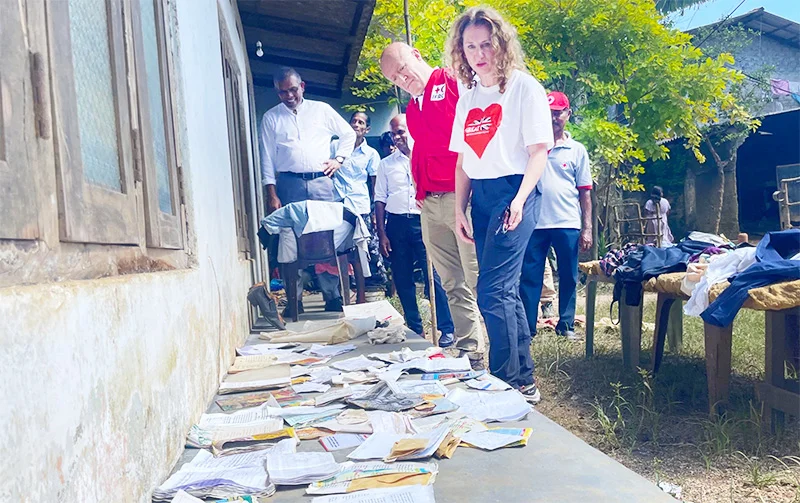
The UK has pledged £1 million (around $1.3 million) in aid to support victims of Cyclone Ditwah, following Acting High Commissioner Theresa O’Mahony’s visit to Sri Lanka Red Cross operations in Gampaha.
“This funding will help deliver emergency supplies and life-saving assistance to those who need it most,” the British High Commission said. The aid will be distributed through humanitarian partners.
During her visit, O’Mahony toured the Red Cross warehouse where UK relief supplies are being prepared, met volunteers coordinating relief efforts, and visited flood-affected areas to speak with families impacted by the cyclone.
“Our support is about helping people get back on their feet—safely and with dignity,” she said, adding that the UK stands “shoulder to shoulder with the people of Sri Lanka” and will continue collaborating with the government, the Red Cross, the UN, and local partners in recovery efforts.
She was accompanied by John Entwhistle, IFRC Head of South Asia, and Mahesh Gunasekara, Secretary General of the Sri Lanka Red Cross.
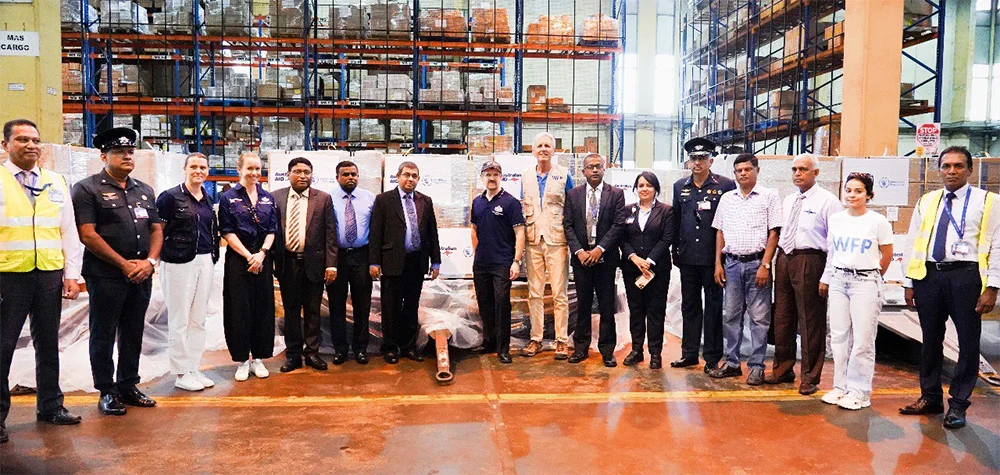
The United Nations World Food Programme (WFP) has scaled up its emergency response in Sri Lanka following the devastation caused by Cyclone Ditwah, thanks to a generous AUD 1.5 million contribution from the Government of Australia. This support is enabling WFP to deliver life-saving fortified food and provide cash assistance to families most affected by the disaster, Australian High Commission said in a release yesterday.
It said: The first airlift of fortified biscuits – 10 metric tonnes from WFP’s humanitarian hub in Dubai arrived in Sri Lanka, with upto 67 metric tonnes expected in the coming days. WFP has already dispatched fortified biscuits to Nuwara Eliya and Kegalle. Further deliveries are planned for Badulla and Kandy, among the hardest-hit districts.
“Australia stands with Sri Lanka at this devastating time. We are proud to work closely with our longstanding humanitarian partner the WFP, as well as with the Sri Lankan government and local authorities, to rapidly respond to meet the urgent needs of those affected communities,” said Australia’s High Commissioner to Sri Lanka, Matthew Duckworth.
WFP’s fortified biscuits provide a quick boost of energy and nutrition when families need it most.
“As rescue operations wind down, our priority is delivering life-saving fortified food to tackle immediate food needs of affected families, targeting especially those most at risk – children, older persons, pregnant and breastfeeding women, and people with disabilities, who often bear the brunt of such crises,” said Philip Ward, Representative and Country Director of the World Food Programme.
Australia’s contribution will also fund cash assistance programmes, complementing Government efforts to help families meet essential needs and rebuild their lives. WFP continues to appeal for additional donor support to sustain emergency operations and accelerate recovery for communities devastated by Cyclone Ditwah.

Showers will occur at times in the Northern, North-Central, Eastern, Central, and Uva provinces

Regulatory rollback tailored for “politically backed megaprojects”— Environmentalists

UK pledges £1 mn in aid for Ditwah victims

WFP scales up its emergency response in Sri Lanka

Opposition Leader discusses with Russian Ambassador more emergency relief

Heavy rainfall forecast for some places in Northern, North-Central and Eastern provinces today

‘Dates have the highest sugar content to fight Coronavirus’

Sunday Island 27 December – Headlines

#SundayIsland 17th December – Headlines

Sunday Island – 28th March

Sunday Island Headlines – 21 March

Sunday Island – 21st February – Headlines
-

 News3 days ago
Over 35,000 drug offenders nabbed in 36 days
-
 News7 days ago
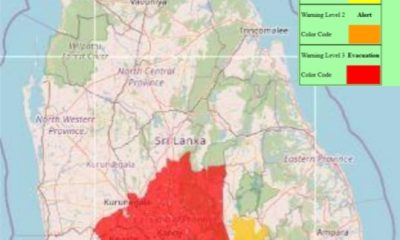
Level III landslide early warning continue to be in force in the districts of Kandy, Kegalle, Kurunegala and Matale
-

 Business5 days ago
LOLC Finance Factoring powers business growth
-
 News2 days ago
Cyclone Ditwah leaves Sri Lanka’s biodiversity in ruins: Top scientist warns of unseen ecological disaster
-

 News5 days ago
CPC delegation meets JVP for talks on disaster response
-
 News5 days ago
A 6th Year Accolade: The Eternal Opulence of My Fair Lady
-

 Features1 day ago
Finally, Mahinda Yapa sets the record straight
-

 News3 days ago
Rising water level in Malwathu Oya triggers alert in Thanthirimale