
Business
Experts discuss sustainability-linked opportunities and challenges for Sri Lanka’s textile and apparel sector


A Capacity Building Workshop on Sustainability Impact Measurement and Reporting for Sri Lanka’s Textile and Apparel Sector was jointly organized recently by the Global Reporting Initiative (GRI), Sustainable Development Council, Joint Apparel Association Forum (JAAF) and the Export Development Board.
A key highlight of the Workshop was the Roundtable Discussion on ‘Aligning Business, Policy, and Investment Priorities for Sustainable Growth” that brought together representatives from the textile and apparel industry as well as business support organizations to share insights on important aspects relating to sustainable businesses such as role of standards, sectoral priorities, business and policy alignment and investment and incentivization.
Setting the Context, the Chair, Chamindry Saparamadu, Executive Director of DevPro and former Director General of the Sustainable Development Council of Sri Lanka highlighted that in the backdrop of recent U.S. tariff policy changes which is threatening to disrupt market access for Sri Lanka’s textile and apparel sector, sustainability could be a gateway to UK and EU markets that place strong emphasis on sustainability-linked trade incentives such as traceability, decarbonization, and ethical labor practices. if the businesses align swiftly with those standards.
Kicking off the dialogue, Roshan Peries, National Project Coordinator, International Trade Centre (ITC) emphasized that alignment with global standards such as GRI standards is critical for improving the competitiveness of SMEs and enabling their integration into international value chains. She further mentioned that ITC supports local enterprises in meeting these standards, be it on quality, sustainability, or compliance, so they can access new markets, build trust with global buyers, and drive long-term growth and that this approach ensures that trade becomes a vehicle for inclusive and sustainable development.”
Complementing the above, Chulendra de Silva, GRI Global Sustainability Standards Board (GSSB) Member emphasized that sustainability in textiles and apparel is essential, given the industry’s far-reaching environmental impacts – from water and energy consumption to chemical use and waste generation. Social impacts are equally significant, he said, affecting workers, retailers, and end-use customers. While responsible manufacturing and supply chain practices are vital, retailers also play a critical role by fostering respectful partnerships, ensuring fair pricing, and engaging proactively with suppliers. He further said that a new GRI Sector Standard for Textiles and Apparel can empower organizations to identify their most significant impacts and report on them with clarity and transparency – driving a more ethical, accountable and sustainable industry.
Amanthi Perera, Head – Social Sustainability of MAS Capital Private Limited shared perspectives on how businesses are currently navigating supply chain engagement and the evolving standards landscape said that increasing focus on supply chain sustainability, driven by new regulations like CSDDD and CSRD, presents a significant undertaking. She noted that ‘It’s one thing to prioritize our supply chain; it’s another to genuinely engage and ensure our diverse suppliers, globally and locally, are committed to sustainable practices. This can be complex due to varying levels of maturity and resources among our partners. On top of this, the world of sustainability reporting is constantly evolving. New standards emerge, and we need to align our reports with multiple frameworks simultaneously. Keeping up with these changes while ensuring consistent data collation and alignment is a challenging, continuous and resource-intensive effort for businesses that are leading the way in real-world sustainability’. She emphasized the need to create a sector standard that reflects all voices of Apparel including even the voice of manufacturers.
Speaking on behalf of the textile and apparel industry, Yohan Lawrence, Secretary General of Joint Apparel Association of Sri Lanka (JAAF) appreciated the progress made by Sri Lanka in aligning current national policies with business efforts at sustainability through initiatives such as the National Strategy to Promote Inclusive and Sustainable Businesses led by the Sustainable Development Council (SDC), and the Green Finance Taxonomy. He noted that this shift comes at a critical time where the Country is looking to leverage its reputation for sustainable business to take advantage of the EU and UK regulations that reward initiatives, such as Carbon Border Adjustment Mechanism (CBAM), Corporate Sustainability Reporting Directive (CSRD) etc. He further noted that whilst there is already a basic framework in place, JAAF recognizes the need for global standards like GRI reporting to ensure alignment to global transparency requirements and for validation of the trust of international buyers.
Lawrence also highlighted the existing significant challenges as it remains difficult to incentivize a thorough sustainable transformation across all businesses, especially small and medium-sized enterprises (SMEs). He highlighted that to deepen this transformation, regulatory bodies and industry associations need to work closely together advocating tailored incentives that are in line with international standards, creating shared platforms for exchanging knowledge, addressing common environmental, social, and governance (ESG) challenges, and building capacity to help SMEs fully engage with and benefit from global sustainability practices.

Dialog Axiata PLC announced its consolidated financial results for the quarter ended 31 March 2026 on Friday 15 May 2026. Financial results included those of Dialog Axiata PLC (the “Company”) and of the Dialog Axiata Group (the “Group”).
Group Performance
The Group delivered revenue growth of 9% Year on Year (“YoY”) on the back of strong performances in Mobile, Fixed and Digital Pay Television businesses as Group Revenue reached Rs 47.3Bn, despite the continued strategic scaling down of the low-margin international wholesale business. On a Quarter-on-Quarter (“QoQ”) basis, revenue increased by 2% supported by Data Revenue growth and advertising revenue generated by Television Business.
The Group Earnings Before Interest, Tax, Depreciation and Amortisation (“EBITDA”) was recorded at Rs 24.3Bn, up 23% YoY supported by Revenue performance and Cost Rescaling Initiatives. EBITDA margin expanded by 5.8pp YoY to reach 51.3%. On a QoQ basis Group EBITDA grew 5%.
Group Net Profit After Tax (“NPAT”) was recorded at Rs 9.2Bn for Q1 2026, up +>100% YoY and 56% QoQ, supported by robust EBITDA growth, lower net finance costs and lower forex losses.
Reflecting strong operational performance, the Group recorded Operating Free Cash Flow (“OFCF”) of Rs 14.6Bn for Q1 2026, up 8% YoY.
Interim Dividend to Shareholders
The Board of Directors of Dialog Axiata PLC approved an interim dividend for Q1 2026, after considering the financial performance of the Group and taking into account the forward investment requirements, at the meeting held on 14th May 2026. The approved first interim dividend for FY 2026 amounts to Rs 0.70 per share and would translate to an Annualized Dividend Yield of 9.2% based on share closing price for Q1 2026.
Company and Subsidiary Performance
At an entity level, Dialog Axiata PLC (the “Company”) continued to be the primary contributor to Group Revenue (76%) and Group EBITDA (75%). Supported by YoY growth in the Data segment and effective cost-rescaling initiatives, Company revenue for Q1 2026 increased by 12% YoY to Rs 36.0Bn, while EBITDA rose 29% YoY to Rs 18.2Bn. On a QoQ basis, Company revenue grew by 4% while EBITDA grew by 7% QoQ, primarily attributable to the flow-through impact of revenue growth and reduction in direct costs. Furthermore, NPAT for Q1 2026 was recorded at Rs 7.6Bn, up +>100% YoY. On a QoQ basis, Company NPAT grew 83% QoQ.

The balance of trade between Canada and Sri Lanka which is in Canada’s favour, could be developed more evenly by promoting to a greater extent trade, investment, tourism and business partnerships between the countries, Canadian Chamber of Commerce in Sri Lanka (CanCham SL) Secretary General Nilupul De Silva said.
‘CanCham SL was established as a dynamic platform to promote trade, investment, tourism and strategic business partnerships between Canada, Sri Lanka and the wider Indo-Pacific Region, Secretary General De Silva explained.
‘The Chamber aims to facilitate stronger commercial engagement while supporting sustainable economic growth and regional collaboration. More than 65 percent of the world’s population resides is in the region, she said at a media conference held at CanCham House, Horton Place recently.
The Secretary General added: ‘The Canadian High Commissioner to Sri Lanka serves as the Patron of CanCham SL, further reinforcing the Chamber’s commitment towards strengthening bilateral and regional economic cooperation.’
‘The Canadian Chamber of Commerce in Sri Lanka proudly participated in a historic milestone with the formal signing of a landmark MOU alongside all Canadian Chambers across the Indo-Pacific region, in the presence of the Canadian Prime Minister Hon. Mark Carney, she said.
‘The agreement signifies a new era of collaboration among the Canadian Chambers of the Indo-Pacific, with a strong focus on strengthening trade and investment ties, enabling strategic resource sharing, enhancing regional cooperation and fostering knowledge exchanges across member chambers and markets, founder and board member CanCham SL M.H.K.M Hammez said.
He said that PM Carney announced a Canadian commitment of CAD 0.5 trillion (CAD 500 billion) towards strengthening Canada’s economic relationship with the Indo-Pacific region over the next decade.
‘Subsequently Canada established a sovereign wealth fund with an allocation of Canadian dollars 25 billion to support long term strategic and international economic initiatives in the region, Hammez said.
‘The Chamber will work closely with business leaders, diplomatic missions, government institutions, investors and industry stakeholders to create meaningful opportunities for Canadian and Sri Lankan enterprises, he added.
‘Not having a permanent Sri Lankan High Commissioner for Canada is one of the biggest issues we are encountering. There is nobody to coordinate and communicate from that end, Hammez said.
‘CanCham is an independent entity trying its level best to promote certain priority development sectors in the country with Canadian support, he explained.
By Hiran H.Senewiratne.
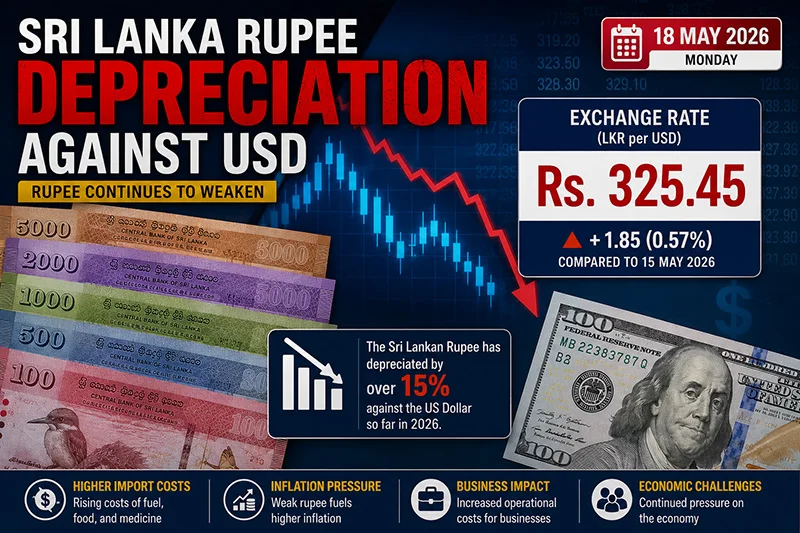
The continued depreciation pressure on the Sri Lankan rupee is exposing deep-rooted structural weaknesses within the economy, while simultaneously creating limited opportunities for export-oriented sectors, according to Rajkumar Kanagasingam.
Kanagasingam warned that while some export industries may temporarily benefit from a weaker currency, the broader economic strain caused by rising import costs, inflationary pressures, and investor uncertainty continues to weigh heavily on businesses and consumers alike.
Speaking to The Island Financial Review, he said local industries are struggling to absorb rising costs linked to imported raw materials, machinery, fuel, and intermediate goods as the rupee remains under pressure.
“Local industries are coping through cost-cutting measures, selective price increases, tighter inventory management, and delaying certain capital investments,” he said. “Many businesses are also exploring alternative suppliers and improving operational efficiency to manage rising import-related costs.”
He noted that import-dependent sectors are among the hardest hit by currency depreciation, particularly construction, transport, pharmaceuticals, manufacturing, and food imports, where businesses face mounting operational expenses and shrinking margins.
At the same time, Kanagasingam observed that export-oriented sectors such as apparel, tea, IT services, tourism, and businesses promoting local substitutes may gain some competitive advantage from the weaker rupee, as foreign exchange earnings translate into higher rupee revenues.
“A weaker rupee can improve the competitiveness of export-oriented sectors by increasing rupee earnings from foreign exchange,” he explained. “However, the benefits may be partially offset by higher imported input costs, energy expenses, and broader economic pressures.”
He stressed that small and medium-scale enterprises (SMEs) remain significantly more vulnerable than larger corporates during periods of currency instability.
“SMEs generally have limited financial buffers, less access to foreign currency, and weaker bargaining power,” he said. “Larger corporates are typically better positioned to manage exchange rate fluctuations through stronger reserves, export earnings, and diversified financing options.”
Kanagasingam added that consumers are ultimately carrying much of the burden created by rupee depreciation, with higher prices increasingly visible across food, transport, utilities, imported goods, and daily services.
“In many cases, increased business costs are gradually passed on to consumers,” he said, warning that sustained currency weakness could continue to fuel inflationary pressure across the economy.
He also pointed to a growing shift among local manufacturers toward localization and import substitution as businesses attempt to reduce reliance on imported inputs.
“There is growing interest in strengthening domestic supply chains and local production,” he noted. “However, Sri Lanka still faces challenges in terms of industrial scale, technology, and the availability of locally sourced raw materials.”
According to Kanagasingam, persistent currency volatility also undermines investor confidence and complicates long-term industrial planning.
“Currency fluctuations create uncertainty for investors, particularly in areas such as pricing, financing, debt servicing, and long-term project planning,” he said. “Greater exchange rate stability generally improves investor confidence and supports long-term industrial growth.”
He urged policymakers and the Central Bank to prioritize macroeconomic stability, foreign reserve strengthening, export expansion, energy efficiency, and targeted support for SMEs in order to cushion the impact of exchange rate volatility.
“The priority should be maintaining macroeconomic stability, strengthening foreign reserves, supporting export growth, improving energy efficiency, encouraging local production, and providing targeted support for SMEs,” he said. “Consistent and predictable policy measures are also essential to strengthen investor confidence.”
Kanagasingam further cautioned that prolonged rupee depreciation could eventually lead to job losses in sectors heavily dependent on imports.
“Prolonged depreciation could place pressure on import-dependent industries, potentially leading to reduced production, delayed expansion, and job losses, particularly among smaller businesses and vulnerable sectors,” he warned.
Describing the current exchange rate situation as more than a temporary market adjustment, Kanagasingam said Sri Lanka must address its long-standing structural vulnerabilities if it hopes to achieve lasting currency stability.
“It reflects both short-term external pressures and deeper structural challenges within the economy,” he said. “These include high import dependence, limited export diversification, debt-related pressures, and the need for stronger foreign exchange generation over the long term.”
Economic analysts note that the rupee’s trajectory in the coming months will remain closely tied to external debt management, reserve accumulation, export performance, remittance inflows, and broader investor sentiment surrounding Sri Lanka’s economic recovery efforts.
By Ifham Nizam

Jackson Pollock painting sells for record $181m at auction

New ownership group takes over Colombo Kaps in LPL

Thailand to slash tourist visa-free stays

President inquires into the well-being of soldiers at the Ragama “Ranaviru Sevana”

Rizwan and Agha resist but Bangladesh on course for 2-0 sweep

ICC deputy chair has ‘cordial and constructive’ meetings with new SLC committee

‘Dates have the highest sugar content to fight Coronavirus’

Sunday Island 27 December – Headlines

#SundayIsland 17th December – Headlines

Sunday Island – 28th March

Sunday Island Headlines – 21 March

Sunday Island – 21st February – Headlines
-

 Features3 days ago
Sri Lankan Airlines Airbus Scandal and the Death of Kapila Chandrasena and my Brother Rajeewa
-

 News7 days ago
Ex-SriLankan CEO’s death: Controversy surrounds execution of bail bond
-
 News4 days ago
Lanka’s eligibility to draw next IMF tranche of USD 700 mn hinges on ‘restoration of cost-recovery pricing for electricity and fuel’
-

 News3 days ago
Kapila Chandrasena case: GN phone records under court scrutiny
-

 Midweek Review7 days ago
A victory that can never be forgotten
-

 News3 days ago
Rupee slide rekindles 2022 crisis fears as inflation risks mount
-

 Opinion6 days ago
Electricity tariffs have skyrocketed: Can further increases be prevented?
-

 Features5 days ago
Mysterious Death of United Nations Secretary General Hammarskjöld