
News
Expert: Mismanagement of CEB hydro resources increases costly oil-powered electricity generation


The Ceylon Electricity Board (CEB) is in one of the strongest hydro storage positions in recent memory, but it has mismanaged key hydropower complexes, causing an increase in oil-powered electricity generation and and costs.
Energy expert Dr. Vidura Ralapanawe has raised serious concerns over CEB’s operational decisions, particularly the skewed use of the Mahaweli and Laxapana hydropower complexes. “By mid-May, the system had ample storage — about 60% overall — which is actually a very good position to be in just before the South-West monsoon rains,” he said. “But within that headline figure is a huge imbalance. Mahaweli reservoirs are near 75%, while Laxapana is languishing at 30%.”
This lopsided storage has already caused direct operational problems. The Canyon power station, which is fed by the Maussakele Reservoir in the Laxapana complex, has been forced to reduce its output. The 60MW plant is now operating at just 40MW due to limited water availability. Downstream, the 100MW New Laxapana station is similarly constrained.
The Laxapana complex is not just another hydropower asset — it plays a vital role in Colombo’s drinking water supply. It is required to run continuously to maintain flows for water treatment plants. “That means the CEB must generate from Laxapana 24/7, no matter what,” Ralapanawe said. “So how did they allow it to reach such a critically low level, especially when Mahaweli reservoirs are full?”
Ralpanawe said: “Instead of making adjustments to maintain operational flexibility, the CEB appears to have run the Laxapana complex harder than necessary in previous months while underutilising Mahaweli, where Victoria and Randenigala are sitting comfortably. The consequence? More reliance on oil-based thermal generation, even as the country’s dams remain well-stocked.”
“This is not just a technical problem — it’s an economic one,” he stressed. “Oil is expensive. When you underutilise hydropower in a year like this, you’re actively choosing to drive up the cost of generation.”
The apparent lack of coordination between the Mahaweli and Laxapana systems is especially baffling given the CEB’s long-standing familiarity with both. “The CEB has operated these systems for over 40 years. They know the inflows, the rainfall patterns, the seasonal irrigation releases — none of this is new,” Ralapanawe said.
Moreover, the growing integration of AI and data-driven forecasting tools in the global energy sector makes such mismanagement increasingly indefensible. “If, in the age of AI, we’re still hearing that ‘it’s too complex’ to manage these reservoirs in tandem, then something is seriously wrong,” he added.
Dr. Ralapanawe urges the CEB to provide an explanation: “Why was Mahaweli underdispatched when it was full? Why was Laxapana overused to the point that we now can’t get full capacity from critical plants like Canyon and New Laxapana? What is the economic impact of burning more oil than necessary?”
The missteps are already costing the public. Higher generation costs will ultimately be passed on to consumers in the form of increased tariffs, a burden made heavier in an already strained economy,” says Dr. Ralapanawe.
Ironically, 2025 was shaping up to be a strong hydro year, offering a rare opportunity for cost savings and reduced fossil fuel use. Instead, mismanagement has left key reservoirs unbalanced and locked the system into a more expensive operating mode — one that benefits oil suppliers but punishes the average household and industry.
Dr. Ralapanawe’s message is blunt: “This is not just about water and electricity. This is about public accountability and economic responsibility. If the CEB cannot manage two hydro systems properly with decades of data at its fingertips, then it must rethink its leadership and planning structures — or risk repeating the same costly mistakes year after year.”
Our efforts to contact CEB officials for comment were in vain.
By Ifham Nizam






The National Peace Council (NPC) said that the death sentence imposed on Sri Lankan citizen Sivarasa Anojan in Saudi Arabia and the removal of the Thileepan statue in Jaffna are very different events that carry the risk of turning into grievances that affect entire communities. The NPC urged the government as well as political parties, civil society and religious leaders to ensure that this does not happen.
The text of the statement: “NPC welcomes the government’s efforts in the Anojan case and the appeals for clemency made by political and religious leaders, including Muslim leaders. We encourage Muslim, Buddhist, Hindu and Christian leaders to express solidarity together. This would demonstrate that the life of a Sri Lankan citizen is a concern of all Sri Lankans, and that seeking mercy for him is not against any one religion. In particular, political, civil and religious leaders should reject attempts to turn the case into a source of anti-Muslim sentiment or collective blame. It is in this spirit that NPC joins the appeal for clemency for Anojan.
The Thileepan statue raises a different but related peacebuilding concern. Many Tamils attach deep significance to Thileepan, who died on 26 September 1987 after a twelve-day fast to protest the terms of the Indo-Lanka Peace Accord. The statue erected during this year’s commemoration was removed by police on 27 September. The government has raised legal concerns relating to the commemoration of a person associated with the LTTE, which remains a proscribed organisation. But the depth of Tamil anguish cannot be disregarded. For many Tamils, remembrance of Thileepan is connected to grief, loss and historical memory.
NPC notes that the Office for Reparations Act, No. 34 of 2018 provides for policies on memorialisation within its broader reparations framework. The government needs to engage the Office for Reparations and examine whether an appropriate form of memorialisation can be accommodated within the law. The JVP that now leads the NPP Government was itself once proscribed, later entered democratic politics, and now for many years has publicly commemorated its own fallen. The opportunity to remember those who died, while remaining within the law, should not belong to one community alone.
The cases involving Anojan and Thileepan give Sri Lanka an opportunity to demonstrate that it has learned from its past. Peacebuilding is the capacity to address today’s difficult issues in ways that prevent them from becoming tomorrow’s communal divisions. That is the real test of Sri Lanka’s continuing peace.”

The Sri Lanka Podujana Peramuna (SLPP) has accused the government of bending the law and targeting opposition politicians to distract the public from large-scale corruption, including alleged coal import losses, missing containers, and illegal dollar outflows.
Speaking at the launch of the “Yukthiya Wenuwen Nagitimu” (Stand Up for Justice) conference series in Kalutara, SLPP National Convener D.V. Chanaka claimed that key government figures are currently operating above the law while state investigative institutions are being politically manipulated.
Chanaka noted that diesel prices have risen significantly to Rs. 392 per litre compared to Rs. 283 when President Anura Kumara Dissanayake took office, despite drop in global oil prices.
He claimed the public was misled by prior political narratives.
Alleging that all 19 coal shipments imported under the current administration failed quality and procedural standards, Chanaka claimed the resulting Rs. 50 billion loss translates to an additional burden of Rs. 8,500 per household across Sri Lanka’s 6 million electricity consumers.
He emphasised that despite over 23 formal complaints filed with the CIABOC (Bribery Commission) and the CID, no arrests or prosecutions have taken place.
He raised concerns over 323 illegally released containers and a missing sum of $2.5 million, noting that no suspects have been detained.
Furthermore, he alleged that a senior police officer involved in a recent drug bust was transferred to prevent public connections to the missing container cases.
He accused the government of selectively weaponising law enforcement to target opposition leaders, specifically to distract the public from its own administrative corruption and financial irregularities.
During his address Chanaka also argued that high-profile arrests are deliberately timed to coincide with exposure of government scandals, including alleged coal procurement losses, missing containers, and illegal foreign currency outflows.
Chanaka specifically alleged that the administration was carrying out targeted arrests of key opposition figures, including Shasheendra Rajapaksa, former Minister Johnston Fernando, and SLPP National Organiser MP Namal Rajapaksa, strictly as a media tactic to divert public attention whenever new government corruption allegations surfaced.
Citing a 12-year-old case involving sponsorship funds for a rugby tournament, the speaker argued that law enforcement bypassed standard investigative protocols, such as interviewing tournament organisers or verifying properly approved corporate sponsorships, and instead pursued arbitrary arrests based on forced statements.
The government was criticised for failing to investigate or recover over $1 billion allegedly smuggled out of the country between 2025 and 2026, alongside other unresolved multi-million-dollar scandals.
Chanaka also expressed concern over the perceived loss of independence within key institutions, claiming that senior appointments across the Police, CID, and Commission to Investigate Allegations of Bribery or Corruption (CIABOC) are tied to ruling party political affiliations.
Concluding his address, Chanaka called on the public and opposition forces to unite for country-wide street protests, stating that the campaign initiated in Kalutara will expand nationally to demand justice and accountability.
By S.K. Samaranayake
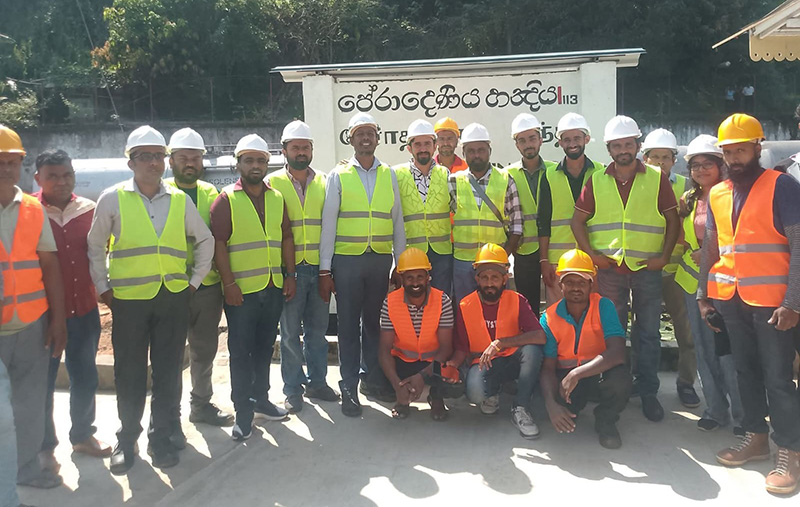
Following the severe landslide disaster caused by Cyclone Ditwah, in November last year (2025), which damaged 103 railway track locations and triggered 36 major landslides, train services between Rambukkana, Kadigamuwa, Kadugannawa, and Peradeniya have been restored.
Thanks to the immense dedication of engineers, technicians, and staff of the Department of Railways, Train No. 982 reached Peradeniya Railway Station from Colombo Fort, after 310 days, amidst joyful tears from passengers and railway personnel.
The recent inaugural train journey from Colombo Fort to Peradeniya was joined by Minister of Transport Bimal Rathnayake, Deputy Minister of Transport Dr. Prasanna Gunasena, the General Manager of Railways, railway staff, and commuters.
Minister of Transport Bimal Rathnayake stated that this train will operate daily between Peradeniya and Colombo, in both directions.
The Minister expressed his deep gratitude and joy over the ability to operate a train from Colombo to Peradeniya, Kandy, after 10 months, commending the round-the-clock commitment of the National Building Research Organisation (NBRO), railway technicians, engineers, and track maintenance crew

The internationally acclaimed play ‘Every Brilliant Thing’ comes to Sri Lanka

JXG’s Spartans I graduates step forward to forge their futures

Public Relations Association of Sri Lanka completes a successful educational initiative

High value and export-oriented agribusiness: Unlocking agrifood sector potential in Sri Lanka

Akram Cassim re-elected SLGJA president for third term

NPC warns catastrophic impact of Anojan death sentence and Thileepan removal by state

‘Dates have the highest sugar content to fight Coronavirus’

Sunday Island 27 December – Headlines

#SundayIsland 17th December – Headlines

Sunday Island – 28th March

Sunday Island Headlines – 21 March

Sunday Island – 21st February – Headlines
-

 News7 days ago
Police remove Thileepan statue in Jaffna
-

 Features7 days ago
The 22nd Amendment, constitutional recovery and illiberal slippage
-

 Latest News5 days ago
Gold winner Tharanga gets brand-new Honda Vezel from SLAAJ
-

 News7 days ago
Sajith rejects Jt. Opp. protest sabotage claim; SJB TU chief demands remedial action
-

 Features5 days ago
Why Sri Lanka needs an Inclusive Civic Nationalism – urgently
-

 News4 days ago
US-assisted ‘Ice’ detection: NPC to examine IGP’s move to transfer drug-busting team
-

 Features6 days ago
Thailand’s biggest new global star …
-
 News7 days ago
From Marx to Modi: JVP heads to BJP