
Latest News
“Expeditious measures must be taken to address the challenges, barriers, and discriminatory practices against women” – Prime Minister

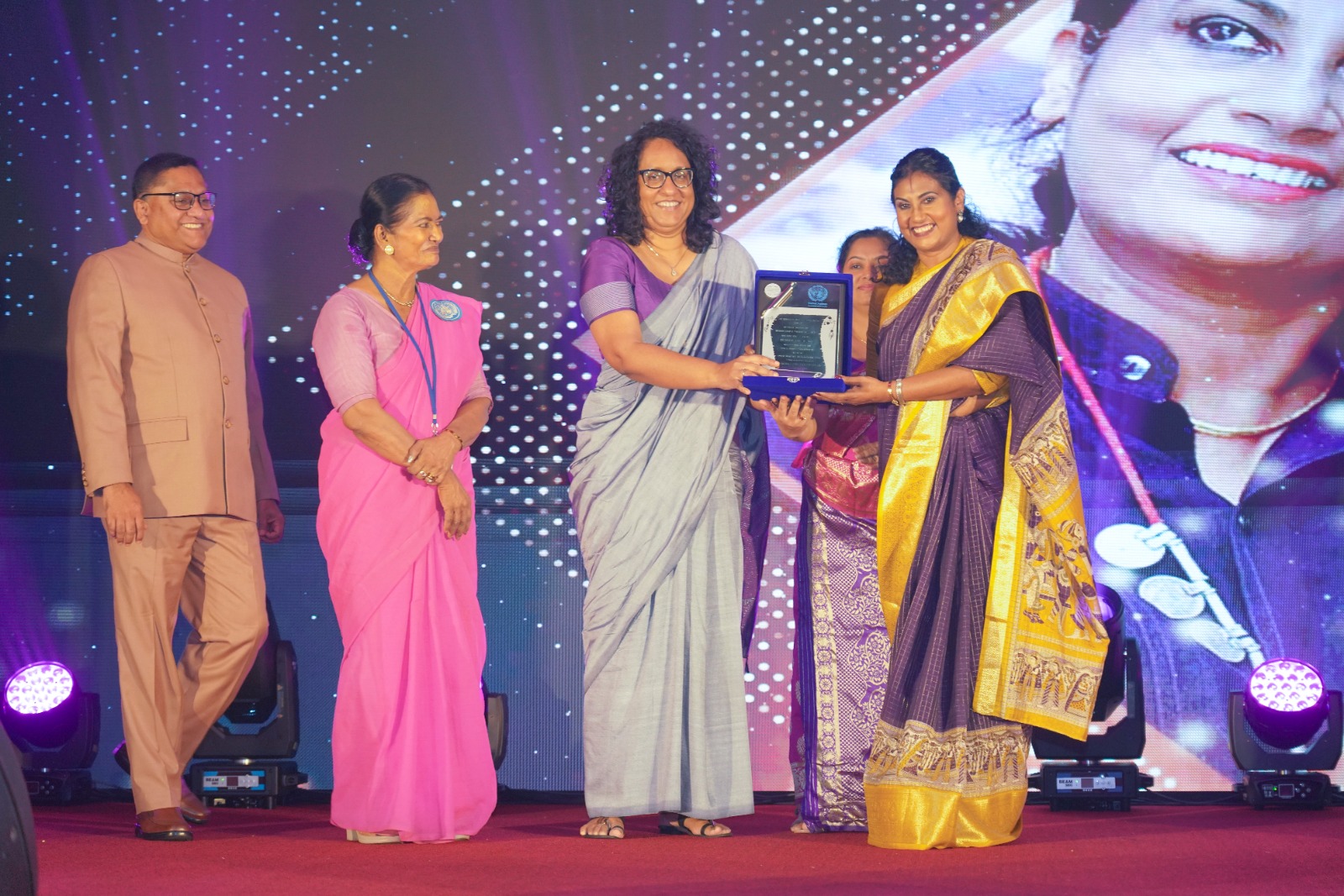
Prime Minister Dr. Harini Amarasuriya emphasized the urgent need for prompt and decisive measures to address the challenges, barriers, and discriminatory practices encountered by women both domestically and globally.
The Prime Minister made these remarks on Saturday (22) while addressing the International Women’s Day celebration organized by the United Nations Association in Sri Lanka, held at the Sri Lanka Foundation Institute in Colombo.
During the event, awards were presented in appreciation of women who have achieved significant accomplishments and earned societal recognition in different fields.
Delivering the key note speech, the Prime Minister further stated:
“Equality of all women including young female must be protected irrespective of their socio-economic status, educational background, religion, ethnicity, disability, or any other personal identity. Their fundamental rights must be safeguarded. Sri Lanka has a proud history of strong women who have contributed significantly to the development of the nation and I am well aware that many such remarkable individuals are present in this esteemed audience today.
Women are driving transformational change by assuming leadership roles in politics, business, and social initiatives. The government has implemented different policies and programme to empower women. The 2024 Women’s Empowerment Act has laid the foundation for new legal protections and the establishment of an Independent National Women’s Commission leading a significant step toward institutionalizing gender equality.
The government has prioritized increasing the participation of women in workforce by introducing entrepreneurship and digital financial literacy programme for rural women, along with establishing nine ministries for uplifting the economic level of women and the entire nation. Several initiatives were also incorporated into the recently approved budget. Nevertheless, female representation in leadership, decision-making, and economic participation remains disproportionately low. While efforts have been made to create opportunities in education, economic development, and healthcare for women and young female, it is imperative to acknowledge that there are much more remains to be done.
Although the women’s representation in Parliament has been doubled, it remains at approximately 10%. A greater representation of women is essential in political spheres, decision-making, and leadership roles. Currently, women’s participation in the formal workforce with pay is at 32%, which is significantly lower compared to the male counterparts.
Some individuals assert that achieving work-life balance is an unattainable goal for women, while simultaneously expecting them to manage all responsibilities. However, it is important to acknowledge that it is not possible to do everything. What is truly required is the opportunity for women to pursue what they aspire to do, within families and a society that values and respect women. It is imperative to foster an environment that offers greater support for women. In this regard, recognizing and appreciating the care giving responsibilities undertaken by unpaid women is essential.
Gender-based violence and discrimination remain prevalent in society. Addressing these issues requires urgent legal and social reforms. The journey toward gender equality cannot be undertaken in isolation. As a nation committed to the United Nations Sustainable Development Goals, particularly Goal 5 on Gender Equality, it is essential to maintain strong global partnerships and take sincere steps toward the empowerment of women. In a rapidly evolving world, empowering women must go hand in hand with ensuring their active contribution to national development and the United Nations in Sri Lanka continues to serve as a valuable advisor and advocate for women’s rights.”
Prime Minister Dr. Harini Amarasuriya reiterated the importance of implementing effective measures to identify and address the challenges, barriers, and discriminatory practices faced by women both locally and internationally.
The event was attended by the Minister of Foreign Affairs, Foreign Employment and Tourism, Vijitha Herath; Secretary-General to United Nations Association of Sri Lanka Mr. M.M. Rushaudeen; Assistant Secretary-General to United Nations Association of Sri Lanka Ms. Panchali Ratnayake; and several other distinguished guests.
[Prime Minister’s Media Division]


Oman made a couple of changes in the last two fixtures without success. Shakeel Ahmed went in and out of the side in the three games, but picked three wickets against Ireland and should keep his place. Jatinder might look at giving top-order batter Karan Sonavale another go.
[Cricbuzz]

Several countries which have signed up to Donald Trump’s Board of Peace have contributed more than $7bn (£5.2bn) towards a Gaza “relief package”, the US president has said.
Trump made the announcement during the first meeting of the organisation that many of US’s Western allies have refused to join, fearing the body originally meant to help end the war between Israel and Hamas may be intended to replace the UN.
The second phase of a US-brokered Gaza ceasefire plan includes the disarmament of Hamas and the reconstruction of Gaza.
It “looks like” Hamas would disarm, Trump told participants. However, there are few signs of the Palestinian group disarming. Gazans say it is extending its control over the Strip.
Speaking as the Board of Peace convened on Thursday, Israeli Prime Minister Benjamin Netanyahu said Israel had “agreed with our ally the US there will be no reconstruction of Gaza before the demilitarisation of Gaza”.
The war was triggered by the Hamas-led attack on southern Israel on 7 October 2023, in which about 1,200 people were killed and 251 others were taken hostage.
Israel responded to the attack by launching a military campaign in Gaza, during which more than 72,000 people have been killed, according to the territory’s Hamas-run health ministry.
The enclave’s economy is in ruins, with its buildings and infrastructure largely destroyed. The UN estimates the cost of damage at $70bn.
Countries including the UK, Canada, France and Germany have refused to join the Board of Peace that came into being last month.
In an effort to address concerns that the organisation was meant as a way of sidelining the UN, Trump told the board’s first meeting in Washington that “we’re going to be working with the United Nations very closely, we’re going to bring them back”.
Gaza, the US president said, was “no longer a hotbed of radicalism and terror”.
“And to end that, we have today, and I’m pleased to announce that Kazakhstan, Azerbaijan, UAE, Morocco, Bahrain, Qatar, Saudi Arabia, Uzbekistan, and Kuwait have all contributed more than $7bn toward the relief package”.
“Every dollar spent is an investment in stability,” he said, adding that the UN would contribute $2bn for humanitarian assistance, while football body Fifa would raise $75m for soccer-related projects in the Strip.
Nickolay Mladenov, a Bulgarian politician who has been given the title of high representative for Gaza as part of the board, said the process of recruiting a new transitional Palestinian police force had begun and “just in the first few hours we have 2,000 people who have applied”.
But both Israel and the US have insisted that the force is not drawn from the existing Hamas-controlled police without stringent vetting, nor do they want it simply made up of the security forces of the Palestinian Authority in the West Bank.
That means starting from scratch, and the task is daunting.
Mladenov has previously said the Palestinian police force must be the primary security agency in Gaza, assisted by the International Stabilisation Force (ISF), and not vice-versa.
According to the US plan, the ISF will work with Israel and Egypt, along with a newly trained and vetted Palestinian police force, to help secure border areas and ensure the process of permanently disarming non-state armed groups, including Hamas.
But Mladenov said there is little evidence such a force could yet oversee the disarmament of Hamas and other Palestinian factions.
Meanwhile, there was no indication at the meeting that Hamas was prepared to hand over its weapons, despite Trump’s combination of optimism and threat on this point.
So far, Hamas has publicly appeared to make handing over weapons contingent on – at least – Israeli withdrawal from Gaza.
Progress on this issue is critical because none of Trump’s proposals for reconstruction and governance can take place without a security force on the ground that has broad backing of the Palestinian population, given its role includes assuming a monopoly of force within Gaza.
The Washington meeting itself was characteristic of Trump’s approach to Israeli-Palestinian peace-making over his two terms – involving a future for Palestinians seen often through the lens of real-estate development and wealthy investor funding.
Meanwhile Israel’s leadership has been wary about some of Trump’s efforts, particularly the invitations to his board for Turkey and Qatar, whom Israel does not want to see take a prominent role in decisions on the future of Gaza.
Trump and his team have defended his unconventional approach saying it amounts to “new thinking” to try to solve the conflict.
However, Mladenov has warned that without rapid progress, Gaza will remain split into two territories, one under continuing Israeli occupation and the other under Hamas control – and also split from the West Bank, making a future independent state unviable and failing to secure either Palestinians or Israelis.
[BBC]

President Donald Trump says the world will find out “over the next, probably, 10 days” whether the US will reach a deal with Iran or take military action.
At the inaugural meeting of his Board of Peace in Washington DC, Trump said “we have some work to do” in coming to an agreement with the Islamic Republic about its nuclear programme, and that “we may have to take it a step further”.
In recent days, the US has surged military forces to the Middle East, while progress was also reported at talks between American and Iranian negotiators in Switzerland.
Democratic lawmakers, and some Republicans, have voiced opposition to any potential military action in Iran without congressional approval.
In his remarks, Trump noted that Special Envoys Steve Witkoff and Jared Kushner, who is also Trump’s son-in-law, had “some very good meetings” with Iran.
“It’s proven to be, over the years, not easy to make a meaningful deal with Iran,” he said. “Otherwise bad things happen.”
One day earlier, White House press secretary Karoline Leavitt warned that Iran would be “very wise” to make a deal with the US, adding that Trump was still hoping for a diplomatic solution over Tehran’s nuclear programme.
When Trump first announced the Board of Peace, it was thought to be aimed at helping end the two-year war between Israel and Hamas in Gaza and oversee reconstruction.
But in the last month its mission has appeared to go beyond one conflict, with many wondering if the Trump-chaired board, made up of about two dozen countries, is meant to sideline the United Nations.
US missile and aircraft struck three Iranian nuclear facilities in June last year, and the White House was reportedly discussing new attack options this week.
American forces have been ramping up their presence in the region in recent weeks, including the deployment of the USS Abraham Lincoln aircraft carrier.
However, the BBC understands that the British government has not given permission for the US to use UK military bases to support any potential strikes on Iran.
In previous military operations in the Middle East, the US used RAF Fairford, in Gloucestershire, and the UK overseas territory of Diego Garcia, in the Indian Ocean.
Satellite images have also shown that Iran has reinforced military facilities, and the country’s Supreme Leader, Ayatollah Ali Khamanei, has posted messages to social media threatening US forces.
“The US President constantly says that the US has sent a warship toward Iran. Of course, a warship is a dangerous piece of military hardware,” one of Khamenei’s posts read.
“However, more dangerous than that warship is the weapon that can send that warship to the bottom of the sea.”
Several members of US Congress have expressed opposition to any military action against Iran.
California Democrat Ro Khanna and Kentucky Republican Thomas Massie have said they will try to force a vote on the matter next week, citing the 1973 War Powers Act.
The act grants Congress the ability to check the president’s power to commit the US to armed conflict.
“A war with Iran would be catastrophic,” Khanna posted on social media. “Iran is a complex society of 90 million people with significant air defences and military capabilities.”
He also said thousands of US troops in the region “could be at risk of retaliation”.
The chances of passage in both chambers of Congress are not strong.
In January, Senate Republicans blocked a similar war powers resolution that would have required the Trump administration to obtain congressional approval before launching further military operations in Venezuela following the capture of Nicolas Maduro.
[BBC]

Fairly heavy showers likely in the Eastern province and in Matale, Badulla, Mullaitivu and Polonnaruwa districts

CEB trade unions hint at stringent industrial action after talks fail

PM reveals allowances and perks available to MPs

CID expresses regret to Natasha; IGP to issue guidelines on ICCPR arrests

Construction begins on country’s largest solar power project in Hambantota

Lanka silent as 85 countries rebuke Israel at UN

‘Dates have the highest sugar content to fight Coronavirus’

Sunday Island 27 December – Headlines

#SundayIsland 17th December – Headlines

Sunday Island – 28th March

Sunday Island Headlines – 21 March

Sunday Island – 21st February – Headlines
-
 Life style5 days ago
Marriot new GM Suranga
-

 Business4 days ago
Ministry of Brands to launch Sri Lanka’s first off-price retail destination
-

 Features5 days ago
Monks’ march, in America and Sri Lanka
-
 Features5 days ago
The Rise of Takaichi
-
 Features5 days ago
Wetlands of Sri Lanka:
-
 News5 days ago
Thailand to recruit 10,000 Lankans under new labour pact
-

 News5 days ago
Massive Sangha confab to address alleged injustices against monks
-
 News3 days ago
IMF MD here