
News
Ex-MP reveals how to spot bogus qualifications


Speaker Ranwala’s resignation:
Former MP Dr. Nalaka Godahewa said that the recent resignation of Speaker ‘Dr’ Asoka Ranwala, following public outcry over his academic qualifications, underscored the need to identify bogus claims.In recent years, a disturbing trend has emerged here with an increasing number of individuals claiming prestigious academic titles, such as ‘Doctor’ or ‘Professor’ without possessing the necessary qualifications to back them up.
The ex-Minister and State Minister said that just because someone introduced him or her as a ‘Doctor’ or ‘Professor’ that did not necessarily mean he or she had earned those titles through legitimate means.
Due to the absence of proper verification methods, many people had started using these titles overnight, with little to no understanding of the rigorous academic processes required to truly achieve them, Dr. Godahewa said, suggesting that the public should explore the proper processes behind earning a doctorate and a professorship so that you can easily verify whether someone is genuinely qualified or not.
THE PROCESS OF EARNING A DOCTORATE
The first step in understanding how to spot bogus qualifications is to recognize what it truly takes to earn a doctorate. While the title “Doctor” may seem simple, obtaining this level of education requires years of hard work, dedication, and a series of academic achievements. Here’s a breakdown of the steps involved:
1. Bachelor’s Degree: The journey to a doctorate typically begins with a bachelor’s degree in a related field. This usually takes 3–4 years of study and is the foundational step in academic education.
2. Master’s Degree (Optional): Some fields, such as engineering, science, or the humanities, may require candidates to complete a master’s degree before they can even apply for a doctoral programme. This adds another 1–2 years of study.
3. Doctoral Programme: Once you’ve completed your bachelor’s (and perhaps master’s) degree, you apply to a university offering a doctoral programme. Acceptance into such programs is highly competitive, and once admitted, students typically engage in advanced coursework and original research.
4. Research and Dissertation: The core of a doctoral programme is conducting original research in your field. This research must contribute new knowledge or insights. The culmination of this work is a dissertation or thesis, which must be rigorously written and submitted for review.
5. Dissertation on Defence: After completing the dissertation, candidates must defend their research in front of a panel of experts. This is a crucial step where candidates are questioned on the methodology, findings, and significance of their work.
6. Awarding the Doctorate: If the dissertation is accepted and successfully defended, the candidate is awarded a doctorate—typically a Ph.D., but there are other types, such as Doctor of Science, Doctor of Education, etc. This title is a recognition of the candidate’s expertise and contribution to their field.
THE PROCESS OF BECOMING A PROFESSOR:
While being a Doctor is an impressive achievement in itself, becoming a Professor involves a different set of qualifications and experience. The path to professorship goes beyond earning a doctorate—it requires a combination of teaching, research, and academic leadership. Here’s a look at what it typically takes:
1. Educational Requirements: Like a Doctorate, becoming a Professor usually requires a Ph.D. or its equivalent in a relevant field. In some cases, individuals may become professors without a Ph.D., but this is rare and often depends on the field and level of expertise.
2. Research and Publications: Professors are expected to contribute to the academic community not only by teaching but also by conducting research. This often involves publishing articles, books, or research papers in peer-reviewed journals or other academic platforms.
3. Post-doctoral Experience: After earning a Ph.D., many aspiring professors engage post-doctoral research positions, commonly known as “postdocs.” This allows them to gain deeper expertise and further contribute to their field while building their academic reputation.
4. Teaching Experience: Teaching experience is crucial for becoming a professor. This may begin with roles as a teaching assistant during a Ph.D. programme and evolve into adjunct positions before securing a full time faculty position.
5. Applying for Faculty Positions: Once candidates have gained sufficient qualifications and experience, they can apply for professorships at universities. This process is highly competitive and often involves a rigorous selection procedure, with candidates needing to demonstrate both teaching ability and research expertise.
6. Promotion to Professor: Once hired, professors usually start at the rank of Assistant Professor and can be promoted to Associate Professor and then Full Professor based on their contributions to teaching, research, and the academic community.
DIFFERENCE BETWEEN A DOCTOR AND A PROFESSOR:
It’s important to understand that being a Doctor and being a Professor are not the same thing. While both are highly respected academic titles, they represent different achievements and career paths.
A Doctor is someone who has completed a Ph.D. or similar doctoral degree, signifying deep expertise in a particular field. This title doesn’t necessarily mean the person is involved in teaching at a university. Many Doctors work in research, industry, healthcare, or other professional roles outside academia.
On the other hand, becoming a Professor requires more than just having a doctoral degree. It involves years of teaching, research, and often administrative contributions to the academic community. A Professor is not only an expert in their field but also a mentor and educator to the next generation of students.
HOW TO VERIFY A GENUINE DOCTOR OR PROFESSOR:
Given the rise of people falsely claiming academic titles, it is important to know how to verify someone’s credentials.
If someone claims to be a Doctor, you can ask:
* From which university did you receive your Ph.D.?
* Where is your Ph.D. officially recorded? (Check with the university or academic bodies.)
* What is the title of your thesis, and where can it be accessed for reference or verification?
Similarly, if someone claims to be a Professor, ask:
* Which academic institution have you taught at?
* For how many years have you taught there, and at what levels?
* What research papers or academic articles have you published? (Check academic databases like Google Scholar or Scopus.)
These simple questions can help public to verify whether someone truly holds these prestigious titles or if they are merely abusing them to gain undue credibility.






More than 1,600 students sat this year’s Russian Classical Ballet Examination, the largest number ever to take part in the examination in Sri Lanka. Exams were held in Colombo from 5, to 18, October and in Galle on 10 October.
Students aged four and above came from across the island, including Colombo, Galle, Gampaha, Negombo, Matara, Kelaniya, Panadura, Wattala, Kiribathgoda, Ratnapura, Kandy, Kurunegala, Bandarawela and Badulla. They are taught by 15 dedicated teachers trained in the Vaganova method, the renowned Russian system of classical ballet training.
They were examined by Dr. Oxana Karnovich of the Moscow State Academy of Choreography, a distinguished academic and curator.
The Russian School of Ballet and Dancing was established in 2001 by Michael Ustinov, Buddhapriya Ramanayake and Mrs Chandi Aluvihare, with Mrs Galina Pleshakova as its founding instructor. Today the School is led by Director Madam Maria Popova, Counsellor of the Embassy of the Russian Federation in Sri Lanka.

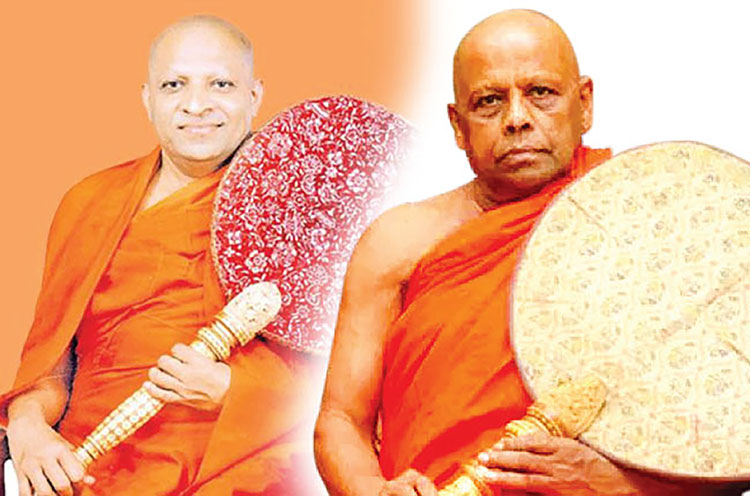
MONETABRIEF– Sri Lanka’s two most senior Buddhist chapters, Malwatte and Asgiriya, demanded special concessions for monks serving prison sentences, following the disrobing of convicted monk Ven. Galagodaatte Gnanasara in line with established procedures.
The chief prelate of the Asgiriya chapter, Most Venerable Warakagoda Sri Gnanarathana, told Prisons Commissioner Senaka Palletenna that Ven. Gnanasara, who is serving a six-year sentence for contempt of court, must be released immediately.
Prison authorities have no power to release or pardon convicts, but Palletenna told the monk in Kandy on Friday that he would convey his request to the relevant government authorities.
“There is no point in talking about this and that… The entire country has been shaken (??????? ) . He must be released,” the Asgiriya chief prelate said.
The Malwatte chief prelate, Most Venerable Thibbatuwawe Sri Siddhartha Sumangala, appeared to accept the court verdict against Ven. Gnanasara, but asked the prisons chief whether a separate section could be established for convicted monks.
Palletenna noted that a special ward for the clergy already existed at Welikada Prison.
At least 63 convicted Buddhist monks are currently incarcerated within Sri Lanka’s criminal justice system.
Meanwhile, a group of 34 Buddhist monks named in a Colombo Fort Magistrate’s Court order to vacate the vicinity of the Presidential Secretariat ended their protest and dispersed after lunch on Friday.The monks are demanding an unconditional pardon for Ven. Gnanasara, who has previously been imprisoned, making him a reconvicted prisoner.
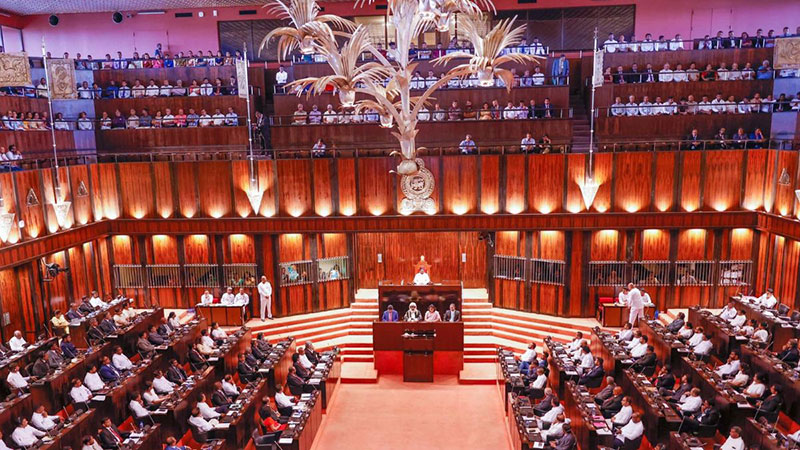
The debate on the no-confidence motion against Speaker Dr. Jagath Wickramaratne, submitted by the Samagi Jana Balawegaya (SJB), has been postponed indefinitely pending the Attorney General’s opinion on certain technical issues in the motion.
Government representatives raised the matter at a meeting of the Committee on Parliamentary Business, pointing out that several provisions of the motion required clarification and that the Attorney General’s advice should be obtained.
As obtaining the opinion would take time, the debate could not be scheduled for the next parliamentary week, parliamentary sources said.
Chief Opposition Whip Gayantha Karunatilaka said a date for the debate would be decided after the Attorney General’s advice was received.
Meanwhile, Parliament is scheduled to meet from October 20 to 23, Secretary General of Parliament Kushani Rohanadeera announced.
The parliamentary business for the week was finalised at a meeting of the Committee on Parliamentary Business held on Friday (16) under the chairmanship of Deputy Speaker Dr. Rizvie Salih.
On each sitting day, the period from 9.30 a.m. to 10 a.m. will be allocated for parliamentary business under Items 1 to 6 of Standing Order 22. Questions for Oral Answers will be taken up from 10 a.m. to 11 a.m., followed by questions under Standing Order 27(2) from 11 a.m. to 11.30 a.m.
On Tuesday, October 20, an Opposition-sponsored Adjournment Motion will be debated from 11.30 a.m. to 5.30 p.m.
On Wednesday, October 21, a resolution under the Public Debt Management Act and a Supplementary Estimate will be taken up for debate and approval from 11.30 a.m. to 5 p.m. The annual reports of five statutory institutions will subsequently be presented for approval without debate, while questions at the Adjournment Time will be taken up from 5 p.m. to 5.30 p.m.
On Thursday, October 22, the Second Reading debates on two Bills to amend the Poisons, Opium and Dangerous Drugs Ordinance (Bills Nos. 79 and 80) will be held from 11.30 a.m. to 5 p.m.
The annual reports of five statutory institutions will then be taken up for approval without debate, followed by an Opposition-sponsored Adjournment Motion from 5 p.m. to 5.30 p.m.
On Friday, October 23, the Second Reading debate on the Elimination of Rabies and Registration of Dogs Bill will be held from 11.30 a.m. to 5 p.m. A Government-sponsored Adjournment Motion will be debated during the final half-hour of the sitting.

Record 1,600 students take Russian Classical Ballet examination in Sri Lanka

Half a million people join protests in France, but some turn violent

Deadly fire breaks out at Canada military base

Showers or thundershowers will occur in most parts of the island after 1.00 p.m.

Buddhist hierarchy demands prison perks for monk convicts

Debate on NCM against Speaker postponed indefinitely

‘Dates have the highest sugar content to fight Coronavirus’

Sunday Island 27 December – Headlines

#SundayIsland 17th December – Headlines

Sunday Island – 28th March

Sunday Island Headlines – 21 March

Sunday Island – 21st February – Headlines
-

 Latest News5 days ago
Nissanka’s return headlines Sri Lanka’s Test squad against Pakistan
-

 Latest News7 days ago
Farhan and Sadaqat help Pakistan seal series in style
-

 Features7 days ago
Intake 16: 45 years of duty and honour
-

 News7 days ago
Malwathu Chapter issues statement on talks with President over Gnanasara Thera’s robes
-

 News7 days ago
CP alleges NPP has taken the blame for illegal US sanctions on Iranian vessels
-

 News5 days ago
Sri Lanka, India caught in US-Iran ship crisis
-

 Opinion7 days ago
How long can Sri Lanka remain silent on its demographic crisis?
-

 Latest News5 days ago
Kusal Mendis’ unbeaten 87 hands Sri Lanka consolation win