
Foreign News
Europe’s night of election drama capped by Macron bombshell


Exit polls had begun to roll in at the end of European elections across the EU’s 27 countries, when President Emmanuel Macron delivered his bombshell moment in a televised address to a stunned French population.
“I’ve decided to hand you back the choice of our parliamentary future with a vote. I am therefore dissolving the National Assembly,” he declared.
The National Rally party – led by Macron’s rivals Marine Le Pen and Jordan Bardella – was one of the big gains that Europe’s far-right parties had expected, and confirmation came with all the exit polls giving the party more than 30%, double that of Mr Macron’s centrist Renaissance.
But beyond France, the broader story of Europe’s four-day vote marathon really belonged to the parties of the centre right. They tightened their grip on the European Parliament, with victories in Germany and Spain, and significant advances in Hungary, against long-dominant Prime Minister Viktor Orban.
The far right did not enjoy as great a surge across Europe as many had predicted.
In the Netherlands, Geert Wilders’ Freedom Party came second, while Austria’s party of the same name came out as winners, but only narrowly.
“The centre is holding, but it is also true that the extremes on the left and on the right have gained support,” said Ursula von der Leyen, the centre-right head of the European Commission. “And this is why the result comes with great responsibility for the parties in the centre.”
There had been talk before the vote that her dominant European People’s Party might consider talking to the two right-wing groups that house the far right. But she made clear her only allies would be the Socialists & Democrats and the liberal Renew group that includes Mr Macron’s party.
Germany’s opposition conservatives were always going to come out on top, and they scored an impressive 30% of the vote. But for Chancellor Olaf Scholz’s SPD party this was the worst ever result in a European election, coming third behind the far-right Alternative for Germany (AfD).
The AfD has endured a slew of scandals involving espionage, foreign interference and allegations of Nazi sympathies, and yet its support still held up. “After all the prophecies of doom, after the barrage of the last few weeks, we are the second strongest force. And I’m telling you, the only way is up,” said co-leader Alice Weidel.

Meanwhile a new anti-migrant far-left party, BSW, led by charismatic left-wing firebrand Sahra Wagenknecht, also performed well – rounding off a good night for radical parties.
In Spain, the centre-right opposition Popular Party (PP) defeated Prime Minister Pedro Sánchez’s Socialists, but not by the big margin that PP leader Alberto Núñez Feijóo had been hoping for. Another far-right party, Vox, came a distant third.
Meanwhile, in Italy, Giorgia Meloni’s dominance of the country’s politics continues. Her far-right Brothers of Italy defeated the centre left Democratic Party of Elly Schlein by less than four points. “Thank you to the Italians who are continuing to choose us… I am proud of the result tonight,” she told her supporters.

In just five years, Ms Meloni has more than doubled her party’s seats in the European Parliament, while Ms Schlein’s performance pleasantly surprised even party activists.
There was no far-right success story in Belgium’s national elections, even though Flemish separatist party Vlaams Belang was widely expected to win. The Flemish National Alliance is now the dominant party there, bringing an end to the rule of liberal Prime Minister Alexander De Croo.
“The far right has under-performed in Belgium, the Czech Republic, Hungary, Finland and Poland. But it has over-performed in France,” said Prof Alberto Alemanno of HEC Paris, who was surprised that President Macron decided to dissolve parliament.
“It’s disproportionate that these election results might push a government out of a country,” he told the BBC.
[BBC]













China has executed four members of the Bai family mafia, one of the notorious dynasties that ran scam centres in Myanmar, state media report.
They were among 21 of the family’s members and associates who were convicted of fraud, homicide, injury and other crimes by a court in Guangdong province.
Last November the court sentenced five of them to death including the clan’s patriarch Bai Suocheng, who died of illness after his conviction, state media reported.
Last week, China executed 11 members of the Ming family mafia as part of its crackdown on scam operations in South East Asia that have entrapped thousands of Chinese victims.
For years, the Bais, Mings and several other families dominated Myanmar’s border town of Laukkaing, where they ran casinos, red-light districts and cyberscam operations.
Among the clans, the Bais were “number one”, Bai Suocheng’s son previously told state media after he was detained.
The Bais, who controlled their own militia, established 41 compounds to house cyberscam activities and casinos, authorities said. Within the walls of those compounds was a culture of violence, where beatings and torture were routine.
The Bai family’s criminal activities led to the deaths of six Chinese citizens, the suicide of one person and multiple injuries, the court said.
The Bais rose to power in Laukkaing in the early 2000s after the town’s then warlord was ousted in a military operation led by Min Aung Hlaing – who now leads Myanmar’s military government.
The military leader had been looking for co-operative allies, and Bai Suocheng – then a deputy of the warlord – fitted the bill.
But the families’ empires crashed in 2023, when Beijing became frustrated by the Myanmar military’s inaction on the scam operations and tacitly backed an offensive by ethnic insurgents in the area, which marked a turning point in Myanmar’s civil war.
That led to the capture of the scam mafias and their members were handed to Beijing.
In China, they became subjects of state documentaries which emphasised Chinese authorities’ resolve to eradicate the scam networks.
With these recent executions Beijing appears to be sending a message of deterrence to would-be scammers.
Hundreds of thousands of people have been trafficked to run online scams in Myanmar and elsewhere in South East Asia, according to estimates by the United Nations.
Among them are thousands of Chinese people, and their victims who they swindle billions of dollars from are mainly Chinese as well.
(BBC)
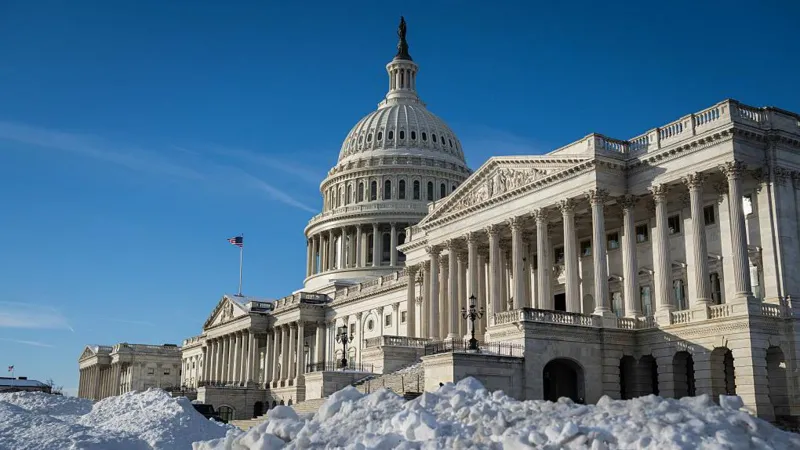
The US federal government has partially shutdown despite a last-ditch funding deal approved by the Senate.
The funding lapse began at midnight US eastern time (05:00 GMT) on Saturday, hours after senators agreed to fund most agencies until September. The bill includes just two weeks’ funding for the Department of Homeland Security, which oversees immigration enforcement, instead of shutting it down entirely.
The bill has yet to be approved by the House of Representatives, which is out of session.
US President Donald Trump struck the deal with Democrats after they refused to give more funding for immigration enforcement following the fatal shooting of two US citizens in Minneapolis by federal agents.
It is the second such government shutdown in the past year and comes just 11 weeks after the end of the previous funding impasse that lasted 43 days, the longest in US history.
That shutdown in 2025, which spanned 1 October to 14 November, had widespread impacts on essential government services including air travel and left hundreds of thousands of federal workers without pay for weeks.
This shutdown, however, is unlikely to be that long or widespread as the House of Representatives is set to be back in session on Monday.
The White House, though, has directed several agencies, including the departments of transportation, education and defence to execute shutdown plans.
“Employees should report to work for their next regularly scheduled tour of duty to undertake orderly shutdown activities,” a White House memo to agencies said. “It is our hope that this lapse will be short.”
Trump has urged Republicans, who hold the majority of seats in the US House, to vote for the deal.
Lawmakers plan to use the fortnight in which the DHS will continue to be funded to negotiate a deal. Democrats want that deal to include new policies for immigration enforcement agents.
“We need to rein in ICE and end the violence,” Senate Minority Leader Chuck Schumer said referring to Immigration and Customs Enforcement.
“That means ending roving patrols. It means requiring rules, oversight, and judicial warrants… Masks need to come off, cameras need to stay on, and officers need visible identification. No secret police.”
Both Republican and Democratic lawmakers have sharply criticised tactics used by immigration agents in the wake of the fatal shooting of Alex Pretti in Minneapolis last weekend.
Pretti, an intensive care nurse, was shot by a US Border Patrol agent after an altercation in which several agents tried to restrain him.
On Friday, the Justice Department launched a civil rights investigation into the shooting.
[BBC]

Sustained heavy gunfire and loud explosions have been heard in Niger near the international airport outside the capital, Niamey.
Multiple eyewitness accounts and videos showed air defence systems apparently engaging unidentified projectiles in the early hours of Thursday.
The situation later calmed down, reports say, with an official reportedly saying the situation was now under control, without elaborating.
It is not clear what caused the blasts, or if there were any casualties. There has been no official statement from the military government.
The gunfire and blasts began shortly after midnight, according to residents of a neighbourhood near the Diori Hamani International Airport, the AFP news agency reports. They said calm returned after two hours.
The airport houses an air force base and is located about 10km (six miles) from the presidential palace.
Niger is led by Abdourahamane Tiani who seized power in a 2023 coup that ousted the country’s elected civilian president.
Like its neighbours Burkina Faso and Mali, the country has been fighting jihadist groups who have carried out deadly attacks across the region.
It is also a major producer of uranium.
A huge uranium shipment destined for export has been stuck at the airport amid unresolved legal and diplomatic complications with France after the military government nationalised the country’s uranium mines.
“The situation is under control. There is no need to worry,” the Anadolu news agency quoted a Foreign Affairs ministry official as saying, without elaborating.
The official told the agency they were trying to determine whether the gunfire was linked to the uranium shipment.
[BBC]

Trump confirms talks with Iran as US military shoots down Iranian drone

Shower will occur in the Northern, North-central, Eastern and Uva provinces and in Nuwara-Eliya and Matale districts

House erupts over suspension of Deputy Secretary General

78th Independence Day celebrations at Bogambara Stadium

Colombo-Kandy railway line to be fully restored this year – Minister Bimal

FCID records statements from Shiranthi and Namal

‘Dates have the highest sugar content to fight Coronavirus’

Sunday Island 27 December – Headlines

#SundayIsland 17th December – Headlines

Sunday Island – 28th March

Sunday Island Headlines – 21 March

Sunday Island – 21st February – Headlines
-

 Opinion5 days ago
Sri Lanka, the Stars,and statesmen
-

 Business6 days ago
Climate risks, poverty, and recovery financing in focus at CEPA policy panel
-

 Business4 days ago
Hayleys Mobility ushering in a new era of premium sustainable mobility
-

 Business1 day ago
SLIM-Kantar People’s Awards 2026 to recognise Sri Lanka’s most trusted brands and personalities
-

 Business4 days ago
Advice Lab unveils new 13,000+ sqft office, marking major expansion in financial services BPO to Australia
-

 Business4 days ago
Arpico NextGen Mattress gains recognition for innovation
-

 Business3 days ago
Altair issues over 100+ title deeds post ownership change
-

 Business3 days ago
Sri Lanka opens first country pavilion at London exhibition