
News
EU-Lanka talks: Focus on ‘Independent Institutions, civil society and security law


The European Union (EU) has underlined the importance of independence and effective functioning of the Independent Institutions in Sri Lanka. The EU and Sri Lanka have agreed on the importance of empowering civil society and giving it the necessary space to function in all its diversity. The EU reiterated its continued commitment to support Sri Lanka in justice reform and reconciliation, the EU and Sri Lanka said in a joint statement issued yesterday (09)
The EU has stressed on the Independent Institutions and the civil society after Sri Lanka apprised the EU delegation on the progress being made in reconciliation and in the independent institutions, notably the Office of Missing Persons (OMP), the Office for Reparations (OR), the Office for National Unity and Reconciliation (ONUR), and the Human Rights Commission of Sri Lanka (HRCSL). The EU strongly encouraged Sri Lanka to continue cooperation and engagement with the Human Rights Council and its mechanisms.
The following is the text of the statement issued following on Feb 8 talks in Brussels: “The meeting, which was held in a friendly and open atmosphere, reviewed bilateral relations and entailed an exchange of views and updates on a wide range of topics of bilateral interest – ranging from governance, reconciliation and human rights, to trade, development cooperation, climate change and environment, sectoral cooperation, security and counter-terrorism, and cooperation in multilateral fora.
With respect to the COVID-19 pandemic, the EU congratulated Sri Lanka on the country’s effective vaccine strategy. Highlighting the need to address vulnerabilities and inequalities exacerbated by the pandemic, the EU emphasised its commitment to making the COVID-19 vaccine accessible to low- and middle-income countries in a fair and equitable manner. Sri Lanka appreciated the EU’s continued contribution to global vaccine equity.
The meeting provided an opportunity for updates on developments, relevant action and legislative initiatives in the EU and Sri Lanka. The discussion focused on democracy, governance, rule of law, human rights, including the rights of minorities, women, children and labour rights, and freedom of expression and association.
Sri Lanka reiterated its objective to achieve measurable, tangible and verifiable results on the ground in meeting its commitments. In this context, the EU welcomed the submission by the Government of Sri Lanka of amendments to the Prevention of Terrorism Act (PTA). However, the EU noted that important elements had not been included in the Amendment Bill gazetted. Sri Lanka took note of the views expressed by the EU to take further steps to make the PTA fully compliant with international norms. In the interim, while taking note of the administrative steps taken in the form of directives issued by the Inspector General of Police, the EU urged Sri Lanka to continue reducing the use of the PTA, and to undertake further practical and administrative steps to release on bail those detained under the PTA without charges.
The Joint Commission took stock of the conclusions of the Working Group on Trade and Economic Cooperation held virtually on 26 January 2022. The EU and Sri Lanka noted the significance of bilateral trade relations. In this regard, the EU strongly urged Sri Lanka to lift forthwith import restrictions preventing many European products from entering its market. Sri Lanka clarified that it has imposed temporary import restrictions on non-essential items, strictly as an interim measure, due to a foreign exchange shortfall resulting from the impact of the global pandemic. Sri Lanka noted that these measures are subject to continuous and progressive review. Sri Lanka appreciated the valued contribution of the GSP+ regime to the country’s sustainable development. The EU acknowledged the constructive engagement by Sri Lankan stake-holders during the GSP+ monitoring mission in September 2021. The two sides reviewed Sri Lanka’s compliance with 27 International Conventions related to human rights, labour rights, protection of the environment and good governance covered by the GSP+ scheme. Sri Lanka reiterated its commitment to effective implementation of the 27 conventions, and noted its adherence to the principle of non-discrimination, and the removal of any further impediments in the exercise of labour rights and fundamental freedoms. The EU invited Sri Lanka to provide further updates on progress.
The Joint Commission also discussed the conclusions of the Working Group on Development Cooperation, which took place on 2 February 2022. The Working Group reviewed all aspects of EU – Sri Lanka development cooperation, and discussed priorities of the EU Multi-Annual Indicative Programme (MIP) for 2021-2027. They also discussed the interventions adopted in 2021, including the COVID-19 response package. The EU noted that the MIP, which focuses on Green Recovery and Inclusive and Peaceful Society, supports Sri Lanka’s development priorities, and is aligned with the external dimensions of the European Green Deal, and the EU Strategy for Cooperation in the Indo-Pacific. Appreciating the EU’s development cooperation, Sri Lanka reiterated the need for it to complement Sri Lanka’s national and developmental priorities. The EU and Sri Lanka expressed their commitment to work together on joint priorities under the MIP.
The EU and Sri Lanka agreed on the importance of continued cooperation in deterring and eliminating IUU fishing practices, and honouring commitments of the partnership.
Issues related to migration and readmission were also discussed.
The EU and Sri Lanka exchanged on ways to deepen cooperation in higher education and research and technical cooperation under the Erasmus+ programme, the Marie-Sklodowska-Curie programme, and the Horizon Europe framework programme.
The EU welcomed Sri Lanka’s update on its Nationally Determined Contributions under the United Nations Framework Convention on Climate Change (UNFCCC), and the country’s commitment to ambitious targets. The EU looked forward to working closely with Sri Lanka, bilaterally and in multilateral fora, on climate action and environment protection. Both sides exchanged views on priorities ahead of the 27th UN Climate Change Conference (COP27).
The EU and Sri Lanka reviewed ongoing cooperation in the area of security and counter-terrorism. Sri Lanka appreciated the EU’s continued listing of the Liberation Tigers of Tamil Eelam (LTTE) as a terrorist organisation. Both sides stressed the importance of adherence to international norms and standards in the fight against terrorism. They reiterated willingness to further enhance cooperation in Maritime Domain Awareness.
The EU and Sri Lanka highlighted their commitment to continue joint efforts in the promotion of a rules-based international order and effective multilateralism. They also discussed regional developments, and cooperation in the Indian Ocean. The EU presented Global Gateway, the new EU plan for major investments in infrastructure development around the world, which was launched on 1 December 2021. The initiative was welcomed by Sri Lanka.
The EU and Sri Lanka agreed to convene the next Joint Commission meeting in Colombo in 2023. They also discussed the timeframe of the next Working Group meetings under the Joint Commission.
The meeting was co-chaired by Ms. Paola Pampaloni, Deputy Managing Director for Asia and the Pacific at the European External Action Service, and Admiral (Prof.) Jayanath Colombage, Secretary, Foreign Ministry of Sri Lanka.”



More than 1,600 students sat this year’s Russian Classical Ballet Examination, the largest number ever to take part in the examination in Sri Lanka. Exams were held in Colombo from 5, to 18, October and in Galle on 10 October.
Students aged four and above came from across the island, including Colombo, Galle, Gampaha, Negombo, Matara, Kelaniya, Panadura, Wattala, Kiribathgoda, Ratnapura, Kandy, Kurunegala, Bandarawela and Badulla. They are taught by 15 dedicated teachers trained in the Vaganova method, the renowned Russian system of classical ballet training.
They were examined by Dr. Oxana Karnovich of the Moscow State Academy of Choreography, a distinguished academic and curator.
The Russian School of Ballet and Dancing was established in 2001 by Michael Ustinov, Buddhapriya Ramanayake and Mrs Chandi Aluvihare, with Mrs Galina Pleshakova as its founding instructor. Today the School is led by Director Madam Maria Popova, Counsellor of the Embassy of the Russian Federation in Sri Lanka.


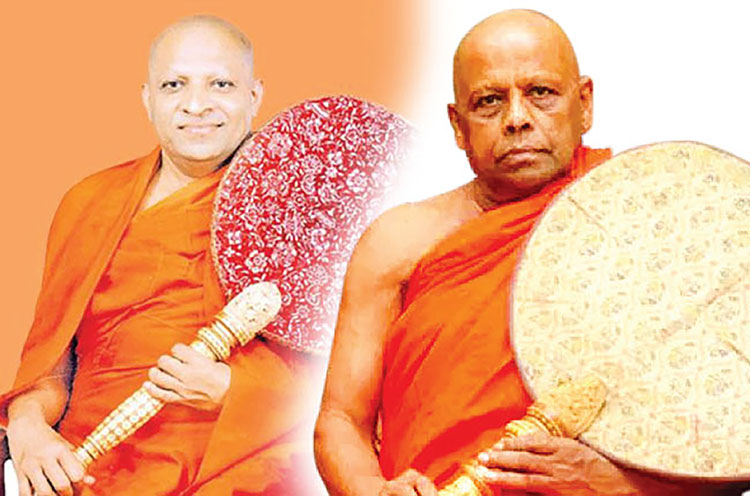
MONETABRIEF– Sri Lanka’s two most senior Buddhist chapters, Malwatte and Asgiriya, demanded special concessions for monks serving prison sentences, following the disrobing of convicted monk Ven. Galagodaatte Gnanasara in line with established procedures.
The chief prelate of the Asgiriya chapter, Most Venerable Warakagoda Sri Gnanarathana, told Prisons Commissioner Senaka Palletenna that Ven. Gnanasara, who is serving a six-year sentence for contempt of court, must be released immediately.
Prison authorities have no power to release or pardon convicts, but Palletenna told the monk in Kandy on Friday that he would convey his request to the relevant government authorities.
“There is no point in talking about this and that… The entire country has been shaken (??????? ) . He must be released,” the Asgiriya chief prelate said.
The Malwatte chief prelate, Most Venerable Thibbatuwawe Sri Siddhartha Sumangala, appeared to accept the court verdict against Ven. Gnanasara, but asked the prisons chief whether a separate section could be established for convicted monks.
Palletenna noted that a special ward for the clergy already existed at Welikada Prison.
At least 63 convicted Buddhist monks are currently incarcerated within Sri Lanka’s criminal justice system.
Meanwhile, a group of 34 Buddhist monks named in a Colombo Fort Magistrate’s Court order to vacate the vicinity of the Presidential Secretariat ended their protest and dispersed after lunch on Friday.The monks are demanding an unconditional pardon for Ven. Gnanasara, who has previously been imprisoned, making him a reconvicted prisoner.
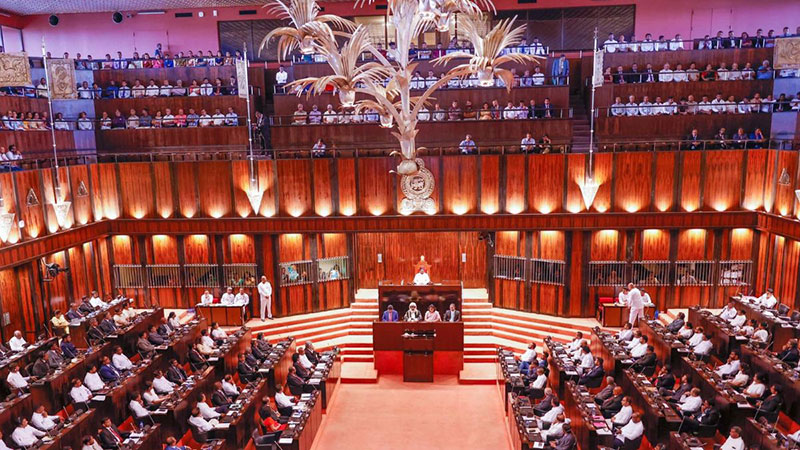
The debate on the no-confidence motion against Speaker Dr. Jagath Wickramaratne, submitted by the Samagi Jana Balawegaya (SJB), has been postponed indefinitely pending the Attorney General’s opinion on certain technical issues in the motion.
Government representatives raised the matter at a meeting of the Committee on Parliamentary Business, pointing out that several provisions of the motion required clarification and that the Attorney General’s advice should be obtained.
As obtaining the opinion would take time, the debate could not be scheduled for the next parliamentary week, parliamentary sources said.
Chief Opposition Whip Gayantha Karunatilaka said a date for the debate would be decided after the Attorney General’s advice was received.
Meanwhile, Parliament is scheduled to meet from October 20 to 23, Secretary General of Parliament Kushani Rohanadeera announced.
The parliamentary business for the week was finalised at a meeting of the Committee on Parliamentary Business held on Friday (16) under the chairmanship of Deputy Speaker Dr. Rizvie Salih.
On each sitting day, the period from 9.30 a.m. to 10 a.m. will be allocated for parliamentary business under Items 1 to 6 of Standing Order 22. Questions for Oral Answers will be taken up from 10 a.m. to 11 a.m., followed by questions under Standing Order 27(2) from 11 a.m. to 11.30 a.m.
On Tuesday, October 20, an Opposition-sponsored Adjournment Motion will be debated from 11.30 a.m. to 5.30 p.m.
On Wednesday, October 21, a resolution under the Public Debt Management Act and a Supplementary Estimate will be taken up for debate and approval from 11.30 a.m. to 5 p.m. The annual reports of five statutory institutions will subsequently be presented for approval without debate, while questions at the Adjournment Time will be taken up from 5 p.m. to 5.30 p.m.
On Thursday, October 22, the Second Reading debates on two Bills to amend the Poisons, Opium and Dangerous Drugs Ordinance (Bills Nos. 79 and 80) will be held from 11.30 a.m. to 5 p.m.
The annual reports of five statutory institutions will then be taken up for approval without debate, followed by an Opposition-sponsored Adjournment Motion from 5 p.m. to 5.30 p.m.
On Friday, October 23, the Second Reading debate on the Elimination of Rabies and Registration of Dogs Bill will be held from 11.30 a.m. to 5 p.m. A Government-sponsored Adjournment Motion will be debated during the final half-hour of the sitting.

Record 1,600 students take Russian Classical Ballet examination in Sri Lanka

Half a million people join protests in France, but some turn violent

Deadly fire breaks out at Canada military base

Showers or thundershowers will occur in most parts of the island after 1.00 p.m.

Buddhist hierarchy demands prison perks for monk convicts

Debate on NCM against Speaker postponed indefinitely

‘Dates have the highest sugar content to fight Coronavirus’

Sunday Island 27 December – Headlines

#SundayIsland 17th December – Headlines

Sunday Island – 28th March

Sunday Island Headlines – 21 March

Sunday Island – 21st February – Headlines
-

 Latest News5 days ago
Nissanka’s return headlines Sri Lanka’s Test squad against Pakistan
-

 Latest News7 days ago
Farhan and Sadaqat help Pakistan seal series in style
-

 Features7 days ago
Intake 16: 45 years of duty and honour
-
 News7 days ago
Malwathu Chapter issues statement on talks with President over Gnanasara Thera’s robes
-
 News7 days ago
CP alleges NPP has taken the blame for illegal US sanctions on Iranian vessels
-

 News5 days ago
Sri Lanka, India caught in US-Iran ship crisis
-

 Opinion7 days ago
How long can Sri Lanka remain silent on its demographic crisis?
-
 Latest News5 days ago
Kusal Mendis’ unbeaten 87 hands Sri Lanka consolation win