
Opinion
Enigma of Basil’s importance

All of a sudden there has been a chorus of approvals by some MPs of the ruling party calling for Basil Rajapaksa, currently Special Representative of the President and Head of the Presidential Task Force on Economic Revival and Poverty Eradication, to become a Member of Parliament on the National List. Some of his loyalists are willing to give up their seats in Parliament for this great welcome back to Basil. It is widely reported that he is to be given the nerve centre portfolios of Economic Development and Finance of Sri Lanka, once he is allowed to enter Parliament and become a Member of the Cabinet.
His supporters in Parliament declare that once Basil Rajapaksa takes over the Economic Development of Sri Lanka, all the problems, that beset this island besieged by mounting debt traps, foreign exchange crisis, balance of payments and budget deficits, rising unemployment and poverty, pandemic growth and spread, trade deficits, human/elephant conflict, fertiliser/agricultural sector woes, environment devastation, destruction of marine life, pollution and fisheries livelihoods, spiraling costs of living, energy crisis and, etc., would be all sorted out by his Midas Touch of expertise and efficiency.
Considering the Great Expectations in store and the enormity of the task, the public would do well to examine the background, qualifications and performance of this worthy, lest we either overestimate or undermine his supposed capacity and acumen for this vital task of Mr. Fix It. Whatever it is!
It may be reasonable for the people to examine the facts of the case relating to this prospective VIP appointment and selectivity in respect of Basil Rajapaksa. He is the younger brother of the President and the Prime Minister of Sri Lanka. In the absence of any specific academic or professional credentials for the post, it is presumably due to family ties that he took over the Task Force on Economic Revival and Poverty Eradication last year. The question is whether with so much of leadership authority given to him already by his two brothers, there has been any appreciable improvement in the socio-economic sphere due to his leadership to date?
On the contrary, despite his prominent role as advisor to the President and Head of the Presidential Task Force on Economic Revival and Poverty Eradication nearly a year ago, the country seems to have gone into a vortex of cataclysmic blunders and plunders too numerous to relate. These range from the rape of the forest cover in Sinharaja, the wetlands, the systematic appropriation of state lands circumventing legislation to be distributed at will to business groups via the District Secretaries, the Fertiliser fiasco, the mounting Covid-19 pandemic that allowed the deaths to grow from a mere 10 to 3000 owing to bungling of Covid Prevention and Protection policies, etc.
In this context, even his previous track record and experience as National List Minister, Advisor, and elected Minister, holding Cabinet Portfolio as Minister of Economic Development in the Rajapaksa government during 2007 – 2014, shows a pendulum shift of the People rejecting the Mahinda Chinthanaya government for a subsequent yahapalanaya, that subsequently betrayed their trust as well! In this instance, too, history may have a record of repeating itself at the next election, considering the widespread discontent and indignation of the masses at the present mayhem in governance and civil life.
The people should be wary of bold declarations and assumptions made by a few acolytes, who claim the strategic coordinating and organisational abilities of their Master Basil Rajapaksa; who is supposedly the mastermind behind the unification of the Sri Lanka Podujana Peramuna (SLPP) and the formation of political alliances with other parties to form a stable government. Power Politics is for politicians and their stooges. What the people of this country want is a wise, honest and professional leadership, to address the myriad problems of this country and deliver result-oriented solutions and deliverables across the urban and rural divide, in an equitable manner. Certainly, skills and strategies of political machinations towards wresting power from its opponents’ is of the least interest to the people.
In that case, we should consider whether the prospective return of Basil Rajapaksa to the arena of finance and economic development, is chiefly to celebrate the fact it was only very recently that he and three others working under him when he was Minister of Economic Development in the last decade, were acquitted and released by the Colombo High Court in the case filed over the misappropriation of public funds to distribute roofing sheets during the run up to the 2015 Presidential Election. The Divineguma case was filed by the Attorney General against Former Minister of Economic Development Basil Rajapaksa, and a number of officials working under him, including his former Ministry Secretary, ex-Director-General and Deputy DG of the Divineguma Development Department Kithsiri Ranawaka. for committing offences punishable under the Offences against Public Property Act, under five separate indictments for the criminal misappropriation of funds from the Divineguma Development Department. An overseas travel ban that was imposed concurrently to the case in hand was also lifted by the High Court. Another salutary move on the part of the government contributing to the rising star of Basil Rajapaksa, was the notable exception in retaining the controversial dual citizenship clause of the 20th Amendment to the Constitution, which amended the other three Public Interest issues. Dual citizens such as Basil Rajapaksa, who owe allegiance as citizens of both Sri Lanka and USA therefore can now hold public office.
Basil Rajapaksa was under investigation for corruption and abuse of state assets until last year. In 2016, the court ordered authorities to auction a luxury villa and 6.5 ha (16 acres) of land in Malwana. His hasty departure to his other home in the USA upon the defeat of his brother at the presidential election is inscribed indelibly in the minds of those who have long memories. Setting the context is another revelation in Parliament in April this year when JVP Leader Anura Kumara Dissanayake, has highlighted the highly suspect conduct and performance of the Presidential Commission on Political Victimisation, and the highly arbitrary and manner in which it exonerated certain persons associated with the President and his family.
The enigma of the importance of popular political personalities like Basil Rajapaksa must after all be subject to the dictates of our Socialist Democratic Republic and its vibrant relatively free media, that we must continue to uphold as our liberty and defence, against all odds and abuses.
According to John Adams, founding father and 2nd President of the USA, we the people of this country “have a right, an indisputable, unalienable, indefeasible, divine right to that most dreaded and envied kind of knowledge — I mean of the character and conduct of their rulers.” Therefore, the ultimate ascendancy of personalities must rest on the knowledge of their character and conduct acquired by the people of this country, whatever be the magical or meteorite properties assigned to them by their sycophant followers.
SONALI WIJERATNE
Kotte


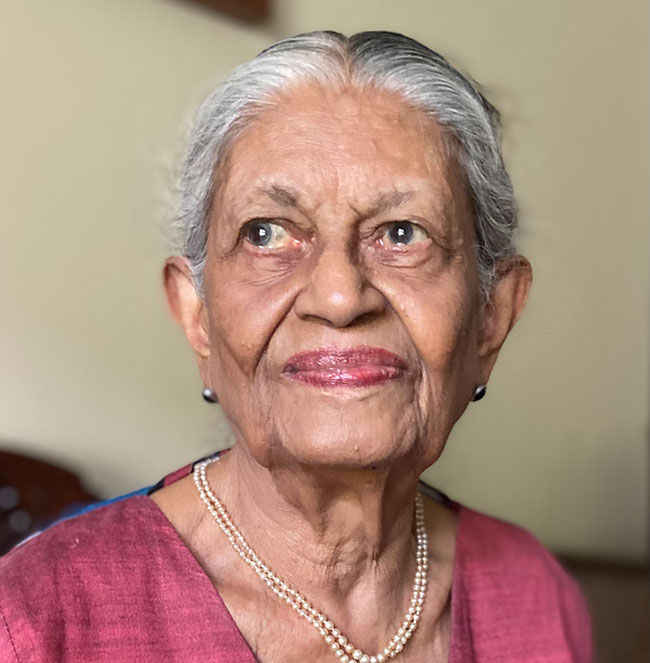
A familiar presence who enlivened these pages for over 30 years is no more. Nanda Pethiyagoda Wanasundera who wrote the People and Events column for the Sunday Island under the pseudonym Nan died on Wednesday morning at the age of 93 after a short illness and was cremated the next day in accordance with her wishes. Her last two columns, which she dictated to her younger son, Rajiv, visiting his mother from the US, and to a niece a week later, appeared in April.
Nanda was already on board this newspaper when I became its editor in 1997, writing a weekly column for quite awhile. When I saw her first piece under my stewardship – I think it was on her good friend Ayya Khema of the Dodanduwa nun’s island – I found it so readable and substantial that I realized I had a treasure of a columnist on my newspaper. It remained so for early 30 years when she had written close to maybe 2,000 articles not just her People and Events for the Sunday Island but for The Island (daily) where she had a weekly column, Cassandra Cry as well as under her initials NPW.
She regarded one of my aunts, Mrs. Ratna (NQ) Dias, as her kalyana mitta (mentor or companion who supports, inspires, and guides you on the path to enlightenment) and this could not but further endear her to me. She and Ratna nenda would take a bus to Dodanduwa to visit the island hermitage and those trips were anything but comfortable.
Nanda trained and worked both as a teacher and a librarian. She taught at the Kataluwa government school in the South and later in Colombo at Bishop’s College and Buddhist Ladies College. She was thereafter the librarian at the Overseas School and the Law Faculty of the Colombo University. A loyal alumnus of Girl’s High School, Kandy, where she had both her primary and secondary education, she must surely have been the oldest old girl living at the time of her passing.
Our relationship soon moved from that of professional colleagues to personal friends. She was always immaculately groomed with a collection of Thai/Indonesian lungis matched with stylish tops. She loved to entertain her friends in her well appointed apartment at Fifth Lane, Kollupitiya, laying an elegant table with stoneware crockery and all the trimmings. Although she claimed she couldn’t cook she was supported by her loyal and efficient domestic, Karuna, who had worked in New York for her elder son. Nanda knew how to choose her menus offering us goodies Rajiv brought her from abroad.
I was fortunate to belong to one of her close knit social circles and we met regularly at each other’s homes and restaurants and always had a whale of a time sharing anecdotes and memories, often chatting on the phone of this and that and mutual friends. It is hard to accept that she is gone.
Nanda wrote fluently and had the feel for a story written in a warm and chatty style. Memories of a happy childhood near Kandy, holidays with an elder brother who was one of the first batch of Ceylon’s DROs with a remote posting, extensive travel, work experience, warm relations with a wide and varied circle of friends and acquaintances equipped her with a vast reservoir of background information to draw on.
She swam at the Ladies College pool, a short walk along the barrel drain fro her home on Fifth Lane well into her eighties, practiced yoga, read voraciously and was extremely generous to those who worked for her. It wasn’t long ago that she with Rajiv did a long drive to the rural heartland to visit Podi Hamy who had looked after her two boys and later worked as her cook in Colombo.
Nanda was a very good Buddhist who meditated, She was close to many erudite bhikkus who turned to her to write and publicize many matters of interest to Buddhists and Buddhism. Let me relate a single anecdote to complete this appreciation of a remarkable woman who added light to many lives. It illustrates her ability to deftly turn the tables on whoever when the circumstances so demanded.
Nanda and I, both friends of Capt. Elmo Jayawardena, participated in a ‘Talkmates’ program he set up to improve the English of poor speakers of the language by pairing them with good English speakers for longish telephone conversation. A young woman called Piumi was mentored by both Nanda and I.
She invited Piumi and me along with a cousin of hers to her home for lunch one day. The cousin and I were swapping yarns across the table when I used the ‘b’ word. Piumi turned to Nanda and asked her, “Madam what does ‘b—r’ mean? Nanda responded instantly saying “you better ask the person who used it!”
Touche´! Incidentally Piumi left the lunch with a very generous gift from Nanda.
Manik de Silva

From Burden to Solutions:
Every year on 07 June, the world pauses to reflect on a truth that is at once mundane and profound: the food on our plate should not make us sick. This year, the World Health Organization and the Food and Agriculture Organization of the United Nations have chosen a theme that is both a diagnosis and a directive “From burden to solutions – safe food everywhere.”
The framing is deliberate. For too long, conversations about food safety have been dominated by the language of loss counting the sick, tallying the dead, lamenting the economic damage. The 2026 theme demands that we harness that data not as an epitaph, but as a map that guides us toward targeted, evidence-based action.
Globally, foodborne diseases cause illness in at least 600 million people and claim an estimated 420,000 lives every year. These are not abstractions. They are children who did not return to school, breadwinners who could not return to work, and farmers whose produce never reached a market.
For Sri Lanka, the stakes are deeply personal. As a food scientist who has spent over a decade studying, teaching, and working across our food systems from university laboratories and hotel kitchens to dairy processing plants and international sporting events, I have witnessed both the fragility and the resilience of food safety in this country.
The burden is real. Foodborne infections from Campylobacter, Escherichia coli, Vibrio cholerae, and Hepatitis A continue to be recorded by the Epidemiology Unit. Pesticide residues in vegetables, aflatoxin in stored grains, and heavy metal contamination in seafood present chronic, low-visibility risks that rarely make headlines but accumulate silently in our bodies and in our healthcare bills. The unchecked proliferation of informal food establishments has widened the exposure surface significantly.
Sri Lanka’s food safety architecture rests primarily on the Food Act No. 26 of 1980. A legislation conceived in an era that could not have anticipated the complexity of today’s supply chains, the growth of modern retail, or the risks posed by climate-driven changes in microbial ecology. While amendments in 1991 and 2011 have partially modernised the framework, the foundational challenge of fragmented, multi-ministerial oversight remains unresolved. No single authority commands the end-to-end food chain from farm to fork.
The consequences are visible. Sri Lanka has repeatedly seen food export consignments rejected at international borders due to non-compliance with safety standards. A reputational and economic wound that strikes our tea, spices, fish, and fruit sectors. These rejections are not merely trade disputes; they are data points, signalling systemic gaps in Good Agricultural Practices, cold chain infrastructure, and laboratory testing capacity. The 2026 World Food Safety Day theme is therefore a clarion call to Sri Lanka’s policymakers, industry leaders, academics, and consumers alike. We have data. We have science. What we need is the collective will to act.
The solution begins with data.
The WHO’s landmark 2026 release of national-level foodborne disease burden estimates the first of their kind, covering the period 2000–2021 provides an unprecedented opportunity. For the first time, Sri Lanka will have access to country-specific data on the incidence, mortality, and disability-adjusted life years attributable to specific foodborne hazards. This is not merely an academic resource; it is a policy instrument. Ministries of Health, Agriculture, and Industries must treat it as such, using it to identify where risk is highest, which population groups are most vulnerable, and which interventions deliver the greatest return on public health investment.
Having served as a Food Safety Officer/Trainer and Trainer at the FIFA 2022 World Cup in Qatar, I observed first-hand how a structured, data-driven approach to food safety management grounded in HACCP principles and supported by rigorous real-time monitoring can successfully feed tens of thousands of people across dozens of venues without a single outbreak. The lesson for Sri Lanka is not that we must import foreign systems wholesale, but that the underlying principles of evidence, accountability, and prevention translate universally.
Education is the second pillar of transformation.
In my years of teaching food safety to university students, hotel management students, tourism professionals, and food industry workers, the most consistent finding is that unsafe food practices are rarely born of malice. They arise from ignorance of microbial growth temperatures, of cross-contamination pathways, of the invisible consequences of inadequate handwashing. Behaviour change at scale requires education that begins early. We must embed food safety literacy into our school curricula, not as an elective topic in home economics, but as a fundamental life skill taught alongside reading and arithmetic. Food safety must be as instinctive as looking before crossing a road. Industry bears its own responsibility. Food business operators from the multinational processor to the neighbourhood bakery must understand that food safety is not a compliance cost to be minimised. It is a brand asset, an ethical obligation, and ultimately, a business survival strategy. The investment in quality management systems, whether ISO 22000, FSSC 22000, or the foundational GMP and GHP frameworks, pays returns in consumer trust, export market access, and reduced liability. Safe food is not a luxury reserved for export markets or five-star hotels. It is a right that belongs equally to a schoolchild buying a kottu roti from a street cart and a tourist dining in a star hotel. The 2026 theme reminds us that the burden is well-documented. The solutions exist. The only thing left is the resolve to implement them everywhere, for everyone.
PRIORITY ACTIONS FOR SRI LANKA
= Enact a unified Food Safety Authority consolidating fragmented regulatory mandates under a single body
= Establish mandatory HACCP certification for food businesses beyond the large-scale sector
= Invest in regional food testing laboratories with accredited capacity (ISO/IEC 17025)
= Integrate food safety education into the national school curriculum from primary level
= Strengthen cold chain infrastructure, particularly for seafood and fresh produce destined for export
= Adopt the WHO 2026 national burden data to prioritise health spending on highest-risk hazards
= Empower Public Health Inspectors with digital reporting tools and updated training mandates

I must first thank Gayantha Dehiwatte for inviting me this afternoon to the launch of his book, The Path of Freedom: Dismantling the Imperialist Debt Trap. The title itself suggests that Sri Lanka has yet to achieve genuine independence, particularly in the sphere of economic decision-making. In recent years, most economic decisions of major importance appear to have emanated from Washington. During the initial phase, these decisions reached Colombo in the form of International Monetary Fund- World bank conditionalities. In more recent years, however, many of these policies have been designed locally by the economists and bureaucrats in the Treasury and the Central Bank of Sri Lanka who are trained in western academic institutions. As a result, local and international experts have worked in synergy united by their adherence to what may be called the TINA (There Is No Alternative) doctrine.
According to Dehiwatte, ‘the current economic structure in Sri Lanka is guided by the principles of neo-liberal free-market economics. This economic theory has been steering the course of Sri Lankan economy since 1978’ (page iii). It was consistently claimed that the policy package introduced in 1978 would generate higher rates of growth, lower unemployment, poverty alleviation, reduced dependency and inequality transforming Sri Lanka into the Singapore or South Korea of the Indian ocean region.
In this talk, I would focus on three main points. My first thesis is that Sri Lanka is now facing a simultaneous presence of three crises namely, the structural, conjunctural and contingent crises, as a direct consequence of the neo-liberal economic policies introduced in 1977. Second, the decision to invite the IMF to play a central role in managing the 2022 debt crisis was a serious mistake. Third, although the de-dollarisation is an essential step towards resolving the crisis it is not by itself sufficient to transform the existing global economic architecture.
The performance of the Sri Lankan economy over the last 48 years (1978- 2026) does not support the contention that the adoption of neo-liberal economic policies as outlined in Washington Consensus would pave the way for sustained economic growth and development. Compared to the period from 1950- 77 period, there has been no significant improvement in either the rate of economic growth or in the level of employment. Dehiwatte reports: ‘As of 2024, approximately one-third of Sri Lankan population -around 7 million people – are living below the poverty line, with about 2.3 million children suffering from hunger due to inadequate access of food. That is, exactly half of the children are going hungry. The total number of families in Sri Lanka is about 5.7 million, of which 3.7 million seeking assistance to survive’ (p. 18). data on consumption patterns strongly corroborate these findings. The top 1% of the population accounts for 22% of GDP whereas the bottom 50% accounts for only about 14%. The crisis Sri Lanka has experienced over the last 48 years is an all-embracing structural crisis, the resolution of which requires far-reaching changes to the existing economic structure. Following Istvan Meszaros, four characteristics of the present crisis may be identified:
(1) It is not confined to a particular sector of the economy;
(2) It is global in scope, being closely linked to the process of globalization;
(3) Its temporal scale is continuous rather than limited and cyclical, making it difficult to identify a clear beginning or point;
(4) Its mode of unfolding is gradual and creeping rather than in contrast to sudden and explosive. (Beyond Capital. pp. 680- 81).
The structural crisis is the product of a conjunction of three interrelated developments: the absence of an independent macroeconomic policy framework, the nature of the bourgeoisie, and the nature of the state and its relationship to different social classes. Given the limited time available, I will not attempt a detailed analysis of these three dimensions. Nonetheless, two observations deserve emphasis. First, the average annual growth rate during the last 48 years has not been significantly higher than that achieved during the preceding period of the so-called dirigisme regime. Second, although Sri Lanka experienced two periods of relatively rapid growth (1978- 1982 and 2010- 2915), it failed to sustain the momentum generated during these periods. Consequently, these episodes were ultimately reduced to little more than infra-structure driven bubbles.
Cyclical fluctuations within a prolonged structural crisis are not uncommon in market economies. Sri Lanka is no exception. During the public debate surrounding the 2022 economic crisis, it was frequently argued that the crisis began in 2019 because of misguided economic policies. However, as data demonstrates, the current conjunctural crisis began not in 2019 but in 2016. The recession that started in 2016 culminated in negative growth in 2020. A modest recovery in 2021 was followed by a negative growth both in 2022 and 2023. The economy returned to a limited recovery in 2024, but by 2026 that recovery appears to have lost momentum. If one plots annual growth rates between 2026- 2026 a W-shaped cycle emerges, with its lowest point in 2022. The debt crisis in 2022 should therefore be viewed not as an isolated event, but as the trough of the 2016- 2025 cycle. Of course, the acceleration of the crisis in 2022 was triggered by excessive borrowing in the global capital market through ISDs (International Sovereign Bonds). Prof Prabath Patnaik depicts this specific phenomenon as a contingent crisis: a crisis that appears manageable until a sudden financial crunch exposes underlying vulnerabilities. The IMF’s own projection that annual growth will remain around 3 per cent in 1926 together with its assessment that debt sustainability remains fragile, suggests that Sri Lanka is once again approaching a tipping point.
Confronted with these three interrelated crises, the neoclassical economists, CBSL and Treasury officials and politicians representing bourgeoisie parties argued that seeking IMF support was the only available solution. According to this view, it was imperative to accept a comprehensive IMF program at any cost. The irony is that these same actors have failed to acknowledge that Sri Lanka has been operating under the IMF program for seven out of ten years under consideration. (2017- 2020 and 2022- 2026). A second group adopted a more critical position. While accepting the need for IMF engagement, they argued for greater local input, theoretical as well as practical, into the program and advocated modifications and incorporation of selected elements of the augmented-Washington consensus. Both groups, however justified IMF intervention on the grounds that the IMF is an international institution of which Sri Lanka is a member and that the country therefore has a legitimate right to seek assistance during a foreign exchange crisis.
This argument suffers from three fundamental defects. First, it overlooks that the IMF and the IBRD established in 1945 are very different institutions from those that emerged during the mid-1970s. The original purpose of the IMF and IBRD was to assist war-ravaged countries in Western Europe and Japan facing balance of payment difficulties and reconstruction needs. By the 1970s these tasks had largely been completed rendering the original mandate of the institutions increasingly redundant Following the quadrupling of oil prices and the accumulation of petro-dollars in the US banks, the IMF effectively assigned itself a new role: that of managing the interests international finance capital during the neo-liberalist phase of the capitalist development. Its primary responsibility thus shifted away from member states and towards the preservation and upholding of the interests of the global capital market and its institutions. (For a detailed discussion, see : Unholy Trinity: the IMF, World Bank and WTO by Richard Peet) 2003.
Second, the dominant approach is based on the presupposition that there is no alternative. Consequently. The magnitude of the crisis was exaggerated in order to ensure Sri Lanka’s continued integration into the global financial system and therefore its continued entrapment with a cycle of indebtedness. Third, the argument rests on a fundamental misunderstanding of the IMF’s mode of crisis management. When dealing with a crisis ridden country, the IMF typically intensifies the crisis by imposing deflationary policies designed to restore creditor confidence.
The Sri Lankan experience illustrates this pattern clearly. Although the economy achieved a modest but positive rate of growth in 2021, growth contracted sharply in 2022 and 2023 following the implementation of IMF-backed policies. Once an economy reaches the trough of the cycle, its internal dynamics tend to generate some degree of recovery because aggregate demand rarely falls to zero. Consequently, the stability achieved since 2024 should be understood as a low-level stability -an outcome of economic contraction and adjustment rather than genuine transformation.
Let me turn to my third thesis that Dehiwatte had raised in his proposal for de-dollarization. The book appears to suggest that de-dollarization is imperative if the imperialist debt trap is to be dismantled. In a different historical context, some French economists argued that replacing the franc with a currency based on labour value would provide a solution to balance-of-payments crises. Commenting on this view, Marx observed:
“In order to balance the decrease of domestic production by means of imports on the one side and the increase of industrial undertakings abroad on the other side, what would have been required were not symbols of circulation which facilitate the exchange of equivalents but the equivalents themselves, not money but capital” (Grundrisse, p. 121).
However, the context to which Gayantha Dehiwatte refers is substantially different. In 1944–45, when the advanced capitalist countries debated the design of the post-Second World War international financial architecture, they arrived at a consensus that it should be centred on the U.S. dollar. The principal reason for this decision was the overwhelming dominance and productive superiority of the U.S. economy.
By the early 1970s, however, this superiority had begun to erode. Nevertheless, as Costas Lapavitsas has argued, “dollar dominance persisted and deepened through structural dependence as global trade, finance and reserves remained locked into dollar circuits, sustained by military power and institutional inertia despite the declining share of the United States in the world economy.”
It is in this context that Gayantha Dehiwatte’s argument acquires its significance. For him, de-dollarization does not simply mean replacing the dollar with another international currency. Rather, it entails transforming the structures of power that underpin dollar hegemony and reproducing a global order based on dependence and financial subordination. In this sense, de-dollarization is not merely a monetary reform but part of a broader project of restructuring the international order itself.
Ultimately, the argument points toward the possibility of imagining a new world order founded on the principles of democracy, equality, and ecological sustainability.
The writer is a retired teacher at the University of Peradeniya
Email: sumane_l@yahoo.com
Revieved by Sumanasiri Liyanage
(Text of a recent speech.)

Five Indian air force staff killed as transport plane crashes in Assam

New York Knicks win NBA championship for first time in over 50 years

Shanaka, Mishara fifties set up series-levelling win for Sri Lanka

India v Pakistan: The noise the World Cup had been waiting for

Vinicus Jr recues draw for Brazil against Morocco

Kidnapped Nigerian retired general dies in captivity

‘Dates have the highest sugar content to fight Coronavirus’

Sunday Island 27 December – Headlines

#SundayIsland 17th December – Headlines

Sunday Island – 28th March

Sunday Island Headlines – 21 March

Sunday Island – 21st February – Headlines
-

 Editorial6 days ago
Probe Sallay’s complaint
-
 News2 days ago
CIABOC summons Yoshitha over his participation in British Navy training programme
-
 News4 days ago
Local firms move millions of dollars overseas for phantom imports: Govt.
-
 Midweek Review4 days ago
July 09: An inexcusable overall security failure and exceptional contingency plan
-

 Opinion5 days ago
Could Sri Lanka once again face an economic crisis similar to 2022?
-

 News4 days ago
AI raises concerns over arrest of Sallay and rapper under PTA
-
 News5 days ago
Sallay refuses to end hunger strike unless probe is taken out of CID led by Shani
-
 Latest News5 days ago
Iran and Israel say they will pause strikes but warn of retaliation if ceasefire breached again