
Sports
England declaration sets up intriguing final day in Rawalpindi

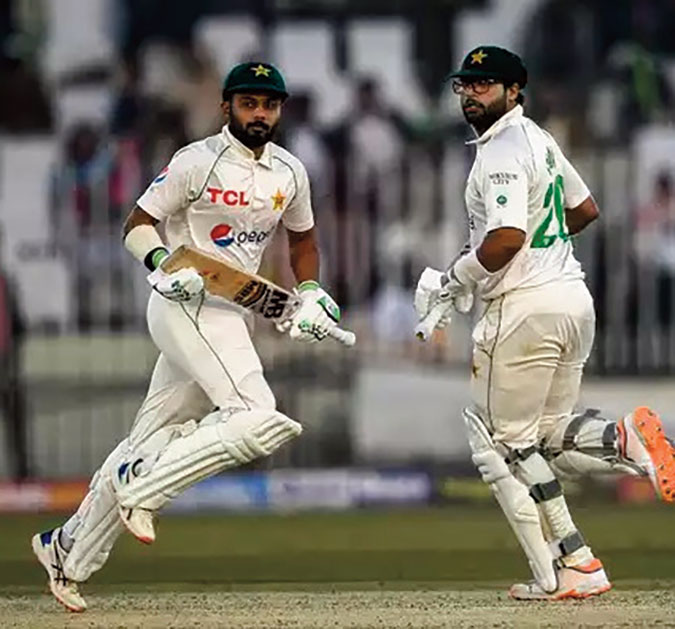
Brendon McCullum and Ben Stokes had underscored their philosophy several times over: England will risk defeat in order to win Test matches. And so it proved in Rawalpindi. The visitors offered a brave declaration of their second innings, asking Pakistan to chase 342 for victory with about 100 overs left in the game, light permitting. At the end of another truncated final session, Pakistan had whittled down 80 runs from their target but lost two of their first-innings centurions Abdullah Shafique and Babar Azam along the way while experienced batter Azhar Ali had to retire hurt with a finger injury.
Thankfully for the hosts, their other centurion from the first dig, Imam-ul-Haq, survived England’s bouncer plan and moved along to 43 and added 55 runs for the third wicket in the company of Saud Shakeel. It was a tricky 20 over period for Pakistan before bad light ended play early once more. They were chasing leather for much of the day before Stokes and McCullum dangled the fourth-innings carrot. Given the pitch had continued to remain benign deep into the fourth day, a chase at a rate above three runs to the over wasn’t going to be difficult. But, in it was England’s best chance to force mistakes out of their excitable opponents.
Stokes also began the final session by inverting all usual conventions. Test cricket’s most prolific fast bowler, James Anderson, was not handed the new ball and instead Ollie Robinson and Stokes took it upon themselves to test out areas half-way down from the batters. The bouncer ploy worked. Shafique miscued a pull and was caught by Harry Brook at deep square leg. Ollie Robinson then around the stumps and got a ball to climb awkwardly on Azhar Ali and pinged him on the fingers, forcing the senior batter into retiring hurt. In walked Babar at No.4. He slapped one short ball over the off-side for four but then was caught in two minds against a Stokes short ball and inside-edged a ball to the ‘keeper.
At 25/2, Pakistan were wobbling. But the pair of Imam and Shakeel managed to work their way out of trouble. It helped that the ring of attacking fielders stationed by Stokes allowed for ready boundary opportunities. Jack Leach, for instance, when introduced into the attack bowled with a pair of catching mid-wickets, a slip, a forward short leg and a silly point. That meant Shakeel could simply chip the ball towards mid-on for a pair of boundaries. There was one nervy moment for Pakistan when a Shakeel clip went straight to Keaton Jennings at short leg but the reflex catch didn’t ‘stick’ and Pakistan could go into the final day with no further damage and still with a realistic chance of victory.
It is an intriguing place for them to find themselves having conceded 657 in the first innings and then again 264 in less than 36 overs on the fourth day. When it was their turn to bat, England’s batters were in no mood to allow the game to peter out. Zak Crawley, Joe Root and Harry Brook all hit fifties at faster than a run a ball.
The signs were not hard to read in that second session. Crawley, who was on 24 at Lunch, began with an on-drive and a square drive while Root played an audacious reverse scoop off Naseem Shah for a boundary of his own. Almost immediately after getting to a half-century to go with his first-innings ton, Crawley was strangled down the legside attempting to put away a short ball from Mohammad Ali. The umpires didn’t pick up the glove and the opener himself appeared to suggest the ball had hit his shoulder but Pakistan’s ring fielders were convinced enough to ask for the DRS aid and get their third wicket.
Brook joined Root with the former captain seamlessly taking over as the tempo setter. He continued to play with the field, pushing the ball into gaps and running twos or using his famous dab to run the ball down to third man. Despite hitting only four boundaries, Root had a 48-ball 50 of his own.
Babar Azam, already hamstrung by the loss of Haris Rauf to an injury, brought the spinners on with the strategy to bowl from round the stumps and into the right-handers’ blindspot. To counter and continue with his run-making ways, Root turned into a left-hander for a ball and then abandoned that move in favour of the reverse sweep. Boundaries continued to flow as Root raced into the 70s. Eventually, Zahid Mahmood and Pakistan’s persistence paid off when Root eventually miscued a sweep and was caught at short fine. Ben Stokes followed his former skipper into the dressing room in the same over, miscuing a shot to sweeper cover.
Brook took over from there and launched an all-out offense on debutant legspinner Mahmood, repeatedly slogging him over mid-wicket or stepping out and hitting him over his head. Will Jacks, promoted above the injured Liam Livingstone, hit three sixes off his own in a 13-ball knock of 24. It was Brooks, however, who was marched on rapidly towards a second hundred of the game before he was out on the cusp of the Tea break, bowled off Naseem Shah while trying to swipe across the line. His 11 fours and three sixes, however, was perfect for England to set up a brave declaration.
More earlier in the day, Jacks finished with a six-fer on debut, having known of his participation in the Test merely minutes before the start of the game. Pakistan had begun the day, trailing England by 158 in the first innings and had Agha Salman to thank for eating into his deficit by farming the strike with the tail. Salman though edged Jacks to first slip and the offie went on to dismiss Mahmood and Rauf for figures of 6 for 161. Little would he have known then that he would be needed to produce another strong show on the final day for that first-innings performance to not end up on a losing side.
Brief scores:
England 657 and 264 for 7 decl. (Harry Brook 87, Joe Root 73; Mohammad Ali 2-64)
Pakistan 579 and 80/2 (Imam-ul-Haq 43n.o.)

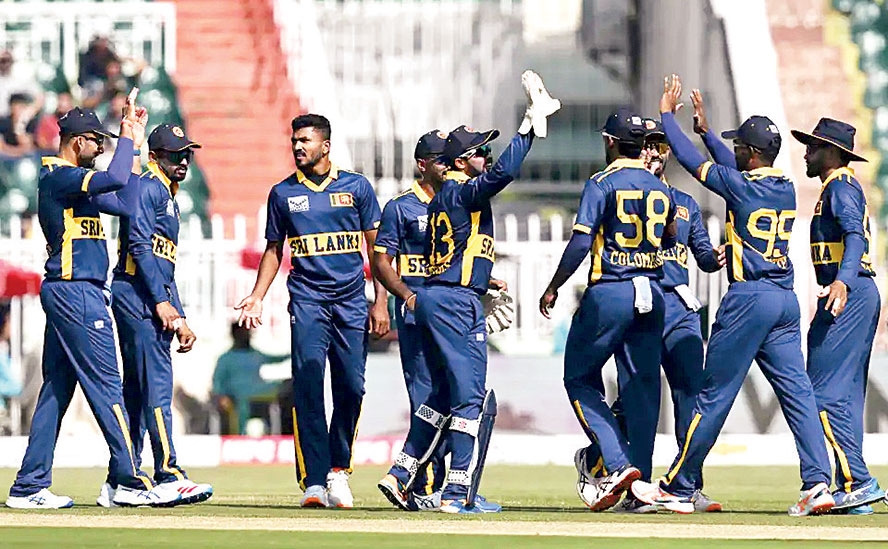
Eshan Malinga returned career best figures of four for 46, but his impressive spell could not prevent Pakistan from breaching the 300 run mark in the curtain-raiser of the ODI tri-nation series in Rawalpindi on Sunday.
Pakistan were bowled out for 305, with former captain Salman Ali Agha leading the charge with his fourth ODI hundred.
Agha struck a fluent 107 off 90 deliveries, peppering the boundary with ten fours and a six before falling to Asitha Fernando. The Sri Lankan seamer was equally impressive, returning tidy figures of three for 39.
Agha featured in a 97 run partnership with Hasan Nawaz and at 215 for four with 13 overs remaining, Pakistan appeared poised for a formidable total. However, Sri Lanka’s bowlers clawed their way back into the contest, applying the brakes just when the hosts threatened to run away with the game.
On a surface tailor made for batting, Sri Lanka’s late fightback could prove crucial, with the visitors fancying their chances of chasing down the target.
Left-arm seamer Dilshan Madushanka finished with two for 67, although his figures flattered him somewhat. He was guilty of straying onto the pads far too often, offering the Pakistan batters several scoring opportunities.
Sri Lanka went into the contest with just four specialist bowlers, leaving the part timers to shoulder a fair share of the workload. To their credit, the makeshift attack rose to the occasion, sharing ten overs between three bowlers without allowing Pakistan to completely dictate terms.
Dasun Shanaka did the lion’s share of the work, sending down seven overs, while Sahan Arachchige and Kamindu Mendis chipped in with the remaining three.
Sri Lanka also welcomed back top order batter Avishka Fernando, who returned to the ODI fold after spending several years on the sidelines.
England are the third team in the tri-nation competition, which serves as valuable preparation for next year’s World Cup.
The opening three matches will be played in Rawalpindi before the tournament shifts to Lahore for the remaining fixtures, including the final.
Sri Lanka are in the midst of a marathon 50 day tour of Pakistan. Having already completed a three-match T20I series, they will turn their attention to the tri-nation tournament before playing a First Class warm-up fixture followed by two Tests.
19 Division I – Tier ‘A’ Cricket
by Reemus Fernando
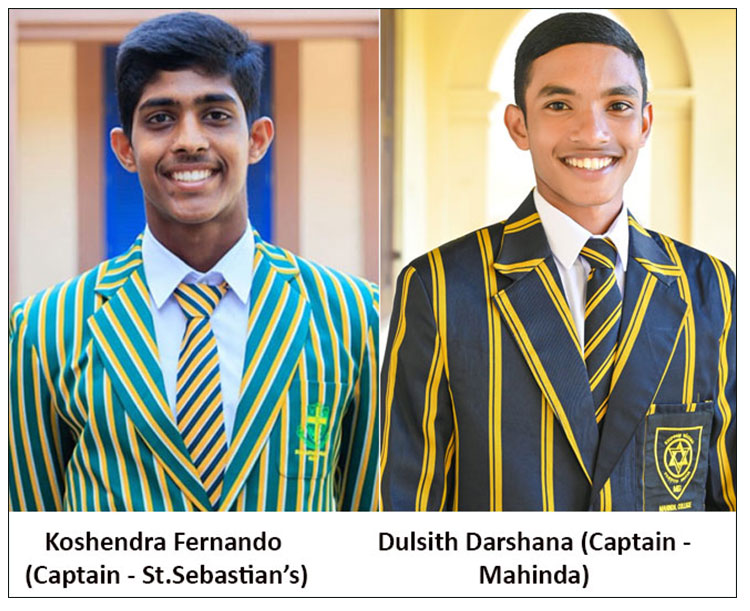
The top eight teams begin their battle for the Under 19 Division I Tier ‘A’ limited-overs title today, when Mahinda College, Galle, take on St. Sebastian’s College, Moratuwa, in the first quarter-final at Dombagoda.
Led by Dulsith Dharshana, Mahinda qualified for the knockout stage with wins over St. Anthony’s College, Katugastota (by five wickets), Royal College, Colombo (by six wickets) and Lumbini (by ten wickets). Their only defeat came against St. Peter’s College, Bambalapitiya, the only side to top 200 against them. In their other matches, Mahinda’s bowlers kept opponents to low totals.
That bowling unit, spearheaded by left-arm paceman Sadew Nethmina, appears to have peaked ahead of the crucial clash. They bundled Lumbini out for 40 in their last match, with Nethmina and Vishmitha Sathsara sharing nine wickets between them.
St. Sebastian’s reached the knockout stage on the back of wins over Maris Stella College, Negombo, and D. S. Senanayake College, Colombo. Their match against Sri Sumangala College, Panadura, ended without a result because of rain, while they lost by two wickets to Richmond, the eventual group champions.
St. Sebastian’s boast a strong batting line-up, with Hirusha Perera, Navinu Fernando, Lashen Fernando, Thivanka Fernando and Meshone Ferdinando all making notable contributions in the group stage. Skipper Koshendra Fernando is expected to lead the bowling attack with his spin, supported by Adeesha Lakshan, Lashen Fernando and Risinu Prabesh.
Teams
Mahinda (from):
Dulsith Darshana (Captain), Sadew Nethmina (Vice Captain), Randula Mabarana, Manitha Rajapaksha, Sehas Ashinsa, Kaveesha Githmal, Thiyon Helika, Kavindu Nimsata, Gesandu Bisas, Vishmitha Sathsara, Buddhima Tharupathi, Naviru Nishitha, Nihindu Sesitha, Anuga Palliyaguru, Senuja Vehan, Kevin Geemitha, Bakshara Jayarathne.
Officials: Denuwan Rajakaruna (Head Coach), Sandaru Nethmina (Asst. Coach), Y. Nishantha Kumara (Master in Charge)
St. Sebastian’s (from): Koshendra Fernando (Captain), Meshone Ferdinando, Nisila Dimath, Navinu Fernando, Hirusha Lochana, Lashen Fernando, Thejan Bandara, Chamath Wellalage, Risinu Prabesh, Sanoj Perera, Deneth Keshara, Adeesha Lakshan, Dilena Fernando, Thiwanka Fernando, Shenas Hashein, Pathiv Vehan, Dineepa Wickramsooriya.
Officials:
Lahiru Kanishka (Head coach), Nishantha Fernando (Asst. Coach), Sandaru Tharusha Perera (Master in Charge)
The other three quarter finals will be played on Tuesday as per the below schedule.
Mahanama Colombo V St. Joseph’s Darley Road at Mattegoda
Nalanda Colombo V St. Anthony’s Katugastota at Campbell Place
Richmond Galle V Wesley Colombo at Weeraketiya
Several big names fell at the first hurdle, including last year’s finalists Royal College, Colombo, as well as S. Thomas’ College, Mount Lavinia, Trinity College, Kandy, and St. Peter’s College, Bambalapitiya. Royal and St. Peter’s were in the same group and finished behind Mahinda and St. Anthony’s. S. Thomas’ were in Group ‘A’, where Mahanama and Wesley edged out the rest to book their places.
by Reemus Fernando
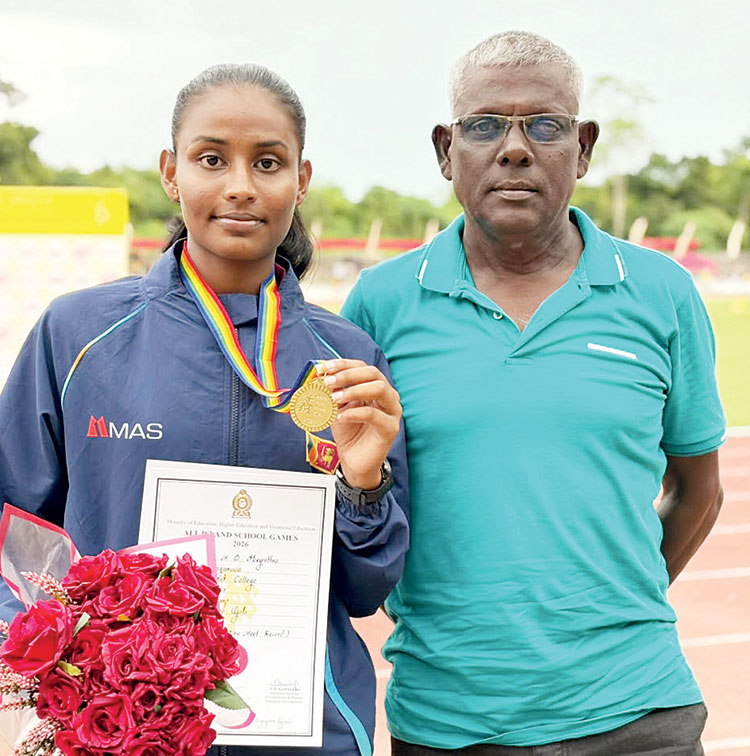
Asian Junior Championship medallist Mihinsa Dewmini Abeyratne broke a ten-year-old meet record to win the Under 20 high jump at the All Island Schools Games Athletics Championship at Diyagama on Sunday.
The President’s College, Embilipitiya, athlete cleared 1.75 metres, equalling her personal best, to erase the record of Poornima Gunarathne of Leeds International, Panadura. Gunarathne’s mark of 1.74 metres had stood since 2016.
Trained by retired sports officer Gamini Dias, Mihinsa was expected to achieve something special this season after setting a personal best of 1.75 metres at the same venue earlier this year. She followed that with a bronze medal at the Asian Junior Championship in Hong Kong.
Hers was one of six meet records to fall by the time this report was filed on day three of the meet.
In the girls’ category, Lyceum International School, Wattala, and Ave Maria Convent, Negombo, set new marks in relay events. In a closely contested Under 14 4×100 metres final, Lyceum clocked 51.35 seconds to erase Musaeus College’s 2019 record. Ladies’ College, who finished second in 51.52, also bettered the previous mark.
Ave Maria Convent edged Nimala Maria Balika in another tight finish to win the Under 16 girls’ 4×100 metres in a new meet record of 49.49 seconds. Nimala Maria Balika also bettered the old record.
In the boys’ category, Sadeesh Denuwan of Halmillaketiya MV stole the limelight with a new meet record of 11.22 seconds in the Under 14 80 metres hurdles. Maneesha Samarasinghe of Lyceum International, Wattala, set a new record of 13.09 seconds in the Under 16 100 metres hurdles.
Lyceum International, Wattala, also set a new meet record of 3:13.76 in the Under 20 4×400 metres relay.

Showers or thundershowers will occur in most parts of the island after 1.00 p.m

CTU: Teacher shortage casts doubt on govt.’s education reforms

Norochcholai to remain offline for several days after blackout

President links businessman held with arms to politicians

CID probe sought into tusker’s death amid fears of elephant-killing syndicate

Bill to allow remote witness testimony in courts

‘Dates have the highest sugar content to fight Coronavirus’

Sunday Island 27 December – Headlines

#SundayIsland 17th December – Headlines

Sunday Island – 28th March

Sunday Island Headlines – 21 March

Sunday Island – 21st February – Headlines
-

 Latest News6 days ago
Nissanka’s return headlines Sri Lanka’s Test squad against Pakistan
-

 News5 days ago
Sri Lanka, India caught in US-Iran ship crisis
-
 Latest News6 days ago
Imran Khan’s PTI braces to fight federal takeover of Khyber Pakhtunkhwa
-

 Latest News5 days ago
Missiles intercepted near Riyadh after Saudi coalition hits Yemen fuel depot
-
 Latest News5 days ago
Kusal Mendis’ unbeaten 87 hands Sri Lanka consolation win
-
 News2 days ago
Asgiri Mahanayake calls for immediate release of Gnanasara Thera
-
 News6 days ago
Mahinda and Shiranthi hospitalised
-

 News6 days ago
Presidential pardons: Govt. studying Justice Thurairaja’s recommendations – Minister