
News
Embarking on a digital journey: Exploring Sri Lanka’s readiness

The new normal requires new approaches and solutions, an imperative change that must be embraced by all sections of the economy to survive and to stay relevant.
The outbreak of the pandemic saw the country grappling to keep up with day-to- day activities, both on a personal and corporate level. One of the key challenges observed was in the areas of transacting for goods and services in what can be called an increasingly contactless word.
Although relevant authorities have pushed for Sri Lanka to move towards a cashless economy, it was during the initial outbreak of COVID-19 that people actively looked to use the digital payment infrastructure that is in place.
Across the world, including Sri Lanka, the digital modes of communications including payments are continuing to boom, thanks to the introduction of new technologies coupled with other developments to encourage the emergence of innovative ways of doing things, which leads to the creation of new business opportunities.
The Information Communications Technology Agency (ICTA) has been in the forefront in driving the adoption of digital technologies and legal frameworks in the country especially within the government.
However, despite efforts to deploy platforms and technologies by many stakeholders, the uptake has been slow largely due to the lack of awareness.
Sri Lanka’s readiness to embrace the digital journey
Even before the crisis hit, Sri Lanka had all the necessary framework to embark on the digital journey, and the ability of consumers to make an immediate transition from manual to electronic transactions provide clear evidence that a strong foundation has already been laid.
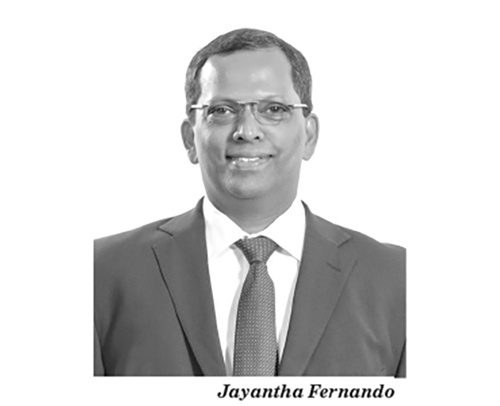
In order to enable this transition from a policy perspective, Director/Legal Advisor at ICTA & Director, Sri Lanka CERT, Mr. Jayantha Fernando affirmed that Sri Lanka has the enabling legal framework to transform every form of physical activity that is carried out, into the digital medium, except for certain classes of instruments where notarization is needed.
“I believe and can firmly say that we have sufficient legal grounds to embrace this transition,” Fernando assured.
Digital signatures
Making the digital journey even more convenient to embark on is the ability to use digital signatures. Digital signatures essentially work by proving that a digital message or document was not modified, intentionally or unintentionally, from the time it was signed. This is done by generating a unique hash of the message or document and encrypting it using the sender’s private key. In addition, the sender is bound to the communication if a digital signature is affixed, thus, providing non-repudiation.
In this context, Sri Lanka has been successful in terms of cross border transactions as well, since the root key from the island nation is recognized globally from the beginning of this year, after its launch on 14th February 2020.
In the first phase, digital certificates were provided to banks for use in financial transaction clearing systems, such as SLIPS and CITS.
During the second phase of development in 2011, digital certificates were provided to all sectors including their enterprise applications; SSL certificates and end-user certificates on both private and public networks. LankaSign provided an affordable option to Sri Lanka’s financial as well as other sectors and allowed them to automate documentation work, which was previously done manually.
With regards to verifying the validity of digital signatures, what is required is a valid certificate from the signatory, and the complete issuer chain of certificates up to the root certificate. In addition, the signatory’s public key, issuer Certificate Status Protocol (CSP) certificates and their Certificate Revocation List (CRL) are also required.
A seamless Work from Home (WFH) arrangement: Is SL capitalizing enough?
While most enterprises have been focusing on their digital transformation over the last few years, many are still utilizing processes that have manual, physical, or face-to-face components and document signing is probably the best example of this.
According to Fernando, digital signatures actually help in the current context since there is reluctance at the moment to work on premise due to the outbreak of the pandemic.
“The digital signatures are the electronic equivalent of hand-written signatures. A digital certificate issued from a trusted party would have a higher degree of validity attached to them, which ensures integrity to the transactions. What should be ideally done is for governments, Corporates and SMEs to consider the option of using digitally signed documents, so that they can communicate those in electronic form to all participants in a transaction,” he said.
However, due to lack of awareness, most private organizations are somewhat reluctant to use digital certificates or digital signatures for their day-to-day transactions, he said.
Fernando stressed that companies should embrace digital signatures as they are convenient, versatile, legally binding, secure and adaptable.
The choice of digital signatures
This again is a business choice. Customers opting for digital signatures under the Electronic Transaction Act have a number of options across various categories.
“In law, we have left it to the trading parties to decide the category of electronic signatures they would like to use. One important feature of the Act is that we have kept the law technology neutral so that it can adapt to developments in technology,” Fernando, further said.
He added that under the law, it is said that any method that helps to identify a person and to indicate that person’s intention in relation to an electronic communication would fall within the framework of an electronic signature and depending on the type of transaction, the parties can use various methods.
“So basically, customers and businesses have choices, they must pick what is suitable to them. My suggestion is to make that choice wisely and use a method that is secure, ensures integrity to the transactions and guarantees digital transactions are not tampered with. Digital signatures achieve this objectives and there are no legal barriers to use them”, he said.
Fernando outlined that Sri Lanka has been examining this area and plans are afoot to fast track the Data Protection Bill. He Chairs the drafting committee responsible for this area, and drafted the Legislation that went through a public consultation process, which has received policy level approval.
Given the recent developments in the country and the world since the emergence of an unforeseen crisis, the Data Protection bill is being further refined and amended, Fernando stressed.
The bill will be finalized in the next few months and the new Ministry of Technology, established on 20th November 2020 is given the mandate to fast track the initiative and set up the institutional framework for its implementation.

News
Establishment of an Institutional Framework to Inagurate Upper Hydro Catchment Areas Management Authority


Policy approval of the Cabinet of Ministers was granted at their meeting held on 08.06.2026 to establish the Upper Hydro Catchment Areas Management Authority for identification and
execution of a formal and long – lasting remedy to secure the central hills including the upper hydro catchment areas enabling them to sustain amidst extreme weather conditions
due to natural calamities and human activities as well as to be used for the sustainable development of the country.
Accordingly, a concept paper has been prepared including
institutional structure, activities, powers, active subject area as well as administrative and coordination mechanism for the proposed authority by an expert technical committee appointed by the Secretary to the President.
Based on the said concept paper, the Cabinet of Ministers granted approval to the resolution furnished by the President to instruct the Legal Draftsman to prepare a draft bill including legal provisions required for the establishment of Upper Hydro Catchment Areas Management Authority.
News
Introduction of Flora and Fauna (Regulation of actions of the Indigenous Community within the nominated areas) Regulations
With the objective of securing the traditional livelihood and the eco system of the indigenous community, it has been recognized the necessity of introducing a formal regulation methodology to secure their engagement in livelihood activities by being more sensitive to the existing laws.
Thereby, the Fauna and Flora (regularizing) regulations under the Fauna and Flora Protection Ordinance (Authority 469) have been prepared so that nominated activities within the prescribed area to a member of the indigenous community
who has been registered for securing the rights acquired from law or custom or usage or traditional stance to execute an act within a certain state land that is fundamental to the survival of the indigenous community permission can be granted
Accordingly, the Cabinet of Ministers granted approval to the resolution furnished by the Minister of Environment to publish the said regulations in the government gazette notification and thereby submit to the Parliament for its concurrence.
Latest News
M. M. D. J. Senarathne, appointed Director General of the Department of National Botanical Gardens
The Cabinet of Ministers approved the resolution furnished by the Minister of Environment to appoint M. M. D. J. Senarathne, who is the senior most officer in Grade I of Sri Lanka Scientific Service se

Establishment of an Institutional Framework to Inagurate Upper Hydro Catchment Areas Management Authority
Introduction of Flora and Fauna (Regulation of actions of the Indigenous Community within the nominated areas) Regulations
M. M. D. J. Senarathne, appointed Director General of the Department of National Botanical Gardens

Harmanpreet Kaur steps down as India captain

Turkiye, Pakistan agree Saudi Arabia military deployment under Mecca pact

Rumesh Tharanga among nominees announced for World Athlete of the Year 2026

‘Dates have the highest sugar content to fight Coronavirus’

Sunday Island 27 December – Headlines

#SundayIsland 17th December – Headlines

Sunday Island – 28th March

Sunday Island Headlines – 21 March

Sunday Island – 21st February – Headlines
-

 Latest News7 days ago
Gold winner Tharanga gets brand-new Honda Vezel from SLAAJ
-

 News6 days ago
US-assisted ‘Ice’ detection: NPC to examine IGP’s move to transfer drug-busting team
-

 Features7 days ago
Why Sri Lanka needs an Inclusive Civic Nationalism – urgently
-

 Editorial5 days ago
Colombo Port drug bust: The plot thickens
-

 News7 days ago
Civil society activist accuses govt. of favouring Ven. Gnanasara
-
 Midweek Review7 days ago
Dappula’s Easter Sunday ‘grand conspiracy’ claim demolished
-

 Editorial7 days ago
When crime bosses rise above law and shrines
-
Editorial6 days ago
Drug busting, transfers and trust deficit