
News
Election Commission urges voters to leave mobile phones at home, outlines preferential voting process


By Rathindra Kuruwita
The Chairman of the Election Commission, R.M.A.L. Rathnayake, has advised voters to leave their mobile phones at home, as there will be no provision for safeguarding them at polling centres. He emphasised that voters will not be allowed to carry their phones into polling booths.
“If you bring your phone with you while waiting in line, when it’s your turn to vote, you will need to leave it outside or hand it to someone else before entering the booth. Election officials and police officers are not in a position to take responsibility for your phone. This is why we are urging voters not to bring their phones with them,” Rathnayake explained.
He further mentioned that police would be conducting checks to ensure that voters do not carry mobile phones into polling booths. “We have instructed election officers at polling centres to remain vigilant. During postal voting, certain state officials took photos of marked ballots and uploaded them online, setting a bad precedent. We are currently investigating these incidents and will take action against those in charge of these polling stations,” he added. Rathnayake also noted that fines for violating election laws have been significantly increased.
Regarding the 48-hour silence period before the election, Rathnayake said it is intended to give voters time to reflect on the candidates’ promises and make their final decision without external influence.
Police and election officials will begin removing unauthorised election offices and materials once the campaigning period has officially ended, he stated.
“Some individuals still display stickers supporting their preferred candidates on their vehicles. Police will remove such materials, and fines will be imposed on those who fail to comply,” Rathnayake warned.
Addressing the possibility of no candidate securing more than 50 percent of the vote, Rathnayake outlined the procedure that will be followed in such a scenario. If no candidate reaches the 50 percent threshold, the Commission will instruct counting centres to begin tallying the preferential votes.
“At this stage, we will have a list of candidates based on the number of votes they’ve received. We will exclude the top two and begin counting the preferential votes marked in ballot papers cast for the remaining 36 candidates. We start by examining the ballots cast for the third-placed candidate to determine whom voters have selected as their second and third preferences. For instance, if a ballot marked for the third-placed candidate has the name of the leading candidate as the second preference, we will allocate that vote to the leading candidate. If the second preference is for a lower-ranked candidate but the third preference is for the leading candidate, the vote will also be considered for the leading candidate. This process is repeated until all the preferential votes from the bottom 36 candidates have been counted,” he explained.
Rathnayake said that the counting officers would record the numbers and submit them to the returning officers, who would then send the figures to the Election Secretariat. “We will collect this data and add the preferential votes to the votes obtained by the top two candidates. In some cases, the candidate who was initially in second place may overtake the first. I’m sharing this information to ensure that voters are aware of all the possible outcomes,” he concluded.

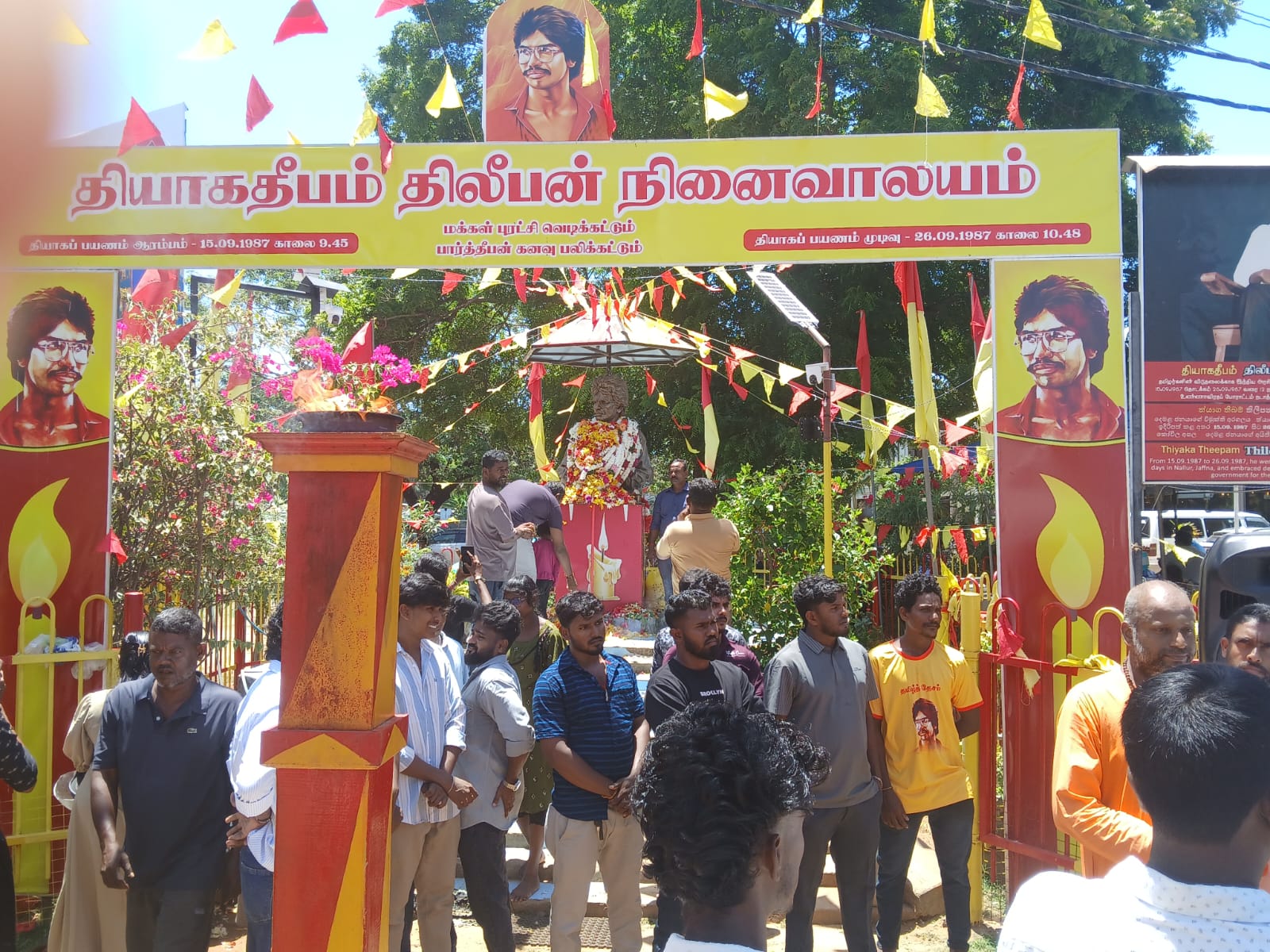
A commemorative service was held in memory of Rasaiah Parthipan commonly known by the nom de guerre ‘Thileepan’ in Nallur Jaffna this morning (26).
Parthipan a revolutionary member of the LTTE and a student of the University of Jaffna, commenced a hunger strike on 15th September 1987 untill his death on 26th September 1987. He was 23 years old at the time of his demise.
Latest News
Landslide Early Warnings issued to the districts of Colombo, Galle, Gampaha, Hambanthota, Kalutara, Kandy, Kegalle, Kurunegala, Matara, Nuwara Eliya and Ratnapura


The National Building Research Institute has issued landslide early warnings to the districts of Colombo, Galle, Gampaha, Hambanthota, Kalutara, Kandy, Kegalle, Kurunegala, Matara, Nuwara Eliya and Ratnapura from 16:00 hrs on 25.09.2026 To 16:00 hrs on 26.09.2026
Accordingly,
LEVEL III [RED] landslide early warnings have been issued to the Divisional Secretaries Divisions and surrounding areas of Neluwa, Nagoda, Niyagama and Thawalama inthe Galle district, Ganga Ihala Korale, Udapalatha, Doluwa and Pasbage Korale in the Kandy district, and Kothmale West, Ambagamuwa, Kotmale East and Norwood in the Nuwara Eliya district.
LEVEL II [AMBER] landslide early warnings have been issued to the Divisional Secretaries Divisions and surrounding areas of Elpitiya, Baddegama and Karandeniya in the Galle district, Walallawita in the Kalutara district, Deltota, Udunuwara, Gangawata Korale, Yatinuwara and Panvila in the Kandy district, Aranayake, Dehiowita, Mawanella, Deraniyagala and Yatiyanthota in the Kegalle district, Thalawakelle in the Nuwara Eliya district and Ratnapura and Pelmadulla in the Ratnapura district.
LEVEL I [YELLOW] landslide early warnings have been issued to the Divisional Secretaries Divisions and surrounding areas of Seethawaka and Padukka in the Colombo district, Attanagalla and Mirigama in the Gampaha district, Katuwana and Walasmulla in the Hambanthota district, Ingiriya and Bulathsinhala in the Kalutara district, Hatharaliyadda, Poojapitiya, Medadumbara, Kundasale, Ududumbara, Thumpane, Akurana, Pathadumbara, Harispattuwa and Pathahewaheta in the Kandy district, Warakapola, Bulathkohupitiya, Galigamuwa, Kegalle and Ruwanwella in the Kegalle district, Mallawapitiya, Alawwa, Polgahawela and Mawathagama in the Kegalle district, Pitabeddara, Kotapola and Pasgoda in the Matara district, Nuwara Eliya in the Nuwara Eliya district and Elapatha, Ayagama, Nivithigala, Kuruwita and Kalawana in the Ratnapura district
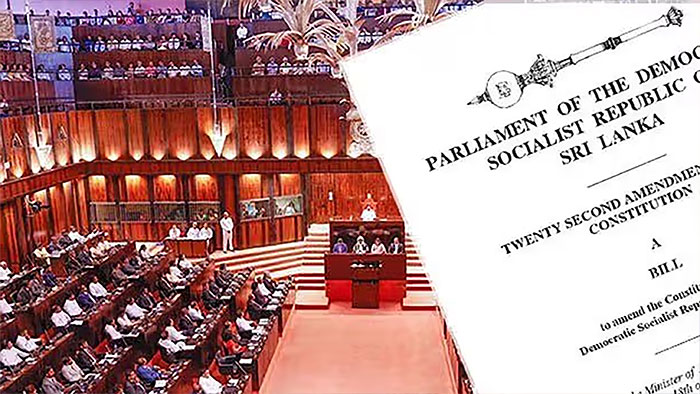
Parliament yesterday passed the Twenty-Second Amendment to the Constitution Bill and the Judicature (Amendment) Bill with two-thirds majorities, with 158 MPs voting in favour and 63 against each Bill.
The Illankai Tamil Arasu Kadchi (ITAK) and Sri Lanka Muslim Congress (SLMC) voted with the SJB against the Bills.
NDF MPs Ravi Karunanayake and Faizer Musthapha and SJB Badulla District MP Nayana Wasalathilaka were not present when the votes were taken.
The final vote on the Judicature (Amendment) Bill was announced at around 8.08 p.m. after Opposition MPs called for divisions on its clauses during the Committee Stage.
The votes followed a two-day debate which commenced on Thursday (24), after Justice and National Integration Minister Harshana Nanayakkara presented the Bills for their Second Reading.
The Supreme Court’s determination on the Bills was presented to Parliament on Tuesday (22) by Speaker Dr Jagath Wickramaratne. The Court determined that the 22nd Amendment Bill did not require approval at a referendum and could be passed by a special two-thirds majority in Parliament.
The amendment provides for raising the mandatory retirement age of Supreme Court judges from 65 to 67 and that of Court of Appeal judges from 63 to 65. It also provides for the Chief Justice to retire at 67 or after completing six years in office, whichever comes earlier.
The Speaker informed Parliament that the Judicature (Amendment) Bill could be passed by a simple majority.
The SJB opposed the legislation and its MPs attended Parliament dressed in black yesterday. The party also staged a protest at Polduwa Junction, Battaramulla, under the theme “No to 22, which destroys democracy”, with Opposition Leader Sajith Premadasa and several SJB politicians participating.

Thileepan rembered on 39th death anniversary

Landslide Early Warnings issued to the districts of Colombo, Galle, Gampaha, Hambanthota, Kalutara, Kandy, Kegalle, Kurunegala, Matara, Nuwara Eliya and Ratnapura

Showers in the Western, Uva and Sabaragamuwa provinces and in Galle, Matara, Kandy, Nuwara-Eliya, Batticaloa and Ampara districts.

22A, Judicature Amendment Bills passed with 2/3 majority

TIN mandatory for key transactions from Nov. 1

Navy brings 25 Indonesian fishermen ashore after trawler capsizes

‘Dates have the highest sugar content to fight Coronavirus’

Sunday Island 27 December – Headlines

#SundayIsland 17th December – Headlines

Sunday Island – 28th March

Sunday Island Headlines – 21 March

Sunday Island – 21st February – Headlines
-

 News7 days ago
Namal Rajapaksa Buddhist gambit fails, bail denied
-

 Features7 days ago
Why the spelling Sri Lankan names in English vary
-

 Features7 days ago
Three bands, a new identity: Sri Lankan wolf snake recognised as distinct species
-

 Business7 days ago
SLIIT holds largest-ever convocation
-

 News7 days ago
Vehicle prices drop by up to Rs. 1 mn, says importers’ body
-

 News7 days ago
Govt monitors reported Saudi death sentence – Foreign Ministry
-
 Business7 days ago
Lanka’s famed beach shack battles demolition
-

 Business7 days ago
All-new Bolero MaXX Pik-Up unveiled in Lanka