
News
Election Commission prepares for challenges with over 1.1 million new voters and lengthy ballot papers


There are over 1.1 million new voters since the last election in Sri Lanka, R.M.A.L. Rathnayake, Chairman of the Election Commission has said.He also mentioned that more than 17.1 million voters are eligible to vote on 21 September at the Presidential election.
Rathnayake noted that there were 36 candidates in the 2020 election, and he anticipates an even greater number this time, which could present significant challenges.
“We have discussed this with the government printer. The ballot paper cannot exceed a length of 27 inches due to the limitations of the printing machines at the government printer. If this length is exceeded, we will have to redesign the ballot paper, possibly printing it in an A4 format. Last time, we accommodated 36 names, which took up 26 inches,” Rathnayake said.
He also pointed out that a lengthy ballot paper could impact the number of ballot boxes required and the process of counting votes.
“A lengthy ballot paper also poses difficulties for voters, as it takes longer to locate their preferred candidate when the list is very long. This increases the average time spent voting, which, in turn, affects the overall time taken to cast votes,” he added.
Rathnayake highlighted that this election marks the first time the new campaign finance laws, under the Regulation of Election Expenditure Act No. 3 of 2023, will come into effect. Several discussions with stakeholders have already taken place. He noted that these campaign finance laws will only become effective once nominations are called for the Presidential Election.
“Within five days after the nomination period ends, representatives of political parties will be summoned to the election secretariat to determine how much a candidate can spend per voter during the campaign. We have already consulted relevant state entities and other election stakeholders. After considering all inputs, the Election Commission will set the spending limits for candidates,” Rathnayake explained.
He further stated that candidates are required to submit their expenditure reports within 21 days after the election concludes. The Election Commission must then make these reports public within 10 days, after which the public can lodge complaints regarding candidate expenditures.
Rathnayake assured that the absence of an Inspector General of Police (IGP) has not affected the Election Commission. The Secretary to the Ministry of Public Security has guaranteed that an adequate number of police officers will be provided to ensure a free and fair election.
“In late July, we requested the Secretary to the President to appoint an IGP or an acting IGP to coordinate with us throughout the election period. We received a response indicating that the Secretary to the Ministry of Public Security has been directed to supply the necessary number of police officers. We subsequently met with the Secretary and the Senior Deputy Inspector General (SDIG) responsible for elections. We have also spoken to all Senior DIGs and the STF commandant, and everyone has agreed to provide the necessary security,” he said. (RK)

Latest News
Heat Index at Caution Level at some places in the Western, Sabaragamuwa, Southern and North-western provinces and in Monaragala, Mannar, Vavuniya and Anuradhapura districts

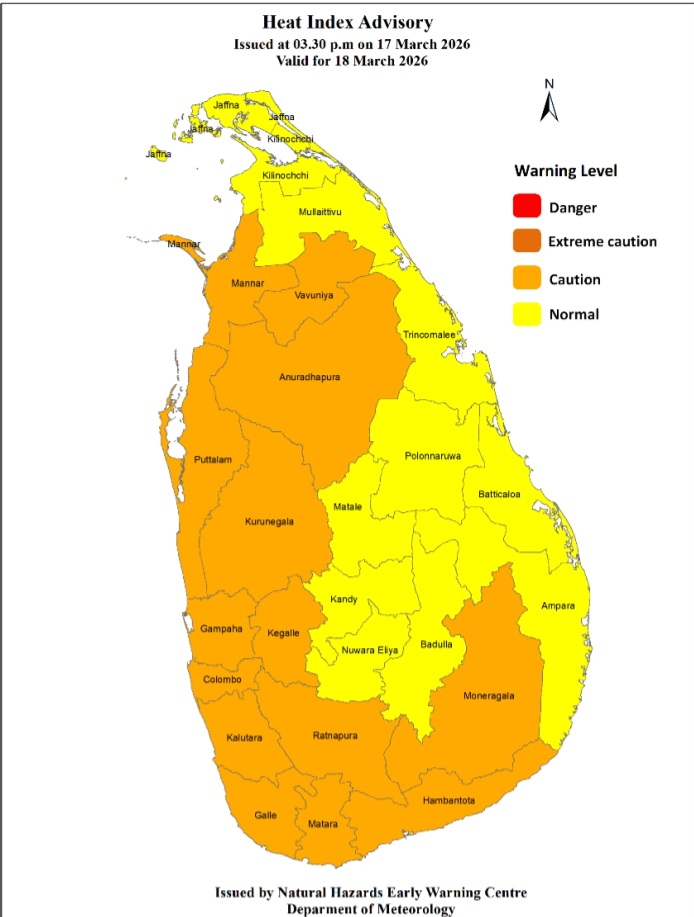
Warm Weather Advisory Issued by the Natural Hazards Early Warning Centre of the Department of Meteorology at 3.30 p.m. on 17 March 2026, valid for 18 March 2026.
The general public are warned that the Heat index, the temperature felt on human body is likely to increase up to ‘Caution level’ at some places in the Western, Sabaragamuwa, Southern and North-western provinces and in Monaragala, Mannar, Vavuniya and Anuradhapura districts.
The Heat Index Forecast is calculated by using relative humidity and maximum temperature and this is the condition that is felt on your body. This is not the forecast of maximum temperature. It is generated by the Department of Meteorology for the next day period and prepared by using global numerical weather prediction model data.
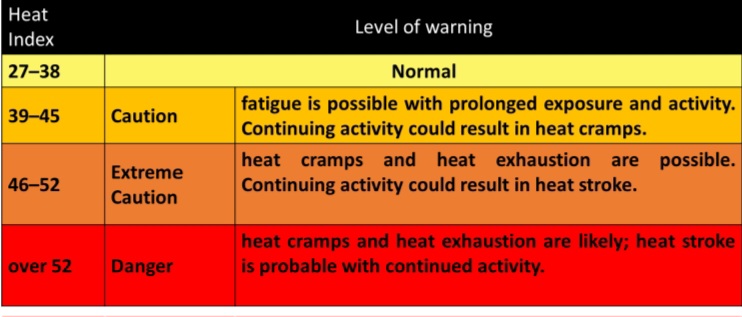
Effect of the heat index on human body is mentioned in the above table and it is prepared on the advice of the Ministry of Health and Indigenous Medical Services.
ACTION REQUIRED
Job sites: Stay hydrated and takes breaks in the shade as often as possible.
Indoors: Check up on the elderly and the sick.
Vehicles: Never leave children unattended.
Outdoors: Limit strenuous outdoor activities, find shade and stay hydrated.
Dress: Wear lightweight and white or light-colored clothing.
Note:
In addition, please refer to advisories issued by the Disaster Preparedness & Response Division, Ministry of Health in this regard as well. For further clarifications please contact 011-7446491


The Commission to Investigate Allegations of Bribery or Corruption (CIABOC) yesterday (17) recorded a statement from former President Gotabaya Rajapaksa on the allocation of a house for a maid working at the residence of the then Chief Justice Mohan Peiris, PC.
Gotabaya Rajapaksa, in his capacity as the Secretary to the Ministry Defence and Urban Development, allegedly authorised the allocation of the house on the recommendation of the CJ during President Mahinda Rajapaksa’s second term. The Rajapaksa government brought in Peiris as the Chief Justice after impeaching Dr. Shirani Bandaranayake in January 2013.
The allocation of the house was made by the Urban Development Authority (UDA), following the mandatory examination of the request, sources said, adding that during that time the government had launched several mega housing projects in Colombo and its suburbs to accommodate those living in shanties, etc.
CIABOC is expected to record a statement from ex-CJ Peiris who subsequently served as the country’s Permanent Representative to the United Nations in New York.
By Shamindra Ferdinando

As part of the assistance extended by the Government of India towards rehabilitation and reconstruction efforts in Sri Lanka in the aftermath of Cyclone Ditwah, a four-member technical delegation of health experts from Sri Lanka visited India recently.
The Indian HC said: “The delegation studied the Indian models of Medical Kiosks/Health ATMs, Mobile Diagnostic Laboratories and the telemedicine platform ‘eSanjeevani’ to explore replicating these initiatives in Sri Lanka in order to strengthen the local healthcare delivery system.
During the visit, the delegation participated in a series of technical sessions organized by premier Indian institutions like National Health Authority, Indian Council of Medical Research (ICMR) and Centre for Development of Advanced Computing (C-DAC). Visits were arranged for the delegation to Combined Hospital at Loni, Ghaziabad, and Civil Hospital, Sector 10, Gurugram as part of exposure to India’s digital health ecosystem. Demonstrations were conducted on Mobile Health Kiosks / Health ATMs, including basic diagnostics and their role in strengthening primary healthcare delivery. The Sri Lankan experts were also provided an overview of India’s highly successful Ayushman Bharat Digital Mission. A live teleconsultation through eSanjeevani was demonstrated, highlighting the integration of remote consultations with digital health records.
The initiative reflects the continued robust cooperation between India and Sri Lanka in strengthening healthcare delivery systems, particularly in vulnerable areas, and supporting recovery efforts among affected communities.”

Families search for loved ones after deadly Pakistan strike on Kabul rehab

CAF strips Senegal of AFCON title, Morocco declared African champions

Heat Index at Caution Level at some places in the Western, Sabaragamuwa, Southern and North-western provinces and in Monaragala, Mannar, Vavuniya and Anuradhapura districts

Showers above 50 mm can be expected at some places in the Central, Sabaragamuwa, Southern and Uva provinces and in Anuradhapura district

CIABOC questions Ex-President GR on house for CJ’s maid

Post-Ditwah Indian recovery assistance to SL: health experts from here visited India

‘Dates have the highest sugar content to fight Coronavirus’

Sunday Island 27 December – Headlines

#SundayIsland 17th December – Headlines

Sunday Island – 28th March

Sunday Island Headlines – 21 March

Sunday Island – 21st February – Headlines
-

 News6 days ago
Historic address by BASL President at the Supreme Court of India
-

 Sports6 days ago
The 147th Royal–Thomian and 175 Years of the School by the Sea
-

 Life style3 days ago
From culture to empowerment: Indonesia’s vision for Sri Lanka
-

 Business2 days ago
Browns EV launches fast-charging BAW E7 Pro at Rs. 5.8 million
-
 News6 days ago
Power sector reforms jolted by 40% pay hike demand
-

 Latest News3 days ago
QR code system will be implemented for fuel with effect from 06.00 a.m. today (15th)
-

 News4 days ago
Crypto loopholes funnel Lankan funds abroad
-

 Sports3 days ago
Kirsten brings pedigree, but Sri Lanka must fix the system