
Foreign News
Egypt’s Grand Museum opens, displaying Tutankhamun tomb in full for first time


Near one of the Seven Wonders of the Ancient World – the Great Pyramid of Khufu at Giza – Egypt is officially opening what it intends as a cultural highlight of the modern age.
The Grand Egyptian Museum (GEM), described as the world’s largest archaeological museum, is packed with some 100,000 artefacts covering some seven millennia of the country’s history from pre-dynastic times to the Greek and Roman eras.
Prominent Egyptologists argue that its establishment strengthens their demand for key Egyptian antiquities held in other countries to be returned – including the famed Rosetta Stone displayed at the British Museum.
A main draw of the GEM will be the entire contents of the intact tomb of the boy king Tutankhamun, displayed together for the first time since it was found by British Egyptologist Howard Carter. They include Tutankhamun’s spectacular gold mask, throne and chariots.
“I had to think, how can we show him in a different way, because since the discovery of the tomb in 1922, about 1,800 pieces from a total of over 5,500 that were inside the tomb were on display,” says Dr Tarek Tawfik, president of the International Association of Egyptologists and former head of the GEM.
“I had the idea of displaying the complete tomb, which means nothing remains in storage, nothing remains in other museums, and you get to have the complete experience, the way Howard Carter had it over a hundred years ago.”
Costing some $1.2bn (£910m; €1.1bn), the vast museum complex is expected to attract up to 8m visitors a year, giving a huge boost to Egyptian tourism which has been hit by regional crises.
“We hope the Grand Egyptian Museum will usher in a new golden age of Egyptology and cultural tourism,” says Ahmed Seddik, a guide and aspiring Egyptologist by the pyramids on the Giza Plateau.
Apart from the Tutankhamun exhibit and a new display of the spectacular, 4,500-year-old funerary boat of Khufu – one of the oldest and best-preserved vessels from antiquity – most of the galleries at the site have been opened to the public since last year.
“I’ve been organising so many tours to the museum even though it was partially open,” Ahmed continues. “Now it will be at the pinnacle of its glory. When the Tutankhamun collection opens, then you can imagine the whole world will come back, because this is an iconic Pharoah, the most famous king of all antiquity.”
“It’s an absolute must-see,” says Spanish tourist, Raúl, who is awaiting the full public opening on 4 November.
“We’re just waiting to go and check out all of the Egyptian artefacts,” says Sam from London, who is on an Egypt tour. “It’s a once in a lifetime opportunity.”
Another British tourist says she previously saw the Tutankhamun exhibits on display at the neoclassical Egyptian Museum in bustling Tahrir Square.
“The old museum was pretty chaotic, and it was a bit confusing,” she comments. “Hopefully the Grand Museum will be a lot easier to take in and I think you will just get more out of it.”
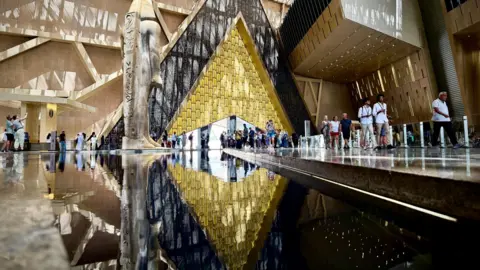
The new museum is colossal, spanning 500,000 square metres (5.4m sq ft) – about the size of 70 football pitches. The exterior is covered in hieroglyphs and translucent alabaster cut into triangles with a pyramid shaped entrance.
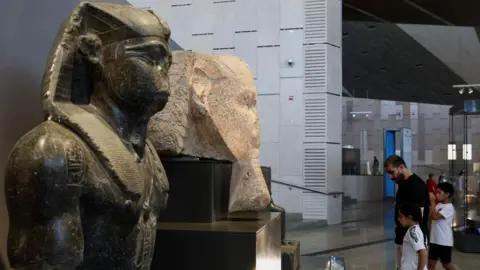
Among the GEM showstoppers are a 3,200-year-old, 16m-long suspended obelisk of the powerful pharaoh, Ramesses II, and his massive 11m-high statue. The imposing statue was moved from close to the Cairo railway station in 2006, in a complex operation in preparation for the new institution.
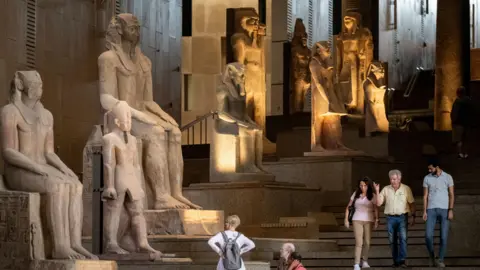
A giant staircase is lined with the statues of other ancient kings and queens and on an upper floor a huge window offers a perfectly framed view of the Giza pyramids.
The museum was first proposed in 1992, during the rule of President Hosni Mubarak, and construction began in 2005. It has now taken nearly as long to complete as the Great Pyramid, according to estimates.
The project was hit by financial crises, the 2011 Arab Spring – which deposed Mubarak and led to years of turmoil – the Covid-19 pandemic, and regional wars.
“It was my dream. I’m really happy to see this museum is finally opened!” Dr Zahi Hawass, Egypt’s former long-time minister of tourism and antiquities, tells the BBC. The veteran archaeologist says it shows that Egyptians are equals of foreign Egyptologists when it comes to excavations, preservation of monuments and curating museums.
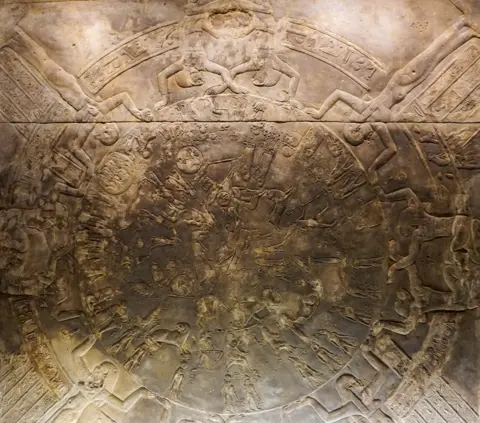
“Now I want two things: number one, museums to stop buying stolen artefacts and number two, I need three objects to come back: the Rosetta Stone from the British Museum, the Zodiac from the Louvre and the Bust of Nefertiti from Berlin.”
Dr Hawass has set up online petitions – attracting hundreds of thousands of signatures – calling for all three items to be repatriated.
The Rosetta Stone, found in 1799, provided the key to deciphering hieroglyphics. It was discovered by the French army and was seized by the British as war booty. A French team cut the Dendera Zodiac, an ancient Egyptian celestial map, from the Temple of Hathor in Upper Egypt in 1821. Egypt accuses German archaeologists of smuggling the colourfully painted bust of Nefertiti, wife of Egyptian pharaoh Akhenaten, out of the country more than a century ago.
“We need the three objects to come as a good feeling from these three countries, as a gift, as Egypt gave the world many gifts,” Dr Hawass says.
Another leading Egyptologist, Dr Monica Hanna, names the same objects, “taken under a colonialist pretext”, as ones which must be repatriated. She adds: “The GEM gives this message that Egypt has done its homework very well to officially ask for the objects.”
The British Museum told the BBC that it had received “no formal requests for either the return or the loan of the Rosetta Stone from the Egyptian Government”.
Egyptian Egyptologists voice their excitement about the new museum becoming a centre for academic research, driving new discoveries.
Already, Egyptian conservators based there have painstakingly restored items belonging to Tutankhamun, including his impressive armour made of textiles and leather. According to Egyptian law, such restorations can only be done by Egyptians.
“Colleagues from around the world have been in awe of the fantastic conservation work that has been done,” says Dr Tawfik, adding that the entire project is a source of great national pride. “As well as ancient Egyptian history, we are also showcasing modern Egypt because it’s Egypt that built this museum.”
[BBC]


An animal rights group is urging Crystal Palace to retire their live bald eagle mascot with immediate effect, saying a “bright stadium filled with boisterous fans is no place for animals”.
In a letter to Palace CEO Sharon Lacey, People for the Ethical Treatment of Animals (Peta) asked the Premier League club to stop using the eagle, named Phoenix, in pre-match displays at Selhurst Park and to never use live animal mascots again.
The London team, known as the Eagles since 1973, introduced a live eagle to matchdays in 2010. Kayla, who died in 2020, performed the role for 10 years and her replacement Phoenix made her debut against West Ham in August 2024.
Peta says birds can become “frightened, disoriented and panicked” in stadium environments, putting themselves and fans at risk.
Using them for displays and entertainment also denies the animals, who “would naturally avoid humans”, the opportunity to engage with their natural instincts, leading to “frustration and stress”, the group said.
The organisation has “detailed records” of incidents involving live mascots, including birds, being injured or killed in collisions with walls, windows and match balls, as well as a falcon embedding its talons in a spectator’s scalp after landing on his head.
In 2017, a Charlton Athletic fan was found guilty of trying to punch Kayla the eagle at a League Cup fixture two years earlier.
“Many professional sports teams use only willing humans as mascots and the club already has Pete the Eagle to excite the crowd,” said Dr Carys Bennett, Peta’s senior corporate projects manager.
“Bald eagles are widely recognised as symbols of freedom. They deserve better than to be used as an entertainment prop to amuse the Eagles’ fans.
[BBC]
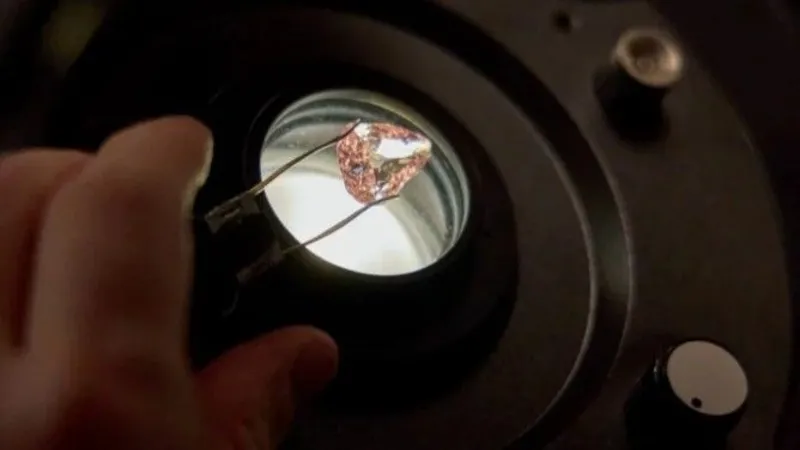
A rare pink diamond is going on display in France for the first time since it was stolen almost 100 years ago to the day – the last time it was shown to the public.
The nine-carat, pear-shaped gemstone known as the “Grand Condé” was pilfered in an overnight raid on the Château de Chantilly in October 1926 and concealed in a hollowed-out apple.
The diamond – one of few royal jewels to survive the French Revolution – was recovered a few weeks later when a hungry maid at the hotel in which the thieves were staying took a bite of the apple.
It will once again be on display in the Condé Museum at the Château de Chantilly until 3 January.
The museum’s director Mathieu Deldicque said that while the apple story may sounds far-fetched, it was widely covered by newspapers at the time.
Deldicque has faced questions about whether the exhibition may be tempting fate, especially given the string of heists on European cultural institutions in the past 12 months, including the daring daylight robbery of jewellery from the Louvre museum in Paris.
While he declined to reveal to CNN how much the diamond was insured for, he noted that extensive academic study into the properties of the diamond had taken place to make it uniquely identifiable.
The results of this analysis, as well as previously unseen archive material about the gem’s history and theft, form part of the exhibition, according to the museum.
Naturally occurring pink diamonds are exceptionally rare and often sell for tens of millions of dollars. The highest price ever fetched for one at auction was $71.2m (£53.6m) in 2017, according to Sotheby’s.
The exact origins of the Grand Condé remain a mystery.
It was first mentioned in 1740 in an inventory of Louis Henri de Bourbon, Prince of Condé, drawn up following his death, the Château de Chantilly said.
It then became part of the collection of Queen Marie-Amélie of Bourbon-Sicily, the wife of French King Louis Philippe I, and then her son, Prince Henri of Orléans, the Duke of Aumale.
He bequeathed it to the Institut de France, which now owns the Château de Chantilly, 50km (31 miles) north of Paris, along with thousands of artworks and manuscripts which became the Musée Condé collection.
(BBC)

A nursery owner and five members of her staff have been jailed after they were found to have poisoned more than 200 children with lead-tainted food.
Li Huifang, who operated the Heshi Peixin Kindergarten in Tianshui, in the Gansu province, was sentenced to life in prison for producing and selling toxic and harmful food, according to Chinese state media.
In July 2025, 247 pupils and staff at the nursery were found to have abnormally high blood lead levels after children began falling ill.
A report into the incident found that chefs at Heshi Peixin had used inedible paint to “enhance the look” of its meals to attract more students – despite the paint being being clearly marked as such.
In addition to the sentence, the Lanzhou Intermediate People’s Court also ordered the confiscation of 500,000 yuan (£56,200; $74,700) of Li’s personal assets, state broadcaster CCTV reported.
Nursery executive principal Zhi Jinglin was sentenced to 15 years in prison and fined 300,000 yuan.
Four other members of staff who worked in the nursery’s kitchen received sentences of between six to eight years, according to state media.
The court found the four had been instructed by Li and Zhi to add toxic and harmful ingredients to food served to children and staff.
Food samples were later found to contain lead 2,000 times in excess of China’s national safety limit.
The investigation into the poisoning began after 235 children from Heshi Peixin nursery had to be treated for lead poisoning after eating steamed red date cakes and sausage corn buns.
Investigators found that the red date cake and the corn sausage rolls had lead levels of 1052mg/kg and 1340mg/kg respectively, both of which far exceed the national food safety standard limit of 0.5mg/kg.
Lead poisoning is “particularly harmful to young children” and can “severely damage the brain and central nervous system”, according to the World Health Organization.
Officials later found that dozens of provincial officials and hospital staff attempted to cover up the incident by tampering with blood tests and accepting bribes from a nursery investor.
China has since published a set of national guidelines for the provision of meals on campuses. Among the measures is the requirement for every new batch of food to be tested, and for flour, rice and cooking oil to be purchased from centralised procurement points only.
(BBC)

Crystal Palace urged to retire bald eagle mascot

Little time to unpack as India open in Christchurch

Senior England players to miss Sri Lanka T20Is for WPL 2027

Bangladesh and Nepal to host Women’s Under-19 T20 World Cup from January 21 to February 6

Showers above 100 mm are likely at some places in the Western, Sabaragamuwa, Central, North-western, Northern and Southern provinces and in Anuradhapura district.

Low-quality coal causes power cuts: Ex-LECO Chief

‘Dates have the highest sugar content to fight Coronavirus’

Sunday Island 27 December – Headlines

#SundayIsland 17th December – Headlines

Sunday Island – 28th March

Sunday Island Headlines – 21 March

Sunday Island – 21st February – Headlines
-

 Features4 days ago
Kotahena:A Small Enclave, An Extraordinary Legacy
-

 News5 days ago
Asgiri Mahanayake calls for immediate release of Gnanasara Thera
-

 News3 days ago
Record 1,600 students take Russian Classical Ballet examination in Sri Lanka
-
 News7 days ago
AC President recuses himself from hearing prison attire case pertaining to Gnanasara Thera
-
 News6 days ago
Naval officer testifies Yoshitha received Rs. 5.15 mn in salaries during SLN service
-

 News4 days ago
Karannagoda pushed for £24,536 for Yoshitha’s UK training, Court told
-

 Editorial6 days ago
Saving Anojan: Beyond Executioner’s Blade
-
 News7 days ago
CID informs Fort Magistrate’s Court investigation into money laundering case against Namal completed