
Business
Efforts underway to promote investment from Austria to Sri Lanka

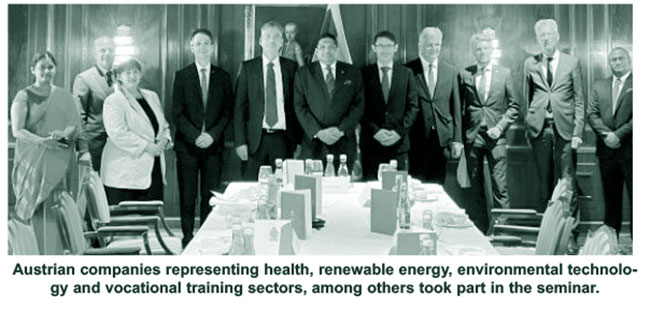
The Embassy and Permanent Mission of Sri Lanka in Vienna in collaboration with the Vienna Chamber of Commerce (WKO) organized a hybrid webinar to promote investment from Austria to Sri Lanka.
The hybrid webinar was attended by Regional Manager for Asia & Pacific Region Johannes Brunner, Commercial Attaché of the Austrian Embassy in India Bernd Andersson together with Austrian companies while Chairman of the State Pharmaceuticals Corporation of Sri Lanka Prasanna Gunasena, Executive Director of Investment Promotion Prasanjith Wijayatilake, Director of Investment Promotion Nilupul de Silva, Head of Ecosystem of the Board of Investment of Sri Lanka Darshan Maralanda, Deputy Director of Export Development Board of Sri Lanka Udeni Wijekoon, and officials from the Foreign Ministry took part in the event virtually.
Austrian companies representing health, renewable energy, environmental technology and vocational training sectors who are keen to invest in the region, particularly in Sri Lanka were selected by the Vienna Chamber of Commerce. The said companies were namely Odelga Med Engineering GmbH, AME International GmbH, Med-El Elektromedizinische Geräte GmbH, VAMED Engineering GmbH. VACE Systemtechnik GmbH, M-U-T Maschinen-Umwelttechnik-Transportanlagen GmbH and Global Hydro Energy GmbH.
The Ambassador and Permanent Representative of Sri Lanka to Austria Majintha Jayesinghe welcomed the participants by stating that Sri Lanka has set an ambitious plan to facilitate investments that can have a transformative impact on the economy. The Government is doing its utmost to create an enabling environment to attract more investments. The Ambassador emphasized that special relations between Sri Lanka and Austria have grown exponentially covering a multitude of areas with mutual benefits and called on everyone to join this transformative journey by investing in Sri Lanka.
Regional Manager for Asia & Pacific Region from the Vienna Chamber of Commerce Johannes Brunner highlighted the importance of the webinar to further expand the cooperation between the two countries. It was also pointed out that potential investments from Austria are focused in the fields of renewable energy, pharmaceutical industry and vocational training. It was further highlighted that Sri Lanka needs to develop projects that could attract these investments especially during the Covid pandemic. The participants also expressed their willingness to facilitate the request to procure high quality medicines from Austria to Sri Lanka.
Prasanjith Wijayatilake provided a detailed brief on emerging investment opportunities. Sri Lanka is a vibrant destination with over 1,200 foreign companies engaged in various economic sectors including IT services, tourism, food processing, logistics, education and large-scale infrastructure. It was further stated that Sri Lanka is on the right track to achieve a 5-7% GDP growth rate in the next decade based on a knowledge-driven economy. The Executive Director explained the conducive investment climate with new policies and tax incentives. The briefing also focused on five priority sectors to drive FDIs, namely manufacturing, ICT, hospitality and tourism, agriculture and food processing, construction and infrastructure. The BOI Executive Director also elaborated on the newly created specialized economic zones for pharmaceutical and textile items in Hambantota and Batticaloa.


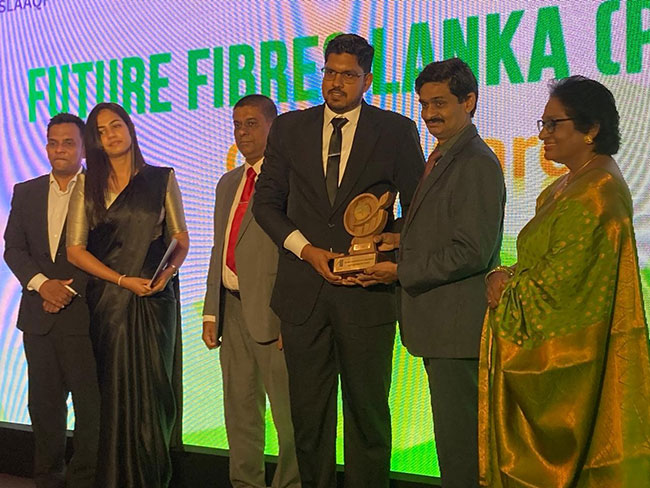
While the corporate world celebrates the merger of efficiency and ecology, a leading academic last week issued a sobering warning: the very technology driving the next “Green Revolution” may leave the human workforce behind.
Speaking at the recently concluded Green Productivity Awards, organised by the Sri Lanka Association for the Advancement of Quality and Productivity (SLAAQP), Professor Hiran Amarasekera of the University of Sri Jayewardenepura characterised Artificial Intelligence (AI) as a “godsend” for environmental sustainability – but one that carries profound social risks.
Professor Amarasekera’s keynote address cut through the celebratory atmosphere, targeting a perceived complacency among top-tier management.
“Managers are already using AI, but many CEOs, directors and managing directors remain sceptical,” he observed. “They think AI will come in another five years. No, it is already here.”
According to the Professor, AI is no longer a futuristic concept but a functional tool currently revolutionising green metrics. He highlighted how the technology is already replacing manual monitoring for energy optimisation, using predictive algorithms to drastically reduce industrial waste, and automating sustainability reporting – turning months of consumption data analysis into a task of mere seconds.
While these advancements provide a massive boost to the “bottom line” and help organisations meet the national Net Zero pledge, Prof. Amarasekera warned of a looming “danger”: the displacement of human workers.
“AI is boosting productivity while cutting back the need for human resources. What will happen to the jobs and the wider society? Not even the USA or other advanced economies have an answer to this,” he noted.
In a moment that elicited both laughter and reflection from the audience, he touched upon the irony of modern higher education: “Students produce their work through AI and we detect plagiarism through AI. So, with AI around, hardly anyone does any real work!”
The technological warning was balanced by the moral urgency of Senior Professor Ajith de Alwis from the University of Moratuwa. Invoking the words of David Attenborough, Prof. de Alwis asked the audience how they would look into the eyes of their grandchildren if they knew of the world’s collapse and did nothing.
The takeaway message of the evening was clear: While AI provides the tools to save the planet, human leadership remains the only force capable of managing the social consequences of that salvation.
Despite the warnings of future challenges, the SLAAQP awards proved that Sri Lankan industries are currently making notable strides. The event recognised 38 organisations – including 28 Gold Award winners – across sectors ranging from plantation, garments and rubber to poultry and textiles.
These winners were evaluated on four critical pillars: Leadership, Environmental Sustainability, Productivity Enhancement and Social Contribution.
By Sanath Nanayakkare
Steps into a critical void to earn recognition in international markets
For decades, Sri Lanka has been globally revered as the “Island of Gems,” yet the industry has long grappled with a paradoxical challenge: while the Sri Lankan soil yields the world’s finest stones, the local certification process has often struggled to command the same recognition in international markets.
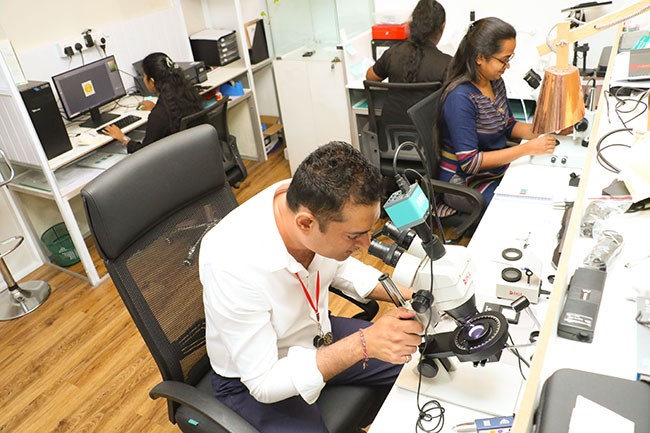
Stepping into this critical void is the Gemological Report of Ceylon (GRC). Located at No. 97, Galle Road, Colombo 3, this newly launched laboratory is on a mission to redefine the standards of local gem certification, ensuring that the “fatherhood” of Sri Lankan gemstones remains firmly within its home soil.
Founded by Milinda Edirisinghe, a seasoned gemologist with over 20 years of experience in mining, trading, and geological study, GRC is the result of a lifelong observation of the industry’s “trust gap.”
“I saw a critical disparity,” says Edirisinghe, who received specialised training in Thailand, the global hub for gemstone treatments. “Sri Lankan exporters often face unfair skepticism in markets like Thailand, Hong Kong, and the US. International buyers often view local reports with doubt. I launched GRC to provide a local institute that is on par with the highest-caliber laboratories in the world.”
He made these comments while speaking to media at the new laboratory.
According to him, in its first month of operation, GRC has already seen a surge in demand, processing 30 to 40 stones daily – a success driven largely by its word-of-mouth reputation.
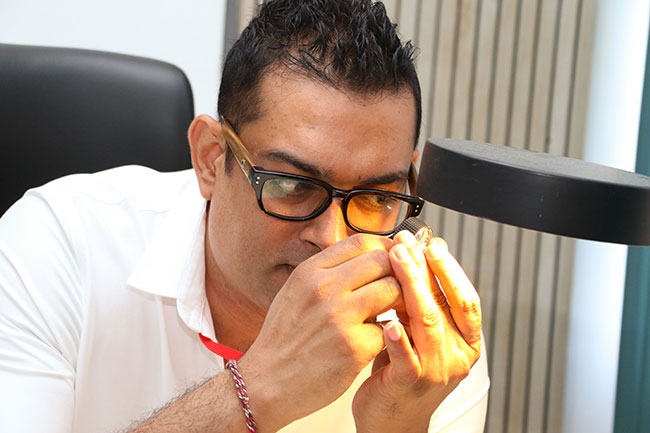
Milinda Edirisinghe performs a sensory inspection of a gemstone using a loupe to assess its initial characteristics
“The lab’s rapid growth is built on a foundation of total transparency. Unlike traditional setups, GRC employs a rigorous triple-blind screening process: three independent gemologists evaluate each specimen – from Sapphires, Ruby and Emeralds to semi-precious stones, polycrystals, rare meteorites, and even organic materials like natural Pearls, and rare coral species etc., used in high-end jewelry. By evaluating the stones without consulting one another, the three gemologists’ independent findings are then synthesised into a final, authoritative and error-free assessment,” he explained.
“As gemstone treatments become increasingly sophisticated – ranging from Beryllium diffusion to evolving heat and irradiation treatments – the need for advanced technology is paramount. GRC’s facility is equipped to identify the full spectrum of enhancements, ensuring the end consumer knows the exact “human intervention” history of their asset,” he further said.
However, Edirisinghe maintains that technology is a tool, not a replacement. When asked if AI could eventually handle the certification job alone, he noted:
“AI already assists our workflow to an extent, but a human gemologist remains an indispensable part of the process. Just as a surgeon uses advanced technology to enhance precision, they must still be present to execute the nuances of a complex operation. AI cannot truly ‘see,’ touch, or feel the soul of a stone.”
He further added, “AI can support our findings, but it cannot replace the gemologist’s ‘eye-view’ and the tactile senses that go a long way in issuing an accurate certification.”
Furthermore, GRC leverages an international expert network. “If we encounter a complex inclusion, we utilize virtual screen-sharing with leading labs in Thailand for real-time peer review,” Edirisinghe explains. “Our conclusions are science-based facts, not just opinions.”
Beyond technical excellence, GRC serves a vital economic purpose. Historically, local dealers spent thousands of dollars obtaining international certificates. GRC offers these world-class reports at a fraction of the cost, with detailed certificates starting from LKR 15,000 for full reports, a medium report at LKR 6,000, “memo cards” at LKR 1,500, and verbal opinions for LKR 500.
“By providing a credible, globally-recognised home-based laboratory, we are stemming the outflow of foreign currency to international labs,” said Edirisinghe.
With plans to participate in upcoming exhibitions in Dubai, Hong Kong, and the USA, GRC is positioning itself as a global contender. As the industry shifts toward “knowledgeable customers” who view jewellery as a liquid asset, GRC stands ready to provide the clarity and integrity the Sri Lankan gem industry deserves.
“If Sri Lanka produces the best stones in the world, it is only right that we also provide the world-class expertise to certify them. Our mission is to ensure that the ‘fatherhood’ of these precious stones remains in Sri Lanka, backed by a certificate that is respected from the USA to the European Union,” Edirisinghe said in conclusion.
By Sanath Nanayakkare

Sri Lanka’s retail landscape will reach a major milestone with the launch of Ministry of Brands (MOB), the country’s first off-price retailer. The flagship store is set to open on 16 February 2026, introducing Sri Lankan consumers to authentic global luxury and premium brands at discounts of up to 90% off original retail prices.
Backed by Akbar Brothers, Ministry of Brands brings the globally established off-price model to South Asia for the first time. The concept allows customers to shop for genuine designer and brand-name products at significantly reduced prices while supporting more sustainable retail practices.
The 10,000 sq. ft. flagship store, located at 28/9, Vajira Road, R.A. De Mel Mawatha, Colombo 4, will feature an extensive range across apparel, footwear, handbags, accessories, homeware, and more. Ministry of Brands will carry over 2,000 international and designer brands spanning womenswear, menswear, childrenswear, home, and accessories, including names such as Gucci, Ferragamo, Valentino, Michael Kors, Ralph Lauren, Burberry, Rag & Bone, Lacoste, Puma, UGG, HOKA, Brooks, Air Jordan, and many more.
Off-price retail is one of the fastest-growing global retail segments, helping fashion houses responsibly manage excess inventory. With the UN Environment Programme estimating 92 million tonnes of textile waste generated annually, sustainable retail models such as off-price are increasingly important.
“Sri Lanka manufactures for many of the world’s leading designer labels, yet these products have often remained out of reach for local consumers,” said Director of Ministry of Brands, Aamir Akbarally. “Through off-price retail, we are proud to make genuine designer brands more accessible to our fellow Sri Lankans, offering premium fashion at affordable prices while delivering a world-class shopping experience built on Akbar Brothers’ longstanding values of integrity, quality, and trust.”
Ministry of Brands Director, Ramzey Hammoud added: “With decades of experience in off-price retail, we see this as an exciting new growth chapter for Sri Lanka’s retail landscape. Our goal is simple: to allow customers to shop global designer brands locally at the best prices, while rediscovering the thrill of the find through a constantly changing, treasure-hunt shopping experience.”
Following the Colombo flagship launch, Ministry of Brands will open a second location at the One Galle Face Mall, with plans to expand across South Asia and Australia.

New Zealand eye Super Eight spot against Canada

Pathirana under injury cloud as he leaves the field early

Kusal Perera in as Sri Lanka bowl; Marsh returns for Australia

Jacks the star as England qualify for Super Eights with nervy win

Navy seizes 02 Indian fishing boats poaching in northern waters

Ramadan 2026: Fasting hours around the world

‘Dates have the highest sugar content to fight Coronavirus’

Sunday Island 27 December – Headlines

#SundayIsland 17th December – Headlines

Sunday Island – 28th March

Sunday Island Headlines – 21 March

Sunday Island – 21st February – Headlines
-
 Life style2 days ago
Marriot new GM Suranga
-

 Features2 days ago
Monks’ march, in America and Sri Lanka
-

 Midweek Review6 days ago
A question of national pride
-

 Business6 days ago
Autodoc 360 relocates to reinforce commitment to premium auto care
-
 Opinion5 days ago
Will computers ever be intelligent?
-

 Business17 hours ago
Ministry of Brands to launch Sri Lanka’s first off-price retail destination
-

 Features2 days ago
The Rise of Takaichi
-
 Features2 days ago
Wetlands of Sri Lanka: