
Features
Efforts to improve things in university sector: More money poured down the drain?


Lee Kwan Yew thought downgrading English main reason for our downfall
In congratulating you on this latest initiative ( launch of Logos, the journal of the Department of Languages), I should add that I am deeply honoured by this gesture on the part of the University and the Faculty, to make this first issue a felicitation volume for me. It was also thoughtful of you to have invited Dr Chitra Jayatilleka to deliver the keynote address today, since she represents what is best about what I consider my other university, that of Sri Jayewardenepura.
I cannot take credit for her achievements, though she would be the first to recognize that, had it not been for the system I put in place at that University, she would not be here today. Her achievements are ample testimonial, as are those of your staff here, to the validity of our decision then to open up English degrees to those who had not done English for their Advanced Levels. And though I did not stay long at that University, I was lucky in that, just as in this University, I was able to recruit excellent staff who took forward my ideas and, as with Chitra and her promotion of Sri Lankan drama in English, developed new ideas on similar lines.
I am immensely proud then of what I managed to do at that university and this one, and of the students who have taken things forward. But with regard to the University of Peradeniya, where I began my teaching career, way back in 1980, since I made no mark at all, I cannot take pride in my brief stint there. But even had I stayed on, perhaps I would not have achieved much, since one of the brightest stars in the English academic firmament, Prof Arjuna Parakrama, who is very different from me in his approach but who shares a similar commitment to students and to productive change, has confessed himself beaten by the place. Having long aspired to the Chair there, he remarked after he had got it that it was even worse than Colombo.
Be that as it may, the point is that, though there are exceptions at both places, those institutions are hidebound in moribund traditions, and like Pope’s Addison simply sit attentive to their own applause. This is very different from the University of Sri Jayewardenepura, which Prof Arjuna Aluvihare, the best UGC Chairman to date, described soon after I joined it as the cutting edge of the university system.
Much has been achieved there, and much at this University. However I come here now at a time when there is a requirement of much more, if this country is ever to return to the leading position it had when the Prime Minister of Singapore hoped that he could bring that country to our level. And I fear that the current project to improve things in the University sector, more money poured down the drain to repeat what has been done again and again, from the year 2000 onward when the irksome IRQUE project first reared its head, money that future bankrupted generations will have to repay, will achieve very little. And that will then allow the World Bank and its cookie-cutting educationists to embark on yet another expensive project, with much more money having to be paid back by those who lack the skills to develop the country productively, and as a consequence try to get away as soon as possible.
Perhaps because of the comfort zone these World Bank projects have engendered, there is nothing of the imaginative radicalism that characterized the period when Arjuna Aluvihare was in charge. And so I feel that, while what I think of as both my institutions try to move forward, they work now in grooves, and do not promote the seminal change which we need.
This is particularly important with regard to English, the downgrading of which as you know Lee Kuan Yew thought the principal reason for our downfall. And that we get worse and worse was brought home to me forcefully when a former senior public servant, now engaged in teaching at higher levels, called to tell me he was in despair about the incapacity of students at one of the premier institutes of management to write correctly. Subject-verb agreement, he said mournfully, was unknown to them. I too, having marked papers recently for your potentially useful MA course in English and Education, which takes up what I tried to do a quarter of a century ago, I am horrified by the English usage of some of those supposed to have degrees in English.
That set me thinking about what might have been, and I make no apologies that what I have to say relates to my own initiatives. For though I can be happy about what I began in the university sector, for that has continued, with many more students able to obtain degrees in English as compared to when it was confined to a charmed circle coming from elite urban schools, I have to confess that my efforts in other areas, secondary education and vocational training, have failed.
The step by step teaching of English envisioned in the curriculum I introduced when I chaired the Academic Affairs Board of the National Institute of Education was promptly abolished when a new Chairman was appointed following a change of government in 2006. He cannot be blamed for the mess except for his failure to impose coherence. But when the dead souls of the NIE took charge, and appointed to advisory positions their incompetent friends, we had a spate of silly books which have completely failed to ensure understanding of basic structures in English.
It is true English medium still continues in government schools but, ever since the current President refused soon after we had commenced it to allow Karunasena Kodituwakku to extend my appointment to run the programme, standards declined, and in place of the systematic training and the excellent textbooks I had initiated, the incompetence of the Ministry and the National Institute of Education hold sway. And as for Vocational Training, the system I put in place to offer English courses at all levels was abandoned, and while Ministers bleat about the need for more English, they do nothing constructive about it.
I have no doubt that nothing will now be done to make things better, but it might help if the universities at least took these problems seriously, and addressed themselves to identifying issues and suggesting remedies.
This was something I proposed when I was briefly State Minister of Higher Education, namely that there should be coherent research done by each university, instead of what we now have, projects chosen at random which cannot then be connected together to improve current practice in different fields.
I wonder now how many Vice-Chancellors, then or now, have any memory of what I proposed, that there should be concerted study of problems in the Divisional Secretariats that formed the catchment areas of each university, so these could contribute to a development plan which the universities could propose to authorities. Heaven knows that this is needed, when currently development funds are devoted to enhancing political popularity, not to development.
I also tried, when I was Minister, to address coherently another problem, though to my horror no one else seems to consider it a problem. I refer to the massive waste of time imposed by our education system. At its most obvious, whereas in other countries there is seamless movement from one level to another, we call a halt after the Ordinary Level examination, which means that our youngsters lose a minimum of four months of their lives, though more often it is six. Worse, the practice of learning in school is totally decimated, a process that had begun earlier with tuition classes from childhood, but now parents have no choice except tuition to keep children gainfully – or not gainfully – employed. Then there is massive waste after the Advanced Level Examination and, though some universities have tried to start soon after results are released, this is exceptional and in any case the release of the results only occurs months after the examination.
This needs to be addressed by reducing the delay, but until that happens there should be measures to use the time productively, with for instance remedial courses in English and Mathematics in Divisional Centres in the three months after the Ordinary Level, with basic core courses such as any modern university system offers in the period after the Advanced Level – Critical Thinking, Bilingualism, Communication Skills, International Awareness.
Interestingly, I was told by one of the MA students, who works for the American Centre, that she plans a Critical Thinking Conference early next week, which suggests that there is wider awareness of the problem. Coincidentally too, in the articles I am now writing about those I have worked with in the university sector, I have explored recently the range of core courses we introduced when this university first took in students for degrees, way back in 1997.
But sadly I believe that particular component was dropped from your curriculum when Sabaragamuwa too forgot the innovations its first Vice-Chancellor Prof Somasundara initiated. All of you will remember how the University Grants Commission tried over many years to destroy the three year Honours Degree Somasundara had started, and how finally they succeeded when conservatism briefly held sway here. So we too waste the resources of the nation, and make no effort to provide essentials for life to our students, working instead to a notion of academia that the world has long abandoned.
But let me move to some practical ideas, for I should not go on for too long, based on something I noticed in the latest Grade 11 English textbook. That at least is not full of misprints, as had been the case earlier, but it continues the practice of being one of a set of three books, all expensively produced, a Pupil’s Book, a Workbook, and a Teacher’s Guide. In other countries there is just the one book, but those other countries have not developed to a fine are the rent-seeking our system has engendered.
The last chapter is about ‘Choices in Life’ and tells you what five students want to do. All of them talk about what they wish to do at university and therefore what they will study for their advanced levels. There are three Sinhalese and one Muslim and one Tamil, and they come from Batticaloa, Kurunegala, Galle, Anuradhapura and Nuwara Eliya.
Admirable diversity, except that rural students do not figure. Even worse is the fact that there is no conception of the real choices students in this country have to make, and no effort to introduce them to vocational training.
Perhaps these and other such books would be suitable subjects for research for student projects at universities. A class of English students could divide the work up and, having gone to several schools in a designated area, find out how much students have learnt, both of English and what appear to be the life skills drilled into them in almost all lessons, what they think of the reading texts and the poetry, and above all what they actually need for their futures.
Surely they do not need flatulent knowledge, already done to death in history textbooks from Grade 1 onward, about kings who built tanks, including Agbo 1 and Agbo 2, particular favourites of the National Institute of Education? There is hardly anything about the former in Wikipedia, except that he reigned for 34 years in the sixth century and was succeeded by his nephew. But the Wikipedia entry for Agbo 2 had different dates for his reign, though doubtless it is considered essential to know in the 21st century that he built the Kantale and Giritale tanks. Perhaps you too will remember that, even if you forget everything else I said, since that it seems is what our current administrators want our students to know.
Finally, may I suggest that those who have studied English here or at Sri Jayewardenepura set up a ginger group to urge reforms in the field? There are several products of the initiatives of the nineties who have done great jobs wherever they are, Dean Abeyweera at Uva Wellassa, Nandana Balasooriya who did so much for English at the Department of Technical Education and Training, Shashikala Assella who heads the Department of English at Kelaniya, to name just a few. You can make suggestions as to curriculum reform, the production of common materials, the introduction of community service centres to provide services to students in deprived areas.
You can produce a newsletter about best practices in the field, to disseminate for instance amongst the teachers who are on your training programmes. And most important, you can initiate through the universities Certificate courses, of three months duration, for English and perhaps Computer competence too, based on the three month courses developed a few years back with the support of the Skills Councils of the Tertiary and Vocational Commission.
I am grateful for this Festschrift, an honour I associate with venerable old age and, though I am not quite seventy, this is a sort of seal on my academic career. But having in a sense abandoned academic approaches half a life ago, I would also suggest that an even more fitting tribute would be aids to action which I believe several of you can help to get going. That, I hope, is what most of you would like to be remembered for, and what your teachers, including the indefatigable Paru Nagasunderam would expect, a continuation of student centred initiatives.

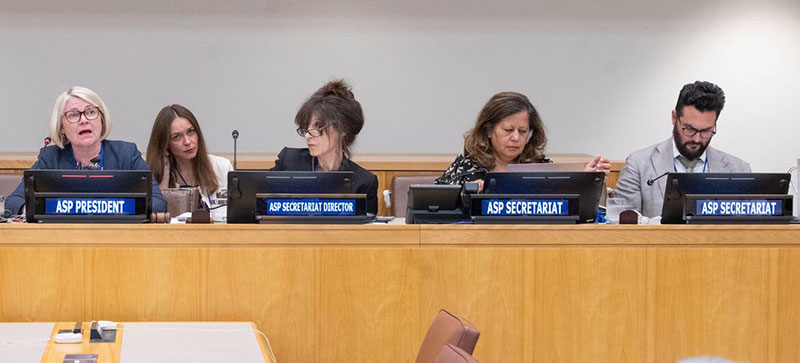
 US Secretary of State Marco Rubio’s warning to the International Criminal Court (ICC) was stark: ‘Either the ICC will end its threats, or we will end the ICC.’ It followed US central administration accusations that the court was unfairly targeting Americans on the basis of trumped-up war crimes charges.
However, a new plethora of sanctions has been clamped on the ICC by the US, which in turn has spurred accusations by sections of the world that the latter has unleashed an ‘assault’ on the international legal order.
What some of the sanctions would mean for the ICC was outlined by Rubio: ‘We will ban transactions with this rogue court, cutting off their resources and crippling their ability to operate against us.’
The ICC has shown consistency of purpose over the years. Despite some operational constraints it has indicted a large number of political strongmen from around the world, accused of war crimes and other governance excesses that come under its purview. Two such recent figures are: Russian President Vladimir Putin and Israeli Prime Minister Benjamin Netanyahu.
Rather than enjoy a mere nominal presence in the world community, the ICC has proved its effectiveness by detaining and bringing to justice scores of VIP politicians and others of their ilk who have been found guilty of human rights abuses and kindred excesses that come within the terms of reference of the ICC.
Accordingly, the international justice system would be stymied considerably as a result of the ICC being dis-empowered, particularly financially. Needless to say, potential and real perpetrators of the species of crime coming under the jurisdiction of the ICC would stand to gain most from such anarchic tendencies. That is, political repression globally would be enabled to enjoy a new lease of life.
A detailing of the types of crime coming under the purview of the ICC provides an idea of what it would cost the international community if the ICC’s operations are gravely hampered. They are mainly: genocide, war crimes, crimes against humanity and the crime of aggression.
That is, the part of the world to be worst affected would be the global South, since the latter is awash with the mentioned crimes. Needless to say, a chronically-disaffected South will sooner rather than later undermine the well being of the world dangerously. The world is already being put through these paces.
At the time of writing, ‘illegal migrants’ from the South, for example, are aggravating many a Western economy’s woes, besides creating for them acute law and order issues. The fact that these migrants’ presence goes on to become a virtual test of the migrant receiving states’ ability to forge domestic social inclusion in the face of jingoistic protests by mainly white supremacist groups is evidence of the latter. As is known, the US, to take just one example, has been up against this crisis for quite a while.
Accordingly, it will be in the best interests of the West if ‘illegal’ migrant arrivals on their shores are stemmed. If the socio-political and economic problems assailing the South are effectively managed through North-South collaborative, ‘trouble-shooting’ efforts the causes leading to ‘illegal’ migration and connected issues could be resolved at source as it were. For, it is the aggravation of the South’s material questions that lays the basis for the emergence of repressive and anti-democratic regimes in the hemisphere.
Until such time that the aforementioned issues in North-South relations are visited afresh and addressed urgently, a vibrantly functioning ICC would be needed. For, the latter would prove a deterrent to Southern political and military strongmen, highly prone to power abuse and like excesses, from coming into being in the wake of the South’s chronic material woes and the wars and conflicts that result from them.
It stands to reason then that the US would be acting in its own interests by enabling the ICC to perpetuate its mandate without hindrance. For a crop of issues that impinges negatively on internal law and order would be defused.
Meanwhile, there needs to be a meeting of minds among the rest of the West to put back in place a North-South dialogue process aimed at reducing some of the economic pressures that are weighing on the South.
Since economics usually drives politics it will be in the interests of the world community to scrutinizingly re-visit North-South issues of the past and put in place economic relief packages for Southern publics that would enable them to tide over their material hardships rather than permit the latter to aggravate into social disaffection and eventually armed militancy. It is the latter juncture that paves the way for the emergence of authoritarian rulers in the South who then go on to be a blight on their publics.
Accordingly, the Southern-based global development thinking of the past that envisaged a more equitable world economic order needs to be seen as an urgent need. That is, NAM’s international development paradigms need to be resuscitated to the extent possible.
It is unlikely that rightist governments of the West, such as the current Republican administration in the US, would find these projects feasible, but democratic states of Europe, led by perhaps the UK, are likely to think otherwise. For it would not be beneficial for the democratic world to be having on their hands repressive governments in the South who would be gravitating towards the major military and economic actors of the South, such as Iran and North Korea, who tend to be in constant power struggles with the West.
However, until such time that the mentioned, pro-people initiatives are given serious thought the ICC would need to be enabled by the international community to be in place comfortably and carry on with its mandate of bringing repressive rulers to book. Besides the ICC should pave the way for the peoples of the developing world to enjoy some substantial respite from the political repression and even terror which tend to be their lot.
Meanwhile, the wars of West Asia are relentlessly aggravating the economic hardships of people everywhere, driving the point home to enlightened sections that there is no alternative to peacemaking. A challenge is to convert the US under President Trump to this line of thinking.

 This week, I give you five simple, time-tested homemade remedies that help reduce the appearance of blemishes, control excess shine and leave your skin feeling softer and smoother.
The Honey and Lemon Brightening Dab:
For stubborn blemish marks, this is a classic. Mix one teaspoon of pure bee honey with three to four drops of fresh lemon juice. Apply gently, only on the affected spots, and leave for 10 minutes before rinsing with lukewarm water. While honey soothes and softens, lemon helps to brighten naturally. Use twice a week in the evening.
Besan and Rose Water Oil-Control Pack:
An ideal remedy to combat shine, especially on the T-zone. Take two teaspoons of besan (gram flour) and mix with sufficient rose water to form a smooth paste. Add a pinch of turmeric for its antiseptic goodness. Apply evenly, keep for 15 minutes and wash off. It absorbs excess oil without over-drying, leaving a beautiful matte finish.
Aloe Vera and Cucumber Ice Soother:
Blend fresh aloe vera gel with the juice of a grated cucumber and freeze the mixture in an ice tray. Each morning, wrap one cube in a soft muslin cloth and gently rub over a cleansed face for 30 seconds. It calms, tightens pores and imparts a baby-soft smoothness.
Oatmeal and Curd Gentle Polish:
Roughness and old blemish marks need gentle exfoliation. Combine one tablespoon of finely powdered oatmeal with one tablespoon of fresh curd (yoghurt). Massage very gently, in circular motions, for one minute, leave for five minutes and rinse. It removes dead cells and unveils softer, clearer skin.
Multani Mitti and Green Tea Magic Mask:
Brew some green tea and allow it to cool completely. Mix one and a half teaspoons of Multani Mitti (Fuller’s Earth) with the tea water to make a fine paste. Apply for 10 to 12 minutes – do not let it dry and crack completely – and wash off. It draws out impurities, fades blemishes and bestows a fresh, shine-free glow.
A Gentle Reminder:
As with any natural remedy, always do a patch test on your inner arm first. For those with oily or combination skin, avoid heavy coconut oil application and harsh scrubbing, as they tend to aggravate shine and blemishes.

 Dream of performing on a world stage? Well, here is your unique, golden opportunity!
The World Championships of Performing Arts (WCOPA) — the one and only official “Talent Olympics” — is the world’s premier global platform for aspiring singers, dancers, actors, models, instrumentalists, etc., to compete, shine and be discovered!
And, yes, this world stage is open to YOU, Sri Lankans living in Sri Lanka and overseas!
Held annually in glittering Las Vegas, WCOPA brings together over 70 countries, all competing for Gold, Silver and Bronze Medals, just like the traditional Olympics.

Lakisha Bernard: Will represent Team Sri Lanka at WCOPA 2027
Outstanding performers vie for the coveted titles of Junior and Senior Grand Champion Performer of the World, with winners and standout participants awarded over $500,000 in scholarships, cash awards and prizes to catapult their education and careers!
Sri Lanka is already making waves! At WCOPA 2026, Natharie Wickramasinghe, representing Team Sri Lanka, made the nation proud by winning a Bronze Medal in the Ethnic/Folklore Dance category!

Lakisha: Accomplished freelance Model and Fashion Design graduate
Recruitment for this prestigious competition is handled through a system of scouts and licensed National Directors — and this is where our very own Chris Rajendra, now based in Las Vegas, and National Director for Team Sri Lanka, comes into the scene.
If you are a singer, dancer, actor, model, instrumentalist — if you have talent burning inside you — contact Chris Rajendra today for registration and, who knows, you may find yourself in Las Vegas, and proudly draped in the Sri Lankan flag, at WCOPA 2027!
The contact address is: Chris Rajendra, wcopa.nationaldirector.sl@gmail.com
or chris.rajendra@gmail.com
Meanwhile, a star is born for 2027, in the form of Lakisha Bernard who is all set to represent Team Sri Lanka at WCOPA 2027.
Originally hailing from the sun-drenched coastal city of Colombo and now carving out her creative career in Canada, 22-year-old Lakisha is stepping into the international spotlight.
This accomplished freelance Model and Fashion Design graduate has officially been appointed as the Team Sri Lanka Promoter for Canada as she prepares to represent Team Sri Lanka at WCOPA in Las Vegas.
Lakisha brings a unique blend of high-fashion sensibility, captivating camera presence and expert garment design to the Team.
Having built her career, from local college shoots to high-glamour concepts, Lakisha’s inspiring journey embodies the true spirit of cultural bridge-building and creative resilience, bringing immense pride and recognition to Sri Lanka on the global stage.
WCOPA 2027 will be held at the legendary Westgate Hotel & Casino, Las Vegas, from 12th to 20th July – the very same iconic arena where the late, great Elvis Presley himself performed!
Your moment is now. Your stage is Las Vegas, so hurry and contact Chris Rajendra.

AgriConnect Sri Lanka’ to be launched on 30 October to Modernise the Agricultural Sector Through Digitalisation

57th Annual Saints’ Quadrangular Tournament on Saturday and Sunday

Showers or thundershowers will occur at most parts of the island

Prison rules to be revised over monks’ attire

AC President recuses himself from hearing prison attire case pertaining to Gnanasara Thera

Court orders steps to obtain INTERPOL Red Notice against Basil

‘Dates have the highest sugar content to fight Coronavirus’

Sunday Island 27 December – Headlines

#SundayIsland 17th December – Headlines

Sunday Island – 28th March

Sunday Island Headlines – 21 March

Sunday Island – 21st February – Headlines
-

 News7 days ago
NDB fraud Rs 60mn more than reported
-

 News7 days ago
Removing monk’s robes matter for Sangha to decide: Mahanayake Theras
-
 News6 days ago
NPP govt. reminded of its responsibilities as US warship leaves Colombo
-

 News5 days ago
Sri Lanka escalates anti-graft drive with Shiranthi’s jailing
-
 Latest News6 days ago
Farhan, Sadaqat help Pakistan ace 183 chase to go 1-0 up
-
 News7 days ago
BHC, Colombo: “LTTE remains a proscribed org. in the UK”
-
 Latest News4 days ago
Farhan and Sadaqat help Pakistan seal series in style
-
 News5 days ago
Iranian ships stranded, Lanka fears US sanctions