
News
Easter Sunday carnage: Gotabaya denies Cardinal’s claims

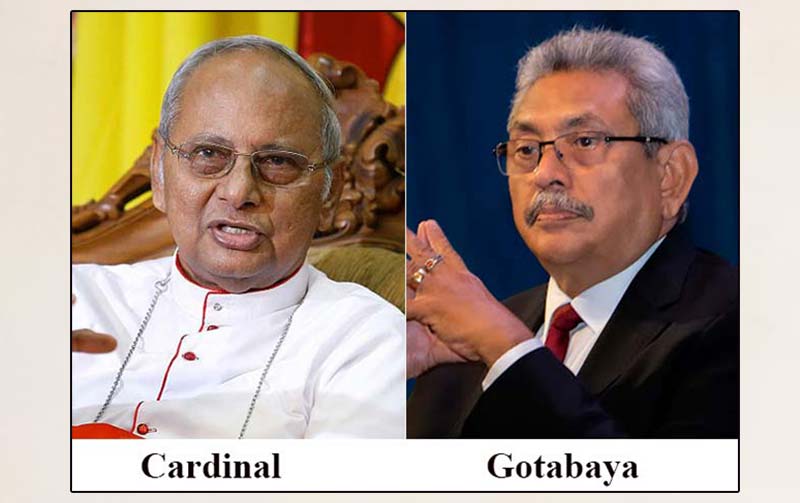
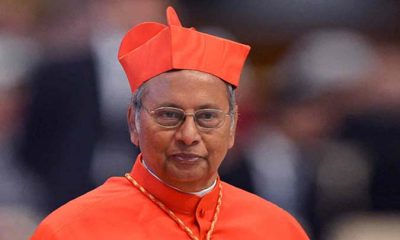
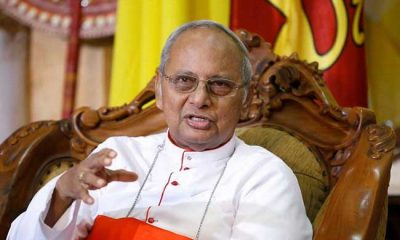
Former president Gotabaya Rajapaksa on Thursday (25) issued a press statement denying several allegations made against him by Archbishop of Colombo Cardinal Malcolm Ranjith in respect of the Easter Sunday carnage probe. “It is a well-known fact that the Muslim community in general did not vote for me or support my candidacy at the Presidential election, so I cannot possibly have had any allies in any organisation that would need to be banned over complicity in the Easter Sunday attacks,’’ he said.
Given below is the press release in full: “At an event held to mark the fifth anniversary of the Easter Sunday suicide bombings, His Eminence Malcolm Cardinal Ranjith made the following allegations against me.
“• That the day after the report of the Presidential Commission of Inquiry on the Easter Sunday attacks was handed over to me, I had spoken to the Cardinal over the phone and said that I had difficulties in implementing the recommendations in that report as it would entail the arrest of individuals and even the banning of organisations that were supportive of me.
“That I had delayed giving the Cardinal a copy of the first volume of the Presidential Commission report and that I had not given him the remaining volumes.
“That I had appointed a six-member cabinet sub-committee to selectively implement only a few of the recommendations made by the various Committees and Commissions appointed to inquire into the Easter Sunday attacks.
” • That I had transferred the CID officers investigating the Easter Sunday attacks and even imprisoned one such senior officer in order to sabotage the investigation.
“With regard to the first allegation, I categorically state that I did NOT speak to the Cardinal over the phone after the Presidential Commission report was submitted to me and tell him that the recommendations of the Presidential Commission could not be implemented because that would entail the arrest of people and even the banning of organisations allied with me.
It is a well-known fact that the Muslim community in general did not vote for me or support my candidacy at the Presidential election, so I cannot possibly have had any allies in any organisation that would need to be banned over complicity in the Easter Sunday attacks.
“As for the second allegation, the report of the Presidential Commission was handed over to me on 1 February 2021. Having studied it myself and referred it to the Attorney General, it was handed over to the Speaker of Parliament on 23 February 2021 and by 1 March 2021 copies had been given to the Venerable Mahanayaka Theras, the Cardinal and the Catholic Bishops. There was no delay in handing over the report to the Cardinal.
“After the Presidential Commission of Inquiry submitted its report, I appointed a six-member Cabinet Sub-committee to prioritize and apportion to the relevant government departments and agencies the task of implementing the recommendations in the reports of the Presidential Commission of Inquiry and the Select Committee of Parliament on the Easter Sunday attacks.
Those familiar with public administration will know that the departments and agencies of the government cannot act without such instructions from the Cabinet.
“In November 2019 the then Director of the CID was transferred by the Police Commission on the recommendation of the then IGP. That was by the Police Commission appointed under the 196 Amendment by the previous government.
A few weeks later this officer was interdicted by the Police Commission over an investigation into the leaked recordings of his telephone conversations with the then Deputy Minister Ranjan Ramanayake regarding the influencing of judges in an ongoing High Court case. Several months later, he was remanded by the Courts over an investigation into the alleged fabrication of evidence in a criminal case concerning a former police DIG. Hence, I reject the allegation that I transferred the CID Director and even placed him in remand custody in order to sabotage the Easter Sunday investigation.
“This particular CID Director had been appointed to that office in 2017 and he continued to hold that position for over seven months after the Easter Sunday attacks. In the months prior to the Easter Sunday attacks, it was the CID that investigated the Vavunativu murders, the vandaliing of Buddha statues in Mawanella and the discovery of explosives in Wanathavilluwa involving the very same individuals and groups that perpetrated the Easter Sunday attacks.
The Presidential Commission has observed that if the law enforcement authorities had been more vigilant, Zaharan and his group could have been apprehended before the Easter Sunday attacks took place. The failure to prevent the attack was a failure of the CID under that Director.
“In his speech mentioned above, the Cardinal accused me of not having brought the perpetrators of the Easter Sunday bombings to justice. However, criminals have to be brought to justice not by politicians but by the police, the Attorney General’s Department and the Courts system working together. That process is now ongoing and according to the media, 93 persons are now facing legal proceedings in court for offences relating to those suicide bombings.
The Easter Sunday attacks were perpetrated by a group of Islamic extremists. The highest investigative arm of the then government – the CID – had for several months prior to the attacks, been investigating the activities of the very same individuals and groups that carried out the suicide bombings but failed to apprehend the terrorists before they struck. The public should take good note of the fact that His Eminence Malcolm Cardinal Ranjith either glosses over the responsibility of, or expressly absolves the two parties mentioned above, while continuing to relentlessly attack and criticize me over the Easter Sunday suicide bombings.”







Latest News
Heat Index at Caution Level in the Northern, North-central, North-western, Western, Sabaragamuwa, Eastern and Southern provinces and in Monaragala district


Warm Weather Advisory
Issued by the Natural Hazards Early Warning Centre
Issued at 3.30 p.m. on 15 April 2026, valid for 16 April 2026.
The Heat index, the temperature felt on human body is likely to increase up to ‘Caution level’ at some places in the Northern, North-central, North-western, Western, Sabaragamuwa, Eastern
and Southern provinces and in Monaragala district.
The Heat Index Forecast is calculated by using relative humidity and maximum temperature and this is the condition that is felt on your body. This is not the forecast of maximum temperature. It is generated by the Department of Meteorology for the next day period and prepared by using global numerical weather prediction model data.
Effect of the heat index on human body is mentioned in the above table and it is prepared on the advice of the Ministry of Health and Indigenous Medical Services.
ACTION REQUIRED
Job sites: Stay hydrated and takes breaks in the shade as often as possible.
Indoors: Check up on the elderly and the sick.
Vehicles: Never leave children unattended.
Outdoors: Limit strenuous outdoor activities, find shade and stay hydrated.
Dress: Wear lightweight and white or light-colored clothing.
Note:
In addition, please refer to advisories issued by the Disaster Preparedness & Response Division, Ministry of Health in this regard as well. For further clarifications please contact 011-7446491

The Indonesian Navy Sailing Ship KRI BIMA SUCI – 945 arrived at the Port of Colombo on a goodwill visit on 15 Apr 2026 and was welcomed by the Sri Lanka Navy (SLN) in compliance with time-honoured naval traditions.
The vessel’s arrival is a key highlight of the ASEAN Plus Cadet Sail (APCS) – 2026 programme , accompanying a diverse contingent of Navy cadets from 26 different nations alongside their Indonesian counterparts.
The ship is commanded by Commander SUGENG HARIYANTO. Meanwhile, Officer Under-trainees of the Sri Lanka Navy are expected to participate in various programmes aboard the
ship and naval personnel observe its operational functions during its stay in the island.
Furthermore, the ship’s crew is scheduled to take part in programmes organized by the Sri Lanka Navy to enhance camaraderie between the two navies, as well as visit several tourist attractions in the country.
News
PM initiates children into learning at the auspicious time while observing New Year traditional customs and rituals

The Sinhala and Tamil New Year cultural festival, organized by the Ministry of Buddha Sasana, Religious and Cultural Affairs, was held on Tuesday (14) in Gampaha under the patronage of Prime Minister Dr. Harini Amarasuriya, with the performance of traditional auspicious customs and rituals.
In accordance with tradition, during the Punya Kalaya (inauspicious time), the Prime Minister visited the Medagama Sri Sunandarama Viharaya in Gampaha and participated in religious observances and received blessings from Venerable Thunmodara Samitha Thero, a member of the Karaka Sangha Sabha of the Sri Lanka Ramanna Maha Nikaya and the Chief Incumbent of the Medagama Sri Sunandarama Dharmaduta Piriven Viharaya.
The traditional observances of the Sinhala and Tamil New Year cultural festival were held at the residence of Darshana Weerasinghe in Gampaha. Marking the auspicious time for commencing work, and upon the invitation of the host family, the Prime Minister planted a sapling within the premises. Concurrently, Minister of Buddha Sasana, Religious and Cultural Affairs, Dr. Hiniduma Sunil Senevi, and Minister of Foreign Affairs and Tourism, Vijitha Herath, joined the PM.
Subsequently, the Prime Minister joined children in engaging in traditional folk games.
At the auspicious time for engaging work and educational activities, the PM participated with children in reading and writing, guiding them and symbolically marking the commitment to advancing the educational development of the nation’s children.
Thereafter, the Prime Minister and other distinguished guests observed the traditional customs of exchanging greetings, transactions and gifts with the host family, and joined them to partake in the customary New Year meal.
Extending New Year greetings to all citizens, the Prime Minister expressed her gratitude to all Sri Lankans, both at home and abroad, for their contributions in overcoming and effectively managing the various challenges faced by the country.
Speaking at the occasion, Minister Dr. Hiniduma Sunil Senevi stated that the Sinhala and Tamil New Year festival symbolizes renewal and purity, and reflects the energy of the sun. He also conveyed his wishes for a peaceful and prosperous New Year for all.
The occasion was attended by the Deputy Minister of Finance and Planning and Minister of Labour, Dr. Anil Jayantha; Deputy Minister of Labour, Mahinda Jayasinghe; Member of Parliament for the Gampaha District, Ruwan Mapalagama; along with the Gampaha District Secretary, Mayor, Divisional Secretaries, and a large number of government officials.
(Prime Minister’s Media Division)

Babar Azam 71* helps Peshawar Zalmi extend lead at top

Trump threatens to fire Fed chair Jerome Powell if he doesn’t leave in May

Royal Challengers Bengaluru top the table after bowlers help thump Lucknow Super Giants

Showers expected in the Western, Sabaragamuwa, Southern, Central, Uva and North-western provinces

Heat Index at Caution Level in the Northern, North-central, North-western, Western, Sabaragamuwa, Eastern and Southern provinces and in Monaragala district

Pakistani army chief in Tehran amid bid to restart US talks

‘Dates have the highest sugar content to fight Coronavirus’

Sunday Island 27 December – Headlines

#SundayIsland 17th December – Headlines

Sunday Island – 28th March

Sunday Island Headlines – 21 March

Sunday Island – 21st February – Headlines
-

 News4 days ago
CEB orders temporary shutdown of large rooftop solar systems
-
 Features4 days ago
From Royal College Platoon to National Cadet Corps: 145 years of discipline, leadership, and modern challenges
-

 Business6 days ago
Israeli attack on Lebanon triggers local stock market volatility
-

 Business6 days ago
HNB Assurance marks 25 years with strategic transformation to ‘HNB Life’
-
 Latest News3 days ago
PNS TAIMUR & ASLAT arrive in Colombo
-

 News5 days ago
Anura Solomons passes away
-

 Features4 days ago
CIA’s hidden weapon in Iran
-
 Latest News3 days ago
Prasidh, Buttler set up comfortable win for Gujarat Titans