
Latest News
East Timor becomes ASEAN’s 11th member

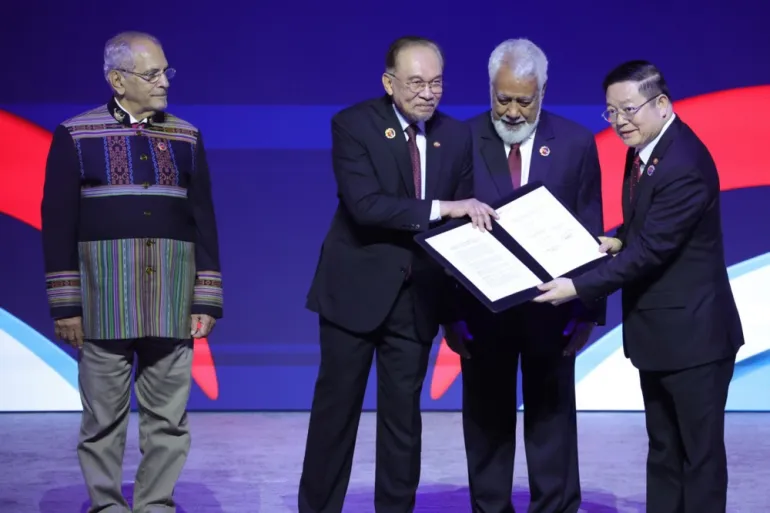
East Timor has joined the Association of Southeast Asian Nations (ASEAN) as the bloc’s 11th member state in a move Prime Minister Xanana Gusmao hailed as a “dream realised”.
The flag of East Timor, which is also known as Timor-Leste, was added to ASEAN’s other 10 on Sunday at a formal ceremony at the bloc’s annual summit at the Malaysian capital, Kuala Lumpur, drawing loud applause.
An emotional Gusmao said it was a historic moment for his country, with a new beginning that would bring “immense opportunities” for trade and investment.
“For the people of Timor-Leste, this is not only a dream realised, but a powerful affirmation of our journey – one marked by resilience, determination and hope,” Gusmao said.
“Our accession is a testament to the spirit of our people, a young democracy, born from our struggle,” he said.
“This is not the end of a journey. This is the beginning of an inspiring new chapter.”
Malaysian Prime Minister Anwar Ibrahim, whose country currently chairs ASEAN, said that East Timor’s accession “completes the ASEAN family – reaffirming our shared destiny and deep sense of regional kinship”.
The country’s admission follows a 14-year wait, and is seen as one of the crowning achievements of Malaysia’s ASEAN chairmanship.
East Timor was ruled for three centuries by Portugal, which abruptly pulled out of its colony in 1975, paving the way for annexation and an at-times bloody occupation by neighbouring Indonesia before East Timor won full independence in 2002.
East Timorese President Jose Ramos-Horta, who also witnessed the event on Sunday, has long campaigned for ASEAN membership. An application was first submitted in 2011, during his first term.
Ramos-Horta, 75, who was awarded the Nobel Peace Prize in 1996, had raised the idea of East Timor joining ASEAN way back in the 1970s, to secure his country’s future through regional integration.
East Timor was granted observer status to the regional body in 2022, but its full membership was delayed by various challenges.
The country of 1.4 million people is among Asia’s poorest and hopes to see gains from integrating its fledgling economy, which at about $2bn represents only a tiny fraction of ASEAN’s collective $3.8 trillion gross domestic product (GDP).
Some 42 percent of East Timor’s population lives below the national poverty line, while nearly two-thirds of its citizens are under 30 years old.
Its major source of government revenue comes from the oil and gas industry, but with resources quickly becoming depleted, it is looking to diversify.
ASEAN membership gives East Timor access to the bloc’s free trade deals, investment opportunities and a broader regional market.
In an interview with Singapore-based Channel News Asia in September, Ramos-Horta said that his country must maintain stability and not burden ASEAN, adding that East Timor could contribute its experience on conflict, including for disputes over borders and the South China Sea.
“If we can in the future contribute towards strengthening ASEAN mechanisms such as conflict mechanisms, that is key. In each country in ASEAN, we put emphasis on dialogue,” Ramos-Horta said.
ASEAN began as a five-member bloc in 1967 and has gradually expanded, with Cambodia previously the most recent addition in 1999.
[Aljazeera]

Latest News
Cabinet approves relief meaures to persons affected due to the War situation in the Middle East
Approval has been granted at the Cabinet Meeting held on 30-03-2026 to provide relief by granting up to rupees 20/- per litre of 92 Octane Petrol, and up to rupees 100/- per litre of Auto Diesel utilized for public transport to minimize the impact on the day today life of the people and the entire economy as a result of escalation of fuel prices due to the war situation in the Middle East region.
Apart from that, the Cabinet of Ministers approved the resolution furnished by the President in his capacity as the Minister of Finance, Planning and Economic Development to grant the following relief for low – income generators, electricity consumers, farmers, fisheries community, and small tea planters who have been exposed to the direct impact of the energy price hike:
(i) Provision of an additional special allowance for April 2026 to low-income generating categories registered under the ‘Aswesuma’ Programme, irrespective of family size: • Providing rupees 7,500/- to a family in the extremely poor category
Providing rupees 5,000/- to a family in the poor category
Providing rupees 2,500/- to a family in the transitional category
(ii) Instead of transferring the additional cost borne for engaging thermal power plants for generating electricity due to the fuel price hike and prevailing dry weather circumstances to the electricity consumers, the additional cost is to be borne by the Government for a period of 03 months so that a relief can be provided to the electricity consumers utilizing below 90 units.
(iii) Increasing the fertilizer subsidiary of rupees 25,000/- per hectare given at present up to rupees 30,000/- per hectare for the Yala season and increasing the fertilizer subsidiary of rupees 15,000/- per hectare given for additional crops that are cultivated in the paddy fields up to rupees 18,000/- per hectare for the Yala season.
(iv) Provide a 50 kg sack of Urea required for the Yala season at a fixed price of Rupees 10,200/- for farmers through Agrarian Services Centres.
(v) Provide a subsidiary of Rupees 50/- per liter for up to 25 liters per day per single-day fishing vessel, for a maximum of 25 days per month, for a period of three (3) months.
(vi) Provide a one-time payment of Rupees 150,000/- per multi-day fishing vessel engaged in fishing activities during the next three (3) months.
(vii) Provide an additional one-time fertilizer allowance of Rs. 5,000 per 50 kg bag of fertilizer to small tea cultivators, in addition to the existing Rs. 4,000 fertilizer subsidy provided by the Sri Lanka Tea Board.

The Cabinet of Ministers has approved the resolution furnished by the President in his capacity as the Minister of Digital Economy, to appoint H.M.J.M.Herath, a special Grade officer in Sri Lanka Administrative Service, who is currently serving as the District Secretary / Government Agent of Kegalle, to the post of Commissioner General of Registration of Persons
Latest News
Cabinet gives green light for old court complex buildings located in Galle Fort to be utilized for a Tourism Promotion Project.
The Galle fort which has been declared as a World Heritage by the United Nations Educational, Scientific, and Cultural Organization (UNESCO), attracts over three (3) hundred thousand local and foreign tourists per year.
Under the Greater Galle Development Plan (2021–2030), Galle Fort has been declared a World Heritage Tourism Zone. Further, having conserved the archaeologically valued buildings existing in the Galle Fort, the Urban Development Authority has planned an integrated development project programme, themed as the ‘Galle Regeneration Project’.
The Cabinet of Ministers has approved the resolution furnished by the Minister of Transport, Highways and Urban Development to relocate the High Court and Magistrate’s Court, which are currently functioning within Galle Fort, to the newly constructed court complex at Beligaha, Galle and to assign the existing buildings to the Urban Development Authority for the implementation of a tourism promotion project under a Public–Private Partnership (PPP) mechanism under this programme.

Cabinet approves relief meaures to persons affected due to the War situation in the Middle East

Amendments to the Finance Act No. 35 of 2018 to be Gazetted

Value Added Tax (Amendment) Bill to be Gazetted

H.M.J.M.Herath appointed Commissioner General of Registration of Persons

Water Resources Board Act, No. 29 of 1964, to be amended

Securing public sector employment opportunities for Athletes demonstrating National-Level sporting excellence

‘Dates have the highest sugar content to fight Coronavirus’

Sunday Island 27 December – Headlines

#SundayIsland 17th December – Headlines

Sunday Island – 28th March

Sunday Island Headlines – 21 March

Sunday Island – 21st February – Headlines
-

 Features3 days ago
Ranjith Siyambalapitiya turns custodian of a rare living collection
-

 News6 days ago
2025 GCE AL: 62% qualify for Uni entrance; results of 111 suspended
-

 News3 days ago
Global ‘Walk for Peace’ to be held in Lanka
-

 Business7 days ago
Hour of reckoning comes for SL’s power sector
-

 Editorial6 days ago
Search for Easter Sunday terror mastermind
-
 Opinion5 days ago
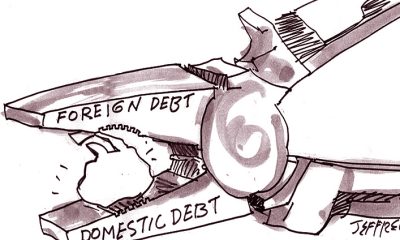
Hidden truth of Sri Lanka’s debt story: The untold narrative behind the report
-
Editorial7 days ago
Ideological confusion and identity crisis
-

 Opinion6 days ago
Is there hope for Palestine?