
News
Early warning for all


International Disaster Risk Reduction Day 2022
“The primary goal of disaster risk reduction is prevention. But when that is not possible, then it is important to minimize the harm to people, assets and livelihoods through early warning systems”- United Nations Office for Disaster Risk Reduction (UNDRR)
In recent years, reducing disaster risk has become an increasing priority in the Disaster Risk Management (DRM) discourse, as DRM started to shift away from response and recovery towards investing in pre-event or ex-ante interventions to reduce future risk. Natural hazards and climate change impacts are pressing risks, but we can keep them from turning into full-fledged disasters by reducing the vulnerability of populations. The Sendai Framework for Disaster Risk Reduction (SFDRR) 2015-2030, adopted in 2015, addressed this need for an action-oriented, tangible framework for reducing disaster risk, in alignment with the Paris Agreement.
Reducing mortality, and minimizing the numbers of people injured, displaced, and left without a livelihood has never been more challenging, especially in the post COVID-19 context. Meanwhile, climate-related disasters have almost doubled over the last 20 years. This has increased inequalities within and between countries, with those contributing least to global emissions often experiencing the worst effects of the climate emergency. As highlighted by the recent Intergovernmental Panel on Climate Change’s 6th Assessment Report, human-induced climate change is intensifying weather and climate extremes in every region, and the average global temperature could rise by 1.5°C above the pre-industrial level by the early 2030s, much earlier than predicted. Hence, failure to address the increasingly complex and systemic nature of disaster risk is undermining efforts to achieve the overall 2030 Agenda for Sustainable Development.
This is especially worrying for Sri Lanka, as the country’s risk profile evolves each day, owing to the ongoing socio-economic crisis. Sri Lanka is one of the most climate-vulnerable countries in the world, ranking 4th, 2nd, and 6th places on the Global Climate Vulnerability Index in 2018, 2019 and 2020 respectively. Sri Lanka is routinely affected by recurring disasters, which have caused recorded damages of nearly $7 billion between 1990-2018 alone. Should climate-induced disaster strike Sri Lanka now, as seen in Pakistan—a country mirroring the debt-sustainability issue of Sri Lanka—the resultant damages would be of equally devastating proportions.
As disasters are seen and described as being unprecedented, what is considered a known risk is constantly being challenged, leading to unimaginable and never experienced future outcomes. Further, the cost of these disasters disproportionately hit the poorest, most vulnerable, or fragile communities the hardest. As a developing island nation, consequences of climate change such as temperature rise, rainfall variability and sea level rise are critically affecting all economic sectors. The impacts these disasters could have on the people of Sri Lanka, coupled with the already contracted economy necessitates prioritizing early warning systems and disaster risk information.
This year’s International Day for Disaster Risk Reduction (IDDRR 2022) focuses on Target G of the Sendai Framework: “Substantially Increase the Availability of and Access to Multi-Hazard Early Warning Systems and Disaster Risk Information and Assessments to People by 2030.” With extreme weather events becoming increasingly common, early warning systems which cultivates disaster and risk-aware communities for early action remain a powerful catalyzer of climate adaptation and disaster risk reduction. IDDRR 2022 presents an opportunity to acknowledge the progress being made towards preventing and reducing disaster risk and losses in lives, livelihoods, economies, and basic infrastructure. As natural hazards become more challenging to cope with, it is not enough for early warning systems to correctly identify an incoming hazard, but must also be people-centered, ensuring that the populations and sectors that are at risk can receive the alert, understand it, and most importantly, act on it.
Ms. Anusha Warnasooriya, Director, Seasonal Forecasting, Department of Meteorology contends, “early warnings, climate forecasts and advisories are crucial foundational elements of all sectors. For an example, this information helps the Department of Agriculture with cultivation planning to reduce losses, while the Department of Irrigation can manage efficient water consumption, and the Electricity Board can plan ahead on their hydro-power efforts.”
The United Nations Development Programme (UNDP) in Sri Lanka in close partnership with the Government of Sri Lanka continues to create engagement and partnership opportunities to further transition towards green resilience and develop a multi-hazard disaster management infrastructure within Sri Lanka. The island nation has progressed significantly since the devastating Indian Ocean Tsunami in 2004, building comprehensive multi-hazard disaster management infrastructure, policy and institutional reform, and improved accessibility disaster risk information. UNDP in Sri Lanka has complemented these efforts of the Government of Sri Lanka by supporting the country, among other disaster management needs, to improve access to climate and water forecasts, and advisories particularly for the agriculture sector. The Climate Resilient Integrated Water Management Project (CRIWMP), implemented in collaboration with the Ministry of Irrigation, the Department of Meteorology, the Disaster Management Center, and other relevant stakeholders with the funding of the Green Climate Fund (GCF), helps to strengthen the resilience of smallholder farmers, particularly women in the Dry Zone through improved water management.
The project’s integrated water management approach particularly focuses on improving access to climate information, early warning and forecasting, and advisories, to further climate change adaptation and resilience, helping communities change their own perceptions of risk and preparedness, while allowing for the promotion of community awareness and preparedness. Having over 780,000 direct beneficiaries in 7 districts, community members are provided with agro-met advisories for seasonal cultivation planning as well as short-term weather forecasts to plan agronomic practices in unpredictable weather conditions. This intervention has helped to substantially increase the level of awareness about access, content and application of weather and agro-met advisories for agriculture and water management activities at the local level. Further to this, bi-weekly weather and agro-met briefings are conducted to strengthen and update the system and provide 520,000 farmers with the necessary technical coordination and equipment through multiple information channels. As weather conditions are becoming more dynamic, the project is constantly improving weather forecasts, early warning systems, and response measures as it is an essential feature for farmers in improving production and minimizing crop loss.
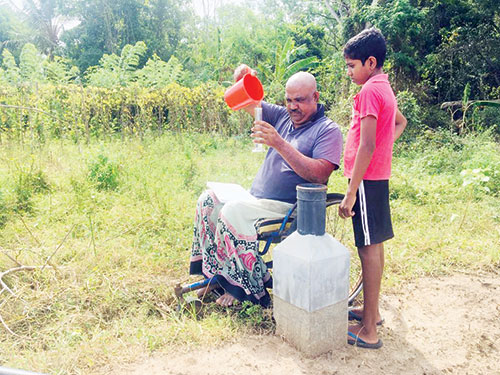
R. A Nishantha Ranaweera and his family are smallholder farmers from Medawachchiya, Anuradhapura, a demographic that often bear the brunt of the climate change induced losses, while also largely lacking the access or knowledge to interpret the technicalities of agro-met information, and capacity to make informed decisions. Sometimes, the heavy rains wash away their crops, while other times, the droughts leave them without a possibility of cultivating. Ranaweera’s wife, Kumuduni Malkanthi adds, “my husband used to farm alongside me before his disability. Now, he primarily focuses on disseminating the climate forecasts and agro-met data that is shared with us, which is interpreted through the rain gauge readings. The accessibility to this data provides him with the necessary information to advise us with crop planning and to ensure that our cultivations can be adapted to our weather conditions.” The agro-met data has led to Ranaweera and his family cultivating in the major season, investing the profits into other field crops in the off season, from which he expects to continue into the next cultivation season without the risks of crop losses – a win for Dry Zone farmers in the agricultural heartland of Sri Lanka.
Investments in disaster risk reduction are a stake in the future safety and resilience of people. One-third of the world’s people, mainly in least developed countries and small island developing states, are still not covered by early warning systems. Climate change impacts are worsening, and people’s vulnerabilities too are exacerbating. As Sri Lanka transitions to a green development trajectory and onto a path of economic recovery, ensuring the availability of and access to multi-hazard early warning systems and disaster risk information continues to be a core development need for the country. This year’s IDDRR 2022 theme aligns well with what UNDP works to achieve. Countries must work towards fulfilling the central and transformative promise of the 2030 Agenda—to leave no one behind.


By Shamindra Ferdinando
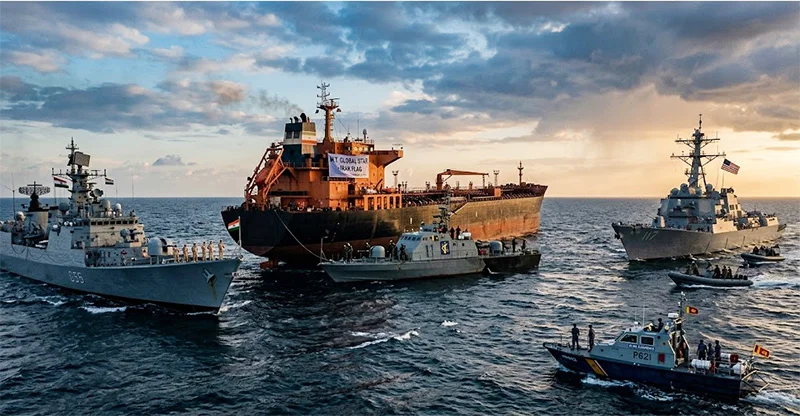
Iran has sought the Indian intervention, at the highest level, to provide lifesaving support to the crews of empty Iranian vessels stranded just outside Sri Lanka’s 12-nautical mile territorial waters off Galle.
Sources familiar with the issue said that Iran had brought the developing situation to the attention of New Delhi as the crews of almost 20 vessels, included Indian nationals. Sources stressed that the group of vessels that unloaded crude oil a couple of months back were now stranded within Sri Lanka’s Exclusive Economic Zone (EEZ).
The US Navy torpedoed an unarmed Iran frigate, returning from India, on 04 March, 2026, about 19 nautical miles off the Galle coast. The unprovoked attack killed nearly 100 Iranians.
The Iranian Embassy in Colombo has inquired from the Indian High Commission of their response to the situation, sources said. The US has issued a global warning against providing food, water, medicine and other services to the Iranian vessels. The outcome of Iran-India talks on the issue at hand was not known, though sources asserted India may not throw its weight behind Iranian efforts to address the issue.
Responding to The Island queries, sources said both Sri Lanka and India were in a dilemma due to the US warning. India couldn’t ignore the plight of the Indian crew members and the Iranian vessels in its backyard.
The Sri Lankan government remains tight-lipped about the vessels stranded in its EEZ. Our efforts to elicit a response from relevant authorities were in vain. In addition to Indians, there are Bangladeshis among the crew members. Iran has explicitly stated the responsibilities of the countries concerned to provide assistance in terms of international law.
The Iranian position was articulated by its Ambassador to Sri Lanka, Dr.Alireza Delkhosh, recently. In a special statement, Ambassador Delkhosh emphasised that in terms of the Convention on the Law of the Sea (Article 98) as well as SOLAS and SAR
Conventions, Sri Lanka couldn’t refrain from providing the needs of the Iranian vessels stranded in its EEZ.
SLMC leader Rauff Hakeem lambasted the NPP government in Parliament for failing to provide assistance to the Iranian ships. The former Minister alleged that the government was simply carrying out dictates of the US. He strongly criticised the way Foreign Minister Vijitha Herath was handling the issue.

MP Namal Rajapaksa, who is in remand custody over the controversial Airbus deal, was further remanded until October 27 by the Colombo Magistrate’s Court yesterday (13).
Colombo Chief Magistrate Asanga S. Bodaragama made the order after considering submissions by officers of the Commission to Investigate Allegations of Bribery or Corruption and lawyers representing Rajapaksa.

Sri Lanka’s economy is expected to sustain its recovery over the next two years, although growth is projected to moderate amid mounting global uncertainties, according to the International Monetary Fund’s (IMF) latest World Economic Outlook.
In its World Economic Outlook 2026: Resilience Under Strain, Urgent Choices, the IMF projects Sri Lanka’s economy to expand by 4% in 2026, slowing to 3.7% in 2027, following estimated growth of 5% in 2025.
Inflation, meanwhile, is forecast to rise to 5.3% in 2026 and 5.4% in 2027, reversing the average deflation rate of 0.5% recorded in 2025.
Unemployment is expected to remain steady at 3.9% throughout the forecast period.
The projections come amid growing pressure on the global economy from the ongoing conflict in the Middle East, elevated energy prices, geopolitical tensions and trade disruptions.
Sri Lanka’s external position is also expected to weaken, with the current account balance projected to shift from a surplus of 1.6% of gross domestic product (GDP) in 2025 to deficits of 0.5% in 2026 and 0.3% in 2027.
The IMF’s outlook points to continued economic expansion in Sri Lanka, but with slower growth, rising inflation and a narrowing external surplus giving way to current account deficits over the forecast period.

Sri Lanka, India caught in US-Iran ship crisis

Namal further remanded

IMF projects Lankan economic growth to moderate amidst mounting global uncertainties

Major Gen Pushpakumara assumes command of 56 Infantry Division

Dickwella axed, Bandara earns maiden Test call up

President signals priority for domestic economic policy autonomy

‘Dates have the highest sugar content to fight Coronavirus’

Sunday Island 27 December – Headlines

#SundayIsland 17th December – Headlines

Sunday Island – 28th March

Sunday Island Headlines – 21 March

Sunday Island – 21st February – Headlines
-

 Features6 days ago
The Sri Lankan who made Scottish history
-

 Sports6 days ago
Nissanka absence opens door for Sri Lanka’s young guns
-

 News5 days ago
NDB fraud Rs 60mn more than reported
-

 News5 days ago
Removing monk’s robes matter for Sangha to decide: Mahanayake Theras
-

 News6 days ago
Shiranthi R remanded until 13 Oct.
-

 Features6 days ago
Future of Sri Lanka’s state university system: Should it be shut down and reopened?
-

 News3 days ago
Sri Lanka escalates anti-graft drive with Shiranthi’s jailing
-

 Latest News4 days ago
Farhan, Sadaqat help Pakistan ace 183 chase to go 1-0 up