
Latest News
Duckett, Stokes revive England in chase of 371

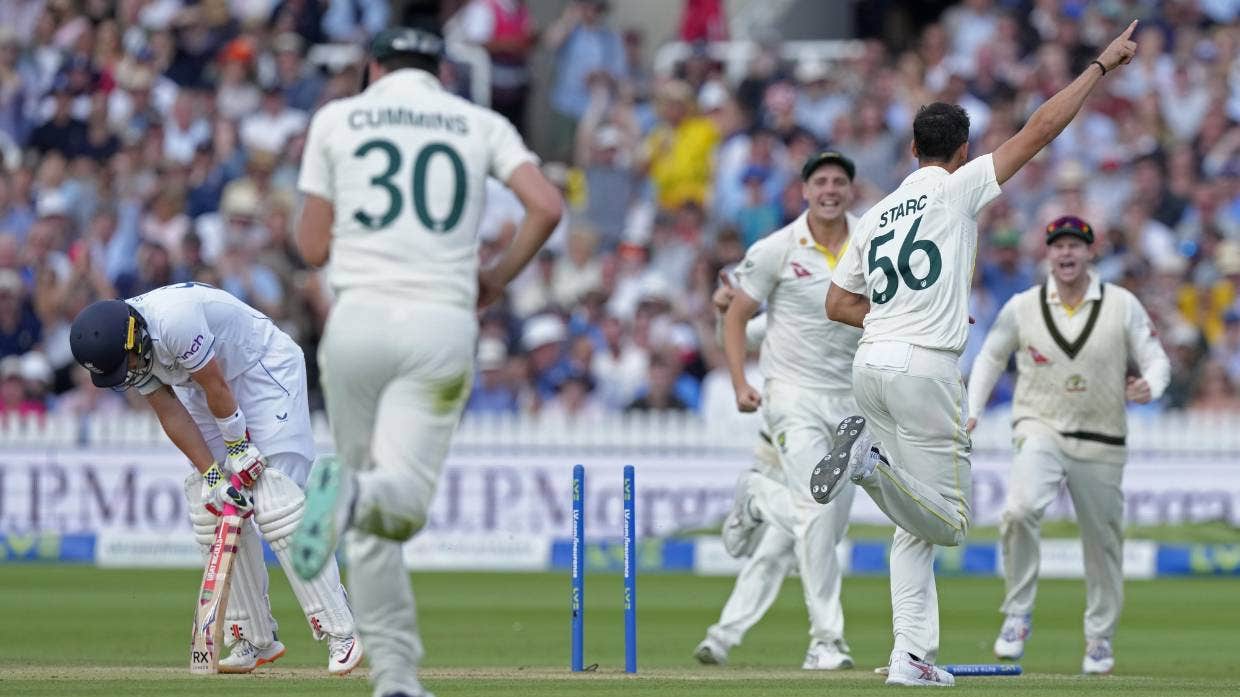
Ben Duckett’s half-century and his unbroken 69-run partnership with Ben Stokes led England’s recovery in the final session on Day 4 after Mitchell Starc and Pat Cummins combined to rattle the hosts early in their chase of 371. After Stuart Broad’s four-wicket haul bowled Australia out for 279, England had slipped to 45/4. But Duckett, who was the beneficiary of a controversial ruling from the third umpire late in the day, helped the hosts to 114/4 at Stumps on Saturday (July 1), with the hosts needing 257 more to win the Lord’s Test and square the series.
An innocuous delivery which was heading down the leg side gave Starc his first wicket as Zak Crawley got a faint tickle through to the ‘keeper. Duckett, who was put down by Cameron Green (a very tough chance) in the opening over, also managed to overturn a leg-before decision. But the left-arm pacer struck in his next, with beauty that swung in late into Ollie Pope and uprooted the middle stump. Joe Root and Duckett then built a steady partnership – rotating the strike well, with the former also scoring a couple of boundaries.
Cummins sowed the seeds of doubt with short balls in the 13th over and there was immediately a change in the atmosphere. Root, hit on his forearm, fended the next one to Warner at first slip to depart for 18. Harry Brook got off the mark with a confident straight drive over Cummins’ head. But he got a terrific delivery soon after, one that pitched on a length, seamed away, beat the outside edge and crashed onto the stumps.
Stokes and Duckett put their heads down and built a steady partnership to aid England’s recovery. They kept the pacemen at bay before taking on part-timer Travis Head. Stokes came down the track to hit a six while Duckett went over mid-on for a boundary as the two batters did not allow the spinner to settle down. They also rotated the strike well, picking up the singles and twos to ensure England weren’t bogged down as they maintained a decent scoring rate.
The introduction of Green saw Australia turn to short balls again but Duckett was up to the task, scoring a couple of boundaries, and also put away a loose ball from Starc for a four. Green, however, troubled Stokes with his short length deliveries and nearly dismissed the England skipper, with the ball just dropping wide of gully. In late drama, Duckett was given not out after being caught at fine leg by Starc off Green, with the third umpire ruling that the ball made contact with the ground when the catch was about to be completed.
Earlier, Khawaja and Smith were untroubled in the first hour, making most of the sunny conditions as they stretched the lead past 250 and extended their stand past 50. James Anderson, who wasn’t effective, was taken off the attack after only three overs. Josh Tongue and Ollie Robinson, who bowled in tandem, came up with a barrage of short deliveries. Smith and Khawaja were disciplined with their shot selection against the short deliveries but they also had a few uncomfortable moments.
It was Stuart Broad, introduced after the drinks break, who made the breakthrough as he had Khawaja off a top edge to end a 64-run stand. Smith handed a catch in the deep trying to guide a short one from Tongue in the gap. Head, dropped by Anderson on 0, had a short stay as he too fell to a short ball from Broad, with Joe Root taking a splendid one-handed catch at short leg. Alex Carey and Green kept the England bowlers at bay as they added 25 before the Lunch break to stretch the lead past 300.
It was an attritional second session with England being relentless with their short-ball strategy while Carey and Green were happy to play the waiting game. Eventually, it was England who came out on top in the game of patience as Robinson’s short-pitched balls got the better of Green and Carey in quick succession after a 42-run partnership that came off 123 deliveries.
Ben Stokes, who bowled right from the start of the post-lunch session, delivered 12 overs on the trot and was struggling with his knee, but continued nevertheless. He eventually accounted for Josh Hazlewood’s wicket, after Broad, who replaced Robinson (nine successive overs) dismissed Cummins. Nathan Lyon, who walked out to bat to a huge reception, added 15 runs with Starc before being the last to be dismissed as Broad finished with four.
Brief scores:
Australia 416 & 279 (Usman Khawaja 77, Steven Smith 34; Stuart Broad 4-65, Ollie Robinson 2-48) lead England 325 & 114/4 (Ben Duckett 50*, Ben Stokes 29*; Pat Cummins 2-20, Mitchell Starc 2-40) by 256 runs.










Latest News
Heat Index at Caution Level at some places in the Western, Sabaragamuwa, Southern, North-central and North-western provinces and in Monaragala, Mannar and Vavuniya districts
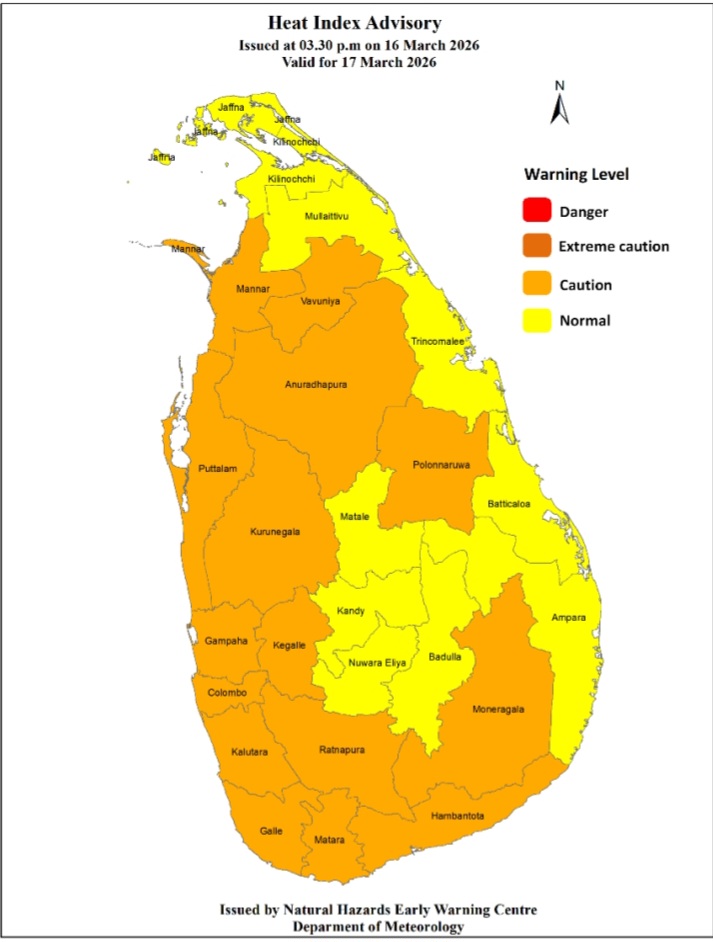
Warm Weather Advisory Issued by the Natural Hazards Early Warning Centre of the Department of Meteorology at 3.30 p.m. on 16 March 2026, valid for 17 March 2026
The general public are warned that the Heat index, the temperature felt on human body is likely to increase up to ‘Caution level’ at some places in the Western, Sabaragamuwa, Southern, North-central and North-western provinces and in Monaragala, Mannar and Vavuniya districts.
The Heat Index Forecast is calculated by using relative humidity and maximum temperature and this is the condition that is felt on your body. This is not the forecast of maximum temperature. It is generated by the Department of Meteorology for the next day period and prepared by using global numerical weather prediction model data.
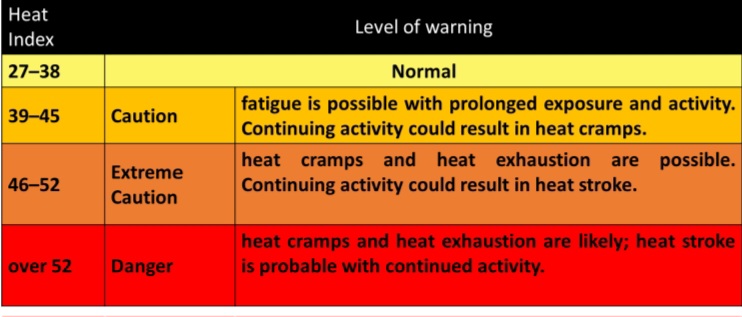
Effect of the heat index on human body is mentioned in the above table and it is prepared on the advice of the Ministry of Health and Indigenous Medical Services.
ACTION REQUIRED
Job sites: Stay hydrated and takes breaks in the shade as often as possible.
Indoors: Check up on the elderly and the sick.
Vehicles: Never leave children unattended.
Outdoors: Limit strenuous outdoor activities, find shade and stay hydrated.
Dress: Wear lightweight and white or light-colored clothing.
Note:
In addition, please refer to advisories issued by the Disaster Preparedness & Response Division, Ministry of Health in this regard as well. For further clarifications please contact 011-7446491.

The Ecuadorean government has deployed more than 75,000 police officers and soldiers to four of the country’s most violence-wracked provinces, the interior minister says.
The authorities have also declared a night-time curfew in these areas as part of a “new phase” in their “war” on criminal gangs.
Since coming to office in November 2023, President Daniel Noboa has tried to quell drug-related violence but nevertheless Ecuador registered a record murder rate in 2025.
Noboa has also joined a US-led alliance of 17 countries aimed at fighting criminal cartels in the Western Hemisphere.
“We’re at war,” Ecuadorean Interior Minister John Reimberg told residents of the provinces of El Oro, Guayas, Los Ríos and Santo Domingo de los Tsáchilas.
“Don’t take any risks, don’t go out, stay at home,” he added.
Ecuador’s geographical location – sandwiched between Colombia and Peru, the world’s largest producers of cocaine – has turned it into a key transit country for the illicit drug.
Around 70% of the cocaine produced in Colombia and Peru is estimated to be shipped through Ecuador.
Noboa’s government has been working with the administration of US President Donald Trump to quell the flow of cocaine from Ecuador to the US.
Last week, the FBI opened its first office in the Andean country, a move which came shortly after the two countries launched joint counter-narcotic operations.
Noboa was one of the Latin American leaders to attend an international meeting hosted by Trump in Mar-a-Lago, which the US authorities dubbed the “Shield of the Americas” summit.
At the summit, Trump likened criminal gangs to a “cancer” and urged his Latin American counterparts to use military force to root them out.
“We don’t want it spreading,” Trump added.
Following the meeting, Noboa posted a photo on social media of himself standing next to Trump with the words: “For too long, the mafias thought that America was their territory. That they could cross borders, move drugs, guns and [spread] violence without consequences. Their time has run out.”
Since coming to office, Noboa has tried to combat criminal organisations in his country with an iron fist and has declared several states of emergency but nevertheless the murder rate rose by over 30% between 2024 and 2025.
[BBC]

The Commissioner General of Essential Services, Prabath Chandrakeerthi has announced that, after taking into consideration the current fuel situation in Sri Lanka, the Government has decided to declare Wednesdays of every week as a holiday for government sector employees, all government schools, universities, and courts with effect from March 18, 2026, until further notice
The holiday will not apply to essential service sectors including Healthcare, Ports, Water Supply and Customs.

Pakistan lodge official complaint about Bangladesh’s review at end of chase

Showers or thundershowers will occur at several places in the Central, Sabaragamuwa, Southern and Uva provinces after 2.00 pm.

Government’s objective is to ensure the continuous functioning of the country’s economic activities and essential services through effective energy management – President

UN resolution on Iran ‘unbalanced’: FM Herath

Japan provides grant for reinforcement of Cyclone Ditwah damaged bridge

Australian HC debunks misleading travel risk claims for Sri Lanka

‘Dates have the highest sugar content to fight Coronavirus’

Sunday Island 27 December – Headlines

#SundayIsland 17th December – Headlines

Sunday Island – 28th March

Sunday Island Headlines – 21 March

Sunday Island – 21st February – Headlines
-

 Business6 days ago
BOI launches ‘Invest in Sri Lanka’ forum
-

 News5 days ago
Historic address by BASL President at the Supreme Court of India
-

 Sports5 days ago
The 147th Royal–Thomian and 175 Years of the School by the Sea
-

 Sports6 days ago
Royal start favourites in historic Battle of the Blues
-

 News6 days ago
CEBEU warns of operational disruptions amid uncertainty over CEB restructuring
-

 Features6 days ago
Indian Ocean zone of peace torpedoed!
-

 News5 days ago
Power sector reforms jolted by 40% pay hike demand
-

 News3 days ago
Crypto loopholes funnel Lankan funds abroad