
Sports
Dr. Suranga says Sri Lanka should take a leaf out of Zambia’s development programme


by Reemus Fernando
Dr. Titus Suranga Fernando, who is in Tokyo as the Chairperson Medical Commission of National Olympic Committee of Zambia says that Sri Lanka can take a leaf out of Zambia’s sports development plan to improve standards in Olympic sports.
In an online interview with The Sunday Island Dr Fernando said that Zambia’s ‘Podium Performance Programme’ could be an ideal development model for Sri Lanka.
“Zambia is in corporation with a number of other Southern African countries and promote competitions in selected sports among athletes of these countries. That has helped Zambia improve standards. That could be a model that Sri Lanka can adopt to improve standards,” said the Sri Lankan doctor.
Like Sri Lanka, Zambia too has won only two Olympic medals in history with its most recent victory recorded in 1996 Olympics. Samuel Matete won the silver in the men’s 400 m hurdles. But from just seven competitors at the 2016 Rio Olympics where only two progressed beyond the first round, Zambia has produced a marked development within the last four years to field a contingent of over 30 athletes of whom a vast majority are qualified athletes. “All athletes except in swimming are qualified athletes.”
At the point of writing two boxers, namely Chinyemba Patrick and Zimba Stephen had progressed from the first round and their two track and field athletes were yet to compete.
“We (Zambia) had three boxers who qualified for the Olympics. They are between 19-22 years of age. So they have at least two more Olympics to go.”
Some of their women’s footballers also earned recognition despite failing to make the quarterfinals. Their captain Barbra Banda wrote her name into the record books by becoming the only female player to have scored two hat tricks at an Olympic Games and her six tournament goals also equalled a record.
According Dr. Fernando, the ‘Podium Performance Programme’ has helped the country improve standards in performances.
“Regular health monitoring which is usually not available to athletes who are not in the programme, the services of sports nutritionists and sports psychologists and other essential services are provided on demand to athletes in the programme. Conducting coaching camps for coaches and athletes, providing equipment, upgrading venues and providing support to conduct international competitions are also done.”
Dr. Fernando suggests that such a programme would benefit countries like Sri Lanka.
By Friday evening, seven out of nine Sri Lankan competitors had concluded their events and been eliminated in the first round.


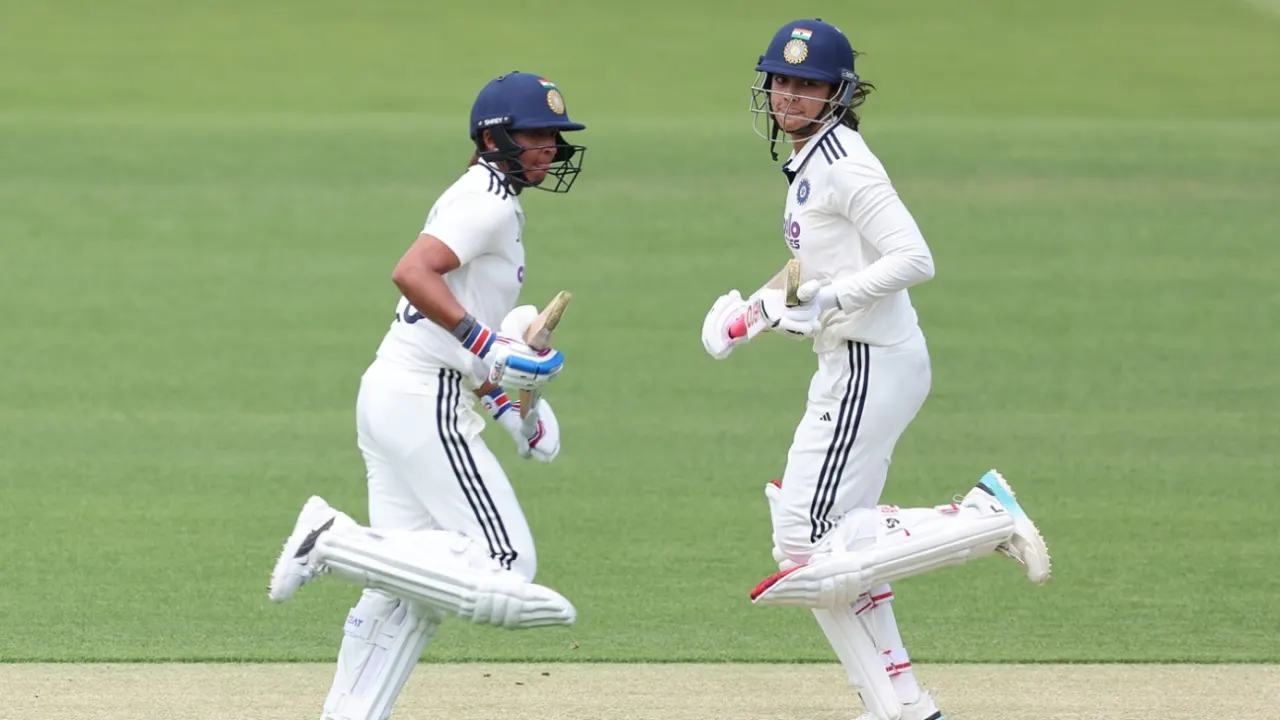
On Friday at Lord’s, they were standing on the shoulders of giants.
In the broader scheme of progress, there have arguably been bigger occasions for the women’s game – not least, the one that took place at this same venue only five days earlier. None, however, have come loaded with quite this much portent. After a lag of 142 years, dating back to 1884 when Lord’s hosted England and Australia for the first of what is now 150 men’s Tests and counting, the women are finally off the mark at the self-styled home of cricket.
On a day of historic firsts, England’s Laurem Bell duly bowled the first delivery in a women’s Test at Lord’s, before Lauren Filer claimed the first wicket. And, for a time during the afternoon session, while India’s third-wicket partnership was bedding into its surroundings and recalibrating to the demands of a rarely-accessed format, it seemed inevitable thatSmriti Mandhana would land the most coveted first of all – a place on the dressing-room honours boards, designated as of this morning as unisex, no matter what the weight of precedent might suggest.
Instead, on 83, Mandhana was lured outside her eyeline by an Issy Wong outswinger, and traipsed off with her own slice of the occasion unfulfilled. And yet, on this day of all days, it somehow felt apt that the wait was made to go on a little while longer. If, as is customary, the opening session of a Test can often be given to the bowlers, then this opening day was handed over to the mighty names of the past, whose endeavours have paved the way for the 22 names who made this final cut of history.
Prior to the start of play, more than 50 former England players made the journey through the Long Room and down the pavilion steps, to line up on the outfield for the national anthems. Among their number was the indomitable Enid Blackwell, 85 years young and sporting a bruise on her shin from wicketkeeping duties in a recreational game only last week. To her fell the honour of ringing the five-minute bell, surrounded by her fellow veterans from England’s maiden ODI on this ground, against Australia in August 1976, almost exactly 50 years ago.
As legend has it, Bakewell’s captain on that day, Rachel Heyhoe-Flint, chose to lead her team onto the field via the Committee Room side-door, so as not to offend the sensibilities of those MCC members whose seminal vote to admit women to their club would have to wait for a further 22 years.
Heyhoe-Flint could scarcely have imagined, back then, that her official portrait would preside over such an occasion from the Long Room wall, or that Bakewell herself would unveil her own painting on the morning of the match – one of six new additions to the MCC’s collection, which at a stroke trebled the female inventory of one of the most famous private art galleries in the world.
Those other names includedMary Duggan, to this day the leading wicket-taker in women’s Tests, with 77 at 13.49, though who in all honesty would have held this fact in their fingertips? Likewise, Myrtle Maclagan, the first woman to take a Test wicket, at Brisbane in 1934, and the first to three figures too, and Janette Brittin – arguably more familiar for her role in the 1993 World Cup triumph, which was separately celebrated in a larger work of art – though less of a household name than her record deserved.
It was against such a wealth of context that Nat Sciver-Brunt won the toss and chose to bowl first. It was a sweltering day, and there was perhaps a misleading tinge of green in the surface. But, with the match coming just five days after England’s heartbreak in the T20 World Cup final, Sciver-Brunt could have been forgiven if there was a defensive reflex in her decision-making.
This was England’s chance to walk through the Long Room as a collective in their whites, and settle into the occasion together. And they did so with admirable verve. Filer’s first wicket of the contest was a collector’s item, fit to grace any one of those 150 men’s Tests – 72mph, nipping back up the slope, and kissing the shoulder of Shafali Verma’s bat for Amy Jones to gather well to her right.
It was the first of a succession of outstanding individual moments from England’s bowlers. Bell’s inswinging, away-seaming delivery to Yastika Bhatia was another moment to savour, as was Mady Villiers’ debut dismissal of India’s captain, Harmanpreet Kaur, for 58 on the stroke of tea. Tossed up on a good length outside off, dipping and gripping through the gate to peg back middle stump. It had shades of another memorable Anglo-Indian moment from nearly a quarter-of-a-century ago – Michael Vaughan’s stunning offbreak to Sachin Tendulkar at Trent Bridge – and at 202 for 5, it was sufficient to ensure at least a share of the spoils of the first two sessions.
The difficulties for England came in between whiles, though it was by no means an isolated problem. As the soon-to-be-retired Tammy Beaumont had pointed out in the lead-up to this match, the crazy expectation of this shoe-horned Great Exhibition was for both sides to forget the drills that had driven them throughout the recent T20 World Cup, and turn on a dime to a format that they tend to play once every 18 months if they are lucky.
The initial pace of the contest was, understandably enough, a long way removed from the standard red-ball tempo. By the time Jemimah Rodrigues dragged a Wong outswinger onto her stumps for 35 from 38 balls, India had clattered along to 101 for 3 in 19 overs, against a bowling attack that struggled to locate that requisite holding line and length for the long-form game.
By the time of her pearler to Bhatia, Bell had been pumped for six fours in three overs and so celebrated with more of a grimace than the moment deserved, while both Ecclestone and Wong were clubbed at a T20 tempo from the start of their respective spells, including Mandhana’s slog-swept six en route to a run-a-ball half-century.
As India’s innings took root, however, so the tempo slowed – partially out of respect for the occasion and the recognition of the rewards for playing the long game, partially thanks to some improved discipline from England’s bowlers, not least the offspin of Villiers, who bowled her 19 overs without change from the Nursery End, save a 20-minute break for tea.
Harmanpreet suffered rather more in that period, with several breaks in play for cramp prior to her dismissal, and Villiers earned further reward in the evening session, when Sneh Rana missed a sweep and was somehow given not-out on the field by umpire Sue Redfern. England’s review showed there had been little room for doubt.
There was a touch more reason for Sayali Satghare to feel aggrieved when Ecclestone extracted the on-field decision from Anna Harris for a slider that was shown to be clipping leg, by which stage Wong had claimed a fine low catch at fine leg, as Filer sprung the short-ball trap on Richa Ghosh – another moment of proper fast bowling from a player who would surely thrive in this format given a more frequent chance to do so.
Deepti Sharma would surely do likewise. She marshalled India’s lower-order in her typically combative manner for 57 from 87 balls, and though Ecclestone rounded up the tail for figures of 3 for 68, their total of 285 felt more than adequate on a surface that appears already to be gripping for the spinners.
Before the close, England’s bid for initial parity had taken a hit with the early extraction of Beaumont, trapped lbw by a Kranti Gaud inswinger for 2. She’ll have another chance to bow out of her own mighty career on a higher note than that. But, simply to have made the cut that eluded so many before her will suffice as reward for now. It was that sort of a day at the game’s grandest venue.
Scores:
England Women 21 for 1 in 11 overs (Mark Bouchier 17*; Kranti Gaud 1-08) trail India Women 285 in 74.5 overs (Smriti Mandhana 83, Harmanpreet Kaur 58, Deepti Sharma 57; La0uren Filer 2-40, Sophie Ecclestone 3-68, Issy Wong 2-41, Maddy Villiers 2-79) by 264 runs
[Cricinfo]

Mikel Merino scored in the 88th minute from a rebound yielded by backup Belgium goalkeeper Senne Lammens, and Spain advanced to the World Cup semifinals with a 2-1 victory.
Merino was the late hero for the second straight match for Spain, who advanced to face tournament favourite France in the semifinals on Tuesday in Dallas.
Merino came on in the 86th minute and scored from his second touch of the match, charging into the box and pouncing after Lammens spilled a Pau Cubarsi shot from outside the area.

The Arsenal forward also scored as a substitute early in injury time to secure Spain’s 1-0 victory over Portugal in the last-16.
Lammens, the Manchester United keeper, was forced into the match in the 71st minute after longtime Belgium keeper Thibaut Courtois left with an apparent thigh injury.
Belgium desperately pressed for an equaliser in the final minutes, but Aymeric Laporte volleyed their best chance out of the box.
Fabian Ruiz scored the opening goal in the 30th minute for Spain after Courtois had parried a shot from Dani Olmo from Pedro Porro’s cut-back from the right of the area, but Belgium forward Charles De Ketelaere scored the first goal allowed by Spain in the entire World Cup in the 41st minute.
His header from Timothy Castagne’s cross from the right ended a record streak of 649 minutes without conceding at the World Cup.


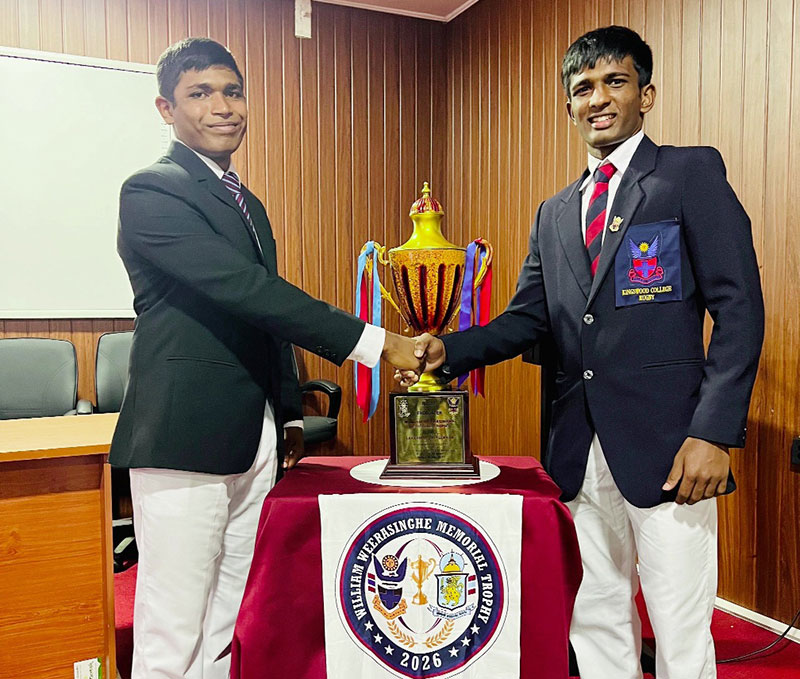
The annual rugby encounter between Dharmaraja College and Kingswood College, played for the William Weerasinghe Memorial Trophy, is set to take place today (July 11, 2026), at 4:00 PM at the Bogambara Stadium, Kandy.
The official unveiling of the trophy took place this week at the Dharmaraja College premises with the participation of the Principals of the two schools, teachers-in-charge of sports, coaches, the Rugby teams, and several distinguished guests, including Dharmaraja College Old Boys’ Association President Mahesh Wijetunga, Kingswood College Old Boys’ Association President Muditha Abeykoon,
Text and Pic by SK Samaranayake

History takes centre stage as Mandhana, Harmanpreet fifties steer India

Spain leave it late to book semifinal date with France

Showers will occur in the Sabaragamuwa, Western and North-western provinces and in Galle, Matara, Kandy and Nuwara-Eliya districts

US$ 2.5 mn cyber heist exposes system failures

Opposition signs no-confidence motion against Justice Minister for dereliction of duty over Negombo Prison deaths

AG informs SC of e-visa agreement review

‘Dates have the highest sugar content to fight Coronavirus’

Sunday Island 27 December – Headlines

#SundayIsland 17th December – Headlines

Sunday Island – 28th March

Sunday Island Headlines – 21 March

Sunday Island – 21st February – Headlines
-

 News6 days ago
Singapore-based Buddhist monk marks nearly four decades of humanitarian service
-
 News1 day ago
Herath warns prospective migrant workers not to get fleeced by racketeers
-

 News5 days ago
AI concerned over proposed SL military deployment in Haiti
-

 Midweek Review3 days ago
Unexpected focus on ‘pieces of tin’ worn by military men
-
 Latest News4 days ago
Nyamhuri and Ngarava stun Bangladesh by defending 141
-

 Features6 days ago
The NPP’s New Challenge: Balancing Easter Lawfare and Economic Welfare
-

 News2 days ago
Negombo Prison riot: Ensuring protection of prisoners fundamental responsibility of the state – UN
-

 Editorial3 days ago
Prison riots and political battles