
News
Dilmah Launches Grey2Green: A Call to Greening Our Urban Spaces


Colombo’s built-up areas have warmed by up to 4°C over the last two decades, according to a study published in the Journal of the National Science Foundation of Sri Lanka, emphasising the urgent need for more green spaces in the city.
In response to this growing ecological and social challenge, Dilmah Conservation and the United Nations Global Compact Sri Lanka launched Grey2Green on 22nd November – a transformative national movement inviting individuals, communities, organisations, and students to turn concrete “grey” areas into thriving green spaces,, a Dilmah new release said.
Unlike traditional greening efforts, Grey2Green is not a tree-planting campaign; it is a grassroots, citizen-powered movement seeded by Dilmah. The initiative empowers the public, universities, environmental groups, and institutions to identify neglected rooftops, unused land, industrial sites, and degraded pockets of the city and convert them into ecological oases.
To support participants, Dilmah will provide training in urban forestry, tree ecology, landscape planning, and ecosystem management through its expert network, ensuring that each site is restored using sound, sustainable science, it added.
The launch event outlined the programme’s vision, goals, and long-term roadmap, opening the door for widespread public involvement.
Grey2Green draws its inspiration from the success of the One Earth Urban Arboretum, where an industrial garment-waste dump was transformed into a green sanctuary, now home to more than 300 trees and shrubs. This pioneering project demonstrates how even the most degraded urban spaces can become biodiverse, restorative landscapes. Grey2Green aims to replicate this model in other parts of Colombo and its suburbs,th release said.
At the event, Dilmah Conservation presented its structured six-step method for community-led urban greening that will move from skill development, identifying locations, conducting baselines, greening, and long-term monitoring and maintenance. Speakers stressed that meaningful urban greening extends far beyond planting trees: it is a long-term, data-driven process integrating ecology, engineering, design, and community use.
Environmental lawyer Dr Jagath Gunawardana highlighted the ecological and human value of urban green spaces, describing them as vital refuges for wildlife in an increasingly fragmented city. Encouraging the public to treat urban gardens as “living laboratories,” he noted that four decades of his own observations – from migrant birds to invasive species to dragonflies – were simple yet powerful acts of citizen science. “If we stop seeing green, we will slowly lose our balance,” he reminded the audience. “Nature is not a luxury. It is a necessity.”
Plant taxonomist Dr Himesh Jayasinghe emphasised the need for careful plant selection, community engagement, and the use of data to identify heat islands and low-canopy areas. “Everyone wants green spaces, but we must also protect them. Leave only footprints,” he advised.
Representing the Central Environmental Authority, Dr Ajith Gunawardena emphasised that urban greening is now a national priority.
“This is not just planting trees. It’s science in action,” added Rishan Sampath, Manager, Conservation and Sustainability at Dilmah Tea, who highlighted opportunities for university students and citizen scientists to participate in monitoring, research, and long-term ecosystem management.
Speaking on the global significance of the initiative, Treshan Galappathy of the United Nations Global Compact Sri Lanka noted: “Urban greening is deeply aligned with global sustainability priorities, particularly SDG 11: Sustainable Cities and Communities and SDG 13: Climate Action. Initiatives like Grey2Green demonstrate how collective action can reshape our urban future.”
Ultimately, Grey2Green invites the public to co-create and safeguard vibrant, restorative urban spaces that enhance both environmental resilience and community wellbeing. Dilmah welcomes all who wish to learn about urban greening and contribute to healthier, greener cities to join the movement.
To learn more or get involved, contact Dilmah Conservation at 011 4 822 490 / 216 or email info@dilmahconservation.org



Former first lady Shiranthi Rajapaksa, wife of former President Mahinda Rajapaksa was produced before the Hulftsdorp court, after being arrested by officers of the Commission to Investigate Allegations of Bribery or Corruption (CIABOC) and produce

The U.S. Navy ship USS Tulsa (LCS 16) arrived at the Port of Colombo this morning, 7 October 2026 for replenishment purposes.
The visiting ship was welcomed by the Sri Lanka Navy in accordance with naval traditions.
The 127.7-metre-long platform is a Littoral Combat Ship commanded by Commander BM Wanier. Commissioned on 16 February 2019, USS Tulsa has since been in service with the US Navy.
The ship previously made a port call in Sri Lanka on 27 August 2025.

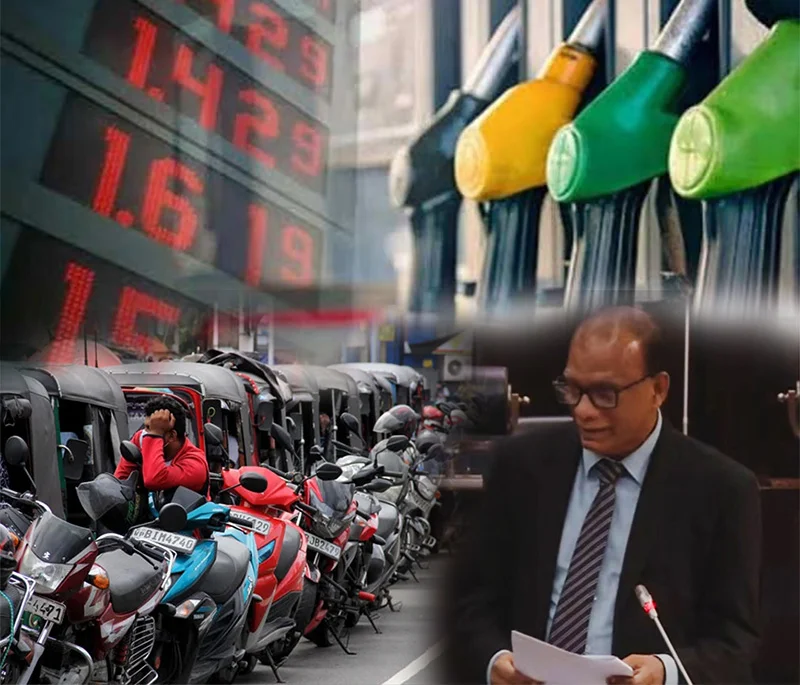
Govt. tells fuel distributors to maintain stocks to ensure uninterrupted supplies
by Saman Indrajith and Norman Palihawadane
The government had instructed private fuel distributors to maintain minimum stocks and ensure uninterrupted supplies to the market, Energy Minister Anura Karunathilaka told Parliament yesterday (06).
Karunathilaka said the Ministry of Energy Secretary had notified the relevant companies of the requirement, following a reduction in supplies by some private distributors, amid higher international fuel prices.
The Minister said private companies had informed the government that they were facing losses because international prices had risen while fuel was being sold, locally, at prevailing prices. As a result, some companies had reduced the volumes released to the market.
The reduced supplies had increased the burden on the Ceylon Petroleum Corporation (CPC), whose share of the diesel market had risen from about 54% to 82%, the Minister said.
“The CPC currently holds an 82% share of the market,” he said, adding that it had increased its supplies, compared with February, to compensate for the reduction by private distributors.
Karunathilaka said the government could not, under the existing agreements with private companies, specify the quantities they should supply to individual filling stations. However, it could require them to maintain minimum stocks in the country.
The Minister said the Energy Ministry had already instructed companies that had failed to maintain the required stocks to take steps to prevent supply disruptions.
The Minister attributed the queues reported at some filling stations to reduced supplies from private distributors, as well as normal variations in fuel distribution. He also said demand for CPC fuel had increased because private companies generally did not provide fuel to dealers on credit, while the CPC offered a three-day credit facility.
“We expect that, as the Ceylon Petroleum Corporation takes on this additional burden, the problem will ease to some extent by Wednesday or Thursday,” Karunathilaka said.
He said instructions had also been issued to increase supplies to CPC filling stations. A special discussion on the issue is scheduled for today (07), with officials of the Energy Ministry and CPC expected to participate,
along with President Anura Kumara Dissanayake.
Meanwhile, Petroleum Dealers’ Association officials have called for an early solution to the supply issue. Association Chairman D.V. Shantha Silva said queues had been reported at many filling stations, mainly those operated by private distributors.
He said the situation was not due to an overall shortage of fuel, but was linked to reduced orders by Lanka IOC, Sinopec and R.M. Parks amid concerns over losses incurred on fuel sales.
The Ceylon Petroleum Private Tanker Owners Association has urged motorists to refrain from panic buying, saying there was no nationwide disruption to fuel supplies.
The government earlier increased fuel prices and introduced a per-litre diesel subsidy following concerns raised by distributors over rising international prices.

Remembering Juvenal, Coke, Acton and Machiavelli

West Asian conflict undergoing manifold complications

Nissanka absence opens door for Sri Lanka’s young guns

The prelate who walked the talk

Needs of populace hit by Cyclone Ditwah seen as waiting to be addressed

Future of Sri Lanka’s state university system: Should it be shut down and reopened?

‘Dates have the highest sugar content to fight Coronavirus’

Sunday Island 27 December – Headlines

#SundayIsland 17th December – Headlines

Sunday Island – 28th March

Sunday Island Headlines – 21 March

Sunday Island – 21st February – Headlines
-

 Editorial6 days ago
Colombo Port drug bust: The plot thickens
-

 Features4 days ago
The first woman in the foreign service or Ceylon Overseas Service it was then called
-

 Editorial5 days ago
Fuelling discontent and protest
-

 News3 days ago
Geneva takes up Sallay’s case and govt. ignores opportunity to answer accusations
-

 Latest News5 days ago
Tharindu Rathnayake, bowlers secure Asian Games Bronze for Sri Lanka
-

 Features3 days ago
Sri Lanka Cricket Bill: Governance reform is not yet a cricket strategy
-

 Foreign News5 days ago
Ten injured after car crashes into rugby supporters in Australia
-

 News4 days ago
Nearly 20 Iranian tankers stranded off Lanka amid US sanctions