
Sports
Dharmaraja’s last wicket pair bat for 70 overs

Under 19 Cricket
by Reemus Fernando
The last wicket pair of Dharmaraja College batted for nine more overs on the second day morning to extend their partnership to 70 overs -one of the longest stands in First XI cricket with regard to overs- but nearly four hours long battle to add 70 runs prevented them from going for a result at Uyanwatta Stadium on Tuesday.
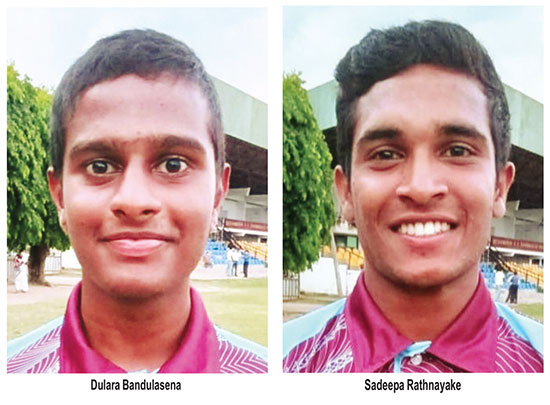
Dulara Bandulasena and Sadeepa Rathnayake joined together during the second session on day one. Dharmaraja were nine wickets down for 109 runs at that point. They kept their wickets intact for nearly four hours for the team to post 179 runs.
Bandulasena made 43(4x4s) in 234 balls and stayed at the wicket for 266 minutes.
Rathnayake remained unbeaten on 20. He faced 225 balls (1x4s) and batted for 238 minutes.
In reply Rahula were bowled out for 131 runs as Thisaru Wanninayake and Praveen Theekshana shared seven wickets between them.
A combined bowling effort from Dharmasoka forced Nalanda to follow on at Ambalangoda.
Following on, they were 95 for seven wickets at one stage but the late order batsmen fought back resisting for nearly 13 overs to force a draw. Eranga Jayakody anchored the tail scoring an unbeaten 21 in 109 balls. Lisura Sigera’s contribution was just 12 runs but he resisted facing 58 balls. So was Janula Indusara who faced 41 balls to remain not out on nine.
At Katugastota, Mohameed Aaqil (64) and Asitha Wanninayake (72n.o.) scored half centuries after Treveen Mathew picked up six wickets for St. Anthony’s to take command against St. Servatius’.
Results
Last wicket pair bat for 70 overs at Uyanwatta
Scores:
Dharmaraja
171 for 9 overnight 179 all out in 111.4 overs (Sachintha Dissanayaka 21, Thisaru Wanninayaka 26, Dulara Bandulasena 43, Sadeepa Rathnayaka 20n.o.; Pasindu Avishka 2/24, Gimsara Sonal 3/28, Sandew Ridmaka 4/54) and 92 for 1 in 14.4 overs (Pulindu Perera 43n.o., Dushyanga Gunasinghe 40n.o.)
Rahula
131 all out in 64.4 overs (Pasindu Shehan 41, Sasindu Battage 28; Thisaru Wanninayake 4/17, Praveen Theekshana 3/18)
Nalanda force a draw at Ambalangoda
Scores:
Dharmasoka
325 all out in 81.5 overs (Akash Mendis 32, Senitha Halambage 29, Manasa De Silva 52, Maneesha Rashmika 112, Senura Sandayuru 39; Lisura Sigera 2/38, Minod Caldera 3/80, Sajitha Vithanage 5/81)
Nalanda
42 for 2 overnight 165 all out 59.4 overs (Vinuja Ranpul 27, Dineth Samaraweera 43, Sajitha Vithanage 28; Pathum Malitha 2/25, Maneesha Rashmika 2/25, Ishan Anuradha 3/33) and 123 for 8 in 55 overs (Yasiru Samarakoon 39, Vinuja Ranpul 20, Eranga Jayakody 21n.o.; Senitha Halambage 3/26, Jithira Sansika 2/24)
St. Anthony’s dominate at Katugastota
Scores:
St. Servatius’
107 all out in 38.4 overs (Kushan Wijerama 22, Deneth Kawya 22n.o.; Divyesh Ramaiya 3/19, Treveen Mathew 6/23)
St Anthony’s
251 for 5 in 54 overs (Thisara Ekanayake 40, Mohameed Aaqil 64, Asitha Wanninayake 72n.o., Lahiru Abeysinghe 40, Chandimal Herath 24n.o.; Hasitha Amarasinghe 4/51)



Sri Lanka won the toss and elected to bowl first in the Asian games semifinal clash against India.
Sri Lanka XI: Lasith Croospulle, Sineth Jayawardene, Sohan de Livera (wk), Ashen Bandara, Sahan Arachchige (c), Nuwanidu Fernando, Chamika Karunaratne, Wanuja Sahan, Tharindu Rathnayake, Binura Fernando, Vijayakanth Viyaskanth

by Rex Clementine
President’s Counsel Dinal Phillips has defended a key provision in the proposed new constitution for Sri Lanka Cricket that allows one of the appointed members, rather than an elected representative, to serve as Chairman of the Board. There have been concerns that a former cricketer will not be able to be appointed as Chairman of SLC if the new constitution comes to effect, but Philips said that the country needed to move on with times.
Successive governments have promised sweeping reforms at the cricket board but delivered precious little. The NPP government, however, has taken concrete steps towards overhauling the administration, with a new constitution now in the public domain.
The proposed constitution has been gazetted and will be debated in Parliament, while the Supreme Court will determine whether its provisions are consistent with the laws of the country. Stakeholders will also have an opportunity to challenge provisions they consider contentious.
Once the legal and parliamentary process is completed, the new constitution will come into force, making SLC answerable to Parliament and by extension, to the public.
“The Chairman of the Board will be from among the appointed individuals because there needs to be a great deal of independence on the Board. You are talking about a Rs. 16 billion organisation,” Phillips told reporters at SLC headquarters yesterday.
Phillips has been a prominent figure in cricketing circles in recent years. He represented his Royal College schoolmate Kusal Janith Perera during the legal battle that eventually cleared the batsman following a doping suspension. He is also a former President of Tamil Union, one of SLC’s controlling clubs.
“You have to have people with sound accounting backgrounds, legal expertise, marketing and IT knowledge involved in running your cricket board. All those areas are covered in this structure,” Phillips said.
“The powers will also be vested in the CEO of SLC and he will run the business of the organisation. The Board of Directors will execute policy.”
Phillips, together with fellow legal expert Upul Kumaraperuma, played a key role in drafting the proposed constitution.
“Look at other parts of the world. We don’t want to be left behind; we want to move with the rest of the world. These are serious, long-term steps. We are trustees for 20 million people. We have been asked questions about what is happening to our cricket. We want to raise the bar,” Phillips added.
SLC chief Eran Wickramaratne was also present at the briefing and faced questions over the national team’s disappointing tour of England, where Sri Lanka were whitewashed 3-0 in the T20I series before enduring an inconsistent ODI campaign.
“We want to see the team winning, no doubt about that. But we don’t have concerns about individuals, say, for example, Gary Kirsten. It requires time to build,” Wickramaratne said.
“In 2011, we were ranked number four in Tests, number three in ODIs and number three in T20s. If you look at where we are now, we are towards the lower end; seven, eight or nine.
“That decline has happened over a period of ten to 15 years. You have to be realistic. Any coach who comes in cannot change things overnight. But we are on the right road.”

by Reemus Fernando
The Sri Lanka Automobile Association in Japan (SLAAJ) awarded a brand-new Honda Vezel to gold medallist Rumesh Tharanga at a felicitation ceremony held for the Sri Lankan team that competed at the Asian Games in Nagoya, Japan.
The gift was presented at a ceremony, held on the eve of the track and field team’s departure from Nagoya.
Sri Lanka’s team captained by Thranga concluded the track and field campaign on Tuesday.
Tharanga’s gold was the solitary medal won by the team.
”We decided to reward every Sri Lankan athlete who wins a gold medal with a brand-new vehicle. We invited all Sri Lankan athletes taking part in the Games to the felicitation, and at the time of the event, only Tharanga had won gold,” Nishantha Meegalla, Vice President of the Nagoya Prefecture of the Sri Lanka Business Council of Japan, told The Island.
Nishantha said that Tharanga will be able to get his vehical from the Hambantota Port.
He said that sea freight charges up to Hambantota port will be taken care of on behalf of Tharanga and it would be incumbent upon the government authorities to decide to waive off any taxes for the newly crowned Asian champion to receive the gift.
Tharanga, the world’s top-ranked javelin thrower this season, won Sri Lanka’s first-ever javelin medal at the Asian Games on Monday, sealing the historic victory with a throw of 88.55 metres.
With his Asian Games triumph the 23-year-old capped a remarkable season where he claimed multiple global titles including the Diamond League title, Commonwealth Games gold and the Ultimate Championship trophy.

Sri Lanka bowl first in semi final clash against India

Trump hints US could strike Iran, warns time coming

Showers or thundershowers will occur at most part of the island after 1.00 p.m.

US-assisted ‘Ice’ detection: NPC to examine IGP’s move to transfer drug-busting team

2027 Budget to be held from 12 Nov. to 14 Dec.

CB Governor confident over timely disbursement of next IMF tranche; hands post-2027 programme decisions to govt.

‘Dates have the highest sugar content to fight Coronavirus’

Sunday Island 27 December – Headlines

#SundayIsland 17th December – Headlines

Sunday Island – 28th March

Sunday Island Headlines – 21 March

Sunday Island – 21st February – Headlines
-

 Editorial5 days ago
Birth of a bad law
-

 Features6 days ago
Beyond traditional jobs: Why Sri Lanka needs to facilitate the gig economy
-

 News3 days ago
Police remove Thileepan statue in Jaffna
-
 Latest News6 days ago
Kusal, Wellalage star as Sri Lanka defend 322 in Headingley thriller
-

 News5 days ago
TIN mandatory for key transactions from Nov. 1
-

 Features3 days ago
The 22nd Amendment, constitutional recovery and illiberal slippage
-

 Features3 days ago
Of foreigners as CEOs of Lankan ventures
-

 News3 days ago
Sajith rejects Jt. Opp. protest sabotage claim; SJB TU chief demands remedial action