
Latest News
Dhananjaya de Silva digs deep for Sri Lanka as England cement their dominance


Dhananjaya de Silva was a lone figure of resistance for Sri Lanka, as he justified his own decision to bat first with a battling 74 from 84 balls on the first day of the Old Trafford Test. Sadly for the captain, however, the rest of his top-order could not summon the same levels of gumption. An initial collapse of three wickets for no runs in ten balls gave way to a tea-time total of xx for 8, as de Silva’s own dismissal to Shoaib Bashir five minutes before the break continued a satisfying first taste of international captaincy for his counterpart, Ollie Pope.
De Silva himself arrived at a sickly scoreline of 40 for 4 in the 16th over, moments after Kusal Mendis had been blasted from the crease by a brute of a delivery from Mark Wood. But, after making it to lunch on 28 not out, he grew into his role as wickets continued to slide away in the afternoon, bringing up a 56-ball fifty as he found some doughty allies lower down the order, not least the debutant Milan Rathnayake, with whom he added 63 for the eighth wicket.
It was a gutsy knock from de Silva, who farmed the strike well in between a diet of eight well-struck boundaries, each of them showcasing his sharp footwork and delicate balance. But having survived a stumping off Bashir on 65, when Jamie Smith failed to gather cleanly with the bails at his mercy, he fell to the same bowler nine runs and ten overs later, when Dan Lawrence at leg slip scooped up a sharp low deflection off a big-turning offbreak.
Nevertheless, de Silva alone had showed what should have been possible on a hard and dry surface that offered good carry to the quicks, and which Pope expected would stay true for the first half of the contest at least.
Choosing to bat first may have been the brave option for Sri Lanka, but Pope himself admitted he would have bowled first anyway, and even before the end of the first half-hour, de Silva’s call was being made to look distinctly foolish. After inching along to 6 for 0 in a misleadingly sedate first 5.3 overs, the innings was soon in tatters at 6 for 3 after seven.
The first blow was landed by Gus Atkinson, whose initial focus had been on a full length and a tight line, to limit Dimuth Karunaratne to a solitary scoring stroke in his first 17 deliveries. Atkinson then bent his back on a sharp lifter from just back of a length, and Smith reached high behind the stumps to claw down a thin top-edge, as Karunaratne fluffed his first shot in anger, an expansive swish across the line.
Four balls later, Nishan Madushka’s early discipline also deserted him as Chris Woakes served up a juicy outswinger that he could only scuff straight to Joe Root at first slip, who clung on in the heel of his palms. And with the final ball of the same over, Woakes had his second courtesy of a ghastly misjudgement from Angelo Mathews. The hero of the 2014 series win was gone for a five-ball duck, burning a review in the process as he offered no stroke to an inducer that was shown to be hitting the top of middle.
Kusal and Chandimal showed some gumption in a limited counterattack, with the first five boundaries of the innings all coming in the space of 12 balls, four of them to Kusal off Matthew Potts, whose wide angle into the stumps offered the chance to free the hands through the off-side.
But, after limping to drinks on 37 for 3, there was another challenge waiting for the second hour. Wood tore into his opening spell with typical gusto, and struck with his seventh ball – a gruesomely quick lifter to Kusal that crashed into his left thumb and looped to Harry Brook at second slip. Much like the snorter that broke Kevin Sinclair’s wrist in the West Indies series, Kusal left the crease wringing his hand, and looking in urgent need of an ice-pack at the very least.
Out came de Silva to shore up the listing innings, but with lunch approaching, his measured stand of 32 in seven overs with Chandimal was undone in cruel and unusual fashion. Shoaib Bashir entered the attack for an exploratory pre-lunch spell, and struck in his second over with an unplayable daisycutter, reminiscent of Nasser Hussain’s viral moment against Carl Hooper in Trinidad in 1998.
Chandimal was the luckless victim, nailed on the shin in line with off stump as he played back to a length delivery that scuttled more wickedly than you could even have expected on a fifth-day wicket, let alone before lunch on day one. He gambled on the review, hoping against hope that he’d been struck outside the line, but Bashir’s sheepish appeal and celebration could have told him everything he needed to know.
Sri Lanka’s steady seepage of wickets continued into the afternoon. Kamindu Mendis, who came into the match with a towering Test average of 107.00 after five previous innings, looked settled for a time, particularly when he rocked back on a rare wide delivery from Woakes to lash his first boundary through the covers. One ball later, however, Woakes changed his approach to round the wicket and delivered the sucker punch: a length ball, angling into the stumps, that the newly pumped-up batter couldn’t resist flirting through to the keeper.
Atkinson then bagged his second in similarly guileless fashion. Prabath Jayasuriya looped a limp uppercut to gully as England switched to a short-ball ploy, only to be reprieved by the third umpire who called no-ball for three bouncers in the over. Not to be discouraged, Atkinson simply fired the extra delivery through on a fuller length, and Jayasuriya snicked off with his feet stuck in the crease.
Rathnayake, however, would not prove quite so gullible in his shot selection. Despite channelling a bashful schoolboy while being presented with his Test cap by Kumar Sangakkara before the start of play, he was more than man enough to withstand England’s eager attempts to dislodge him, picking off four fours in his 67-ball 32 not out. More of the same will be needed after tea if Sri Lanka are to nudge their total past 200.

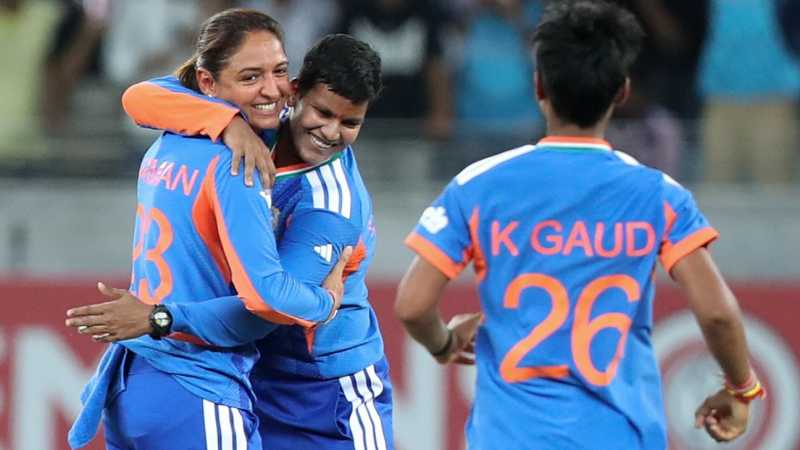
Pakistan were bowled out for 55, their lowest total in T20I cricke. A collapse where they lost six wickets for eight runs in 29 balls set them so far back that they couldn’t even bat out 20 overs. Harmanpreet Kaur, who broke new ground by becoming the first player – male or female – to lead her team 150 times in T20Is, had the time of her life celebrating each wicket and eventually scoring the winning runs as well.
Shree Charani shines
Old-fashioned left-arm spin is having a resurgence. India men have found Manav Suthar. India women already had N Shree Charanin. The No. 1-ranked T20I bowler in the world picked up two wickets in her first over on Saturday.
The flight on the ball drew Gull Feroza out of her crease. The drift in had her looking leg side. The dip and the turn resulted in a leading edge and a simple catch to point. The bowler did everything right. The batter did everything wrong. Shawaal Zulfiqar was the only Pakistan batter to put any kind of pressure on India. Charani had her lbw for 14 off 14 and from there it was a procession.
Pakistan’s batting troubles
Playing their 200th T20I, Pakistan went from 27 for 0 to 35 for 6 before the innings was halfway done. They could not find a risk-free way to score runs, absorbing long periods of dot balls and trying to get out of it by playing low-percentage shots, often against the turn, on a Dubai pitch that was offering plenty of it. Only the openers got to double digits and only Zulfiqar was able to score a run a ball.
Rawat’s support act
Prema Rawat finished with figures of 4-0-9-3. Nineteen of her 24 balls were dots. All of that is remarkable considering she is a legspinner, whose release points tend to be just shy of the perpendicular. Like Shane Warne. From there, they turn their wrist over and it can either be awesome or awful. Rawat’s release point is perpendicular, maybe even beyond it, like Rashid Khan’s. And she doesn’t turn her wrist. For the most part, she just flicks the ball out the front of her hand. This gives her better control at the cost of big turn and in T20Is, that trade-off is well worth it. Nobody could hit Rawat off her line and length and when Sadaf Shamas tried, she got bowled off her pads.
A simple enough chase
Scores:
India Women 57 for 3 in 8.4 overs (Shafali Verma 12, Harmanpreet Kaur 18*, Deepti Sharma 12*; Fatima Sana 3-17) beat Pakistan Women in 18.1 overs 55 (Muneesha Ali 13, Shawal Zulfiqar 14, Shafali Verma 1-10, Shree Charani 3-07, Deepti Sharma 2-05, Prema Rawat 3-09) by seven wickets
(Cricinfo)
Latest News
Sun directly overhead Bentota, Thiniyawala, Iththakanda, Udawalawe, and Kataragama about 12.08 noon t9day (06)

The sun is going to be directly over the latitudes of Sri Lanka from 28th of August to 07th of September due to its apparent southward relative motion.
The nearest places of Sri Lanka over which the sun is
overhead today (06) are Bentota, Thiniyawala, Iththakanda, Udawalawe, and Kataragama about 12.08 noon

Rumesh Tharanga created history in emphatic fashion, winning the men’s javelin at the Diamond League Final in Brussels to become the country’s first Diamond League champion.
The recently crowned Commonwealth champion sealed the prestigious Diamond Trophy with a superb third-round throw of 89.04 metres, producing yet another major performance on the biggest stage.
Tharanga became the first Sri Lakan to win a top position at a global competition conducted under the auspice of World Athletics.
The victory also extended Tharanga’s extraordinary run of form, giving him his 12th victory in his last 13 competitions. His only defeat during that sequence came earlier in the season, underlining the consistency that has made him one of the outstanding performers in world javelin this year.
Tharanga’s winning effort was enough to keep a determined international field at bay, with Poland’s Dawid Wegner producing a lifetime best of 87.47m to take the silver medal. Trinidad and Tobago’s Keshorn Walcott completed the podium in third place.

Shree Charani, Prema Rawat spin Pakistan out for 55 in one-sided contest

Sun directly overhead Bentota, Thiniyawala, Iththakanda, Udawalawe, and Kataragama about 12.08 noon t9day (06)

Showers above 75 mm are likely at some places in the Uva and Eastern provinces.

Tharanga creates history with Diamond League crown in Brussels

UN welcomes Lanka’s anti-graft drive, seeks end to impunity

Dispute which triggered listed company director being detained at BIA resolved

‘Dates have the highest sugar content to fight Coronavirus’

Sunday Island 27 December – Headlines

#SundayIsland 17th December – Headlines

Sunday Island – 28th March

Sunday Island Headlines – 21 March

Sunday Island – 21st February – Headlines
-

 Features6 days ago
When Sri Lankan stories find their own voice
-

 News6 days ago
BASL takes exception to Justice Ganepola being denied a place in SC
-

 News3 days ago
Denied of promotion to SC despite vacancies, justice Gurusinghe retires
-
 Latest News4 days ago
Grade 5 scholarship exam results released
-

 News3 days ago
22A: SC urged to suspend hearing, appoint full bench
-

 Midweek Review4 days ago
The local and global dynamics of Sri Lanka’s 22nd Amendment
-

 Business6 days ago
ADB-funded Thalaiyadi plant serves as blueprint for vulnerable dry zones in Sri Lanka
-

 News4 days ago
Ai-CHA expands Lankan footprint with new Negombo outlet