
Business
DFCC Bank breaks new ground as Sri Lanka’s 1st bank in the Metaverse with DFCC Galaxy


DFCC Bank, Sri Lanka’s Bank for Everyone, has recently launched DFCC Galaxy, making it the first-ever Sri Lankan bank to open a virtual branch in the Metaverse. With this new development, DFCC Bank has taken a pioneering step, setting a benchmark for innovation and digitalisation in Sri Lanka’s banking and financial services space. DFCC Galaxy is set to revolutionise the banking industry in Sri Lanka, providing customers with a new, more exciting, accessible, and engaging way to Bank.
DFCC Galaxy provides an immersive banking experience, allowing customers to explore the virtual branch, interact with other users, play interactive games, and enjoy many benefits. Customers can also use DFCC Galaxy to access a 24×7 chatbot and live customer support, making banking more convenient. DFCC Galaxy is a virtual branch experience that can be enjoyed and explored from the comfort of your home.
“We are extremely excited to announce the launch of DFCC Galaxy. This is a significant milestone, not just for us as a bank, but also as the 1st Bank in Sri Lanka to open a virtual branch in the Metaverse,” exclaimed Thimal Perera, CEO at DFCC Bank, “DFCC Galaxy demonstrates our commitment to continuous innovation and providing our customers with a banking experience that is both convenient and engaging. Digital innovation and integration are key focus areas for DFCC and are clearly outlined in our sustainability strategy, which is our roadmap towards emerging as “the” Bank for green finance in Sri Lanka by 2030. Virtual banking and the shift towards digital are essential in helping us create more resilient societies and minimising our carbon footprint, and we are proud to be a leader in the space with this initiative.”
DFCC Bank has always been driven by customer centrism, and DFCC Galaxy is just another example of the Bank’s dedication towards providing its customers with the best possible banking experience based on their needs and desires. Customers and the public can use DFCC Galaxy to obtain assistance with account opening and credit card applications and access information on DFCC Bank’s diverse financial products and services, making banking more accessible. Why not check out DFCC Galaxy yourself by visiting https://galaxy.dfcc.lk/ and explore the first metaverse banking experience in Sri Lanka!
DFCC Bank, driven by its commitment to customer centricity, sustainable finance, and social upliftment, has consistently been among the digital transformation leaders within Sri Lanka’s banking and financial services space. The Bank was the first or among the first to introduce many revolutionary technologies, such as omnichannel AI-assisted instant customer support, DFCC Video Chatz and digital banking apps and services such as DFCC Virtual Wallet – the perfect companion for your financial and lifestyle needs – and DFCC iConnect – which provides SMEs and corporates in Sri Lanka the latest cutting-edge digital cash management, financial tracking, and transactional banking services. DFCC Bank is also responsible for extensively advocating for and promoting financial inclusivity through its digital banking services across Sri Lanka. DFCC Galaxy is another crucial step on this incredible journey.


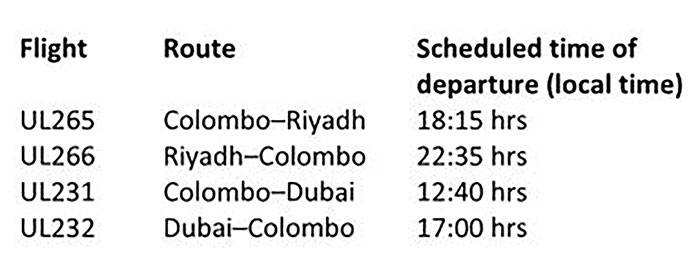
09 March 2026; Colombo – SriLankan Airlines would like to inform passengers that it is resuming daily services to Riyadh tonight and Dubai tomorrow, while continuing to closely monitor the situation in the Middle East and prioritising the safety and wellbeing of its passengers and crew.
The following flights are scheduled to operate:
For more information please contact: 1979 (within Sri Lanka); +94 11 777 1979 (international); WhatsApp +94 74 444 1979 (chat only); your travel agent; visit www.srilankan.com; or follow us on social media.


Global oil prices have jumped above $100 (£75.11) a barrel for the first time since 2022 as the escalating US-Israeli war with Iran has fuelled fears of prolonged disruption to shipments through the Strait of Hormuz.
Iran on Sunday named Mojtaba Khamenei to succeed his father Ali Khamenei as Supreme Leader, signalling that a week into the conflict hardliners remain in charge of the country.
The US and Israel launched fresh waves of airstrikes across Iran over the weekend, hitting multiple targets including oil depots.
Major disruption to energy supplies from the region threatens to push up prices for consumers and businesses around the world.
Early on Monday in Asia, Brent crude was around 15.5% higher at $107.16, while Nymex light sweet was up by more than 17% at $106.77.
Stock markets in the Asia-Pacific region fell sharply in early trading on Monday, with Japan’s Nikkei 225 index down by more than 5% and the ASX 200 in Australia more than 3.5% lower.
Many in the markets predicted that oil would hit the $100 a barrel mark this week.
In the event it took about a minute to jump 10%, and then another 15 minutes to rise a further 10% in early Asian trading.
Last week the markets had been relatively relaxed about the seeming nightmare scenario for millions of barrels of crude and liquefied natural gas trapped in the Gulf, unable or unwilling to transit the Strait of Hormuz.
But the escalations over the weekend, alongside scenes of destruction of energy infrastructure both in Iran and across the Gulf, saw the markets take rapid fright.
The question now is where does this go? Some analysts argue that if the shutdown in the strait lasts until the end of March, we could see record oil prices above $150 a barrel.
The existing rise is likely to further increase petrol prices, and those of important derivative products such as jet fuel and vital precursors for fertilisers.
The physical supplies from the Gulf are mainly consumed in Asia.
Already however there are signs that Asian consumers are bidding up prices for US gas, with some tankers originally heading for Europe turning around in the mid-Atlantic.
US President Donald Trump responded to the jump in prices by saying that short term rises were a “small price to pay” for removing Iran’s nuclear threat.
His energy secretary told US broadcasters on Sunday that Israel, not the US, was targeting Iran’s energy infrastructure, amid some concern about rising domestic pump prices caused by the war.
(BBC)

The Ceylon Motor Traders’ Association (CMTA) has issued a stark cautionary note to prospective vehicle buyers, warning that the initial price advantage of reconditioned imports often masks significant long-term financial risks.
By highlighting a “structural imbalance” in the current duty valuation system – which allows near-identical vehicles to be imported under a 15% automatic depreciation bracket – the CMTA argues that the lack of manufacturer-backed warranties and tropicalised specifications in the grey market could lead to a “reconditioned trap” for unsuspecting consumers. For the savvy buyer, the association suggests that the true cost of ownership is increasingly tilting the scales in favour of brand-new vehicles from authorised agents.
If two identical 2026 models are sitting on different lots, and one is significantly cheaper because it was technically “registered and de-registered” abroad, the frugal buyer’s instinct is to take the discount. But the CMTA argues that this 15% depreciation benefit – intended for genuine used cars – is being leveraged as a loophole for zero-mileage vehicles.
For the savvy buyer, this raises a fundamental question of transparency. If the entry price of a vehicle is built on a “procedural” technicality rather than actual wear and tear, where else is the transparency lacking? Does the lower price reflect a genuine saving passed to the consumer, or does it mask a lack of manufacturer-backed after-sales support?
When a buyer chooses an authorised agent, they are essentially purchasing an insurance policy against the unknown. With a five-year manufacturer warranty, the financial burden of a faulty transmission or a software glitch stays with the global giant that built the car, not the local owner. In an era where vehicles are increasingly “computers on wheels,” the technical specialised tools and genuine parts held by authorised agents are no longer a luxury – they are a necessity for longevity.
The CMTA’s perspective also invites the buyer to look at the “Big Picture.” Every time a vehicle is imported under an under-declared value or an artificial depreciation bracket, it isn’t just a loss for the Treasury; it is a blow to the country’s foreign exchange discipline.
“A savvy buyer today is more informed than ever. They realize that a “cheap” import with no service history and no tropicalised specifications may eventually become a “minus” on the balance sheet. Frequent repairs and lower resale value can quickly evaporate the initial few lakhs saved at the point of purchase. Ultimately, the choice between brand new and used is a choice between certainty and speculation,” the Association says.
The CMTA is advocating for a level playing field where duty is based on true transaction value. Until that day comes, the burden of due diligence rests on the consumer. To be a “savvy buyer” in 2026 means looking past the showroom shine and asking: Who stands behind this car if something goes wrong tomorrow?
In conclusion, CMTA says,” For those seeking long-term peace of mind, the “brand new” path – supported by a transparent duty structure and a solid warranty – remains the gold standard for steering Sri Lanka’s complex automotive landscape.”
Before signing the papers on a reconditioned vehicle, the CMTA suggests buyers evaluate the four “minus” factors against a “brand new” purchase:
By Sanath Nanayakkare

Prime Minister on official visit to Manila, Philippines

It is the government’s responsibility to ensure women’s rights are realized in everyday Life, and are not confined merely to Laws – PM

North Korea cancels Pyongyang Marathon for ‘some reasons’

Canadian officials rescue 23 people who floated away on ice sheet

India offered sanctuary to Iranian ship three days before US sank it

Afghanistan-Sri Lanka white-ball series set to be postponed due to West Asia conflict

‘Dates have the highest sugar content to fight Coronavirus’

Sunday Island 27 December – Headlines

#SundayIsland 17th December – Headlines

Sunday Island – 28th March

Sunday Island Headlines – 21 March

Sunday Island – 21st February – Headlines
-

 News4 days ago
University of Wolverhampton confirms Ranil was officially invited
-

 News5 days ago
Legal experts decry move to demolish STC dining hall
-

 News4 days ago
Female lawyer given 12 years RI for preparing forged deeds for Borella land
-

 News3 days ago
Peradeniya Uni issues alert over leopards in its premises
-

 Business5 days ago
Cabinet nod for the removal of Cess tax imposed on imported good
-

 News4 days ago
Library crisis hits Pera university
-

 News3 days ago
Wife raises alarm over Sallay’s detention under PTA
-

 Business6 days ago
War in Middle East sends shockwaves through Sri Lanka’s export sector