
Business
Debottlenecking the Strained Supply Chain during Covid-19 Pandemic and Beyond


by Denver Brian Coorey
The SARS-COV-2 or the novel Coronavirus Crisis has pushed economies into recession or even depression by triggering economic downturns caused by long-orchestrated lockdowns that brought down International trade to a near standstill.
The Pandemic has changed the business environment for many organizations around the globe. As the acute restrictions and lockdowns created many urgent situations that required immediate attention in the early days of the pandemic, many companies now have begun to move to a “recovery mode” having started not only short and medium term, even long-term planning strategies. It is clear that companies have been faced with substantial business and operational disruptions which include mitigating the effects of reduced supply and stocks in hand, managing disruptions to logistical providers, reviewing contractual obligation and many more.
As a result of the closure of export customer facilities due to disruptions and lock down situations in the target markets overseas, revenues of our exporters/manufacturers reduced during the pandemic affecting cash flows and overhead absorption. However industries adapted fairly well by minimizing overhead costs and diversifying products and delivery channels to mitigate the adverse effects on the revenue, profitability and cash flows. Further, assistance by means of new working capital loans and extensions for existing loans were provided by banking sector as per regulator guidelines.
It is seen that the importance of supply chain resilience and risk management has become more apparent than ever before.
Nevertheless, badly affected companies need a vibrant revival strategy with a positive approach.
The Supply Chain and its current strained state
The movement of goods and services from the point of origin- POO ( Raw material/product supplier) to the point of consumption-POC ( consumer) involving various stages or phases is known as a Supply Chain. Further, it includes the flow of products, information and funds.
The objective of the Supply Chain is to fulfill the requirements of the customer by a smooth flow without disruptions and bottlenecks. As we are aware, during the pandemic most of the global supply chains have been disintegrated and disrupted. It can be a problem mainly related to product, information and most crucially funds.
Let me highlight some of the key areas with bottlenecks observed in the supply chain.
Demand Planning- it is hard to establish forecasts of demand as the future is unknown and unpredictable. Forecasts can generally deviate from the original projections as per its characteristics, but during this pandemic it will be further inaccurate. Historical data will not help establish demand forecasts during crisis such as a global pandemic.
Sourcing- Numerous tier 1 and 2 suppliers have gone out of business and supplier selection process has become a difficult operation. Availability of raw materials /products is lower than before.
Procurement- Decisions on what to buy, when to buy and how much to buy is somewhat questionable and risky as the organizations do not properly foresee the market future .We may use Material Requirement Planning (MRP ) software programmes to establish e buying decisions but inputs such as future demands, safety / buffer stock and the lead time will vary greatly and more rapidly due to the unfurling Covid 19 pandemic situation, hence the output from such systems too will not give the required authentic results.
Lead time- This has exploded due to overwhelming demands on one hand and the demand fluctuations on the other. It is observed that disruptions and delays in production, internal transport (haulage), booking of vessels, stevedoring, sailing times and also congestion in ports add to severe delays in lead times. As we all know currently there is a huge delay in shipping due to disruptions and restrictions in logistics all over the world.
Distribution to the final user/consumer – during the pandemic the objective of the distribution is not fulfilled. That is to deliver to the right place at the right time has somewhat not achieved during the pandemic.
Rebuilding the strained Supply Chain
We have identified some of the key areas of bottlenecks observed in a strained Supply Chain. Now let us see how the debottlenecking should progress in order to have a resilient supply chain.
Planning and Procurement- In a restricted supply chain operation, the organization should identify, carefully analyze and ascertain the “real” need of the raw material /products etc. Short and medium term planning is advisable as long term strategic planning should only be done if the Supply Chain Managers properly foresee the future of markets. What to order, when to order and How much to order should be determined by MRP using the basic principles of procurement such as future demand, stock in hand with safety stock, on way stocks, lead times prevailing during pandemic, production delays if any, port congestion and possible delays, transport availability etc.
Hence, identifying the correct order quantity is vital since it will reflect on the future stocks, production and distribution. During a pandemic, a robust plan may not be activated or fully implemented. It is desirous to evaluate real time data as far as possible. However, no ad hoc or haphazard planning should be encouraged. Further, it is important to formulate a contingency plan for emergency situations.
Sourcing- Supplier network to be updated to consider new sources if Tier 1 and 2 suppliers are not performing or if the prices have gone up tremendously due to the pandemic. Availability of the required quantities with supplier must be known prior to ordering.
Lead time- this is key as it has a lot of concerns from the raw material stage, production, transport to final destination. Estimated Time of Delivery / Estimated Time of Arrival (ETD/ETA) to be known and properly followed up with the supplier/ shipping agents.
Distribution- delivering to end user should also be planned as per the identified priorities. Distribution resource planning/Distribution requirement planning (DRP) through the system network will provide what to deliver, when to deliver and how much to deliver to the correct locations. Most importantly the inputs to the system must be accurate, specific and timely.
In addition to above identified areas for de-bottlenecking, as Steve Jobs said the way to de-bottleneck a problem is to simplify, simplify and simplify the process. Reducing non-moving inventory as it releases more warehouse space and release locked up capitals, is one such area. Simplifying the supply chain and having a separate supply chain for different types of demand profiles can significantly reduce the clutter. It is noted that many top companies simplified their planning, ordering and distributing (delivery) using modern technology and further, outsourcing of certain activities are encouraged specially during the pandemic and beyond. In general simplifying means reducing the phases in the supply chain to fewer steps from supplier to customer.
Let me briefly touch upon the current most important and much talked, distribution of vaccines in Sri Lanka.
As I mentioned under the above demand planning, the “real” need should be identified, analyzed and ascertained considering most vulnerable groups, high risk groups/ areas, age groups districtwise, as per MOH areas , GN divisions, etc. It is needed to carefully follow the above procedure till the consignment is cleared for product release and distribution to identified locations. It is also important to formulate a contingency (alternate) plan if the existing plans fail.
The top management of organizations should take control of the Supply Chain during the pandemic and needs to manage and control the supply chain at every stage or phase ensuring the smooth flow towards the end customer. Supply Chain Management is key to the success and increased performance of a supply chain. Companies looking to change their supply chains should consider how to integrate elements and practices around environmental protection, product sustainability and ethical business practices.
Radically changing an existing supply chain is not as easy as it may sound as creating a robust and secure supply chain will need to balance the demands for cost efficiency. At the same time, new logistics considerations may also have an impact on supply chains and the changes thereto. In the short and medium term, it is expected that companies will begin to search for more diversified supplier base while looking to develop a flexible and a resilient but cost efficient supply chain.
In conclusion, may I suggest that companies appoint a facilitator/a senior manager, preferably a position in the board room that has the responsibility and authority to rebuild the supply chain and coordinate with planning, procurement, quality, production, marketing, sales and distribution or hire an external Supply Chain Advisor to inject best-in-class competencies into your Supply Chain team.
Companies that are faster in rebuilding their Supply Chains will have a competitive edge and will conquer a major market share.
(The writer Denver Brian Coorey is a Consultant /Lecturer on Supply Chain Management and can be contacted on suveentrading@yahoo.com)


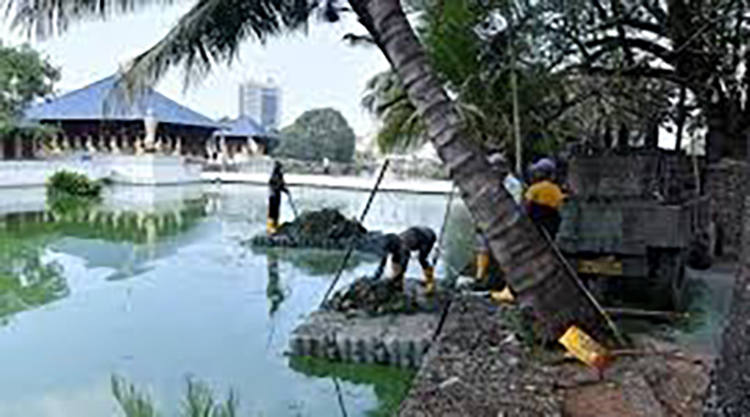
Sri Lanka’s decision to invest Rs. 2.5 billion in restoring the heavily polluted Beira Lake marks one of the most significant urban environmental interventions in recent years, underscoring a growing recognition that ecological rehabilitation is also an economic imperative.
The multi-pronged project—covering the closure of illegal sewage discharge points, large-scale dredging, and the installation of aeration systems—is expected to not only revive aquatic life but also unlock commercial, tourism and real estate value in the heart of Colombo.
Officials say the initiative is designed to transform Beira Lake from a long-neglected liability into a productive urban asset.
A senior official from the Ministry of Environment told The Island Financial Review that untreated wastewater and illegal sewer connections had been the primary contributors to the lake’s degradation for decades. “Closing these illegal sewage points is the most critical intervention. Without that, any dredging or aeration would only offer temporary relief, the official said, adding that enforcement will be carried out in coordination with the Colombo Municipal Council (CMC) and other regulatory agencies.
From a business perspective, the clean-up is being viewed as a catalyst for urban regeneration. Urban Development Authority (UDA) sources noted that a healthier Beira Lake would significantly enhance the attractiveness of surrounding commercial developments, hospitality projects and public spaces. “Environmental remediation directly impacts land values and investor confidence. A clean, living lake changes the entire economic profile of the area, an UDA official said.
The dredging component of the project is aimed at removing decades of accumulated sludge, which has reduced water depth and contributed to foul odours and fish die-offs. According to officials involved in project planning, the dredged material will be disposed of following environmental guidelines to avoid secondary pollution risks—an issue that has undermined similar efforts in the past.
Meanwhile, the installation of modern aerators is expected to improve dissolved oxygen levels, a key requirement for sustaining fish and other aquatic organisms. “Restoring aquatic life is not just about biodiversity; it is about creating a water body that can safely support recreational activities and public engagement, a senior CMC engineer explained.
Economists point out that the Rs. 2.5 billion allocation, while substantial, should be seen against the long-term cost savings and revenue potential. Reduced public health risks, lower water treatment costs downstream, increased tourism activity and higher commercial footfall could deliver returns that far exceed the initial outlay.
By Ifham Nizam

CSE activities kicked off on a negative note initially but later experienced some recovery yesterday because most investors were anticipating positive third quarter result shortly, market analysts said.
Amid those developments, the market indicated mixed reactions. The All Share Price Index went down by 4.13 points, while the S and P SL20 rose by 14.02 points. Turnover stood at Rs 5.17 billion with 11 crossings.
Top seven crossings were reported in Renuka Holdings where eight million shares crossed to the tune of Rs 324 million; its shares traded at Rs 40.50, Tokyo Cement one million shares crossed to the tune of Rs 113 million; its shares traded at Rs 113, Distilleries 1.85 million shares crossed for Rs 111 million; its shares traded at Rs 60, ACL Cables 500,000 shares crossed for Rs 51.5 million, its shares sold at Rs 103 Chevron Lubricants 250,000 shares crossed for Rs 47.5 million; its shares traded at Rs 190, Ambeon Capital 738600 shares crossed at Rs 40.50 each and Melstacope 150,000 shares crossed for Rs 27 million; its shares traded at Rs 180.
In the retail market top seven companies that mainly contributed to the turnover were; Colombo Dockyard Rs 1.26 billion (12 million shares traded), ACL Cables Rs 348 million (3.3 million shares traded), HNB (Non-Voting) Rs 152 million (425,000 shares traded), Hayleys Rs 109 million (507,000 shares traded), Tokyo Cement (Non-Voting) Rs 94 million (989,000 shares traded) Lanka Realty Investments Rs 80 million (1.6 million shares traded) and Sampath Bank Rs 77 million (498,000 shares traded). During the day 135 million share volumes changed hands in 38398 transactions.
It is said that manufacturing sector counters, especially Tokyo Cement and ACL Cables, performed well. Further, Colombo Dockyard became the most preferred share for investors. The Banking sector also performed well.
Browns Beach Hotels said that the company will delist from the CSE, having made arrangements with majority shareholders Melstacope and Aitken Spence Hotel Holdings to buy back shares from minority shareholders at an exit offer price of Rs 30.
Yesterday the rupee was quoted at Rs 309.75/85 to the US dollar in the spot market, from Rs 309.72/77 the previous day, having depreciated in recent weeks, dealers said, while bond yields were down.
A bond maturing on 15.05.2026 was quoted at 8.25/35 percent.
A bond maturing on 15.02.2028 was quoted at 9.00/10 percent, down from 9.05/10 percent.
A bond maturing on 15.12.2029 was quoted at 9.65/70 percent, up from 9.65/69 percent.
A bond maturing on 01.03.2030 was quoted at 9.72/75 percent, from 9.70/76 percent.
A bond maturing on 15.03.2031 was quoted at 9.95/10.00 percent, down from 10.00/10 percent.
A bond maturing on 01.10.2032 was quoted at 10.30/50 percent.
A bond maturing on 01.06.2033 was quoted at 10.72/75 percent, down from 10.70/80 percent.
A bond maturing on 15.06.2035 closed at 11.05/10 percent, down from 11.07/11 percent.
The telegraphic transfer rates for the American dollar were 306.2500 buying, 313.2500 selling; the British pound was 409.9898 buying, and 421.3080 selling, and the euro was 354.1773 buying, 365.5655 selling.
By Hiran H Senewiratne

Ceylon Theatres Limited, in partnership with British Council, is proud to present the first ever screening of National Theatre (NT) Live’s Hamlet starring Hiran Abeysekara in Asia. The first screening will happen at Regal Cinema in Dematagoda (Colombo 9) at 5:30 pm on Sunday, 25 January. Sri Lankan actor Hiran Abeysekera stars in the title role—the first Asian actor to play Hamlet in a National Theatre production.
For Sri Lankan audiences, this screening is both a celebration and a homecoming. It reflects the British Council’s long-standing commitment to nurturing creative talent, widening access to world-class culture, and building deep, people-to-people connections between Sri Lanka and the United Kingdom through theatre and the creative arts. To celebrate the inaugural screening, the British Council is inviting winners and runners-up of the All-Island Inter-School Shakespeare Drama Competition, alongside drama teachers and university actors, to attend the premiere.
Further details on screening dates, venues, and ticketing can be found at: https://ceylontheatres.com/ and on the British Council Instagram page https://www.instagram.com/britishcouncilsrilanka/ or call: 0766192370

ICC board votes to replace Bangladesh if they don’t travel to India

Sri Lanka is an example of hope, recovery and resilience in a world of conflict – PM

Brook needs to ‘regain trust of players’ after New Zealand nightclub incident

Navy seizes 02 Indian fishing boats poaching in northern waters

Prime Minister participates in high-level bilateral meetings at World Economic Forum

Dushmantha Chameera, Dhananjaya de Silva return for England ODIs

‘Dates have the highest sugar content to fight Coronavirus’

Sunday Island 27 December – Headlines

#SundayIsland 17th December – Headlines

Sunday Island – 28th March

Sunday Island Headlines – 21 March

Sunday Island – 21st February – Headlines
-

 Editorial4 days ago
Illusory rule of law
-

 News5 days ago
UNDP’s assessment confirms widespread economic fallout from Cyclone Ditwah
-

 Business7 days ago
Koaloo.Fi and Stredge forge strategic partnership to offer businesses sustainable supply chain solutions
-

 Editorial5 days ago
Crime and cops
-

 Features4 days ago
Daydreams on a winter’s day
-

 Editorial6 days ago
The Chakka Clash
-

 Features4 days ago
Surprise move of both the Minister and myself from Agriculture to Education
-

 Features3 days ago
Extended mind thesis:A Buddhist perspective