
News
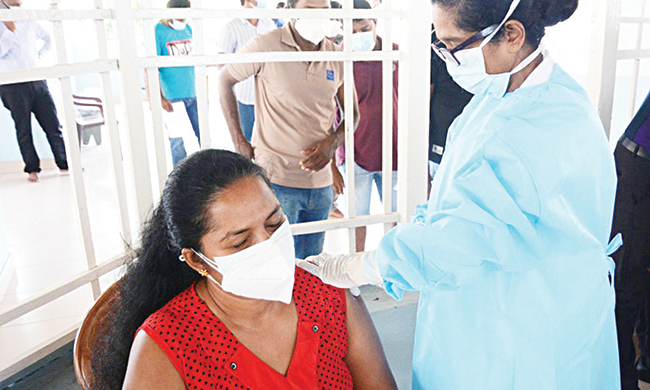
DDGHS: Only 100,000 Lankans have taken fourth jab

By Sujeewa Thathsara and Pradeep Prasanna Samarakoon
Only 100,000 people had taken the fourth dose of the COVID-19 vaccine, Deputy Director-General of Health Services Dr. Hemantha Herath told journalists in Colombo.Dr. Herath said that more people had to be vaccinated to ensure that COVID would not spiral out of control.
“A person who has taken the first jab must follow instructions and get the other three jabs. Most people have taken the first two jabs, but the interest in taking the boosters have been low,” he said.
People should remain vigilant and follow health guidelines because number of religious events are being held now, he said.Dr. Herath warned COVID-19 cases could surge again if people continued to violate health guidelines.
He added that even among young people under 30, there was a small minority with chronic diseases or non-communicable diseases. They were at risk of developing complications, he said.
“That is why we should try to limit the spread of COVID. People now know a lot about the virus; how it spreads and what needs to be done to minimize its spreads. The first thing is to follow health guidelines, the second is to get vaccinated and the third is to self-isolate if you get the virus. If these three are done, there won’t be a great rise in hospitalizations. As long as the health sector can handle the caseload, we will be fine,” he said.
Sri Lankans were taking less precautions about COVID in general, although the government had brought back mask mandates, he said.
“The numbers may be lower compared to 2021, but it does not mean that the threat is gone,” he said.
Dr. Herath also warned people to follow health guidelines like mask wearing, washing hands and maintaining social distance in everyday life.




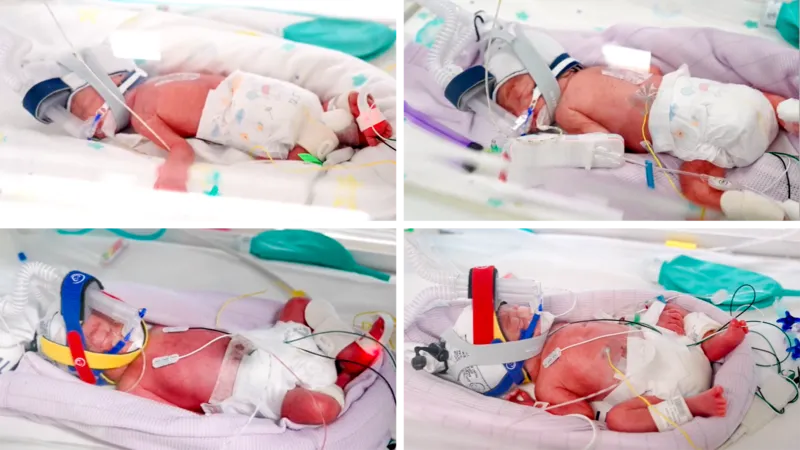
An Australian woman has given birth to rare, naturally-conceived identical quadruplets after a pregnancy described as “extremely high risk” by the Royal Brisbane and Women’s Hospital.
The four girls, who were delivered via caesarean section at 28 weeks and four days on 14 July, were monozygotic quadruplets – where a single fertilised egg splits into four embryos.
The hospital said the girls’ mother, 34-year-old Jenitar Na’amoana, and her husband Jortham, already had four children and were taken by “immense surprise” when told to expect quadruplets.
Dr Alexa Bendall, who cared for the mother from the start of her pregnancy, estimated identical quadruplets occur “at one in every 15 million pregnancies” and said “but to share the same placenta – this is unheard of”.
Bendall, who is a maternal foetal medicine specialist and obstetrician, said such a pregnancy was very high-risk, with the hospital admitting Na’amoana as an inpatient at 25 weeks so she could be monitored.
“We always said that if we could get her to 28 weeks, we would be doing well,” Bendall said.
“So the fact that we’ve got four beautiful, healthy babies born at 28 weeks and four days is incredible and we’re very happy to be a part of it,” she added.
“Jenitar has taken everything in her stride from day one… she has somehow dodged every complication and risk for both herself and her babies,” Bendall said.
The newborn girls have been named Emily, Harriet, Catherine, and also Alexa, after Alexa Bendall, who described it as “a beautiful tribute”.

The babies will stay in the hospital’s neonatal intensive care unit until they grow to full term and are “currently doing extremely well”, Bendall added.
The parents’ other children are between one and 10 years old and the mother has recently launched an online fundraising campaign to help buy a van with at least 10 seats.
In a message alongside the fundraiser, which has already received over A$37,000 (£19,261) in donations, Na’amoana wrote: “Our four precious miracles have arrived safely, and while our hearts are overflowing with gratitude, the reality of caring for four newborns at once has brought challenges we never could have imagined.”
Naturally conceived quadruplets are extremely rare, with doctors estimating the odds at about one in 700,000 births.
(BBC)

… bribe giver departs Colombo port
The Merchant Shipping Secretariat (MSS) is investigating a complaint received from the Captain of an Indonesian flagged vessel Sensho that he had to pay an official USD 5,000 bribe to facilitate what our sources called port state control inspection.
Sources said that the cement carrier arrived at the Colombo Port, on Friday, and departed after having passed the rigorous inspection. Responding to queries, sources said that after paying the bribe, the vessel’s Captain has lodged complaints with MSS and the Commission to Investigate Allegation of Bribery or Corruption (CIABOC).
In spite of the government’s high profile anti-corruption drive there seemed to be fresh cases, sources said, adding that MSS had received a comprehensive complaint. The vessel had departed Colombo for Jeddah, sources said.
“The issue at hand is whether there have been unreported cases of MSS personnel receiving bribes,” sources said, acknowledging that the Captain, instead of immediately bringing the demand for USD 5,000 bribe to the MSS, had paid it and departed Colombo. (SF)
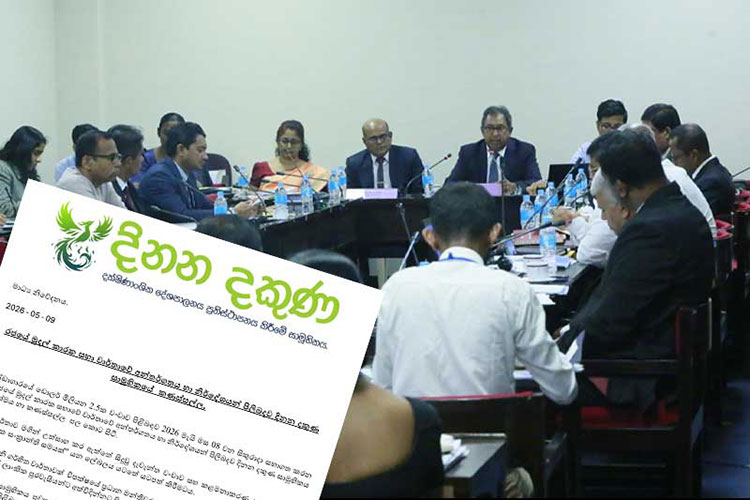
An opposition political group, styled as Dinana Dakuna, has accused the Committee of Public Finance (COPF) of protecting the masterminds behind the USD 2.5 mn theft from the Treasury.
Commenting on the recent COPF report on the theft, the group has alleged that the all-party parliamentary grouping made an attempt to shift the blame to the Central Bank as part of a cover-up. It has described the COPF report as a deliberate attempt to suppress the truth.
The group said that the COPF conveniently asserted that the theft took place due to the inexperience of officers concerned, thereby diverting the attention from those who perpetrated it.
An alleged attempt to portray the collapse of the administrative set-up that led to the USD 2.5 mn theft as a human resource problem, has also been questioned by Dinana Dakuna.

Rare identical quadruplets born in Australia

Showers will occur in the Western, Sabaragamuwa and North-western provinces and in Kandy, Nuwara-Eliya, Galle and Matara districts

Merchant Shipping Secretariat probes bribery scandal

Theft of USD 2.5 mn: Dinana Dakuna claims COPF trying to protect mastermind

COPF chief slams security sticker scam

CAA urged to protect soap users

‘Dates have the highest sugar content to fight Coronavirus’

Sunday Island 27 December – Headlines

#SundayIsland 17th December – Headlines

Sunday Island – 28th March

Sunday Island Headlines – 21 March

Sunday Island – 21st February – Headlines
-
 Business2 days ago
‘Giving up was never an option’: The fisherman who fought back after losing millions in SL
-
 Features2 days ago
Two memorable excerpts from a former SLAF commander’s memoir
-
 Latest News3 days ago
Davis cup Asia/Oceania Group IV 2026 to be held in Colombo from 20th to 25th July
-

 Features2 days ago
Erdoğan’s New Republic
-
 Life style2 days ago
Taste of the Swiss Alps comes to Colombo
-
 Features6 days ago
Dirty Money
-
 News3 days ago
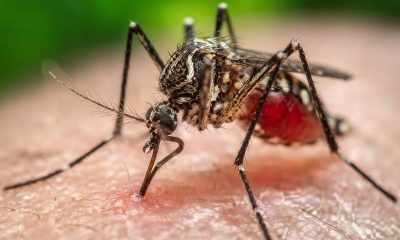
Dengue outbreak gallops ahead: Infections surpasses 73,455, leaving 50 dead
-
 News3 days ago
Evidence recorded in money laundering case against Yoshitha Rajapaksa