
Latest News
Dame Jane Goodall remembered as a ‘true hero for the planet’


Conservationist Dame Jane Goodall, a world-leading expert on chimpanzees, has died aged 91.
Former US president Barack Obama was among those who paid tribute to Dr Goodall, who he said, “opened doors for generations of women in science”.
Actor and environmental campaigner Leonardo DiCaprio said that she “inspired millions to care, to act, and to hope”, and called her a “a true hero for the planet”.
Dr Goodall died of natural causes while in California on a speaking tour of the US, according to a statement from the Jane Goodall Institute.
It said her discoveries “revolutionised science” and that she was “a tireless advocate for the protection and restoration of our natural world”.
The United Nations said it mourned the loss of Dr Goodall, saying that she “worked tirelessly for our planet and all its inhabitants, leaving an extraordinary legacy for humanity and nature”.
Greenpeace said it was “heartbroken” by her death, calling her “one of the true conservation giants of our time”.
Its co-executive director in the UK, Will McCallum, said: “Dr Goodall’s legacy is not only in science but in the global movement she helped spark to protect nature and give hope for a better world.”
Naturalist Chris Packham told the BBC that he counted her among his heroes, calling her “revolutionary” and “remarkable”.
“To have lost a hero at a time when we need all of them on the frontline fighting for life on earth is a tragedy.”
Born in 1934 and raised in London, Dr Goodall said she became fascinated by animals after reading books like The Story of Dr Doolittle and Tarzan.
She met leading primatologist Prof Louis Leakey while staying on a friend’s farm in Kenya in her mid-twenties. Although she had no qualifications, Mr Leakey saw her potential and helped arrange her first research trip to the jungles of Tanzania in 1960.
That year, she became the first person to record witnessing an animal using a tool – a large male chimpanzee, who she had named David Greybeard, digging termites out of a mound with a stick.
Until then, it was thought only humans were intelligent enough to do so. Her observations challenged years of conventional scientific thinking and shaped the future of evolutionary science.
Her work was published in leading journals, and in 1965 she made the front cover of National Geographic, introducing the world to the emotional and social lives of the primates.
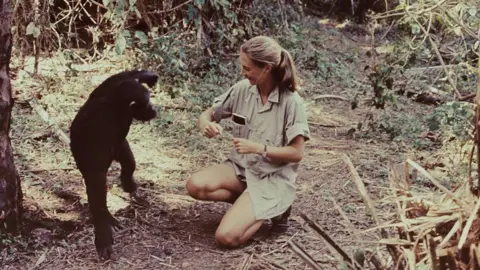
She revealed that the animals form strong family bonds and even engage in warfare over territory. She featured in a television documentary narrated by Orson Welles, which saw her playing and wrestling with baby chimps.
Her approach – associating so closely with the animals she studied, naming them and even referring to them as “my friends” – was scoffed at by some, mostly male, scientists at the time. She undertook a PhD based on her findings, despite not having an undergraduate degree or any prior scientific training.
After her experiences in the field she became an activist, working to free chimpanzees kept in zoos or in captivity for medical research, and later urged action on climate change in the face of widespread habitat devastation.
She told BBC in 2024 “We’re in the midst of the sixth great extinction… the more we can do to restore nature and protect existing forests, the better.”
Asked what kept her motivated late in life, she said: “Surely people want a future for their children.”
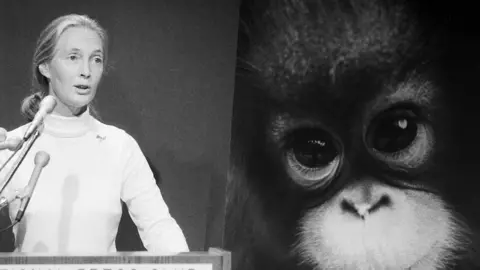 Getty Images
Dr Goodall was appointed a Dame in 2003 and received the US Presidential Medal of Freedom in 2025.
She was known for travelling constantly for her work, telling the Times newspaper in 2022 that she had not slept in the same bed for more than three weeks since 1986.
Dr Goodall worked right up until her death, being interviewed on stage in New York a week ago. She was due to speak again at a sold-out event on 3 October in California.
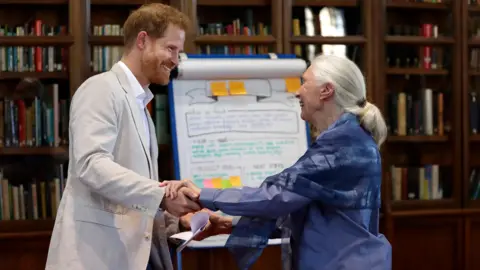
“Dr Jane Goodall DBE was a visionary humanitarian, scientist, friend to the planet, and friend to us,” Prince Harry and Meghan said in a statement.
Former Canadian prime minister, Justin Trudeau, said “her compassion will live on” in future conservation work.
Secretary General of the United Nations Antonio Guterres hailed her work as a Messenger of Peace, a UN title she has held since 2002 for bringing “global attention to the urgency of protecting our environment”.
Environmental organisations, including Greenpeace and People for the Ethical Treatment of Animals (Peta), have also commemorated Dr Goodall’s legacy.
[BBC]

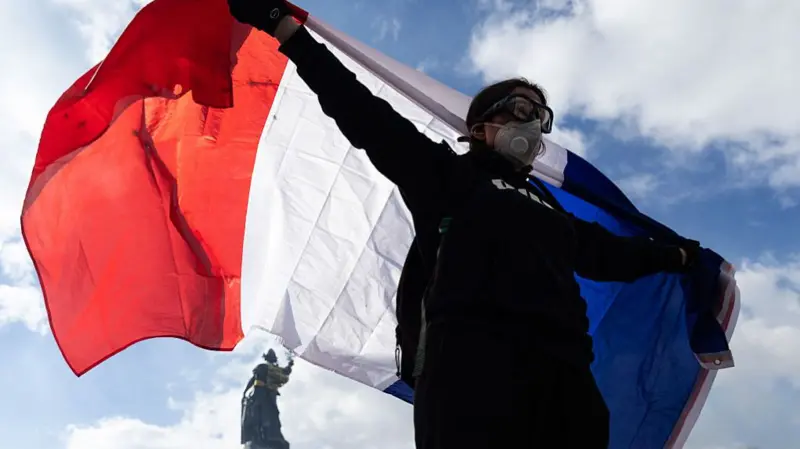
An estimated 550,000 people took part in demonstrations across France today to protest against teaching conditions in schools, rising fuel prices and the cost of living.
Marches were largely peaceful and took place in several major French cities, including Paris, where 110,000 people attended.
“We just want to study, we just want a future” one student taking part in the protest in the capital told BBC News, while another said they were ” just trying to make things change”.
But French Interior Minister Laurent Nunez said some groups “at the margins of these protests” caused the situation to “degenerate”.
According to the French Prime Minister Sébastien Lecornu, 1200 people were arrested. Officials also reported looting in cities such as Marseille, where masked 8ntruders also entered the city hall. In Lyon, the tourist office was set on fire and shops were damaged.
French President Emmanuel Macron said any vandals and looters would be “prosecuted and punished”, while Jean-Luc Mélenchon, the leader of left-wing party La France Insoumise, said demonstrations had been calmly mobilised.
Meanwhile, firefighters are continuing to battle a blaze at Limoges City Hall after a reported break-in and arson inside the 19th-century building during protests there.
(BBC)
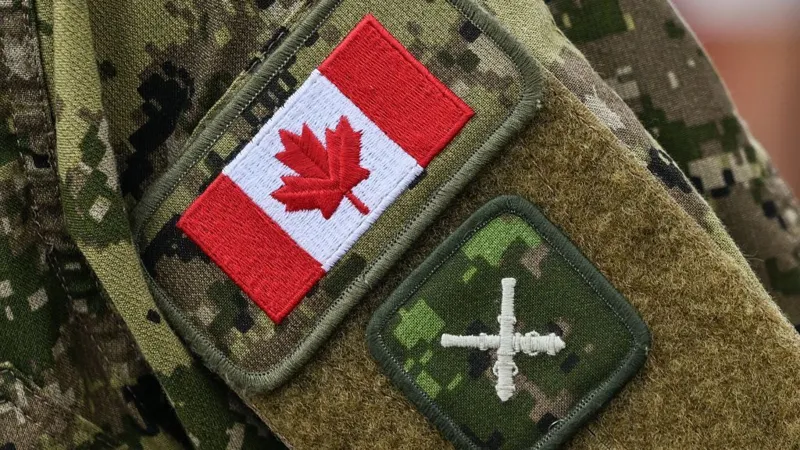
A large fire near a Canadian military base in Alberta has killed and injured some people, the defence minister said, without confirming the number of casualties.
The Canadian Armed Forces were working with local authorities to manage the fire and were looking into what caused it, David McGuinty said, describing the situation as “very, very active and delicate”.
Canada’s Prime Minister Mark Carney said on X that a “serious incident creating a major fire” had occurred, adding his “thoughts are with all the brave women and men affected”.
Canadian Forces Base Wainwright, where the fire broke out, is one of the country’s busiest military training bases.
The blaze “spread rapidly due to high winds” and had torn through the fences of the base, the Municipal District of Wainwright said.
McGuinty told reporters he “cannot recall an incident like this in recent memory”.
It is unclear when the fire broke out, but the district first posted about the incident at about 17:30 local time.
Local authorities have urged residents to avoid the area and give all emergency vehicles right of way.
(BBC)

The Asian Youth Games gold medallist who has run sub four minutes previously returned a time of 3:55.97 seconds to become the first athlete in his age category at these championships to run the distance under four minutes.
Achintha who has a personal best of 3:53.05 from last year was representing Prince College Ratnapura today.
In another impressive 1,500 m feat Tharushi Abhisheka of Lyceum International School, Wattala established a new meet record in the Under-20 Girls’ 1,500m as she returned a time of 4:34.59 seconds to win.
By the end of the second day of the meet seven new meet records had been established.
D. V. C. de Soysa (of Galewela Central College) Under-16 Boys’ Discus Throw – 55.83m.
D. G. Lahiru Achintha (of Ratnapura Kumara Vidyalaya) Under-18 Boys’ 1,500m – 3:55.97 secs.
W. P. Nethula Induwara (Rahula College, Matara) Under-14 Boys’ 100m – 11.70 seconds
K. V. R. Gayesha (Ira Handa Kotuwa Wewa Maha Vidyalaya, Polonnaruwa) Under-16 Girls’ High Jump – 1.70m
H. M. D. S. Herath (Maris Stella College, Thimbirigaskatuwa) Under-20 Boys’ Long Jump – 7.65m
P. M. Amaya Semindi (Vijitha Central College, Dikwella) Under-14 Girls’ High Jump – 1.58m

Record 1,600 students take Russian Classical Ballet examination in Sri Lanka

Half a million people join protests in France, but some turn violent

Deadly fire breaks out at Canada military base

Showers or thundershowers will occur in most parts of the island after 1.00 p.m.

Buddhist hierarchy demands prison perks for monk convicts

Debate on NCM against Speaker postponed indefinitely

‘Dates have the highest sugar content to fight Coronavirus’

Sunday Island 27 December – Headlines

#SundayIsland 17th December – Headlines

Sunday Island – 28th March

Sunday Island Headlines – 21 March

Sunday Island – 21st February – Headlines
-

 Latest News5 days ago
Nissanka’s return headlines Sri Lanka’s Test squad against Pakistan
-

 Latest News6 days ago
Farhan and Sadaqat help Pakistan seal series in style
-

 Features6 days ago
Intake 16: 45 years of duty and honour
-

 News6 days ago
Malwathu Chapter issues statement on talks with President over Gnanasara Thera’s robes
-

 News6 days ago
CP alleges NPP has taken the blame for illegal US sanctions on Iranian vessels
-

 Opinion6 days ago
How long can Sri Lanka remain silent on its demographic crisis?
-

 News4 days ago
Sri Lanka, India caught in US-Iran ship crisis
-

 Latest News4 days ago
Kusal Mendis’ unbeaten 87 hands Sri Lanka consolation win