
Latest News
Cyber-attack causes delays at Heathrow and other European airports

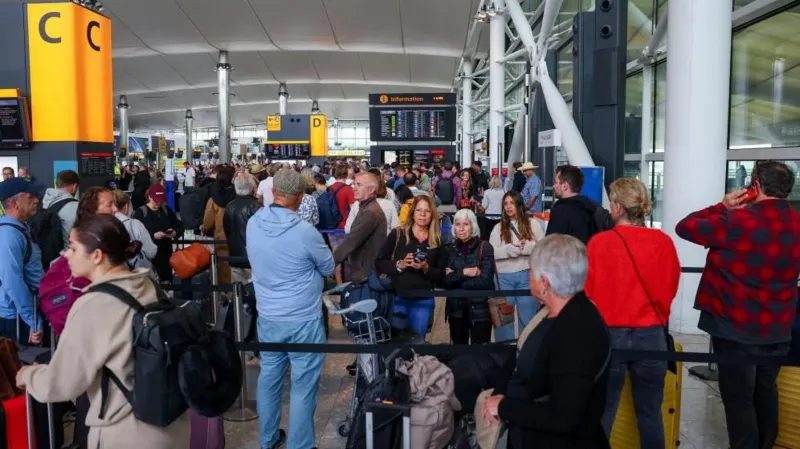
Heathrow is among several European airports hit by a cyber-attack affecting an electronic check-in and baggage system.
A number of flights were delayed at the airport on Saturday as a “technical issue” impacted software provided to several airlines.
Brussels Airport said a cyber-attack on Friday night meant passengers were being checked in and boarded manually, while Berlin’s Brandenburg Airport also reported longer waiting times due to the problem.
RTX, which owns software provider Collins Aerospace, said it was “aware of a cyber-related disruption” to its system in “select airports” and that it was working to resolve the issue as quickly as possible.
The company added: “The impact is limited to electronic customer check-in and baggage drop and can be mitigated with manual check-in operations.”
It said its Muse software – which allows different airlines to use the same check-in desks and boarding gates at an airport, rather than requiring their own – had been affected.
The BBC understands that British Airways is operating as normal using a back-up system, but that most other airlines operating from Heathrow have been affected.
Hundreds of flights have been delayed at the airports throughout Saturday, according to flight tracker FlightAware.
Dublin Airport said it and Cork Airport had experienced a “minor impact” from the cyber-attack, with some airlines implementing manual check-in processes.
Lucy Spencer said she had been queuing to check in for a Malaysia Airlines flight for more than two hours, and that staff were manually tagging luggage and checking passengers in over the phone.
“They told us to use the boarding passes on our phone, but when we got to the gates they weren’t working – they’ve now sent us back to the check-in gate,” she told the BBC from Heathrow’s Terminal 4, adding that she could see hundreds of people queuing up.
Another passenger, Monazza Aslam, said she had been sitting on the tarmac for over an hour “with no idea when we will fly”, and had already missed her onward connection at Doha.
“I’ve been at Heathrow with my elderly parents since 05:00,” she said, adding: “We are hungry and tired.”
Johnny Lal, who was due to fly to Bombay for his mother-in-law’s funeral on Saturday, said he and his mother will now miss their flight.
He told the BBC his mother “can’t walk one step without her [mobility] scooter” but that Heathrow staff had been unable to provide her with one. “They keep just telling us the systems are down.”
Luke Agger-Joynes said that, while queues in Terminal 3 were “much larger than normal”, the airline for his US flight and the airport “seem to be prepared and the queues are moving much faster than I feared”.
He added: “They are also calling out specific flights and picking people out of the queue to ensure they don’t miss their flights.”
Heathrow said additional staff were at hand in check-in areas to help minimise disruption.
“We advise passengers to check their flight status with their airline before travelling to the airport and arrive no earlier than three hours before a long haul flight or two hours for a domestic flight.”
A National Cyber Security Centre spokesperson said: “We are working with Collins Aerospace and affected UK airports, alongside Department for Transport and law enforcement colleagues, to fully understand the impact of an incident.”
Transport Secretary Heidi Alexander said she was aware of the incident and was “getting regular updates and monitoring the situation”.
EasyJet and Ryanair, which do not operate out of Heathrow but are among Europe’s biggest airlines, said they were operating as normal.
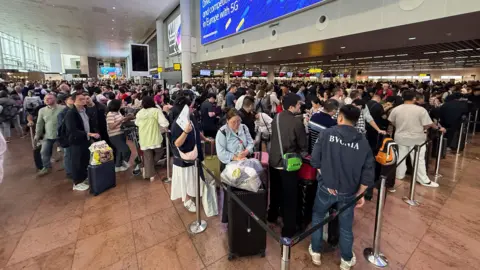
Brussels Airport said there would be a “large impact on the flight schedule”, including cancellations and delays. Long queues and large crowds could be seen at the airport on Saturday morning.
Europe’s combined aviation safety organisation, Eurocontrol, said airline operators had been asked to cancel half their flight schedules to and from the airport between 04:00 GMT on Saturday and 02:00 on Monday due to the disruption.
Travel journalist Simon Calder said that “any disruption is potentially serious” at Heathrow, given it is Europe’s busiest airport, and that “departure control is a really complex business”.
He told the BBC: “These things are all interconnected, so a little bit of a problem in Brussels, in Berlin… people start missing connections, planes and passengers and pilots are not where they are meant to be, and things can get quite a lot worse before they get better.”
It was only last July that a global IT crash due to a faulty software update from cybersecurity firm Crowdstrike caused disruption to aviation, grounding flights across the US.
Analysts said at the time that the incident highlighted how the industry could be vulnerable to issues with digital systems.
While there are unfounded accusations circulating that this cyber-attack was carried out by Kremlin-sponsored hackers, all major hacks in the past few years have been carried out by criminal gangs more interested in extracting money from their victims.
Extortion gangs have made hundreds of millions of dollars a year by stealing data or using ransomware to cause chaos and extract ransoms in bitcoin from their victims.
It is far too early to know who is behind this attack. Some cyber-security experts suggested this could be a ransomware attack, but note that these can be perpetrated by state-sponsored actors as well.
Collins Aerospace has yet to comment publicly about the nature or origin of the hack.
Many hacking gangs are headquartered in Russia or other former Soviet countries, some of which are thought to have ties to the Russian state.
But there have been plenty of arrests elsewhere, while British and American teenagers are accused of carrying out some recent large cyber-attacks against Las Vegas casinos, M&S, Co-op and Transport for London.
[BBC]

Latest News
Heat Index likely to increase up to ‘Caution level’ at some places in the Western, Sabaragamuwa, Southern, North-western, Northern and North- central provinces and in Monaragala district
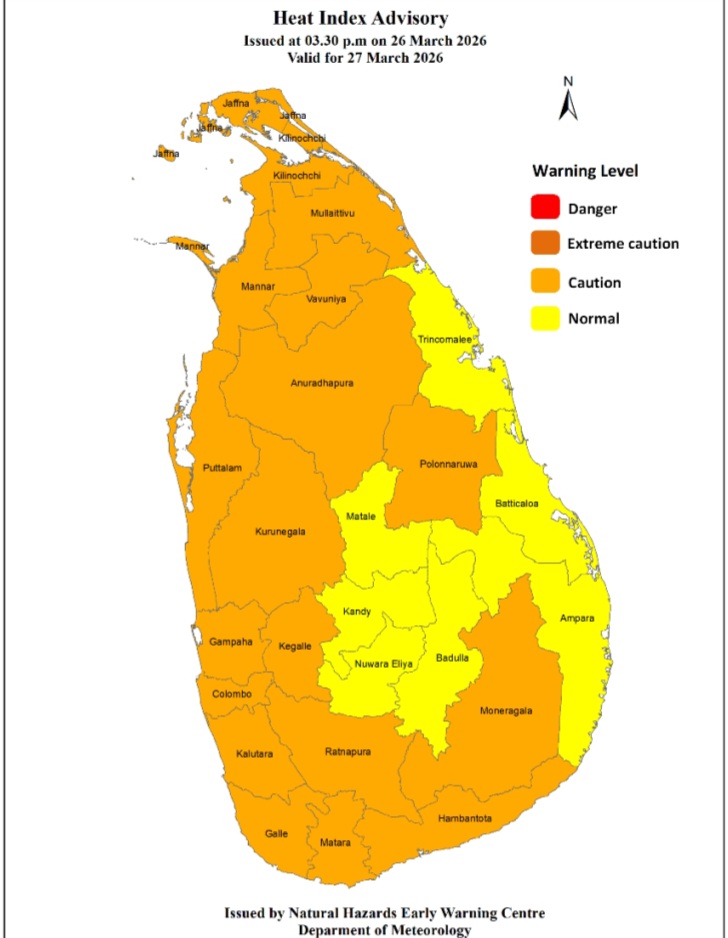
Warm Weather Advisory
Issued by the Natural Hazards Early Warning Centre of the Department of Meteorology
Issued at 3.30 p.m. on 26 March 2026, valid for 27 March 2026.
Thw Heat index, the temperature felt on human body is likely to increase up to ‘Caution level’ at some places in the Western, Sabaragamuwa, Southern, North-western, Northern and North-
central provinces and in Monaragala district.
The Heat Index Forecast is calculated by using relative humidity and maximum temperature and this is the condition that is felt on your body. This is not the forecast of maximum
temperature. It is generated by the Department of Meteorology for the next day period and prepared by using global numerical weather prediction model data.

Effect of the heat index on human body is mentioned in the above table and it is prepared on the advice of the Ministry of Health and Indigenous Medical Services.
ACTION REQUIRED
Job sites: Stay hydrated and takes breaks in the shade as often as possible.
Indoors: Check up on the elderly and the sick.
Vehicles: Never leave children unattended.
Outdoors: Limit strenuous outdoor activities, find shade and stay hydrated.
Dress: Wear lightweight and white or light-colored clothing.
Note:
In addition, please refer to advisories issued by the Disaster Preparedness & Response Division, Ministry of Health in this regard as well. For further clarifications please contact 011-7446491
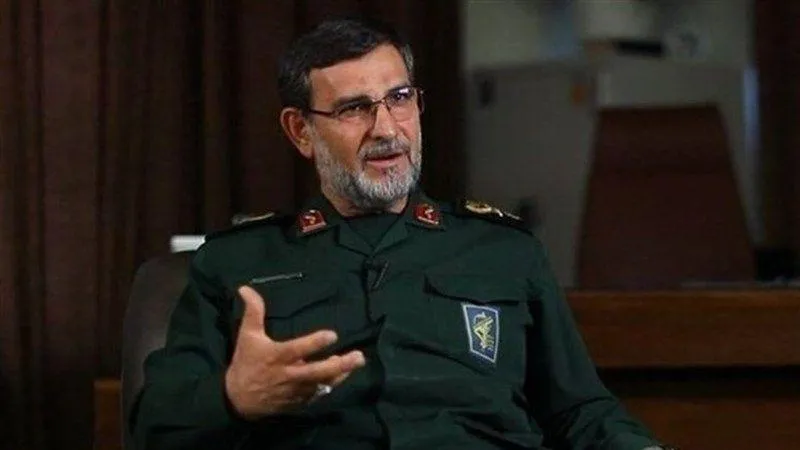
Israel says it has killed the Iranian navy chief overseeing what is a near-total blockade of the Strait of Hormuz.
Alireza Tangsiri, head of the Islamic Revolutionary Guards Corps (IRGC) navy, was “directly responsible for the terrorist act of bombing and blocking the Strait of Hormuz”, and has been “blown up”, according to Israel’s defence minister Israel Katz.
He added that a number of other “senior Navy command officials” have also been killed. Iran has not yet commented.
Since the start of the war on 28 February, Israel has assassinated several top Iranian officials, including Supreme Leader Ayatollah Ali Khamenei and security chief Ali Larijani.
Effectively blockading the Strait of Hormuz – the thin waterway between Iran, the United Arab Emirates (UAE) and Oman, through which around 20% of the world’s oil and liquefied natural gas normally passes – has been a key pillar of Iran’s strategy in the war.
Oil prices have consequently shot up, placing a direct price of the war on consumers in not only the US and Israel but across the world.
In recent weeks, an X account attributed to Tangsiri and cited by Iranian media has posted frequently about the Hormuz blockade, writing that “no vessel associated with the aggressors against Iran has the right to pass through”.
Tangsiri was appointed as the commander of the Navy in 2018, having previously served as deputy commander since 2010. In 2019, he was sanctioned by the US Treasury along with other IRGC commanders after Iran shot down a US surveillance drone near the strait.
Israeli Prime Minister Benjamin Netanyahu described Tangsiri as an individual with “a great deal of blood on his hands” and said his assassination was “yet another example of the co-operation between us and our friend, the United States, toward the common goal of achieving the objectives of the war”.
US Central Command said in a statement Tangsiri’s death “makes the region safer” and that the IRGC’s navy “is on an irreversible decline”. It also called on serving members of the IRGC to abandon their posts and return home “to avoid further risk of unnecessary injury or death”.
Israel’s military said in a statement posted on X that the head of the IRGC Navy’s intelligence directorate, Behnam Rezaei, was also “eliminated”.
(BBC)
Latest News
A strong Technical and Vocational Education and Training (TVET) system equips individuals with practical, relevant, and future-oriented skills helping to innovate responsibly towards a greener and sustainable future – PM

The Prime Minister, Minister of Education, Higher Education and Vocational Education Dr. Harini Amarasuriya participated as the Chief Guest in the international conference on ’Transforming TVET Systems for climate resilience and green jobs’ organized by Colombo Plan Staff College, Philippines together with the Ministry of Education, Higher Education and Vocational Education Sri Lanka on 24 th of March at Courtyard by Marriott Colombo, Sri Lanka.
The Conference serves as the flagship event of the five-day Regional Programme on “Transforming TVET for a Digital, Green, and Inclusive Economy” (23-27 March 2026), which continues throughout the week, bringing together representatives from CPSC member countries including Bhutan, Fiji, Malaysia, Maldives, Myanmar, Nepal, Philippines, Thailand, Pakistan, and Sri Lanka, fostering high-level dialogue and knowledge sharing on climate-resilient and green skills development.
The Conference features technical and plenary sessions on climate-responsive TVET systems, green skills development, national policy frameworks, and emerging technologies shaping industry transformation.
Addressing at the event, the Prime Minister emphasized the role of Technical and Vocational Education and Training (TVET) that equips individuals with practical, relevant, and future-oriented skills in addressing climate change and shaping a sustainable future.
The Prime Minister reaffirmed that this transformation remains a national priority for Sri Lanka. She stressed that education must go beyond knowledge dissemination to empower individuals with opportunities, dignity, and the capacity to contribute meaningfully to society.
She further emphasized the need to integrate environmental sustainability into education and training systems by embedding green skills in curricula, investing in modern training facilities, promoting innovation, and fostering collaboration between training institutions and emerging green industries.
Highlighting the importance of ensuring equity the Prime Minister further stated, that opportunities arising from the green transition must be accessible to all, including youth, young women, people with special needs, and marginalized communities.
Reaffirming Sri Lanka’s commitment to working closely with regional and international partnerships, the Prime Minister emphasized the importance of transforming them to actual benefits and partnerships.
The occasion was attended by the Secretary to the Ministry of Education, Higher Education and Vocational Education Nalaka Kaluwewa, Additional Secretary (Vocational Training) Ms. Samanthi Senanayake Director General Colombo Plan Staff College Prof. Dr. Suresh K. Dhameja , TVET administrators, institutional leaders, policymakers, instructors, industry representatives, and international delegates from across the region and seniors officials and officials from Ministries.
(Prime Minister’s Media division)

Showers may occur at a few places in the Sabaragamuwa province and in Galle, Matara, Kalutara and Nuwara-Eliya districts in the evening

Energy Minister indicted on corruption charges ahead of no-faith motion against him

Over 1000 complaints of misuse of QR quotas

Fuel bowser operators demand 25% hike in haulage charges

Charge sheet issued against former NIE Director for contempt of court

Sallay sent back to CID after being discharged from National Hospital

‘Dates have the highest sugar content to fight Coronavirus’

Sunday Island 27 December – Headlines

#SundayIsland 17th December – Headlines

Sunday Island – 28th March

Sunday Island Headlines – 21 March

Sunday Island – 21st February – Headlines
-

 News2 days ago
Senior citizens above 70 years to receive March allowances on Thursday (26)
-

 Features4 days ago
Trincomalee oil tank farm: An engineering marvel
-

 Business1 day ago
Dialog Unveils Dialog Play Mini with Netflix and Apple TV
-

 Features4 days ago
The scientist who was finally heard
-

 News1 day ago
US dodges question on AKD’s claim SL denied permission for military aircraft to land
-

 News2 days ago
CEB Engineers warn public to be prepared for power cuts after New Year
-
 News2 days ago
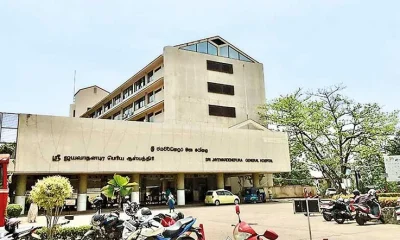
Japanese boost to Sri J’pura Hospital, an outright gift from Tokyo during JRJ rule
-

 News6 days ago
Colombo, Oslo steps up efforts to strengthen bilateral cooperation in key environmental priority areas