
News
Current crises: Emergency, curfew social media ban, no solutions -SJB


‘SLPP’s half-witted response admission of defeat’
By Shamindra Ferdinando
Samagi Jana Balavegaya (SJB) spokesperson Mujibur Rahuman, MP yesterday asked whether the cash-strapped government could address public grievances, or manage the rapidly deteriorating crisis, by imposing curfew, or issuing extraordinary gazette notifications.
Colombo MP Rahuman said that there hadn’t been a previous instance of a government issuing an extra ordinary gazette notification prohibiting the public from being on roads, public parks, public recreation grounds or any other public ground, railway tracks or the seashore.
In a brief interview with The Island, in the wake of the declaration of a State of Emergency, Rahuman alleged that the government had lost its bearings.
Last Thursday’s violence, on the approach to President Gotabaya Rajapaksa’s private residence, at Pangiriwatte Road, Mirihana, meant the irate public were on the offensive and couldn’t be turned back by blocking social media platforms.
Referring to a request by the Defence Ministry to relevant public and private sector officials to temporarily restrict access to social media platforms, including Facebook, WhatsApp, instagram, twitter and YouTube, lawmaker Rahuman asked how the truth could be suppressed by such silly measures.
Responding to another query, the former UNPer said that the government’s half-witted response unwittingly gave recognition to the countrywide public protest campaign announced by social media groups late last week.
MP Rahuman said that the Mirihana protest, that shook the government, close on the heels of the announcement regarding Sunday’s protest, compelled the Rajapaksa administration to declare a state of emergency. The outspoken lawmaker emphasised that the massive eruption of violence at the Mirihana protest hadn’t been an isolated incident but one of many that underlined the growing public anger at the way the current dispensation managed the country.
“Protests erupted at Mahagasthota, Nuwara Eliya last Friday when Shiranthi Rajapaksa arrived there to inaugurate the month-long holiday season. How could the government allow such an event with the participation of Prime Minister Mahinda Rajapaksa’s wife at a time the country was in such a mess,” lawmaker Rahuman asked.
MP Rahuman pointed out that in a way, the government, by imposing the curfew, had acknowledged the severity of the crises and its inability to respond to the situation. Alleging that the government, on the advice of the SLFP, called a so-called All-Party Conference (APC) to divert public attention from the real issues, MP Rahuman said that the trouble-ridden government was incapable of handling the issues at hand. The SJB boycotted the APC.
The MP said that regardless of curfew there had been protests in several towns, including Piliyandala and Ambalangoda, where people came onto streets. The MP responded to The Island queries, hours before the SJB staged a protest at the Independence Square yesterday afternoon against what it termed efforts to suppress public rights. SJB leader Sajith Premadasa led the protest. SJB members lambasted the police for interfering in their protest.
The lawmaker said that the government’s silly response meant it hadn’t realized the ground situation or taken into consideration concerns expressed by SLPP dissident group or some other members of the government parliamentary group, even after the Mirihana eruption. How could the SLPP expect to resolve the crises by news blackouts? Rahuman asked, drawing the government’s attention to a serious shortage of essential items, including food, medicine and fuel.
Asked whether the SJB would cooperate with the government to address the crises, MP Rahuman said that the current dispensation didn’t command the public confidence. The MP questioned the use of such an exercise against the backdrop of an 11-party dissident group calling for the immediate dissolution of the Cabinet to pave the way for an interim administration. The MP noted another State Minister has declared his intention to give up the portfolio on May Day. He was referring to a statement issued by State Minister Roshan Ranasinghe, SLPP MP representing the Polonnaruwa district.
Referring to a statement issued by an organization called Sinhala Sanvidhana Ekamuthuwa (SSE) hours after the incidents at Mirihana, lawmaker Rahuman said that contrary to government claims, the SSE declared the vast majority of those who gathered there backed Gotabaya Rajapaksa and the SLPP at the presidential and parliamentary polls, in 2019 and 2020, respectively.
Having brushed aside Opposition criticism of its strategy, the SLPP ended up with egg on its face, MP Rahuman said. “The Mirihana eruption couldn’t have happened at a worse time for the government,” MP Rahuman said, warning the SLPP public couldn’t be deceived by reducing power cuts.
The SJB spokesperson said a statement issued by the Prime Minister’s Office that Power Minister Pavitradevi Wanniarachchi had been instructed to reduce power cuts, effective April 3, in the wake of the CEB receiving diesel stocks, exposed how the SLPP played politics at every available opportunity. What the PM’s Office conveniently didn’t say was that Sri Lanka received 40,000 mt of diesel on Saturday (2) in terms of USD 500 mn credit line, MP Rahuman said. Therefore, power cuts could be reduced but for how long, MP Rahuman asked, pointing out that the current overwhelming crises couldn’t be overcome by deceiving the public.
The forthcoming debate in Parliament on the IMF report would explain why people gathered outside the President’s residence. The SJB conducted the first protest outside the President’s residence on March 05th, MP Rahuman said, adding that the SLPP couldn’t wriggle out of the current problems.
Lawmaker Rahuman declared that the SLPP never recovered from unbelievably short-sighted decision to ban use of fertilizer and agrochemicals. The government could have easily reversed its decision the moment it realised its folly, MP Rahuman said. Instead, the government ordered carbonic fertiliser from China and ended up paying USD 6.7 mn for a rejected consignment while more foreign reserves were spent on liquid fertiliser from India, the MP said. Today, the public were aware how those in authoritative positions exploited the fertiliser fiasco to their advantage, Rahuman said.

Latest News
Advisory for Severe Lightning issued to the Western and Sabaragamuwa provinces and Nuwara-Eliya, Galle and Matara districts

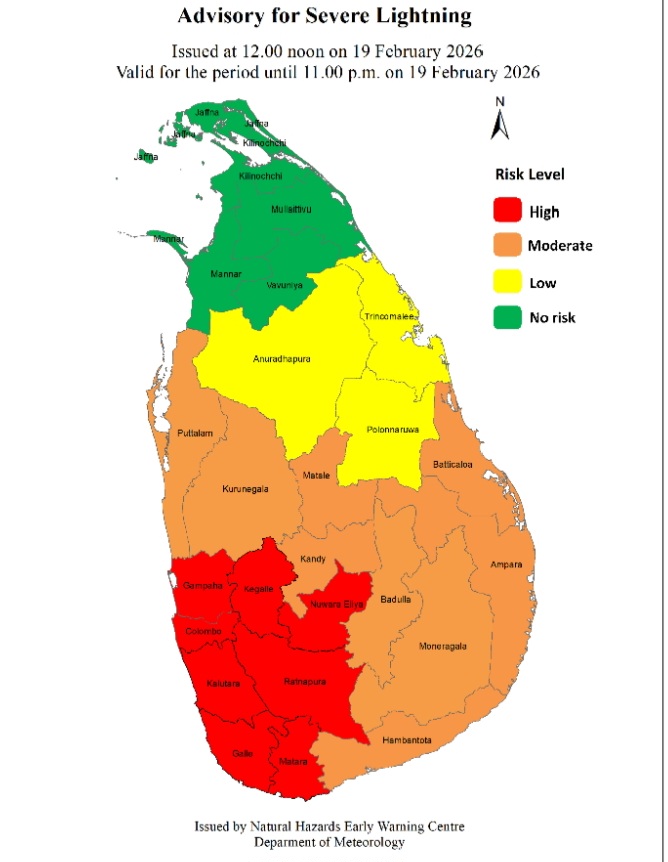
Advisory for Severe Lightning
Issued by the Natural Hazards Early Warning Centre at 12.00 noon 19 February 2026 valid for the period until 11.00 p.m. 19 February 2026
The public are warned that thundershowers accompanied with severe lightning are likely to occur at some places in in the Western and Sabaragamuwa provinces and in Nuwara-Eliya, Galle and Matara districts after 2.00 p.m.
There may be temporary localized strong winds during thundershowers.
General public is kindly requested to take adequate precautions to minimize damages caused by lightning activity.
ACTION REQUIRED:
The Department of Meteorology advises that people should:
Seek shelter, preferably indoors and never under trees.
Avoid open areas such as paddy fields, tea plantations and open water bodies during thunderstorms.
Avoid using wired telephones and connected electric appliances during thunderstorms.
Avoid using open vehicles, such as bicycles, tractors and boats etc.
Beware of fallen trees and power lines.
For emergency assistance contact the local disaster management authorities.
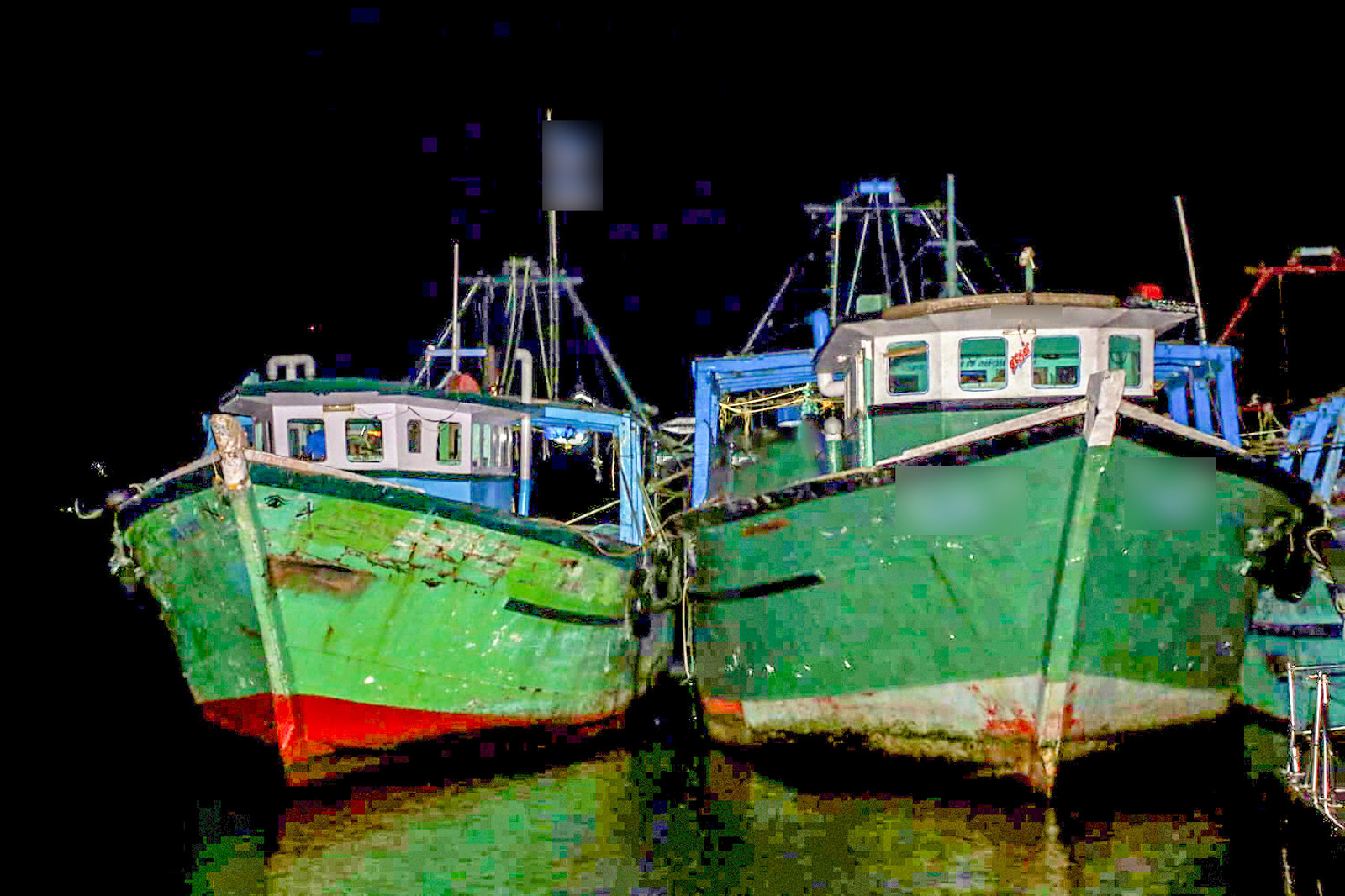
During operations conducted in the dark hours of 18 Feb 26, the Sri Lanka Navy and Coast Guard seized 04 Indian fishing boats and apprehended 22 Indian fishermen, while they were poaching in Sri Lankan waters north of Mannar and off the Delft Island, Jaffna.
Recognizing the detrimental effects of poaching on marine resources and the livelihoods of local fishing communities, the Sri Lanka Navy and Coast Guard continue to conduct regular operations as proactive measures to deter such activities. These efforts underscore the collective robust approach and steadfast commitment to safeguarding the nation’s marine ecosystems while ensuring the economic security and wellbeing of its citizens.
The 02 fishing boats along with the 10 fishermen held in Mannar were handed over to the Fisheries Inspector of Mannar and the remaining 02 fishing boats intercepted off the Delft Island, together with 12 Indian fishermen were handed over to the Fisheries Inspector of Myliddy for onward legal proceedings.
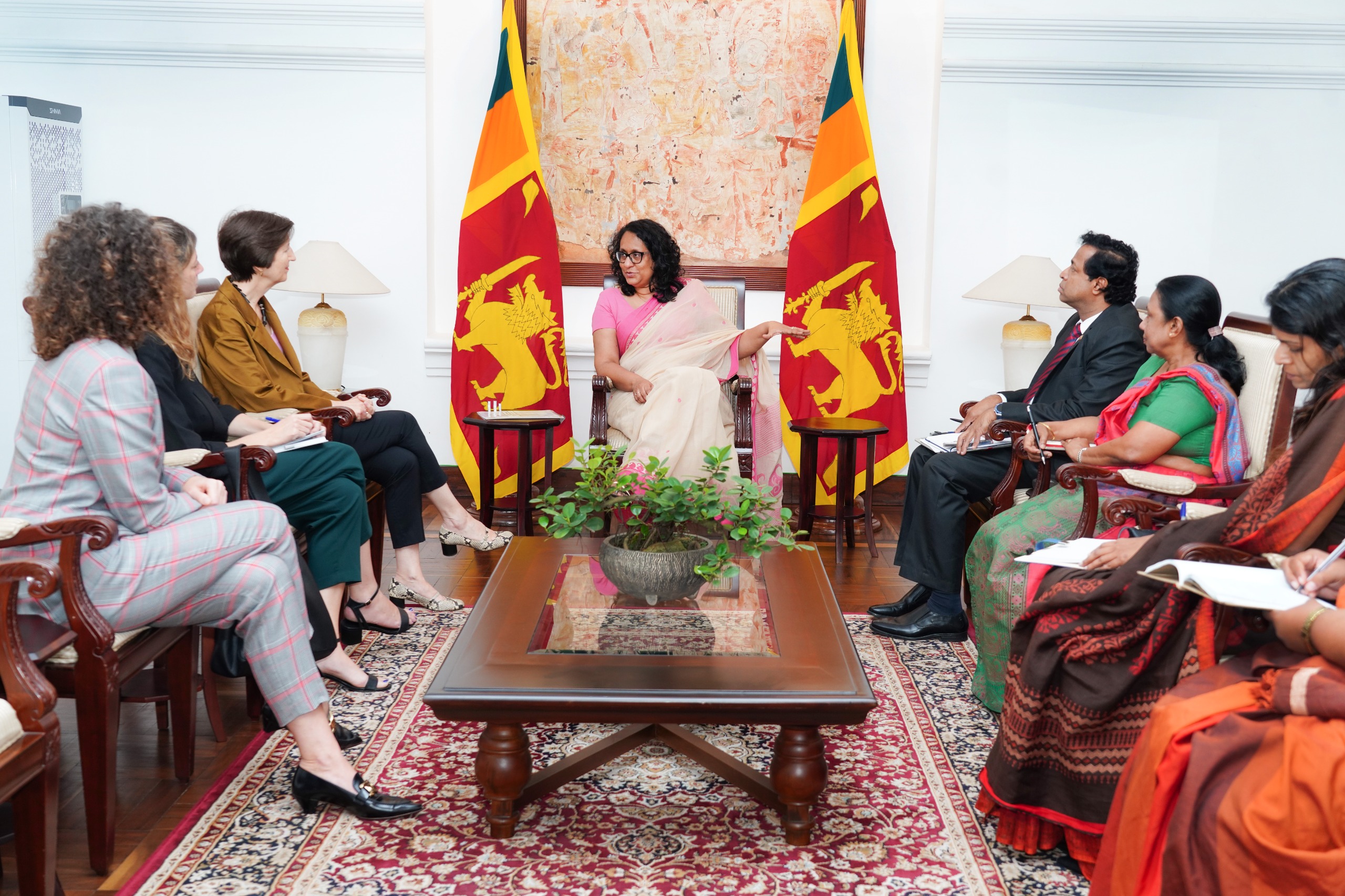
The Ambassador of Switzerland to Sri Lanka Dr. Siri Walt paid a courtesy call on Prime Minister Dr. Harini Amarasuriya on the 17th of February at the Temple Trees.
Welcoming the Ambassador of Switzerland to Sri Lanka the Prime Minister briefed the Ambassador on her recent visit to Davos to participate in the World Economic Forum Annual Meeting noting that the series of high-level bilateral meetings held on the sidelines of the Forum, along with two important industry visits provided valuable insights for Sri Lanka’s economic engagement.
The discussion focused on Switzerland’s vocational education and training (VET) system, with particular interest in exploring possible cooperation and knowledge-sharing opportunities.
The Prime Minister also conveyed her appreciation for the assistance extended by the Government of Switzerland following Cyclone Ditwah. She emphasized Sri Lanka’s need for enhanced technical assistance during the ongoing rebuilding phase, especially in relation to the reconstruction of bridges and railway infrastructure.
Both sides reaffirmed their shared commitment to further strengthening bilateral relations between Sri Lanka and Switzerland, and to expanding cooperation in areas of mutual interest.
First Secretary (Political) of the Embassy of Switzerland in Colombo Ms. Justine Boillat, First Secretary (Migration) of the Embassy of Switzerland in Colombo Ms. Andrea Kienast and the Secretary to the Prime Minister, Pradeep Saputhanthri, Additional Secretary to the Prime Minister, Ms. Sagarika Bogahawatt and officials from the Ministry of Foreign Affairs , Foreign Employment, Tourism.attended the meeting.
[Prime Minister’s Media Division]

Ex-UK Prince Andrew arrested on suspicion of misconduct in public office

Advisory for Severe Lightning issued to the Western and Sabaragamuwa provinces and Nuwara-Eliya, Galle and Matara districts

Navy and Coast Guard seize 04 Indian fishing vessels poaching in Sri Lankan waters

Hope’s 75, Forde and Joseph’s wickets help West Indies go into playoffs unconquered

Sri Lanka opt to bat against Zimbabwe, play Madushanka and Madushan

South Korea’s ex-president jailed for life for masterminding an insurrection

‘Dates have the highest sugar content to fight Coronavirus’

Sunday Island 27 December – Headlines

#SundayIsland 17th December – Headlines

Sunday Island – 28th March

Sunday Island Headlines – 21 March

Sunday Island – 21st February – Headlines
-
 Life style5 days ago
Marriot new GM Suranga
-

 Business4 days ago
Ministry of Brands to launch Sri Lanka’s first off-price retail destination
-
 Features5 days ago
Monks’ march, in America and Sri Lanka
-
 Features5 days ago
The Rise of Takaichi
-
 Features5 days ago
Wetlands of Sri Lanka:
-
 News4 days ago
Thailand to recruit 10,000 Lankans under new labour pact
-
 News4 days ago
Massive Sangha confab to address alleged injustices against monks
-

 News2 days ago
IMF MD here