
Latest News
Cuban and Sri Lankan Presidents forge stronger ties and mutual support through bilateral talks

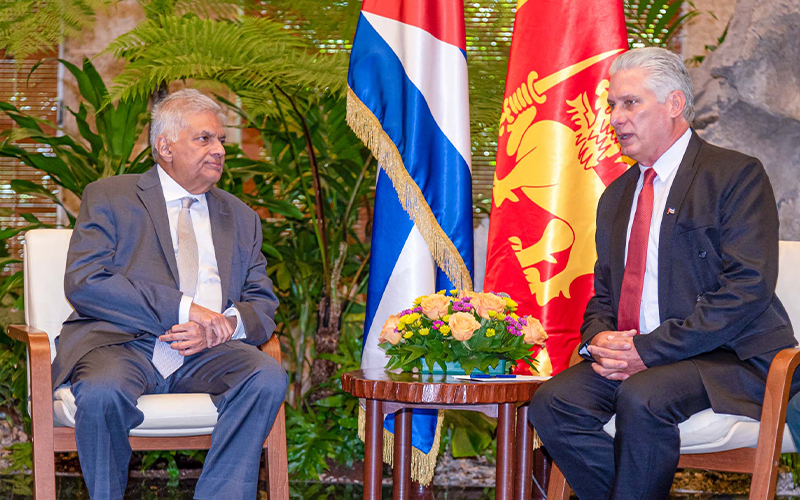
President, Ranil Wickremesinghe, who is on an official visit to Cuba ahead of his participation in the G77 plus China Summit in Havana on September 15-16, hosted by Cuba as the current Chair of the G77 plus China.
During his visit, President Wickremesinghe engaged in bilateral discussions with Cuban President Miguel Díaz-Canel Bermudez, reinforcing the bonds of friendship and dialogue between the two nations. The two leaders emphasized the importance of bolstering the relationship between their countries, focusing on collaboration in medicine, healthcare, sports training and coconut cultivation. President Wickremesinghe expressed Sri Lanka’s commitment to supporting Cuba in international forums, while President Díaz-Canel assured support for Sri Lanka regarding human rights resolutions.

Latest News
Advisory for Severe Lightning issued for Galle, Matara, Kaluthara and Rathnapura districts
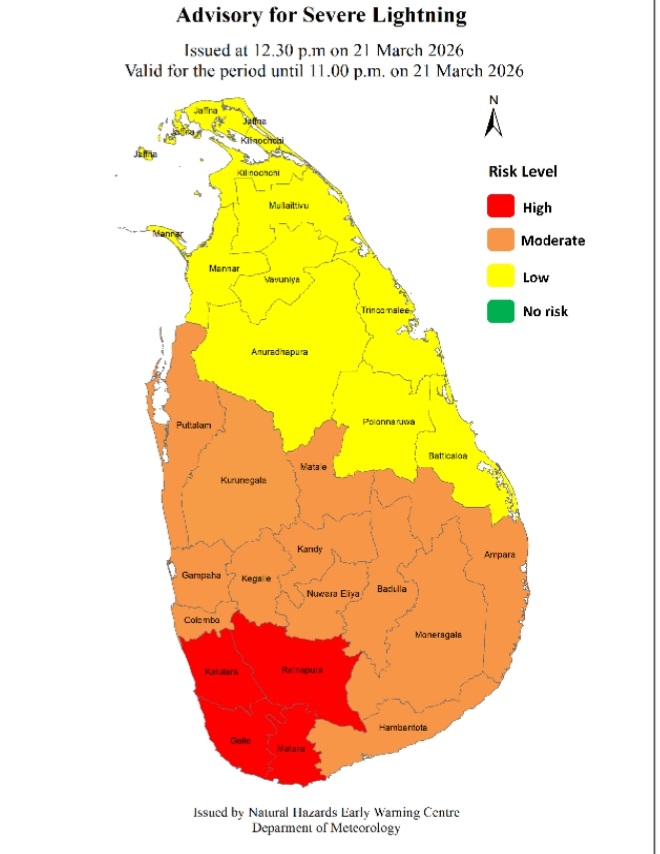
Advisory for Severe Lightning Issued by the Natural Hazards Early Warning Centre Issued at 12.30 p.m. 21 March 2026, valid for the period until 11.00 p.m. 21 March 2026
Thundershowers accompanied with severe lightning are likely to occur at some places in the Galle, Matara, Kaluthara and Rathnapura districts after 1.00 p.m.
There may be temporary localized strong winds during thundershowers. General public is kindly requested to take adequate precautions to minimize damages caused by lightning activity.
ACTION REQUIRED:
The Department of Meteorology advises that people should:
Seek shelter, preferably indoors and never under trees.
Avoid open areas such as paddy fields, tea plantations and open water bodies during thunderstorms.
Avoid using wired telephones and connected electric appliances during thunderstorms.
Avoid using open vehicles, such as bicycles, tractors and boats etc.
Beware of fallen trees and power lines.
For emergency assistance contact the local disaster management authorities.

Iranian strikes on military bases used by the US in the Middle East caused about $800m (£600m) in damage in the first two weeks of the war, a new analysis shows.
Much of the damage was caused in initial retaliatory strikes by Iran in the week after the US and Israel launched the war, according to a report by the Center for Strategic & International Studies (CSIS) and an analysis by the BBC.
The full extent of the damage caused by Iranian strikes on US assets in the region is not clear.
But the $800m in estimated damages to US military infrastructure – a figure that’s higher than has been previously reported – offers a picture of the steep costs to the US as the conflict drags on.
“The damage to US bases in the region has been underreported,” said Mark Cancian, a CSIS senior adviser and co-author of the think tank study. “Although that appears to be extensive, the full amount won’t be known until more information is available.”
In response to a request for comment, the US Department of Defense referred the BBC to US Central Command, which is leading the war. Officials there declined to comment.
Iran’s retaliatory strikes targeted US air-defence and satellite-communication systems, among other assets, in Jordan, the United Arab Emirates, and other countries across the Middle East.
A significant portion of damage was caused by a strike on a US radar for a Thaad missile defence system at an air base in Jordan.
The AN/TPY-2 radar system costs approximately $485m according to a CSIS review of defence department budget documents. The air-defence systems are used for the long-range interception of ballistic missiles.
Strikes by Iran caused an additional $310m in estimated damages to buildings, facilities and other infrastructure on US bases and military bases used by American forces in the region.
Iran also has struck at least three air bases more than once, according to an analysis of satellite imagery by BBC Verify. The repeat strikes underscore Iran’s efforts to target specific US assets. Russia has reportedly shared intelligence with Tehran on American military forces in the region.
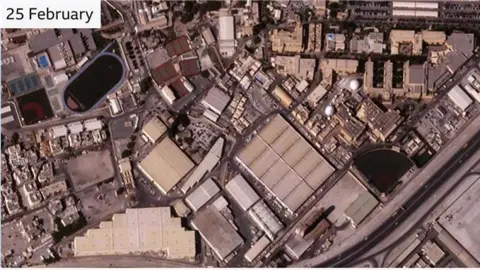
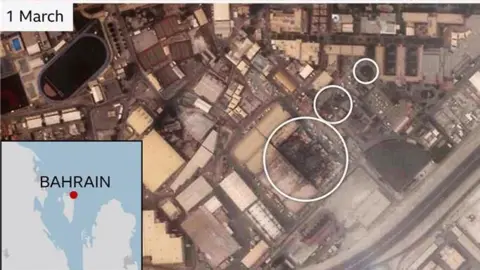
Satellite imagery shows the three air bases – Ali Al-Salim base in Kuwait, Al-Udeid in Qatar and Prince Sultan in Saudi Arabia – with fresh damage appearing during different phases of the conflict.
The US has also lost 13 military service members since President Donald Trump joined Israel in launching the attacks on Iran on 28 February.
The US-based Human Rights Activists News Agency (Hrana) estimates the overall death toll has reached nearly 3,200, including 1,400 civilians.
Trump has said the US is on track to achieve his goals of destroying Iran’s nuclear program, degrading its conventional military power, and ending the regime’s support for proxy groups in the region.
“We’re doing extremely well in Iran,” Trump said at a White House event on Friday.
But the war has rattled the global economy with the near-closure of the Strait of Hormuz, and uncertainty over the duration of the conflict and whether Trump will deploy ground troops.
[BBC]
[BBC]
Analysis of satellite imagery has been hampered by restrictions imposed by major US-based providers on the release of the imagery.
But it is possible to discern certain patterns in Iran’s retaliatory action against US military interests in the region.
Radar and satellite systems have been a focus from the start, when Iranian strikes hit a US naval base in Bahrain. They function as the eyes and ears of modern military operations.
Satellite imagery most notably showed the destruction of two radomes – protective enclosures for such sensitive equipment. It is highly probable the systems themselves were damaged, although it is not possible to gauge the extent.
Radar sites were hit at Camp Arifjan, a US military facility in Kuwait, and Saudi Arabia’s Prince Sultan Air Base, where US aircraft are located. Imagery of the latter shows smoke rising from a radar component for a Thaad air-defence system.
More extensive damage to Thaad systems is evident at US bases in the UAE and Jordan. It’s unclear what the cost of that damage was. The degradation of these systems reportedly led the US to redeploy Thaad components from South Korea to the Middle East.
The damage from Iran’s retaliatory strikes account for a fraction of the overall costs to the US for the war.
Defense Department officials reportedly briefed members of Congress that the first six days of the war cost $11.3bn. The first 12 days cost 16.5bn, according to CSIS.
The Pentagon is asking for another $200bn in funding for the war. Defence Secretary Pete Hegseth said on Thursday that the figure “could move.”
“It takes money to kill bad guys,” Hegseth said.
[BBC]
Latest News
Heat Index likely to increase up to ‘Caution level’ at some places in the Western, Sabaragamuwa, North-central, Southern and North-western provinces and in Monaragala, Mannar, Vavuniya and Mullaitivu districts
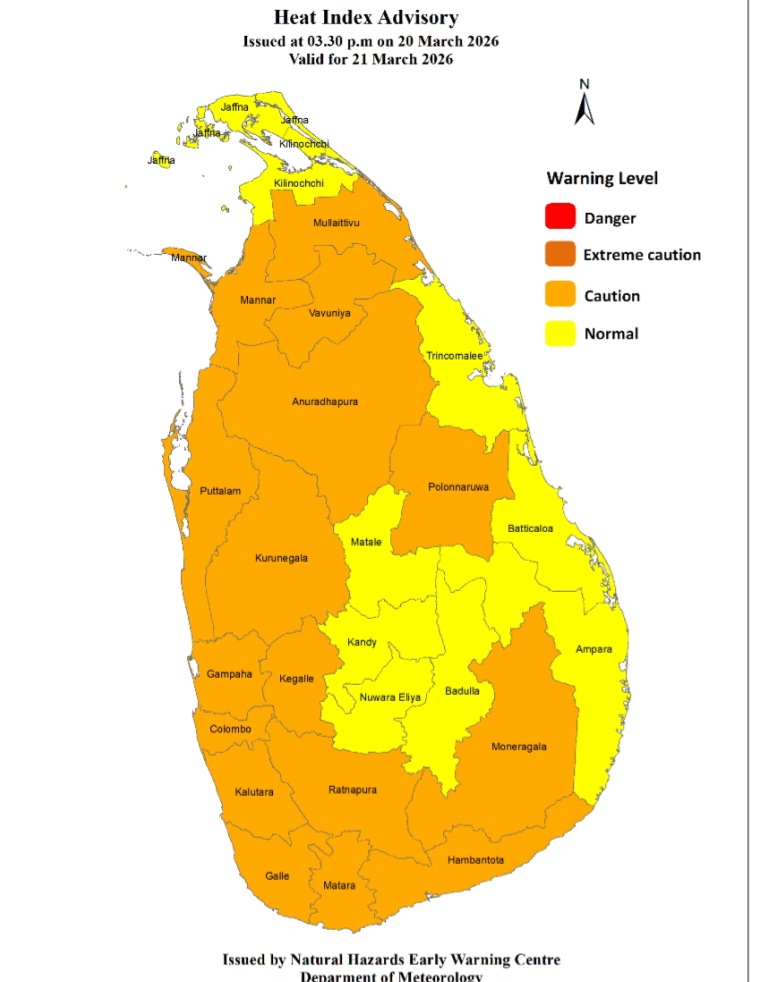
Warm Weather Advisory Issued by the Natural Hazards Early Warning Centre of the Department of Meteorology at 3.30 p.m. on 20 March 2026, valid for 21 March 2026
The public are warned that the Heat index, the temperature felt on human body is likely to increase up to ‘Caution level’ at some places in the Western, Sabaragamuwa, North-central, Southern and North-western provinces and in Monaragala, Mannar, Vavuniya and Mullaitivu districts.
The Heat Index Forecast is calculated by using relative humidity and maximum temperature and this is the condition that is felt on your body. This is not the forecast of maximum temperature. It is generated by the Department of Meteorology for the next day period and prepared by using global numerical weather prediction model data.
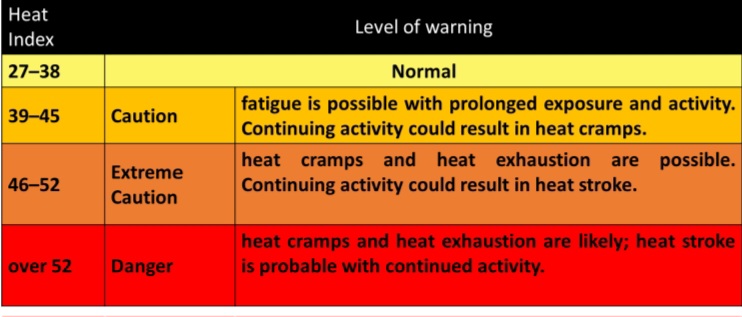
Effect of the heat index on human body is mentioned in the above table and it is prepared on the advice of the Ministry of Health and Indigenous Medical Services.
ACTION REQUIRED
Job sites: Stay hydrated and takes breaks in the shade as often as possible.
Indoors: Check up on the elderly and the sick.
Vehicles: Never leave children unattended.
Outdoors: Limit strenuous outdoor activities, find shade and stay hydrated.
Dress: Wear lightweight and white or light-colored clothing.
Note:
In addition, please refer to advisories issued by the Disaster Preparedness & Response Division, Ministry of Health in this regard as well. For further clarifications please contact 011-7446491

Advisory for Severe Lightning issued for Galle, Matara, Kaluthara and Rathnapura districts

Sri Lanka says it denied US request to land two aircraft at Mattala airport

Eid celebrations dimmed by war and displacement across Middle East

Showers may occur at several places in the Western, Sabaragamuwa, Northwestern and Uva provinces and in Galle, Matara, Kandy and Nuwara-Eliya districts after 1.00 pm.

Iranian strikes on bases used by US caused $800m in damage, new analysis shows

President maintains Lanka has been even-handed in dealing with Iran and US

‘Dates have the highest sugar content to fight Coronavirus’

Sunday Island 27 December – Headlines

#SundayIsland 17th December – Headlines

Sunday Island – 28th March

Sunday Island Headlines – 21 March

Sunday Island – 21st February – Headlines
-

 Business6 days ago
Browns EV launches fast-charging BAW E7 Pro at Rs. 5.8 million
-

 Life style7 days ago
From culture to empowerment: Indonesia’s vision for Sri Lanka
-

 News4 days ago
CIABOC questions Ex-President GR on house for CJ’s maid
-

 Life style7 days ago
Ranjith Fernando celebrates cricketing journey with Hob Nails to Spikes
-

 News5 days ago
Sri Lankan marine scientist Asha de Vos honoured at UNGA opening
-

 Features6 days ago
Achievements of the Hunduwa!
-

 Latest News7 days ago
QR code system will be implemented for fuel with effect from 06.00 a.m. today (15th)
-

 News5 days ago
Australian HC debunks misleading travel risk claims for Sri Lanka