
Foreign News
Crowds overrun US-backed group’s new aid distribution site in Gaza


Thousands of Palestinians have overrun an aid distribution site in Gaza set up by a controversial US and Israeli-backed group, a day after it began working there.
Videos showed crowds walking over torn-down fences and earth berms at the Gaza Humanitarian Foundation’s (GHF) compound in the southern city of Rafah.
The group said that at one point its team fell back because the numbers seeking aid were so great. The Israeli military said troops nearby fired warning shots.
The GHF, which uses armed American security contractors, aims to bypass the UN as the main supplier of aid in Gaza, where experts have warned of a looming famine after an 11-week Israeli blockade that was recently eased.
The UN said the videos from Rafah were “heartbreaking” and that it had a detailed plan ready to get enough aid to the “desperate population” of 2.1 million.
The UN and many aid groups have refused to co-operate with GHF’s plans, which they say contradict humanitarian principles and appear to “weaponise aid”.
They have warned that the system will practically exclude those with mobility issues, force further displacement, expose thousands of people to harm, make aid conditional on political and military aims, and set an unacceptable precedent for aid delivery around the world.
Israel has said an alternative to the current aid system is needed to stop Hamas stealing aid, which the group denies doing.
The GHF announced on Monday that it had “commenced operations in Gaza” and begun giving out supplies to Palestinians at its distribution sites.
On Tuesday afternoon, the Israeli military confirmed two sites located in the Tal al-Sultan neighbourhood of Rafah and the Morag Corridor – an east-west military zone that separates the city from the rest of Gaza – had begun distributing food to families.
At around the same time, Israeli and Palestinian media shared pictures showing long queues of Palestinians at the Tal al-Sultan site.
But just over an hour later, they began posting videos showing thousands of men, women and children streaming into the compound. In one clip, some people are seen running and ducking as what appear to be gunshots ring out.
Witnesses described a scene of chaos as people seized food parcels and other aid from the site. They also said Israeli troops stationed nearby had opened fire.
“The situation was extremely difficult. They only allowed 50 people to cross at a time,” one man told BBC Arabic’s Middle East daily radio programme. “In the end, chaos broke out – people climbed over the gates, attacked others, and took all the [aid].”
“It was a humiliating experience,” he added. “We’ve suffered greatly from hunger. We’re just looking for a bit of sugar to make a cup of tea, and a piece of bread to eat.”
A woman said hunger and poverty had “overwhelmed everyone”.
“People are exhausted – willing to do anything, even risk their lives – just to find food and feed their children.”
A statement from the GHF acknowledged that “the needs on the ground are great” and said it had so far handed out about 8,000 food boxes – equivalent to 462,000 meals – through a partnership with local non-governmental organisations.
However, it said Palestinians had experienced several hours of delays in accessing one site “due to blockades imposed by Hamas”, without providing evidence.
“At one moment in the late afternoon, the volume of people at the SBS [Secure Distribution Site] was such that the GHF team fell back to allow a small number of Gazans to take aid safely and dissipate. This was done in accordance with GHF protocol to avoid casualties. Normal operations have resumed,” it added.
The Israel Defense Forces (IDF) said its troops had fired “warning shots in the area outside the compound”.
“Control over the situation was established, food distribution operations are expected to continue as planned, and the safety of IDF troops was not compromised,” it stated.
Gaza’s Hamas-run Government Media Office said Israel’s efforts to distribute aid had “failed miserably”. It also denied that Hamas had tried to stop civilians reaching the GHF’s sites.
At a news conference in New York, UN spokesman Stéphane Dujarric said: “We have been watching the video coming out of Gaza around one of the distribution points set up by the Gaza Humanitarian Foundation. And frankly, these videos, these images, are heartbreaking.”
“We and our partners have a detailed, principled, operationally sound plan supported by member states to get aid to a desperate population. We continue to stress that a meaningful scale-up of humanitarian operations is essential to stave off famine and meet the needs of all civilians wherever they are,” he added.
The US state department’s spokeswoman called the UN’s criticism “the height of hypocrisy”.
“It is unfortunate, because the issue here is giving aid to Gaza, and then suddenly it moves into complaints about style or the nature of who’s doing it,” Tammy Bruce told reporters.
Challenged by the BBC about the independence and neutrality of the GHF, Bruce acknowledged there are “some disagreements” about how the distribution of food and aid into the region is “being implemented”.
But she added: “I think that most of us would agree that this is good news… the real story here is that there’s food aid going in.”
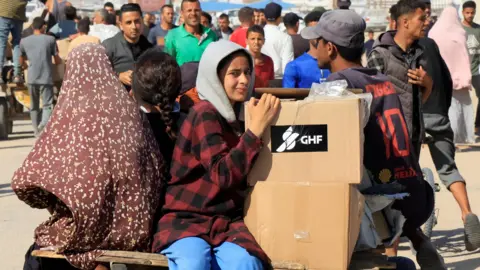
The GHF initially plans to set up four distribution sites in southern and central Gaza where Palestinians will be able to collect food and other aid for their families. It says it aims to feed a million people – just under half the population – by the end of this week.
The sites are meant to be secured by American contractors, with Israeli troops patrolling the perimeters. To access them, Palestinians are expected to have to undergo identity checks and screening for involvement with Hamas.
UN and other aid agencies have insisted they will not co-operate with any scheme that fails to respect fundamental humanitarian principles of humanity, impartiality, independence and neutrality.
On Sunday night, Jake Wood resigned as the GHF’s executive director, saying the group’s system could not work in a way that would be able to fulfil those principles.
The GHF’s board rejected the criticism and accused “those who benefit from the status quo” of being more focused on “tearing this apart than on getting aid in”.
The group also alleged on Monday that Hamas had made death threats to NGOs supporting its distribution sites and attempted to block civilians from accessing the aid.
Hamas has publicly warned Palestinians not to co-operate with GHF’s system.
Israel imposed a total blockade on humanitarian aid and commercial supplies to Gaza on 2 March and resumed its military offensive two weeks later, ending a two-month ceasefire with Hamas. It said the steps were meant to put pressure on the armed group to release the 58 hostages still held in Gaza, up to 23 of whom are believed to be alive.
On 19 May, the Israeli military launched an expanded offensive that Prime Minister Benjamin Netanyahu said would see troops “take control of all areas” of Gaza. The plan reportedly includes completely clearing the north of civilians and forcibly displacing them to the south.
Netanyahu also said Israel would temporarily ease the blockade and allow a “basic” amount of food into Gaza to prevent a famine, following pressure from allies in the US.
Since then, Israeli authorities say they have allowed at least 665 lorry loads of humanitarian aid, including flour, baby food and medical supplies, into Gaza.
However, more than 400 loads were on the Gazan side of the Kerem Shalom crossing awaiting distribution by the UN as of Tuesday evening, according to the Israeli military body in charge of aid co-ordination, Cogat. It called on the UN to “do its job”.
There was no immediate comment from the UN, but it said last week that its teams faced significant challenges in collecting supplies due to insecurity, the risk of looting and co-ordination issues with Israeli forces.
The head of the UN’s World Food Programme warned on Sunday that the aid was only a “drop in the bucket” of what was needed in the territory to reverse the catastrophic levels of hunger, amid significant shortages of basic foods and skyrocketing prices.
Half a million people face starvation in the coming months, according to an assessment by the UN-backed Integrated Food Security Phase Classification (IPC).
Israel launched a military campaign in Gaza in response Hamas’ cross-border attack on 7 October 2023, in which about 1,200 people were killed and 251 others were taken hostage.
At least 54,056 people have been killed in Gaza since then, including 3,901 over the past 10 weeks, according to the territory’s Hamas-run health ministry.
[BBC]


US authorities have found debris from a medical transport aircraft that went missing with six people on board.
The Federal Aviation Administration told the BBC it had lost contact with the Gulfstream G-100 plane just after 01:00 local time (05:00 GMT) on Saturday, while it was travelling from Bermuda to Boston, Massachusetts.
The search for survivors continues off the coast of Nantucket, a Massachusetts island, the US Coast Guard said.
Authorities have notified the next of kin of those on the flight, four Canadian nationals and two Bermudian nationals.
“Search crews located a debris field confirmed to be from the aircraft off the coast of Nantucket,” the US Coast Guard said in an update on Saturday night. It added that ships, helicopters and planes were involved in searches that would through continue the night.
The plane departed from Bermuda’s L.F. Wade International Airport at 23:40 local time, according to flight data from FlightAware, and was due to land at Boston’s Logan International at 01:30 EDT (05:30 GMT).
According to the tail number released by the Coast Guard, the plane belonged to Latitude Air Ambulances, a company that provides international medical flights for patients returning home.
Among those on board were two pilots and two medical staff, both Canadian, Clarence Togeretz, director of flight operations at Latitude, told CBC News.
The crew flew to Bermuda to collect a patient and their relative, who are not Canadian, Togeretz said.
FlightAware’s tracker shows the aircraft significantly dropped in altitude before its communications went dark, plummeting from around 7,300m (24,000ft) to 3,300m (11,000ft).
Radio transmissions shows trouble with communications between the air traffic controller and the pilot, the Boston Globe reported based on transmissions provided by LiveATC.net.
“You’re coming in blind? Is that what you said?,” the air traffic controller asked. “Are you declaring an emergency, or no?”
The pilot’s response was inaudible.
“You’re coming in a little weak so I didn’t hear what your response was, if you were declaring an emergency or not,” the air traffic controller said, according to the Globe.
The air traffic controller later confirmed the pilot had declared an emergency.
An area fire dispatcher asked emergency crews just after 01:00 EDT to prepare to meet a plane with an “electrical issue”.
The dispatcher later said “the aircraft has lost radio and radar”.
The Coast Guard said it would provide an update on Sunday morning local time.
[BBC]

A car has crashed into a crowd of rugby league supporters in the eastern Australian city of Newcastle, injuring 10 people, including three children.
New South Wales police said on Saturday that two of the injured – a five-year-old girl and a 67-year-old man – were in a critical condition and the other eight were in stable condition in hospital.
Police said they had arrested the 18-year-old man driving the vehicle and were investigating what happened. They said the crash was not believed to be related to “terrorism”.
The crowd had gathered to farewell the local rugby league side, the Newcastle Knights, ahead of their grand final against the Sydney Roosters on Sunday.
Newcastle Lord Mayor Gavin Morris said the driver, a rugby league fan, had lost control of his vehicle and had been taken into custody.
“He was revving the car, he was excited, he was a supporter, he was there for the joy of the moment,” Morris told the national broadcaster ABC.
“Somehow he lost control of the car … and he’s gone into the crowd,” he added.
Prime Minister Anthony Albanese said: “My thoughts are with everyone injured or involved in the horrible incident this morning in Newcastle.”
“Rugby league brings people together, and this should have been a weekend of excitement and pride for Newcastle fans,” he wrote in a social media post.
[Aljazeera]

Polls have opened in Latvia for an election taking place against the backdrop of perceived security threats from Russia and a nationwide cost-of-living squeeze.
Saturday’s vote is the first electoral test for Prime Minister Andris Kulbergs after coming to power in May this year when his predecessor resigned due to a backlash from stray drone incursions from Ukraine.
Kulbergs, whose right-wing United List party is currently polling at about 20 percent, is expected to hold onto his position, but the decline of two allies in his current coalition means he is set for a complicated negotiation over the makeup of any future government.
Polls opened at 05:00 GMT and will close at 17:00 GMT. The results are not expected to change Latvia’s pro-European and pro-Ukrainian course.

About 1.5 million people are eligible to vote in the country’s 11th parliamentary election since independence from the Soviet Union in 1991.
Latvian politics are highly fragmented, with parties rarely seeing above 20 percent vote share and coalitions being the norm.
This year, 14 electoral lists are contesting the election, but polls indicate only seven are likely to enter parliament, with the rest expected to fail to meet the minimum 5 percent vote threshold.
Rising living costs, low wages, strains on the healthcare system and long-term population decline have all featured prominently in campaign debates.
Most parties in Latvia are pro-Ukraine; however, the populist Sovereign Power party – which says it wants Ukraine to win but argues money spent supporting Kyiv would be better spent at home – looks likely to become the country’s second-biggest party, with more than 9 percent of the vote. Most other parties have ruled out forming a coalition with Sovereign Power.
Latvia First, a pro-Ukraine and populist nationalist party currently polling at about 9 percent, could be a potential coalition partner for PM Kulbergs.
The Progressives, a pro-European social democratic party, are polling at 6 percent.
Ethnic Russians make up roughly one in four Latvian citizens, but their vote, which has traditionally been cast along identity-based lines, looks set to be made according to economic and social issues.
Latvia is the poorest of the Baltic states, and it has sharply increased its defence spending since Russia invaded Ukraine, now allocating nearly 5 percent of its gross domestic product (GDP) to defence.
[Aljazeera]

Showers or thundershowers will occur at several places in the most part of the island after 1.00 p.m

Geneva takes up Sallay’s case and govt. ignores opportunity to answer accusations

Section of wartime KKS High Security Zone vacated to facilitate economic development in the area

Lawyer lodges complaint against Govt. Printer, Media Ministry Secy.

Sri Lankan troops in joint anti-terrorist exercise in Russia

Nine Indian poachers brought to KKS with their boat

‘Dates have the highest sugar content to fight Coronavirus’

Sunday Island 27 December – Headlines

#SundayIsland 17th December – Headlines

Sunday Island – 28th March

Sunday Island Headlines – 21 March

Sunday Island – 21st February – Headlines
-

 Latest News6 days ago
Gold winner Tharanga gets brand-new Honda Vezel from SLAAJ
-

 Features6 days ago
Why Sri Lanka needs an Inclusive Civic Nationalism – urgently
-

 News5 days ago
US-assisted ‘Ice’ detection: NPC to examine IGP’s move to transfer drug-busting team
-

 Features7 days ago
Thailand’s biggest new global star …
-

 News7 days ago
First cases taken up by SC after enactment of 22A dismissed
-

 News6 days ago
Civil society activist accuses govt. of favouring Ven. Gnanasara
-

 Editorial4 days ago
Colombo Port drug bust: The plot thickens
-

 Editorial7 days ago
Aftershocks of 22A