
News
‘Crises endemic, reflect overall failure of ministers’

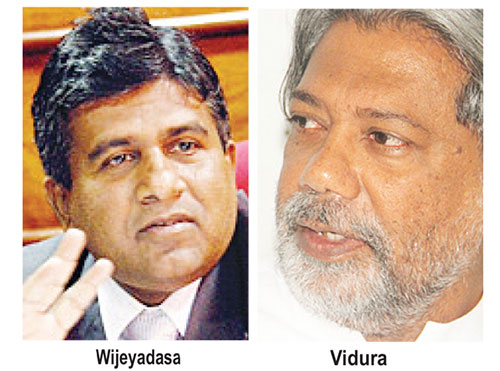
Wijeyadasa, Vidura slam Cabinet
By Shamindra Ferdinando
Blaming the Cabinet of Ministers for a spate of serious crises, State Minister Vidura Wickremanayake says there is absolutely no point in a Cabinet reshuffle.
The Cabinet of Ministers has failed the country, the Kalutara District lawmaker said, urging the government to take tangible measures or face the consequences. The former SLFPer contested the last parliamentary election on the SLPP ticket.
The State Minister said so when The Island asked the outspoken Parliamentarian to explain his recent call for change of strategy due to the pathetic performance of the Cabinet of Ministers.
Responding to The Island queries, the only son of one-time Prime Minister Ratnasiri Wickremanayake said that the country wouldn’t have been in such a sorry state if cabinet ministers accomplished what was expected of them. Instead, the cabinet was the cause of turmoil today, MP Wickremanayake said, explaining how flawed decisions taken without proper consultations, advice in line with overall national policies weakened the government.
Asked whether his frank opinion as regards the performance of the cabinet of ministers received criticism from colleagues in the government, MP Wickremanayake said that how could anyone refuse to accept the truth. According to the State Minister, the cabinet was part of the executive therefore it was responsible for implementing decisions taken by the government.
In terms of the Constitution the President heads the cabinet.
State Minister Wickremanayake said that the failure on the part of the cabinet had caused irreparable damage to the two year old administration. “One or two more wrong decisions will be catastrophic,” MP Wickremanayake said.
State Minister Wickremanayake has questioned the standing of the cabinet of ministers at a time ministers Vasudeva Nanayakkara, Wimal Weerawansa and Udaya Gammanpila have challenged the integrity of the rest of the cabinet ministers over the controversial Yugadanavi deal. The case is now before the Supreme Court.
Former cabinet minister and SLPP Colombo District MP Wijeyadasa Rajapakse asserted that the current crisis should be examined against the backdrop of the enactment of the 20th Amendment in Oct 2020 at the expense of the 19th Amendment.
Acknowledging State Minister Wickremanayake’s strong criticism of the cabinet of ministers, lawmaker Rajapakse emphasized that President Gotabaya Rajapaksa couldn’t absolve himself of responsibility as he chaired the cabinet. The 20th Amendment was meant to strengthen the hands of the President, the former Justice Minister said, the cabinet couldn’t be faulted leaving the President out.
MP Rajapakse voted for the controversial amendment after having strongly criticized it. State Minister Wickremanayake, too, voted for the 20th Amendment.
Former BASL President Rajapakse said that the incumbent dispensation had caused so much turmoil in the administrative and political setups, every sector was in deepening turmoil. Ruination of the agro sector was a glaring case of an example, MP Rajapakse said, adding that the hasty decision regarding the abolition of agro-chemical use destroyed the farmer community.
Subsequent, corruption accusations both in and out of Parliament over both carbonic fertiliser imports from China that ended in disaster with the creation of a new controversy over payment of USD 6.7 mn to the supplier of allegedly contaminated fertiliser that had been rejected and liquid fertilizer imports from India placed the government in an extremely embarrassing situation, the MP said.
Yugadanavi was another crisis that has now ended up in the Supreme Court, the President’s Counsel said, while asserting that the government might not be able to overcome a spate of overwhelming challenges. “The new year is going to be tough. The people are experiencing an extremely difficult situation due to the sharp increase in the cost of living as a result of the continuing balance of payments crisis,” MP Rajapakse said.
Who would accept the responsibility for gas-related explosions in all parts of the country? the former minister asked. Who really believed the crises could be overcome by proroguing the Parliament or selling national assets to external powers through skullduggery.
MP Rajapakse said that nothing could be as important as the government undertaking a comprehensive examination of the ground situation. The executive, the legislature and the judiciary would have to undertake a total review, the former Minister said, warning that the government seemed to be running out of time.



It has been reported that Attorney at Law Rakitha Rajapakshe, the son of former Minister of Justice Wijeyadasa Rajapakshe, has been arrested by the Commission to Investigate Allegations of Bribery or Corruption (CIABOC) over alleged links with the underworld.

… alleges NPP trying to implement UPFA, UNP plan
Front-line Socialist Party (FSP) yesterday (24) alleged that the NPP government’s move to amalgamate the Employees’ Trust Fund (ETF) and the Employees’ Provident Fund (EPF), under a unified, tripartite governance framework, would be detrimental to the private sector workers.
Addressing the media at Melder Place, Nugegoda, FSP spokesman Duminda Nagamuwa said that the Cabinet of Ministers approved this proposal on 15 June.
Nagamuwa claimed that the NPP was trying to implement what President Mahinda Rajapaksa had sought to do, in 2011, causing the police to open fire on a group of the Export Processing Zone workers, protesting against the move to create a private pension scheme. A worker, identified as Roshen Chanaka, was shot by police on May 30, 2011, and he succumbed to his injuries.
Pointing out that the EPF and the ETF had been established for the benefit of private sector workers but with different objectives, Nagamuwa warned that amalgamation of the two funds could cause unnecessary complications.
The FSP spokesman said that Ravi Karunanayake, in his capacity as the Finance Minister of the Yahapalana government, in late November 2015 had declared their intention to amalgamate the ETF with the EPF.
FSP’s Pubudu Jayagoda told The Island that they expected all political parties, other than the NPP, to disclose their stand on the vital issue. Jayagoda urged the Opposition to take a stand on the vital issue .
By Shamindra Ferdinando
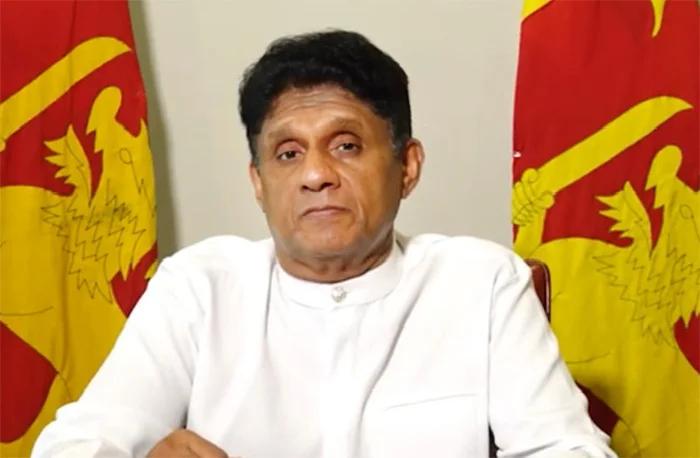
The Opposition yesterday argued in Parliament that the National Environment Amendment Bill was unconstitutional. The Opposition said that it violated the 13th Amendment.
SJB and Opposition Leader Sajith Premadasa argued that the approval of the Provincial Councils was required for the Bill to go ahead, as it was a subject in the Concurrent List of powers as per the 13th Amendment to the Constitution.
The MP also said that the clause which enables the Central Government to file legal actions against Local Government bodies was unconditional as well, since local bodies are included in the Provincial Councils list.
“How can you go ahead at a time when the Provincial Councils do not function properly,” Premadasa questioned.
ITAK MP P. Sathyalingam also raised the issue, but Speaker Jagath Wickramaratne, who responded, said the MPs could raise the relevant matters during the debate.

South Africa stun South Korea to reach World Cup knockouts for the first time

Tremors of 7.5, 7.2 kill 32, injure hundreds in Venezuela

Former Minister Wijeyadasa Rajapakshe’s son arrested by CIABOC

Morocco come back after historic Haiti goals to reach World Cup last 32

Strong earthquake strikes northern Japan

Vinicius nets twice and Neymar returns as Brazil ease by Scotland

‘Dates have the highest sugar content to fight Coronavirus’

Sunday Island 27 December – Headlines

#SundayIsland 17th December – Headlines

Sunday Island – 28th March

Sunday Island Headlines – 21 March

Sunday Island – 21st February – Headlines
-

 News6 days ago
Creditor receives USD 2.5 mn as Lankan public bears loss from theft of Treasury funds
-

 News5 days ago
Creditor not yet paid
-
 News5 days ago
Consumers bearing 22% tax burden despite 18% VAT claim: Dr. Harsha de Silva
-

 Features4 days ago
Nanda Pethiyagoda Wanasundara as three generations of family saw her
-

 Features3 days ago
Sri Lanka developing independent hydrographic capabilities
-

 Opinion6 days ago
SriLankan Airbus struck by lightning
-

 Editorial4 days ago
Fuel crisis: Beyond price debate
-

 Latest News4 days ago
Sooryavanshi thumps fastest List A fifty as India A win tri-series