
News
CP Leader warns of danger of being at mercy of the dollar with it likely to lose its world reserve currency status

Suggests looking at India and China as alternative options
By Rathindra Kuruwita
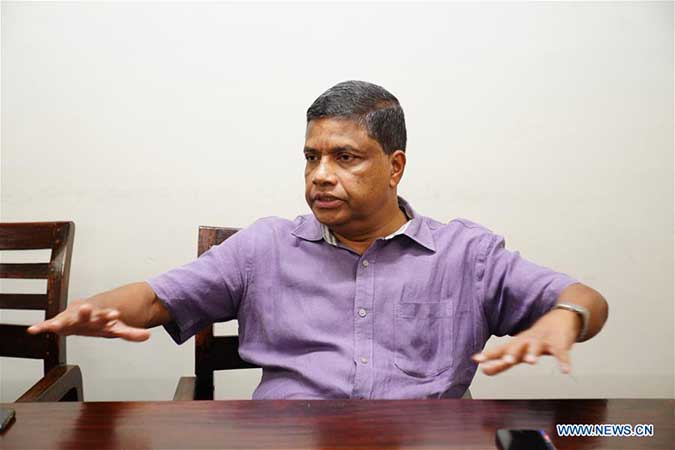
The United States has printed trillions of dollars in the past year and Sri Lanka will be at the mercy of its volatility unless it looks at ways to reduce its dependence on the dollar, General Secretary of the Communist Party of Sri Lanka (CPSL) Dr. G. Weerasinghe told The Island on Wednesday.
The CPSL recently released a policy manifesto, Idirimagin Idiriyata, at the party’s 80th anniversary and proposed an alternative development mechanism.
After several centuries, the centre of world economy has shifted to Asia, and it has opened up new developmental avenues for Sri Lanka, General Secretary of the Communist Party said. Speaking about the Idirimagin Idiriyata policy manifesto the CPSL launched on 03 July, he said that most Sri Lankan economists are western oriented and ignore new world trends.
“In the last 20-30 years, many Asian economies took off, but we couldn’t get on the bus. This is because our entire economy is oriented to the West. We don’t even think what the Chinese, Indian, Korean or Japanese market wants. Clearly they don’t need our tea or garments. We have to figure out what these new markets want,” he said. Dr. Weerasinghe added that China is the main business partner with 140 countries in the world. China and India do a lot of business together, despite the frequent clamouring by Indian media, he said. “China is the biggest market in the world. China has a 500 million strong middle class. We have to also seriously think of India, which is the most populous country in the world. What about ASEAN? CPSL calls for a reorientation of Sri Lanka’s trade policy,” he said.
The CPSL General Secretary said that de-dollarization and the availability of new payment platforms are also developments that Sri Lanka should look at. In recent years, it has become evident that the United States and a few of its allies are manipulating international institutions that were meant to be apolitical, he said.
“They are also using sanctions to punish countries that do not bow down to the West. They are misusing the fact that the U.S. Dollar is the reserve currency of the world. They have also used payment platforms like SWIFT which was said to be beyond politics. A lot of countries have seen what happened to Iran and Russia and are worried that the same fate would befall them. Most major powers in the world are thinking about using alternative currencies to do business between each other. They have also looked at payment gateways like Mir,” he said.
Dr. Weerasinghe said that the US and EU imposed sanctions on about 6000 products on Russia following the Ukrainian war. Without being daunted, it rearranged its economy towards Asia and have managed to escape economic collapse. This made many major powers realize that the US and EU can only influence them, if U.S. dollars are used for trade.
“De-dollarization has gained momentum ever since. Russia, Iran and a few other countries have been kicked out of SWIFT,” he said.
Dr. Weerasinghe said that Sri Lanka has now decided that the Chinese Yuan and the Indian rupee can be used for trade. Some elements are insisting that this would be bad for the country without giving a rational explanation, he said.
The CP General Secretary mentioned that there are a few new development banks in the world, i.e. the BRICS bank and the AAIB. Sri Lanka only depends on the World Bank, IMF, etc., and these establishments have been tools of the West to impose its hegemony on the rest of the world, he said.
Dr. Weerasinghe added that until 1978, Sri Lanka took a number of progressive steps to defeat colonialism, and to industrialize. It attempted to formulate its own drug policy with Dr. Senaka Bibile, which is now widely respected around the world.
However, everything changed after 1977 and the problems created from the shift in the economic policy culminated with the current economic crisis, he said.
“Almost all governments, since 1977, have followed policies that were inimical to the agriculture and manufacturing sectors. We moved to low paying and low-productivity service jobs. It is a well-known fact that all nations that joined the developed nations club in the last 60 years focused on labour intensive manufacturing and boosting agricultural productivity. This is the history of development, but we have decided to ignore, it since 1977,” he said, adding that the institutions set up to ensure adherence to the Washington Consensus, i.e. World Bank and the IMF dictates, had encouraged deindustrialization in Sri Lanka.
“In fact, a 2003 agreement we signed with the IMF says that the Sri Lankan government will not take steps to develop industrialization,” he said.
The CPSL General Secretary said that as the state had lost both tax and non-tax revenue, it was compelled to borrow, especially from the International Sovereign Bond (ISB) markets.
“We started borrowing from these markets in 2007. Up until 2015, we borrowed about 30 percent of our total debt from ISBs. Between 2015 and 2019, we borrowed over 13 billion US dollars from these markets. These bonds are held by companies based in the US and the EU. They are literally poli mudalalis (loan sharks). Borrowing from these markets has ruined us. However, there is a big campaign by the West and its local allies to place the blame on China,” he said.




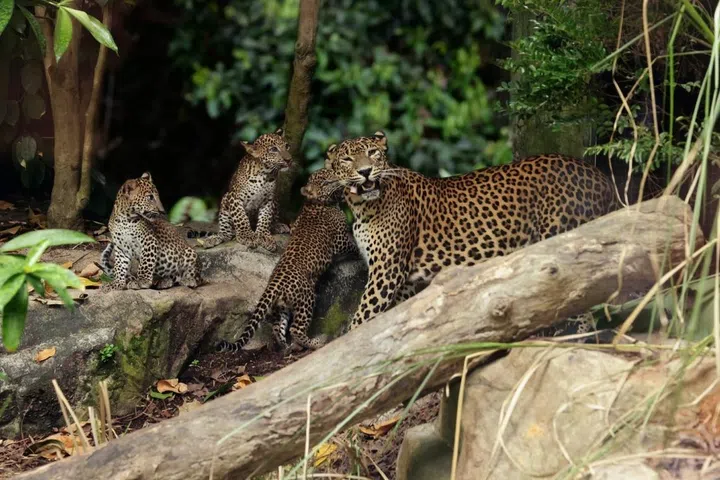
Three Sri Lankan leopard cubs that were born at the Singapore Zoo on Jan 1 have now made their public debut at the facility.
The two males and one female, born to mother Yala and father Asanka, are the first of their species yo be born at the Singapore Zoo. The last successful birth in Singapore was recorded at the Night Safari three decades ago.
The triplets, which are the pair’s first litter, are among around 80 Sri Lankan leopards in zoos worldwide.
The species is listed as vulnerable on the International Union for Conservation of Nature (IUCN) Red List, with fewer than 800 individuals estimated to remain in the wild.
Visitors can now see the triplets at the Wild Africa exhibit, said the Mandai Wildlife Group in a statement on April 16.
The cubs can be found in the exhibit with their mother daily until mid-May and, subsequently, every Wednesday, Saturday and Sunday.
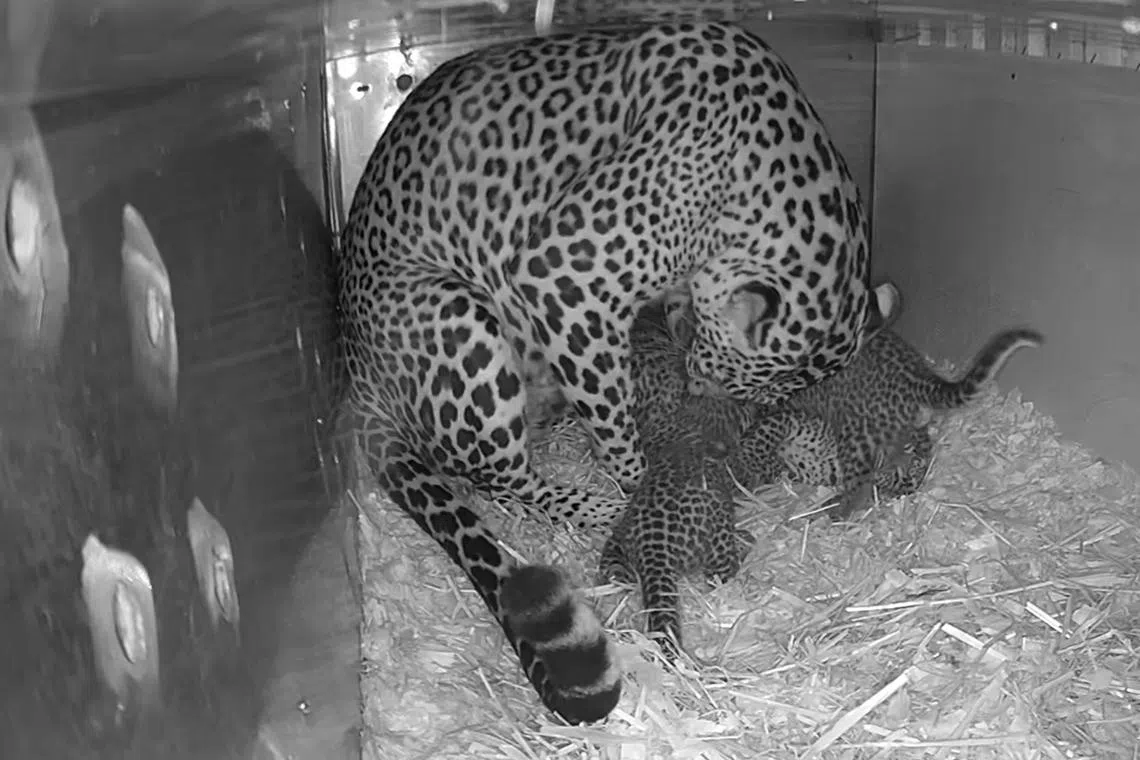
Yala with her cubs in their nest box, a month after their birth on Jan 1. (Straits Times)

A leopard cub investigating a piece of meat suspended from a tree – one of the several enrichment items in the Wild Africa exhibit designed to keep the cats mentally and physically stimulated. (Straits Times)
Mandai Wildlife Group curator Anand Kumar said it took nearly three years and close collaboration across continents to bring together a compatible pair of Sri Lankan leopards.
(Straits Times)
https://www.straitstimes.com/singapore/singapore-zoos-first-sri-lankan-leopard-cubs-make-their-public-debut?ref=top-stories

The Sri Lanka Navy has seized a local multi- day fishing trawler, it’s four man crew together with a consignment suspected to be narcotics off the Southern Coast of the island.
The vessel is presently being escorted to the Dikowita fisheries harbour for further investigations and legal proceedings.
Latest News
Heat Index at Caution Level in the Northern, North-central, North-western, Western, Sabaragamuwa, Eastern and Southern provinces and in Monaragala district


Warm Weather Advisory
Issued by the Natural Hazards Early Warning Centre
Issued at 3.30 p.m. on 15 April 2026, valid for 16 April 2026.
The Heat index, the temperature felt on human body is likely to increase up to ‘Caution level’ at some places in the Northern, North-central, North-western, Western, Sabaragamuwa, Eastern
and Southern provinces and in Monaragala district.
The Heat Index Forecast is calculated by using relative humidity and maximum temperature and this is the condition that is felt on your body. This is not the forecast of maximum temperature. It is generated by the Department of Meteorology for the next day period and prepared by using global numerical weather prediction model data.
Effect of the heat index on human body is mentioned in the above table and it is prepared on the advice of the Ministry of Health and Indigenous Medical Services.
ACTION REQUIRED
Job sites: Stay hydrated and takes breaks in the shade as often as possible.
Indoors: Check up on the elderly and the sick.
Vehicles: Never leave children unattended.
Outdoors: Limit strenuous outdoor activities, find shade and stay hydrated.
Dress: Wear lightweight and white or light-colored clothing.
Note:
In addition, please refer to advisories issued by the Disaster Preparedness & Response Division, Ministry of Health in this regard as well. For further clarifications please contact 011-7446491

Singapore Zoo’s first Sri Lankan leopard cubs make their public debut

Sri Lanka Navy seize multi day fishing craft suspected of smuggling narcotics

‘Sent to be killed’: How Russia forces migrants to fight in Ukraine

Babar Azam 71* helps Peshawar Zalmi extend lead at top

Trump threatens to fire Fed chair Jerome Powell if he doesn’t leave in May

Royal Challengers Bengaluru top the table after bowlers help thump Lucknow Super Giants

‘Dates have the highest sugar content to fight Coronavirus’

Sunday Island 27 December – Headlines

#SundayIsland 17th December – Headlines

Sunday Island – 28th March

Sunday Island Headlines – 21 March

Sunday Island – 21st February – Headlines
-

 News5 days ago
CEB orders temporary shutdown of large rooftop solar systems
-
 Features5 days ago
From Royal College Platoon to National Cadet Corps: 145 years of discipline, leadership, and modern challenges
-

 Business7 days ago
Israeli attack on Lebanon triggers local stock market volatility
-

 Business7 days ago
HNB Assurance marks 25 years with strategic transformation to ‘HNB Life’
-
 Latest News4 days ago
PNS TAIMUR & ASLAT arrive in Colombo
-

 News6 days ago
Anura Solomons passes away
-

 Features5 days ago
CIA’s hidden weapon in Iran
-

 Latest News4 days ago
Prasidh, Buttler set up comfortable win for Gujarat Titans