
News
COVID-19 pandemic darkens South Asia: World Bank


The COVID-19 pandemic hit South Asian nations late but hard, said a report by the World Bank released last Thursday.
The report prepared by the Office of the Chief Economist for the South Asia Region (SARCE) and the Macroeconomics, Trade and Investment (MTI) Global Practice says the pandemic is yet not under control in the region – home to nearly 2 billion people.
The crisis brought South Asia to a near standstill, the report said.
However, the report acknowledged the governments in the region took early containment measures against the pandemic.
“But not all countries were able to contain the domestic spread of COVID-19. Due to low testing, social stigma, and a young population, the actual extent of COVID-19 infections is highly uncertain, but likely much higher than recorded numbers suggest,” it said.
Besides hitting movement and economic activity, the report said the lockdown measures “triggered massive supply disruptions.”
“Information from high-frequency variables, combined in activity indicators, show an unprecedented contraction,” it added.
While the activity dropped by 40% in Pakistan in April, other countries saw a two-thirds drop.
Although the activity has recovered subsequently across the region, “it remained below pre-COVID levels in August.” All the countries witnessed contraction in GDP.
“The collapse in activity was widespread. The economic disruption is even visible from space: South Asia has darkened since March,” the report explained.
“Between March and August, nighttime light intensity declined in more than three-quarters of South Asia’s districts. In August, the average nighttime light intensity across districts was still 10% below its level a year earlier,” the study said. “Mobility declined strongly in nearly all districts, as a result both of national containment measures and local COVID-19 infections.”
Referring to the state of COVID-19 in India, the report showed there is heterogeneity across districts due to voluntary reductions in mobility due to higher local prevalence of COVID-19.
“During the national lockdown in India, districts with more recorded COVID-19 infections per capita experienced larger declines in mobility and nighttime lights.”
Although the local governments “proactively stabilized economic activity through monetary easing, fiscal stimulus, and supportive financial regulation,” the report added: “The situation is fragile amid weak buffers and exhausted policy tools in some countries.”
The report also said that it is yet not clear “whether lockdowns can effectively mitigate a pandemic in countries with a large share of urban poor and densely populated cities.”
“In some cases, they may even be counterproductive.”
The report maintained that the decline in demand and supply disruptions generated by the pandemic and the policies required to contain its spread “have resulted in severe reductions in incomes in the South Asia region.”
“An effective policy response will require a clear understanding of which households and firms are most in need of assistance, and how to reach them,” it added.
“Finding ways to assist these workers will be critical to addressing the welfare losses from the pandemic.”
However, it added that the COVID-19 response “cannot only focus on supporting incomes.”
“The survival of many informal sector firms is threatened by what is hoped to be a temporary shock to their markets and access to supplies. These firms tend to be quite small and lack the savings and the financial access to keep afloat during this extended crisis,” the report added.


Bus fares have been increased by 12.19% with effect from midnight today [23rd March 2026].
The minimum fare will be increased from Rs 27 to Rs 30 while the maximum fare of Rs2159/- will be increased to 2422/-
Latest News
Public will not be served as Computer system failure at Department of Registration of Persons

The Acting Commissioner General of Registration of Persons has announced that due to an unexpected failure of the computer system of the Department of Registration of Persons, all services, including the one day service will not be held on Tuesday (24th March) at the Head Office and all Provincial offices.

Latest News
Heat Index at Caution Level in the Western, Sabaragamuwa, Southern and North-western provinces and in Anuradhapura, Mannar and Vavuniya districts
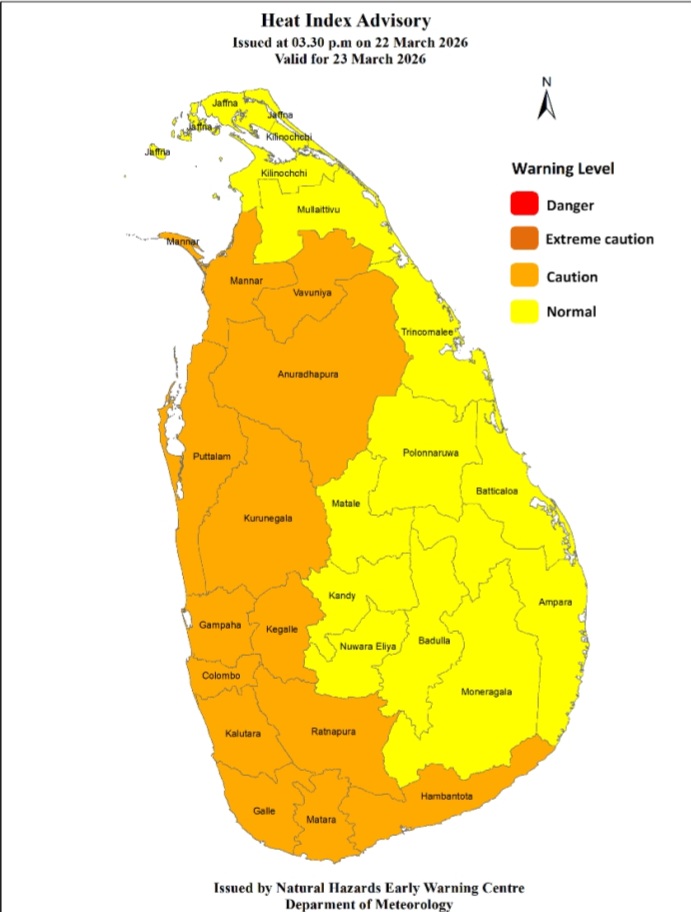
Warm Weather Advisory
Issued by the Natural Hazards Early Warning Centre of the Department of Meteorology
at 3.30 p.m. on 22 March 2026, valid for 23 March 2026.
The Heat index, the temperature felt on human body is likely to increase up to ‘Caution level’ at some places in the Western, Sabaragamuwa, Southern and North-western provinces and in
Anuradhapura, Mannar and Vavuniya districts.
The Heat Index Forecast is calculated by using relative humidity and maximum temperature and this is the condition that is felt on your body. This is not the forecast of maximum temperature. It is generated by the Department of Meteorology for the next day period and prepared by using global numerical weather prediction model data.

Effect of the heat index on human body is mentioned in the above table and it is prepared on the advice of the Ministry of Health and Indigenous Medical Services.
ACTION REQUIRED
Job sites: Stay hydrated and takes breaks in the shade as often as possible.
Indoors: Check up on the elderly and the sick.
Vehicles: Never leave children unattended.
Outdoors: Limit strenuous outdoor activities, find shade and stay hydrated.
Dress: Wear lightweight and white or light-colored clothing.
Note:
In addition, please refer to advisories issued by the Disaster Preparedness & Response Division, Ministry of Health in this regard as well. For further clarifications please contact 011-7446491.

Two killed when Air Canada jet hits fire truck at NYC’s LaGuardia Airport

Bus fares increased by 12.19% from midnight today [23]
Public will not be served as Computer system failure at Department of Registration of Persons

Trump says he is postponing strikes on Iran power plants after ‘productive’ talks on ending war

Asia stocks slide as US and Iran threaten to escalate war

Heat Index at Caution Level in the Western, Sabaragamuwa, Southern and North-western provinces and in Anuradhapura, Mannar and Vavuniya districts

‘Dates have the highest sugar content to fight Coronavirus’

Sunday Island 27 December – Headlines

#SundayIsland 17th December – Headlines

Sunday Island – 28th March

Sunday Island Headlines – 21 March

Sunday Island – 21st February – Headlines
-

 News6 days ago
CIABOC questions Ex-President GR on house for CJ’s maid
-

 News7 days ago
Sri Lankan marine scientist Asha de Vos honoured at UNGA opening
-

 News7 days ago
Australian HC debunks misleading travel risk claims for Sri Lanka
-

 News5 days ago
Bailey Bridge inaugurated at Chilaw
-

 News5 days ago
Pay hike demand: CEB workers climb down from 40 % to 15–20%
-

 News4 days ago
CIABOC tells court Kapila gave Rs 60 mn to MR and Rs. 20 mn to Priyankara
-

 Editorial6 days ago
Couple QR-based quota with odd-even rationing
-

 Features23 hours ago
Trincomalee oil tank farm: An engineering marvel