
News
Countrywide GMOA token strike tomorrow over ad hoc salary policy

Flaying the incumbent government for brazenly violating the national salaries and wages policy, the Government Medical Officers’ Association has announced that they would go on one-day countrywide token strike tomorrow (21) to protest what they alleged as unscrupulous government actions had compelled the entire public sector to launch a wave of strikes.
The GMOA in a statement announcing the trade union action accuses the government of following the destructive yahapalana policy as regards the ad-hoc increase of public sector salaries.
The statement says that the GMOA’s Central Committee has decided to launch a token trade union action on Monday, February 21, 2022 against the current government violating the National Salary Policy and provoking the entire public service to launch a wave of strikes through ill-thought cabinet papers.
The GMOA said the government should take direct responsibility for the current wave of strikes caused by the collapse of the national wage policy, and pointed out that a country can be destabilized by wages without a policy as well as a war.
Salary is a crucial factor in maintaining the right composition of human resources in any institution or country efficiently and more productively and thereby fulfilling the desired role, the GMOA pointed out issuing a statement.
When the salary is not optimal, the institution or service will not be able to obtain or retain the right human resources.
Only way to resolve this is to stop making decisions on salaries through cabinet papers and refer them to the National Salaries Commission, which is made up of technically capable people, and make decisions on salaries in the public service in line with the National Salaries Policy.
If the salary scale is set incorrectly, in addition to the breakdown of the productivity of that organization or service, the internal stability of the organization will also be lost.
Overall Salary consists of the basic salary, allowances and benefits and when determining its scale factors such as educational qualifications, training time, technical skills, decision-making responsibility and responsibility, occupational risk and complexity are considered.
Prior to 2003, the public service faced a wave of strikes due to the arbitrary introduction of the salary factor through ministry committees and the cabinet. Its worst-hit health service, was disrupted by a wave of strikes on185 days out of 365 days a year.
The GMOA realizing this stepped in to correct the salary factor and to improve the public service which had collapsed in the wake of the strikes through the following three proposals.
1. Eliminate cabinet papers, ministry committees and cabinet subcommittees that publish arbitrary salary scales without proper study.
2. Appoint a National Salaries and Remuneration Commission and obtain resource contributions from the leading scholars in the relevant subject.
3. Make all salary revisions only in accordance with a national salary policy.
In 2003, the then President Chandrika Bandaranaike Kumaratunga established a National Salaries and Remuneration Commission and the former President Mahinda Rajapaksa preserved the National Salary Policy formulated by the Commission in 2006 and gave stability to the public service.
However, again during the period of good governance, the Cabinet began to violate the National Wage Policy by amending salaries in the judiciary and the legal field.
The government of President Gotabaya Rajapaksa, is also further complicating this arbitrary process by disregarding any of the factors that should be taken into account in determining the aforesaid salary scale, through Cabinet and Ministry papers or personal commissions.
Today, the country is being destabilized by a wave of strikes due to the sensitive issue of wages, just as the country was destabilized during the war, the GMOA noted.

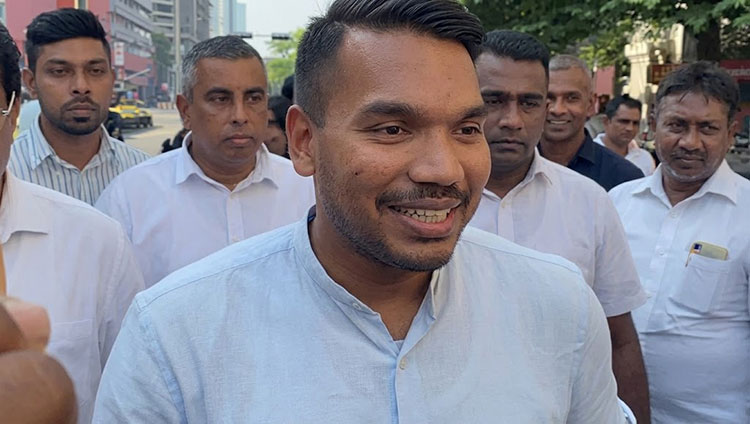
Sri Lanka Podujana Peramuna (SLPP) Member of Parliament Namal Rajapaksa has been arrested by the Commission to Investigate Allegations of Bribery or Corruption (CIABOC).
Namal Rajapaksa had been summoned by CIABOC to provide a statement in connection with investigations into the controversial Airbus deal. He was subsequently arrested by CIABOC after recording his statement for over 5 hours.
Latest News
Sun directly overhead Nittambuwa, Algama, Malwana, Aranayake, Meegahakiula and Panamkadu about 12.09 noon today (04)


The sun is going to be directly over the latitudes of Sri Lanka from 28th of August to 07th of September due to its apparent southward relative motion.
The nearest places of Sri Lanka over which the sun is overhead today (04) are Nittambuwa, Algama, Malwana, Aranayake, Meegahakiula and Panamkadu about 12.09 noon.

Plant’s output cut from 270 MW to 140 MW amidst dwindling stocks; energy analysts warn system remains “at a razor’s edge”
By Ifham Nizam
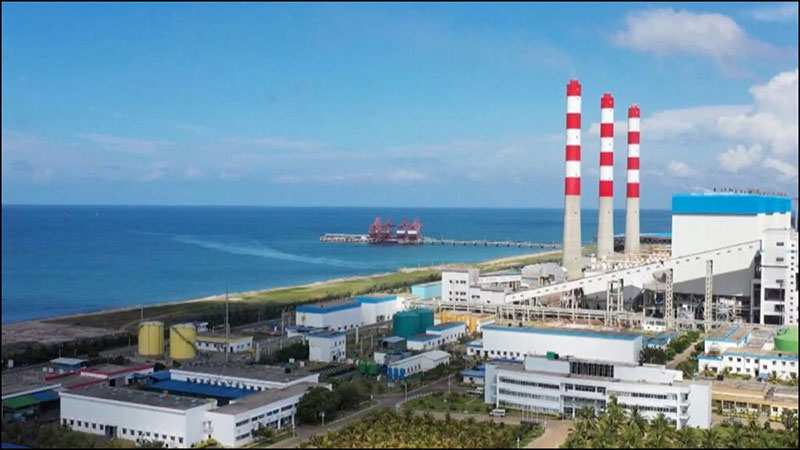
The Norochcholai coal-fired power plant is now digging into the last dredges of its coal stock, with two operational units forced to slash generation from around 270 MW to just 140 MW on Sunday as the plant ran critically short of fuel, according to independent energy analysts and sources familiar with the National System Operator (NSO).
The sudden reduction of approximately 130 MW in coal generation has once again exposed the fragile state of the country’s power supply arrangements, with the plant understood to have coal stocks sufficient only until Friday night.
“This is not how a coal plant is expected to operate. They are digging up the last dredges of coal from the plant,” an independent energy analyst told The Island.
The analyst questioned why the units had been allowed to reach this stage without earlier intervention, arguing that at least one unit should have been deloaded around 10 days ago to conserve the remaining coal.
Had that been done, the analyst said, the country could also have reduced its dependence on more expensive diesel-fired generation during the period when
coal stocks were being conserved.
The latest NSO generation figures highlight the continuing pressure on the system.
Around 7 p.m. on Sunday, when the night peak was reached, total demand stood at 2,552.7 MW. Coal contributed only 282 MW, while major hydro accounted for 1,215.8 MW and thermal-oil generation for 791.9 MW.
The night peak of 2,552.7 MW was substantially higher than the daytime peak of 2,246 MW, according to the NSO Generation Summary for August 30.
The most immediate concern is the remaining coal stock at Norochcholai.
Sources said the plant has coal only to Friday night, making the timing of the next shipment critical.
The first shipment under the emergency arrangement is expected to arrive on Friday, September 4, but the coal unloading will have to begin on the same day if
the power plant is to continue operating without further significant deloading.
That creates another potential vulnerability, with rough sea conditions posing an additional challenge to unloading operations.
Energy sector sources said that even the arrival of the September 4 shipment would not completely eliminate the danger.
The next shipment under the new coal tender would need to commence unloading around September 15. Any significant delay beyond that could again force the Norochcholai units to operate at reduced output.
“We are still at a razor’s edge”
The independent energy analyst said the situation should not be viewed merely as a question of whether a particular vessel arrives on time.
The situation also means that any further reduction in coal generation could have a direct impact on the use of oil-fired power generation, potentially increasing the cost of electricity generation.
The latest NSO figures already show the important role being played by thermal-oil generation during the evening peak, when demand rises sharply.
The analyst questioned the rationale behind allowing the coal units to continue operating at higher loading until stocks reached critically low levels instead of taking measures earlier to stretch the available inventory.

SLPP MP Namal Rajapaksa arrested by CIABOC

Devapathiraja clinch U15 Division I title with 33-run win over Royal

Mandhana’s record ton powers India into semi-finals

Sun directly overhead Nittambuwa, Algama, Malwana, Aranayake, Meegahakiula and Panamkadu about 12.09 noon today (04)

Showers expected in the Uva, Central and Eastern provinces and in Polonnaruwa and Mullaittivu districts after 2.00 p.m

Norochcholai digs into dwindling coal stocks, two units slash generation

‘Dates have the highest sugar content to fight Coronavirus’

Sunday Island 27 December – Headlines

#SundayIsland 17th December – Headlines

Sunday Island – 28th March

Sunday Island Headlines – 21 March

Sunday Island – 21st February – Headlines
-

 Features6 days ago
“Wrap Me Up in My Blazer”— A Gentlemanly Bradby Reminiscence
-

 Features5 days ago
When Sri Lankan stories find their own voice
-
 Features6 days ago
JVP/NPP government as seen from outside by Lionel Bopage now domiciled in Australia
-
 News4 days ago
BASL takes exception to Justice Ganepola being denied a place in SC
-

 Editorial7 days ago
Govt. trying to dupe UN Rapporteur?
-
 Features6 days ago
Prof. Savitri Goonesekere: What has she done?
-

 Features5 days ago
World Trade Politics: Canada rebuffs Trump’s tariff blackmail
-
 News1 day ago
Denied of promotion to SC despite vacancies, justice Gurusinghe retires