
News
Coronavirus: Countries shut borders over new South Africa variant

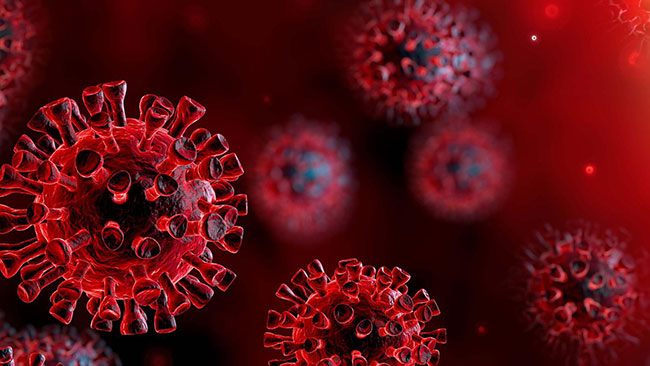
More countries are tightening their travel restrictions after a new coronavirus variant was identified in South Africa earlier this week, said a BBC dispatch yesterday.
It said that the UK, Singapore and Japan are among those rushing in stricter quarantine measures and banning flights from South Africa and neighbouring countries.
The BBC story said: The EU is proposing to ban flights from the region across the whole bloc.
Scientists still have much to learn about the variant, but say they are very worried about it.
The World Health Organization (WHO) has said it will take a few weeks to understand the impact of the new variant, as scientists work to determine how transmissible it is.
The variant is very different to the others that have emerged so far. Scientists have said it is the most heavily mutated version yet, which means vaccines, which were designed using the original strain from Wuhan, may not be as effective.
The new variant is yet to be given a more memorable name, like Delta or Beta, and right now is known as B.1.1.529. The WHO is expected to name it on Friday, and announce whether it is a variant of concern or just a variant of interest.
The WHO says so far fewer than 100 sample sequences have been reported. Cases have mainly been confirmed in South Africa, but have also been detected in Hong Kong, Israel and Botswana.
The UK’s health minister, Sajid Javid, said on Friday that it is “highly likely” to have spread to other countries.
Most of the cases in South Africa have been from its most populated province, Gauteng, of which Johannesburg is the capital city.
Only about 24% of South Africa’s population is fully vaccinated, which could see a rapid spread of cases there, Dr Mike Tildesley, a member of the Scientific Pandemic Influenza Modelling group (Spi-M), told the BBC on Friday.
In Hong Kong, the variant spread during hotel quarantine between a person who had arrived from South Africa and another hotel guest who tested positive a few days later, the Department of Health revealed. Both were fully vaccinated.
Israel’s PM Naftali Bennett said on Friday it is “on the verge of a state of emergency” regarding the new variant, and that he would “act fast, strong and now”.
One case was detected in a person who returned from Malawi, according to Israeli media reports quoting the country’s health ministry. Another two suspected infections were yet to be confirmed with test results. All three are said to have been fully vaccinated.
The WHO has warned against countries hastily imposing travel restrictions, saying they should look to a “risk-based and scientific approach.”
Nevertheless, an increasing amount of nations including the UK, Japan and the Netherlands have temporarily halted flights from these southern African nations: South Africa, Botswana, Namibia, Zimbabwe, Eswatini (formerly Swaziland) and Lesotho.
Singapore, Italy, France and Israel are among those who have also placed Mozambique, on their red lists.
The Head of the European Commission, Ursula von der Leyen, is proposing the whole of the EU put on the “emergency brake” and stop flights from the region.
The EU is already struggling to cope with fresh waves of the virus, and several countries have re-imposed lockdowns and restrictions.
The Czech Republic will ban anyone has has spent more than 12 hours in those nations from entering as of Saturday.
Germany, which is currently going through a fourth wave of infections because of the Delta variant, will allow only Germans to fly into Germany from South Africa as of Friday night, a health ministry source quoted by Reuters news agency said. Even if travellers are fully vaccinated, they will still have to spend 14 days in quarantine.
India has ordered more rigorous screening and testing for travellers arriving from South Africa, Botswana and Hong Kong, local media is reporting.
The flight bans threaten to separate families over the festive season.
Ruth Daines-Slack, 70, had booked to fly from Cape Town to the UK next week for Christmas and her mother’s 100th birthday celebration. She told the BBC she is “beyond devastated” that she will no longer be able to make the trip, adding that the UK’s travel ban is a “knee-jerk reaction”.
The UK was one of the first nations to impose a flight ban, which South Africa’s foreign ministry has criticised as a “rushed decision” made before the WHO has made any announcement on the variant.


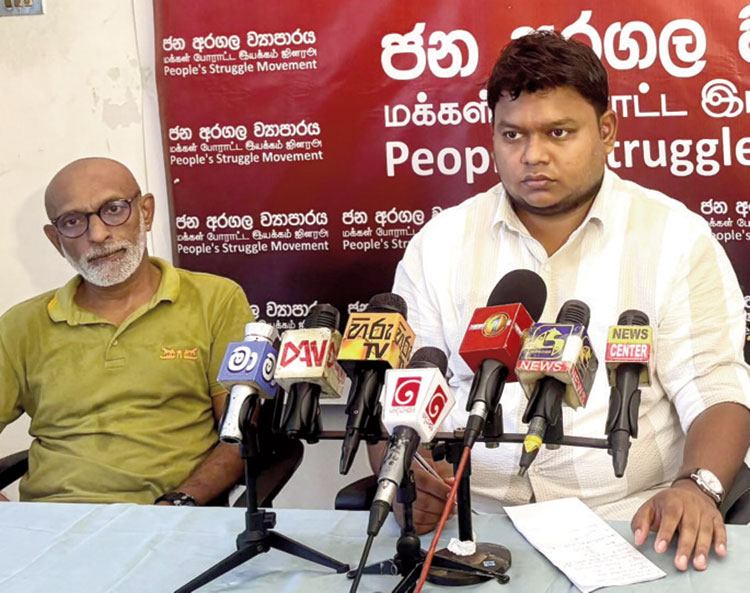
The Frontline Socialist Party-backed People’s Struggle Movement is set to stage a protest march in Colombo today (03) against what it describes as the growing tax burden on the public and the rising cost of living.
The organisers are due to commence the “Colombo March Against Unjust Taxes” at noon from Campbell Park, Borella. The FSP has also been mobilising support for the protest in Colombo and its suburbs in the run-up to the event.
People’s Struggle Movement National Executive Council member Wasantha Mudalige, speaking at a media briefing in Nugegoda yesterday (02), called on the public to join the protest, saying the movement intended to bring the tax burden faced by ordinary people to the forefront.
Mudalige alleged that successive tax measures had placed an excessive burden on households, particularly through taxes on food and educational items. He also criticised the Government over what he described as the high cost of basic food items and the difficulties faced by parents in meeting their children’s educational expenses.
He accused the Opposition of failing to adequately address the issue, claiming that opposition parties raised such concerns, mainly during election periods.
Mudalige also criticised the Government for what he described as a departure from promises made before the 2024 presidential election regarding taxes on educational equipment.
He questioned the tax burden on food items, citing figures of Rs. 100 per kilogramme on dried sprats, Rs. 310 per kilogramme on chicken and Rs. 11 per egg.
He further alleged that while ordinary people were bearing a heavy tax burden, wealthy groups were receiving tax concessions. He also criticised the Government’s economic programme and its implementation of measures associated with the International Monetary Fund (IMF).
The movement has framed today’s protest as part of a broader campaign over the cost of living and taxation. The People’s Struggle Alliance has separately announced that the Campbell Park demonstration will be the first in a series of public actions, with further protests planned in November.
Mudalige said the movement would continue to take the issue to the streets and urged the public to participate in today’s demonstration.
People’s Struggle Movement National Executive Council member Jayantha Amarasinghe also addressed the press.
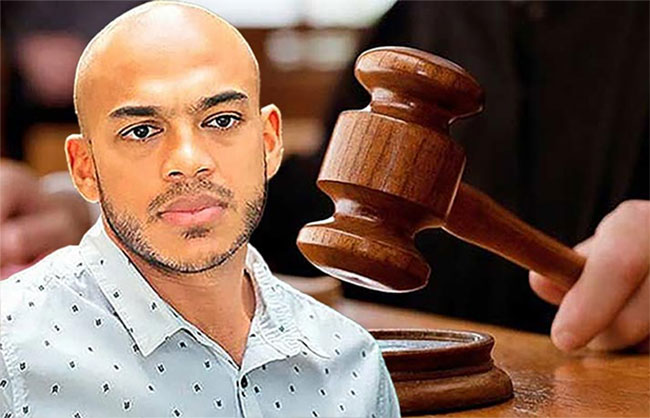
The Colombo High Court yesterday postponed the trial in the case filed under the Prevention of Money Laundering Act against Yoshitha Rajapaksa, son of former President Mahinda Rajapaksa.
The case was taken up before Colombo High Court Judge Udesh Ranatunga, with Yoshitha Rajapaksa, who is currently out on bail, appearing in court.
The trial was postponed as the President’s Counsel appearing for the defence was indisposed.
The Attorney General has filed the case against Rajapaksa, alleging that he committed an offence under the Prevention of Money Laundering Act by purchasing five plots of land in Dehiwala and Ratmalana, worth more than Rs. 73 million.
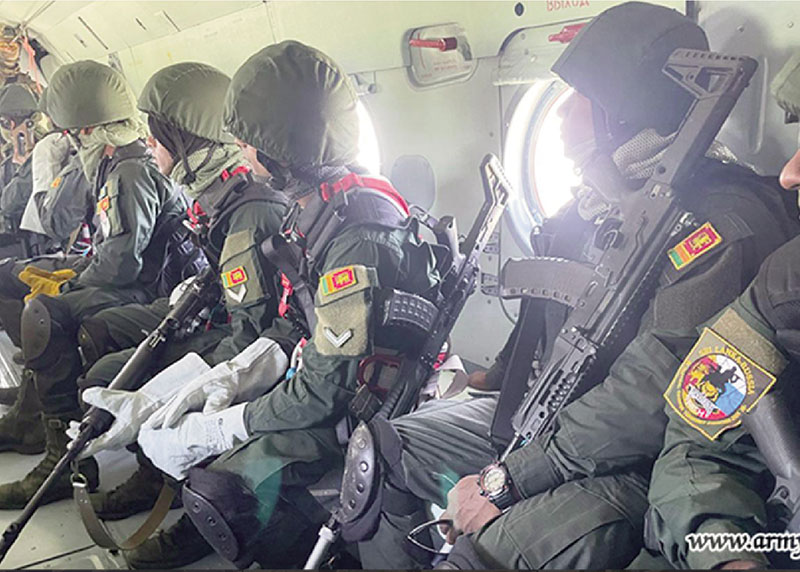
A contingent of the Sri Lanka Army, comprising 20 officers and 55 other ranks, participated in the combined military exercise ‘Wolverine Path II–2026’, conducted with the Armed Forces of the Russian Federation in Vladivostok, Russia, from September 18 to 25.
According to the Ministry of Defence, the exercise primarily focused on counter-terrorism operations and provided participating troops with training in a challenging combined operational environment.
The exercise included a range of tactical activities, including heli-rappelling, close-quarters battle (CQB), ambush operations, sniper firing, drone operations, buggy training and combat medical support.
The Ministry said the training enabled Sri Lankan troops to further develop their combat skills, tactical coordination and operational readiness.
It also provided an opportunity for the two militaries to exchange professional knowledge, operational experience and tactical expertise. Sri Lankan personnel gained exposure to training methodologies, tactical approaches and operational practices adopted by the Russian Armed Forces, the Ministry said.
The participation also enabled the Sri Lankan contingent to identify lessons from the joint training and share its own experiences with the Russian military.
The Sri Lankan contingent returned to the country following the exercise and arrived at Mattala Rajapaksa International Airport on September 28.
The Ministry said participation in the exercise contributed to enhancing the professional knowledge, tactical awareness and operational preparedness of Army personnel while promoting military-to-military cooperation, mutual understanding and professional relations between Sri Lanka and Russia.

Turkish court detains football refereeing chief pending corruption trial

Ten injured after car crashes into rugby supporters in Australia

Polls open in Latvia against backdrop of perceived Russia threat

Abhishek, Tilak and spinners secure gold for India at Asian Games again

Tharindu Rathnayake, bowlers secure Asian Games Bronze for Sri Lanka

G7 to release 100 million barrels of oil and diesel after Trump export ban threat

‘Dates have the highest sugar content to fight Coronavirus’

Sunday Island 27 December – Headlines

#SundayIsland 17th December – Headlines

Sunday Island – 28th March

Sunday Island Headlines – 21 March

Sunday Island – 21st February – Headlines
-

 News6 days ago
Police remove Thileepan statue in Jaffna
-

 Features6 days ago
The 22nd Amendment, constitutional recovery and illiberal slippage
-

 Features6 days ago
Of foreigners as CEOs of Lankan ventures
-

 Latest News3 days ago
Gold winner Tharanga gets brand-new Honda Vezel from SLAAJ
-

 News6 days ago
Sajith rejects Jt. Opp. protest sabotage claim; SJB TU chief demands remedial action
-

 Features4 days ago
Why Sri Lanka needs an Inclusive Civic Nationalism – urgently
-

 Features5 days ago
Thailand’s biggest new global star …
-

 News3 days ago
US-assisted ‘Ice’ detection: NPC to examine IGP’s move to transfer drug-busting team