
Opinion
‘COOL’ debacle in the hands of fools: He laughs best who laughs last! – II


By Rohana R. Wasala
(continued from yesterday)
During the first interview mentioned above, Ali Sabry made the patently false claim that the Aluthgama and Digana incidents drove young Muslims to extremism, whereas the truth was the reverse of that, as borne out by evidence. (These incidents must be investigated even belatedly to discover the factual situation. The disastrous policy of political correctness that led to the submergence of the truth on those occasions then seemed to be at work once again.) Sabry referred to how the UK responded to incidents of Islamic extremist violence as a model to follow in dealing with the same problem in Sri Lanka: the UK government reached out to the mainstream Muslim minority and acted to win their confidence and support in order to contain Islamic extremism in that country. That was a false analogy. He implied that Sri Lanka had to do the same (as if Sri Lanka has not been doing exactly that for centuries). (The violent imagery in his speech was an indication of the commotion in his own mind resulting from his subliminal awareness of guilt as he felt compelled to lie in that situation for political expediency within his own community. His persistent advocacy of burial against the lawful directives of the DGHS revealed his anxiety to avoid displeasing pious Muslims who insisted on burying their dead as per strict Muslim funeral rites.) It was reported that he threatened to resign from his ministerial post on this issue, but that he was persuaded to stay on, which to the genuinely concerned sounded fishy, no doubt.
Ali Sabry had been sounding the warning mentioned above (about possible unrest among Muslim youth over the ‘no burial only cremation’ problem since early April 2020. He apparently believed that he was undergoing a sort of public trial by being blamed by both the Muslim community on the one hand who felt aggrieved by the compulsory cremation rule imposed on all citizens by the health authorities for the safe disposal of bodies of Covid-19 victims and the numerically strong nationalist faction on the other led by the monks, who insisted] that the rule should not be relaxed to satisfy the whims of one particular group of people thereby endangering the lives of the whole population through the possible release of the still inadequately understood novel coronavirus from the interred bodies to the country’s water table, which, in many places in Sri Lanka, is not very deep, and lies close to the surface. The controversial Gnanasara Thera (who is now heading the presidential task force) was an exception: he spoke up for Muslims who wanted to bury; the monk said that the Muslims’ demand for burial should be allowed.
Ali Sabry should know better than most that there has been no lack of reaching out to the mainstream Muslim minority either by the majority community or by the successive governments. Muslims as a community are mainly engaged in business. Seventy-five perscent of their customer base comprises Sinhalese, making it possible for Muslim businesses to thrive normally, though there’s been just condemnation, among the citizenry including the majority Sinhalese, of worsening Islamist extremism in recent years. Be that as it may, it is not simply because Sabry had served president Gotabaya in the past as his implicitly trusted personal legal service provider that he was made a national list MP by the SLPP and honoured and empowered with such a very important key portfolio.
‘One country One law’ was the rallying cry that inspired patriotic Sri Lankans at both the presidential and parliamentary elections to vote for the SLPP, which won with the largest margins. As minister of justice Sabry has been entrusted with the task of supervising the making of a new constitution that is designed to achieve that epoch making change (namely, One Country, One Law) among other things. Gotabaya made no bones about the fact that he won the presidency almost exclusively on the strength of Sinhalese votes, as already hinted above; most Muslims and Tamils chose not to respond positively to his call for support at the presidential election. His bluntness was a reflection of his characteristic candour, which had then not been compromised by the hypocrisy of political correctness, his older brother’s blunt weapon, that fails more often than it succeeds.
But Gotabaya did not hold any grudge against those who rejected him, for in the same breath president elect Gotabaya said that he was elected as president of all the citizens of the country and that he would serve in that post without discriminating against any citizen. There is no doubt about the fact that he meant what he said. By appointing Ali Sabry to the powerful post of Minister of Justice, the president incidentally reassured the Muslims that he would not exclude them from his vision of prosperity and splendour for the nation.
But Ali Sabry did not budge an inch from his original unqualified opposition to the mandatory burning of bodies of Muslim victims of Covid-19 over which he expressed his disappointment in a Facebook post, something mentioned in an Al Jazeera news report/April 3, 2020, with the authorities’ decision which, he alleged, ignored the WHO guidelines that allow both burial and cremation. Were we to believe that our experts chose to overlook the WHO guidelines without a rational explanation? Sabry deliberately ignored the various reservations that clearly qualified the WHO guidelines, leaving the authorised specialists of any member country to modify those recommendations as appropriate for local conditions and ground realities. The basic assumption that he seemed to be operating on, regarding the burial problem, was wrong. For all intents and purposes, he pretended to wrongly believe that the health authorities insisted on making no exception for Muslim dead in this case because that was what the monks wanted. Ali Sabry was the last person that rational people would expect to demand that Muslims should be allowed to bury their loved ones dead from the novel coronavirus while cremation was the only safe method ordered by the Director General of Health Services (DGHS).
This is not a happy thing to say about arguably the most important and influential minister in the cabinet, being the closest companion of the President, next to the Prime Minister, who is the president’s own brother. It was inconceivable how Ali Sabry was capable of (no doubt unintentionally) justifying the berserk behaviour of some virus-infected Muslims (as seen in their show of insubordination, noncooperation, physical harassment of the health workers trying to help them including spitting at them (with the malicious intention of spreading the infection); cases were reported of some Covid-19 positive tested individuals spitting out of the windows of buses carrying them to quarantine centres in vicious attempts to spread dreaded infection). Such demonstration of unprovoked anger is based on the false pretext of alleged discrimination against them by the government in the matter of mandatory cremation of Corona dead as prescribed by the responsible health experts to prevent the escape of the deadly virus with many unknowns into the environment. The virus is no respecter of people’s religious sensitivities. If the Director General of Health determined that cremation was the only option for Sri Lanka in the prevailing emergency, all citizens were obliged to accept that and act accordingly.
Why didn’t Sabry make an effort to explain to the agitating Muslims and to the misinformed Muslim world in general, who have never been enemies of Sri Lanka, that this blown-out-of-proportion controversy over the burial or cremation issue had nothing to do with the monks or the government or the health authorities or the army and police officers (the last mentioned having been co-opted into the Covid containment operation only as ancillary personnel employed for a strictly logistical purpose to serve under the DGHS, the government appointed competent authority, who gives leadership to the whole enterprise, which involves every single citizen of the country).
The cremation imperative was not an arbitrary decision taken by the government to spite the Muslim minority under pressure from the monks as misleadingly suggested by the hostile foreign NGO elements, Islamists, a handful of misguided Muslims, and the irresponsible SJB-led opposition. The DGHS was not acting capriciously either; his recommendations were based on a scientific rationale collectively defined by a group of experts belonging to a number of different but relevant fields of study in the best interest of all resident Sri Lankans and foreign visitors. Ali Sabry seemed to be more concerned about remaining in the good books of the handful of Islamists and their sympathisers than about the feelings of the ninety-five per cent of the population who are against them.
The fate of the goal of One Country One Law under Ali Sabry as Minister of Justice is not difficult to guess.
Concluded

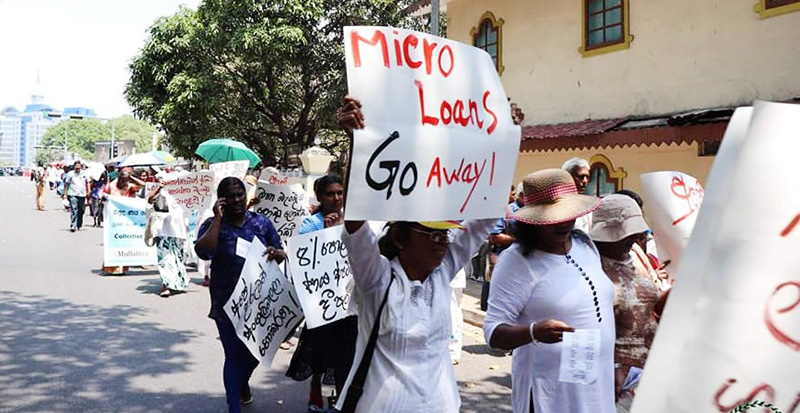
The Microfinance and Credit Regulatory Authority Bill was passed into law by the Parliament of Sri Lanka on 4 March. According to Deputy Minister of Finance and Planning Dr. Anil Jayantha, the main object of the Act is to establish an Authority to “license and supervise the under-regulated microfinance and moneylending sector, aiming to protect borrowers from exploitation and ensure financial stability”.
However, the Yukthi Collective is saddened and disappointed that a government which pledged to take “measures to alleviate the burden of predatory microfinance loans with high interest rates on women” (NPP Manifesto, 2024: Page no. 44), will now add to their unbearable weight.
The new Act, as virtually all legislation enacted by Anura Kumara Dissanayake’s government, is a legacy of the anti-working class Ranil Wickremesinghe regime. It evades the root causes of the microfinance trap, and ignores debt justice for women borrowers.
It fails in understanding the connections between household debt and public debt. The vicious cycle of national debt is sustained by lack of growth in economic activity because of poor access to affordable credit.
It fails to make equal representation of women mandatory in the new Authority. If representatives of women borrowers and their self-run organisations are not present in the regulatory body, how will its members know of their lived experiences and make decisions that value women’s unpaid and paid contributions to sustaining life?
System Change
Millions of indebted households voted for the NPP with hope and expectation of ‘system change’. But instead of honouring its manifesto promise to them, the government has let them down in the law-making process; as well as the focus and substance of the new Act.
It is appalling that NPP parliamentarians, including some of its women members, appear not to have read and understood the bill they enacted into law, nor spoke to the rural credit community providers in their electorates for their views.
Predatory lending exists in the formal and informal sectors. Within this ecosystem, the Act fails to understand, identify, and prohibit predatory lending and recovery practices. It is a cover for the Central Bank’s failure to properly regulate ‘Licensed Finance Companies’ in the interests of citizens.
The biggest offenders are the big finance companies, in which some parliamentarians are deposit-holders. Therefore, some lawmakers benefit from excess profitmaking through exploitative practices, at the expense of poor mostly rural women.
Where law reform should discipline the bullies and thugs in credit delivery, it will instead wipe out, through over-regulation, community-based and managed lenders such as death donation societies, farmer associations, and urban and rural women’s collectives, which have been a lifeline for vulnerable working-class women and a defence from harmful recovery practices.
Structural Adjustment Programmes
The motivation for this new law are the market- and capital- friendly structural reforms insisted by International Financial Institutions; not the concerns and needs of those at the mercy of predatory lenders.
From the Microfinance Act 2016, to the 2023 version of the Ranil Wickremesinghe regime, the Asian Development Bank (ADB) through its loans has been a promoter of these regressive reforms.
The 2026 Act, with some changes suggested by the Supreme Court in 2024 and hardly any of the changes demanded by affected communities, has been moved forward by the NPP government in line with ADB loan conditionalities.
The path of de-regulation for banking, finance, trade, and investment; and over-regulation of poor people’s savings and credit institutions, smacks of the bias to big capital, which the NPP in opposition once criticised.
Reforms needed
The financial and banking reforms we want to see are to make credit from state banks and public funds accessible and affordable to women producers in agriculture and micro and small business operators; with decent wages and social protection for workers; that improve household opportunity for a dignified livelihood and decent lives.
Yukthi is a forum supporting working people’s movements and people’s struggles for democracy and justice in Sri Lanka.
by Yukthi Collective

There is an unofficial bus halt at Gate Number 11 of the National Hospital at the 90-degree bend at the Prof. Nandadasa Kodagoda Mawatha (Old Norris Canal Road) which creates traffic jams at peak hours. Especially at the school opening and closing times at Carey College and hospital visiting hours.
Prospective passengers stand by the bend and then the busses stop suddenly on the middle of the road. The motorcycle in the picture is put into danger. The next bus halt is a few yards further near Carey College and Medical College Junction.
The problem is that illegal practices such as these, end up as approved procedure in our neck of the woods!
It must be nipped in the bud.
G. Fernando
Opinion
Naval hostilities close to a neutral coastal state: Legal assessment of a submarine attack on an Iranian warship near Sri Lanka

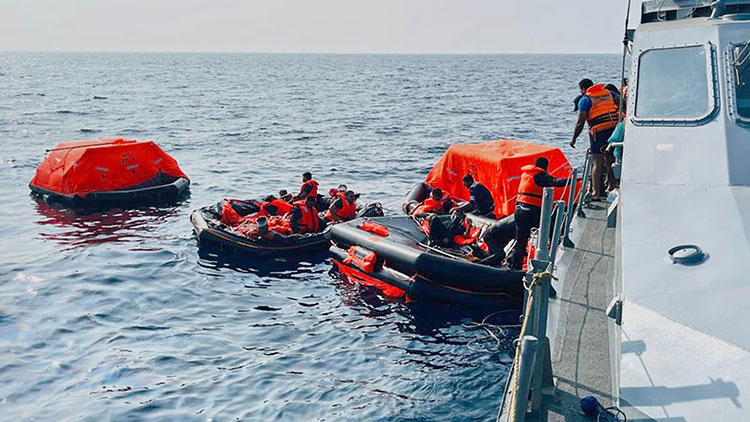
A submarine attack on an Iranian destroyer proximate to Sri Lanka represents more than a discrete naval engagement; it signals a potential horizontal escalation of conflict into the wider Indian Ocean Region (IOR). Historically, confrontations between Iran and Western powers have been largely confined to the Persian Gulf and adjacent regional waters. A strike near Sri Lanka, however, shifts the operational theatre from a semi-enclosed regional sea into the open Indian Ocean. This globally vital maritime space encompasses critical trade routes, energy supply corridors, and strategically sensitive naval zones.
This geographic expansion carries multiple strategic implications. First, it demonstrates the long-range maritime strike capabilities and blue-water operational reach of the belligerent forces. Second, it functions as a form of deterrence signalling, conveying a willingness to project force beyond traditional conflict zones. Third, it widens the theatre of operations, increasing the probability of third-party entanglement and amplifying regional instability.
Beyond its immediate military and strategic dimensions, the incident raises complex legal questions under both jus ad bellum—the body of law governing the use of force between states—and jus in bello, encompassing international humanitarian law applicable to armed conflict at sea. The central questions addressed in this paper are:
a. Lawfulness of Force:
Whether the use of force against the Iranian warship was lawful under the United Nations Charter, including considerations of self-defence and Security Council authorisation.
b. Compliance with International Humanitarian Law:
Whether the attack adhered to the principles and norms of international humanitarian law governing naval warfare, including the lawfulness of the target, proportionality, distinction, and obligations toward shipwrecked personnel.
c. Neutrality and Coastal State Rights:
Whether Sri Lanka’s rights and obligations as a neutral coastal state were violated, particularly within its territorial sea and Exclusive Economic Zone (EEZ).
d. Operational and Geostrategic Implications:
The broader implications of conducting military operations within or near neutral maritime zones, and the interplay between legal permissibility, maritime security, environmental obligations, and regional stability.
These questions form the analytical framework that will guide the discussion throughout this paper, providing a structured lens for examining the legal, humanitarian, and strategic dimensions of the incident.
Jus ad Bellum and Jus in Bello:
Legality of the Use of Force
The legality of a submarine attack against a commissioned warship during an armed conflict must be assessed within a structured framework of international law comprising the jus ad bellum regime under the United Nations Charter, the corpus of international humanitarian law (IHL), and customary principles of naval warfare as reflected in the San Remo Manual on International Law Applicable to Armed Conflicts at Sea.
At the threshold level, the UN Charter governs the lawfulness of the use of force between states. Article 2(4) establishes a general prohibition on the threat or use of force against the territorial integrity or political independence of any state, subject only to narrow exceptions. These exceptions include the inherent right of self-defence under Article 51 and actions authorised by the United Nations Security Council under Chapter VII.
Accordingly, if an Iranian warship were torpedoed by a submarine, the attacking state would be required to demonstrate that the action was undertaken either pursuant to a valid claim of self-defence, necessitated by an armed attack or imminent threat, or as part of an already existing international armed conflict. Absent such justification, the attack could constitute an unlawful use of force in violation of the Charter’s collective security framework.
Where an international armed conflict is already in existence, the analysis shifts from jus ad bellum to Jus in bello, namely the rules governing the conduct of hostilities.
Jus in bello
: Naval Warfare and Attack Against an Iranian Naval Ship
Where an international armed conflict exists between the United States and Iran, the analysis shifts to jus in Bello. Commissioned warships form part of a state’s armed forces and constitute lawful military objectives. Under customary naval warfare law, as reflected in the San Remo Manual on International Law Applicable to Armed Conflicts at Sea, enemy warships may be attacked, including by submarine-launched torpedoes, without prior warning. An Iranian destroyer operating as part of Iran’s navy would therefore constitute a legitimate military objective in principle.
However, the legality of a torpedo attack by a United States submarine remains subject to the foundational principles of international humanitarian law, including distinction, proportionality, military necessity, and precautions in attack. The principle of distinction requires that the target be military in nature; proportionality prohibits attacks expected to cause incidental harm excessive in relation to the anticipated military advantage; and military necessity demands that the force employed be directed toward achieving a legitimate military objective.
These obligations are particularly significant in maritime theatres characterised by dense commercial traffic, such as the sea lanes south of Sri Lanka. Incidental harm to neutral merchant vessels, offshore installations, or third-state interests must therefore be carefully assessed in relation to the anticipated concrete and direct military advantage.Submarine warfare, though technologically sophisticated and strategically consequential, remains subject to these enduring normative constraints, which seek to balance operational effectiveness with humanitarian considerations in the maritime domain.
Customary humanitarian law further requires that feasible measures be taken to search for and rescue the shipwrecked, wounded, and dead following an engagement. In this respect, any action by the Sri Lanka Navy to rescue surviving sailors and recover bodies from the destroyed vessel represents a prudent and legally consonant exercise of humanitarian responsibility. Such conduct reflects long-standing maritime tradition and aligns with the duties recognised under the law of armed conflict and the broader law of the sea, without compromising Sri Lanka’s neutral status.
Sri Lanka’s Legal Position Concerning the Torpedoed Iranian Vessel
Sri Lanka’s legal position is largely determined by the maritime location in which the submarine attack occurred. Should the hostilities have taken place within Sri Lanka’s territorial sea, defined as extending up to 12 nautical miles from the baseline, such conduct would constitute a breach of Sri Lanka’s sovereignty and a violation of the law of neutrality, which forbids belligerent states from engaging in hostilities within neutral waters and imposes a duty on the coastal state to prevent such actions within its jurisdiction. In that circumstance, Sri Lanka would be entitled to issue a diplomatic protest and potentially pursue reparative claims.
By contrast, as the engagement took place within Sri Lanka’s Exclusive Economic Zone (EEZ), the analysis is more nuanced under the United Nations Convention on the Law of the Sea. The EEZ confers sovereign rights for resource exploitation rather than full sovereignty, and prevailing state practice accepts that military operations, including naval manoeuvres, are not per se unlawful in another state’s EEZ. While such an engagement would not automatically breach international law, it would nonetheless generate significant security concerns, including risks to navigational safety, potential environmental damage, and heightened regional instability. Should the sinking result in oil discharge, hazardous material release, or debris affecting shipping lanes, obligations under UNCLOS to protect and preserve the marine environment would be engaged.
Although the Rio Declaration on Environment and Development does not explicitly regulate armed conflict, its principles highlight an increasing expectation for states to protect the environment during hostilities. Similarly, UNCLOS mandates that states protect and preserve the marine environment. Consequently, should the sinking of the Iranian destroyer cause an oil spill, the release of hazardous materials, or navigational hazards, specific environmental liabilities would be triggered. Strategically, a submarine strike near Sri Lanka signals more than a discrete tactical engagement. It reflects the projection of great-power naval capabilities into a strategically sensitive maritime space through which a substantial proportion of global trade transits.
Sri Lanka occupies a pivotal geostrategic position astride the principal East–West Sea Lines of Communication linking Gulf energy supplies, East Asian manufacturing centres, and European markets via the Suez Canal. A substantial proportion of global container traffic transits south of the island, rendering these waters acutely sensitive to instability. Even a limited naval engagement can elevate war-risk insurance premiums, disrupt commercial routing, and indirectly affect port operations in Colombo and Hambantota.
From a jus ad bellum perspective, geographic expansion does not in itself render hostilities unlawful; yet it complicates assessments of necessity and proportionality and increases the risk of escalation affecting neutral states.
The torpedoing of an Iranian naval vessel in maritime zones proximate to Sri Lanka necessitates a carefully layered legal assessment situated at the confluence of jus ad bellum, jus in bello, and the law of the sea. As this paper has demonstrated, the legality of the incident ultimately turns on four interrelated determinations:
(a) whether a lawful basis for the use of force existed under Article 51 of the Charter of the United Nations, grounded in self-defence;
(b) whether the attack complied with the principles of distinction, proportionality, and military necessity under international humanitarian law;
(c) whether the engagement occurred within Sri Lanka’s territorial sea, thereby infringing its sovereignty and violating the law of neutrality; and
(d) whether the obligations owed to survivors, shipwrecked personnel, and the marine environment were respected in accordance with the law of armed conflict at sea and relevant maritime conventions.
If the attack did not occur within Sri Lanka’s territorial sea, it would not amount to a violation of sovereignty or a breach of the law of neutrality capable of engaging state responsibility on that ground.
By contrast, where the engagement occurred beyond the territorial sea whether within the Exclusive Economic Zone or on the high seas prevailing interpretations of the law of naval warfare, reinforced by consistent state practice, suggest that the operation may be regarded as legally defensible, provided that the cumulative requirements of necessity, proportionality, distinction, and humanitarian obligation were satisfied.
Nevertheless, legal permissibility does not equate to strategic prudence. The deployment of a United States submarine to conduct kinetic operations in proximity to a neutral coastal state within the Indian Ocean underscores the increasingly complex convergence of naval power projection, humanitarian norms, environmental obligations, and coastal state rights within the contemporary maritime domain.
Even where consistent with international law, the extension of submarine warfare into the wider Indian Ocean carries destabilising implications for regional security, commercial shipping, and the safety of neutral coastal states situated along critical sea lines of communication. The geographic expansion of hostilities into this maritime space heightens the risks of miscalculation, escalation, and unintended third-party involvement.
For Sri Lanka, the incident underscores the delicate equilibrium between maintaining neutrality, safeguarding maritime security, and upholding the international legal order. The actions undertaken by the Sri Lanka Navy in conducting rescue and recovery operations for surviving sailors and deceased personnel reflect the discharge of well-established humanitarian duties under international law and exemplify responsible conduct at sea.
Ultimately, this episode illustrates the increasingly complex convergence of naval power projection, international humanitarian norms, and coastal state rights within the contemporary maritime domain. In an era marked by intensifying great-power competition and expanding operational reach in the Indian Ocean, the preservation of legal clarity, strategic restraint, and respect for neutral maritime spaces remains essential to sustaining regional stability and safeguarding the integrity of the international maritime order.
by REAR ADMIRAL (RTD.) JAGATH RANASINGHE
VSV, USP, psc, MSc (DS) Mgt, MMaritimePol (Aus),
PG Dip in CPS, DIP in CR, FNI (Lond), Former Govt Fellow GCSP

Heat Index at Caution Level in the Western, Sabaragamuwa and North-western provinces and Monaragala district.

Showers likely in the Northern province and in Trincomalee and Anuradhapura districts

Prof. Dunusinghe warns Lanka at serious risk due to ME war

Power sector restructuring completed; new state-owned entities established: Govt.

Pilleyan held over Eastern Uni VC’s 2006 disappearance seeks SC intervention: Case to be taken up on 18 March

Lanka takes part in Thai Red Cross Charity Bazaar

‘Dates have the highest sugar content to fight Coronavirus’

Sunday Island 27 December – Headlines

#SundayIsland 17th December – Headlines

Sunday Island – 28th March

Sunday Island Headlines – 21 March

Sunday Island – 21st February – Headlines
-

 News4 days ago
University of Wolverhampton confirms Ranil was officially invited
-

 News5 days ago
Legal experts decry move to demolish STC dining hall
-

 News4 days ago
Female lawyer given 12 years RI for preparing forged deeds for Borella land
-

 News3 days ago
Peradeniya Uni issues alert over leopards in its premises
-

 Business6 days ago
Cabinet nod for the removal of Cess tax imposed on imported good
-

 News4 days ago
Library crisis hits Pera university
-

 News3 days ago
Wife raises alarm over Sallay’s detention under PTA
-

 Business6 days ago
War in Middle East sends shockwaves through Sri Lanka’s export sector