
News
Controversy over PSC on electoral reforms amidst formulation of draft Constitution


… can Parliament ensure two processes do not clash
By Shamindra Ferdinando
Controversy surrounds the recent appointment of a Parliamentary Select Committee (PSC) to examine proposals pertaining to election laws and make appropriate amendments to the Constitution as a nine-member committee, appointed by President Gotabaya Rajapaksa, neared work on the formulation of a new draft Constitution.
Romesh de Silva, PC, heads the nine- member expert committee.
The first meeting of the PSC chaired by Foreign Minister and Leader of the House of Parliament Dinesh Gunawardena was held on May 17 in the House. Speaker Mahinda Yapa Abeywardena named the 14-member PSC on May 5.
The PSC consists of Nimal Siripala de Silva, Prof. G. L. Peiris, Pavithradevi Wanniarachchi, Douglas Devananda, Wimal Weerawansa, Ali Sabry, Jeevan Thondaman, Anura Kumara Dissanayake, Kabir Hashim, Ranjith Madduma Bandara, Mano Ganesan, M.A. Sumanthiran, Madhura Withanage and Sagara Kariyawasam.
Those involved in the new Constitution-making process told The Island that the PSC on May 17 requested for public proposals in this regard before June, nearly four months after the Election Commission submitted its own recommendations to the nine-member committee.
The nine-member committee consists of Romesh de Silva, PC, Gamini Marapana P.C., Manohara de Silva P.C., Sanjeewa Jayawardena P.C, Samantha Ratwatte P.C, Prof. Naazima Kamardeen, Dr. A. Sarveswaran, Prof. Wasantha Seneviratne and Prof. G.H. Peiris.
Those political parties that had been represented in the PSC as well as not included in the outfit conveniently refrained from at least raising the possibility of the parliamentary body making an unnecessary intervention, sources said. Asked for a clarification, sources pointed out that all political parties and others interested in making recommendations to the nine-member committee had time and the space to do so.
Sources said that the appointment of the PSC should be examined taking into consideration the nine-member committee in the process of formulating an alternative electoral system based on the submissions received.
Declaring the government was aware of the proposed alternative electoral system, sources said among those who made representations were several representatives of the government, including leader of the PSC on Electoral Reforms Dinesh Gunawardena and National Freedom Front (NFF) leader Wimal Weerawansa.
Asked whether the ruling SLPP had submitted proposals to de Silva’s committee, sources said that submissions weren’t made orally or in writing . The committee report would be submitted to the head of the Cabinet who is the President, sources said. Sources pointed out that both the Chairman of the SLPP and its General Secretary and Attorney-at-Law Sagara Kariyawasam had been accommodated in the PSC. Sources explained that the appointment of a PSC to propose amendments to electoral system was quite questionable when the government repeatedly declared both in the run-up to the 2019 presidential and 2020 parliamentary elections that it intended to enact a new Constitution after the passage of 20th Amendment.
The government secured an overwhelming two-thirds majority for the 20th Amendment in Oct last year.
Shan Wijetunga, Director – Department of Communication, Parliament, in a statement issued on May 19 stated that the Secretary to the PSC and Deputy Secretary General of Parliament and Chief of Staff Mrs. Kushani Rohanadeera, on behalf of the Committee, has requested the public and any interested party to submit their proposals to the Committee in writing or by e-mail at sec.pscelectionreforms2021@parliament.lk .
Wijetunga quoted Mrs. Kushani Rohanadeera as having said: ” If the PSC wished to obtain oral evidence from those who had made submissions, the relevant parties would be summoned to appear before the Committee in due course.”
A source pointed out a new process was being undertaken amidst an unprecedented crisis caused by the eruption of Covid-19 epidemic and at a time further restriction of Parliamentary proceedings and related activities. The General Secretary of the Samagi Jana Balavegaya (SJB) and member of the PSC on electoral reforms Ranjith Madduma Bandara on Sunday (23) acknowledged him being in self-imposed quarantine after SJB leader Sajith Premadasa was tested Covid-19 positive.
The Island
sought an explanation from Justice Minister Ali Sabry, PC, as regards the functioning of the nine-member committee appointed by him last year and whether the PSC would undermine the process, the Minister said that Romesh de Silva’s committee was appointed by President Gotabaya Rajapaksa on his recommendation. Minister Sabry said: “The nine-mmeber committee asked for a three-month extension in March and was given by the President. Once the committee submitted the proposed draft, it will be discussed in Parliament so we get maximum possible consensus.”
Minister Sabry, who is a member of the PSC said that it had been appointed by the Speaker to exclusively look at the electoral reforms. “Hopefully, it will complement the final draft constitution rather than serving as an obstacle,” President’s Counsel Sabry said.
Other sources said that at the PSC’s first meeting held on May 17 some members had expressed concerns over the absence of the Sri Lanka Muslim Congress (SLMC) and the All Ceylon Makkal Congress (ACMC) in the committee. The SLMC and ACMC parliamentary groups comprised five and four members, respectively. Sources said that the Chairman of the PSC Minister Gunawardena pointed out that as the Muslim community was being represented there couldn’t be any issue. Both the SLMC and the ACMC contested the last general election on the SJB ticket.


Independent trade unions cry foul
The government has launched a far-reaching overhaul of the electricity industry, breaking up the Ceylon Electricity Board (CEB) into six fully state-owned companies, claiming to rein in chronic losses and mounting debt.
Under the Preliminary Transfer Plan, the newly incorporated entities, namely, Electricity Generation Lanka (Pvt) Ltd (EGL), National Transmission Network Service Provider (Pvt) Ltd (NTNSP), National System Operator (Pvt) Ltd (NSO), Electricity Distribution Lanka (Pvt) Ltd (EDL), CEB Employees Funds (Pvt) Ltd (CEBEF) and Energy Ventures Lanka (Pvt) Ltd (EVL), will take over the assets, liabilities and operations of the CEB from the appointed date.
Independent trade unions have opposed the restructuring programme.
At the core of the new model is the creation of an independent National System Operator, which will handle power system planning and competitively procure electricity from Electricity Generation Lanka, Independent Power Producers and non-conventional renewable energy developers. Power will be wheeled through the national grid operated by the NTNSP and sold to distribution companies.
Explaining the economic rationale, Eng. Pubudu Niroshan Hedigallage said the separation of functions was critical to restoring cost discipline in the sector.
“Electricity planning and procurement will now be carried out independently, based on least-cost principles. That is essential if we are to control generation costs and ease the upward pressure on tariffs,” he said.
Electricity Generation Lanka, though a successor to the CEB, will compete with private and renewable energy producers for projects, a move expected to curb inefficiencies and end guaranteed returns enjoyed under earlier arrangements.
“There will be no automatic allocation of projects. EGL must compete in the market like any other generator,” Eng. Hedigallage said.
According to officials, the Preliminary Transfer Plan provides for one generation and one distribution company initially, with further unbundling planned under the Final Transfer Plan to introduce sharper financial accountability at operational level.
Economists note that the restructuring is closely watched by multilateral lenders and investors, who have repeatedly flagged the power sector as a major fiscal risk.
The government has insisted that the reforms do not amount to privatisation, stressing that all six entities remain 100 percent state-owned. However, independent trade unions are of the view that what the government has undertaken is divestiture in all but name.
By Ifham Nizam
News
India, Sri Lanka speakers discuss technology-driven parliamentary innovation, including AI-enabled systems
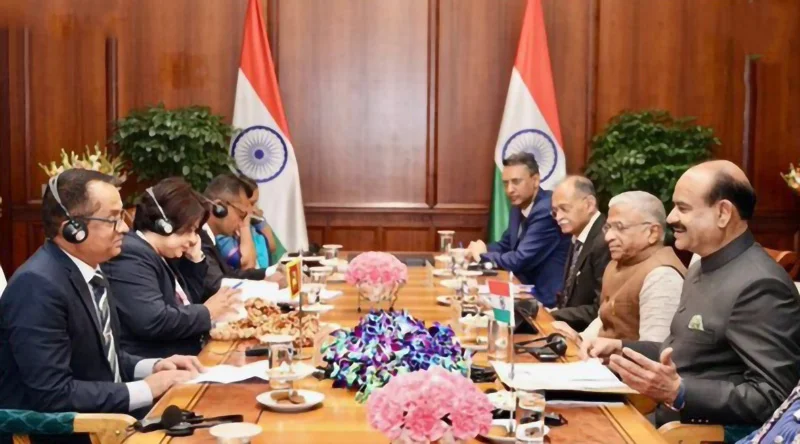
Speaker of Lok Sabha Om Birla and Sri Lankan Speaker (Dr.) Jagath Wickramaratne recently discussed the possibility of expanding parliamentary cooperation through regular exchanges, formation of friendship groups, collaboration in policy and programme design and deeper engagement in technology-driven parliamentary innovation, including AI-enabled systems, real-time multilingual translation, and capacity building through Parliamentary Research and Training Institute for Democracies (PRIDE).
The discussion took place on the sidelines of the 28th Conference of Speakers and Presiding Officers of the Commonwealth (CSPOC) held in New Delhi recently.
The following is the text of the statement issued by the Indian High Commission in Colombo: ” Speaker of the Parliament of Sri Lanka (Dr.) Jagath Wickramaratne concluded his visit to India from 14-18 January 2026, for participation in the 28th Conference of Speakers and Presiding Officers of the Commonwealth (CSPOC) held in New Delhi. This was his first visit to India after assuming office. He was accompanied by Secretary-General of Parliament Kushani Rohanadeera and Assistant Director, (Administration) of the Parliament of Sri Lanka Kanchana Ruchitha Herath. Following the 28th CSPOC from 14-16 January 2026, Speaker and his delegation visited Jaipur, Rajasthan as a part of a two-day tour for CSPOC delegates from 17-18 January 2026.
The 28th CSPOC was inaugurated by Prime Minister of India Narendra Modi on 15 January 2026 at the Central Hall of Samvidhan Sadan, Parliament House Complex, New Delhi. Welcoming parliamentary leaders from across the Commonwealth, Prime Minister Modi highlighted the success of Indian democracy in providing stability, speed, and scale. He shared India’s efforts at giving voice to the Global South and forging new paths of cooperation to co-develop innovation ecosystems. He underlined the use of Artificial Intelligence by the Parliament of India to attract youth to understand Parliament. Prime Minister expressed his confidence in the CSPOC platform for exploring ways to promote knowledge and understanding of parliamentary democracy.
The conference, chaired by Lok Sabha Speaker Om Birla, convened 44 Speakers and 15 Deputy Speakers from 41 Commonwealth countries, along with representatives of four semi-autonomous Parliaments. The theme of the conference was “Effective Delivery of Parliamentary Democracy.” During the conference, participants addressed the role of Speakers in reinforcing democratic institutions, the integration of artificial intelligence in Parliamentary functions, the influence of social media on Members, approaches to enhance public engagement with Parliament, and measures to ensure the security, health, and wellbeing of Members and Parliamentary staff.
The visit marked a significant milestone in the evolving parliamentary partnership between India and Sri Lanka. Last year, two Parliamentary Delegations visited India for Orientation Programmes in May 2025 and August 2025 respectively. These visits, in line with the intent of the India – Sri Lanka Joint Statement on ‘Fostering Partnerships for a Shared Future’, further reinforce the strong democratic ethos and enduring friendship shared between the two nations.”
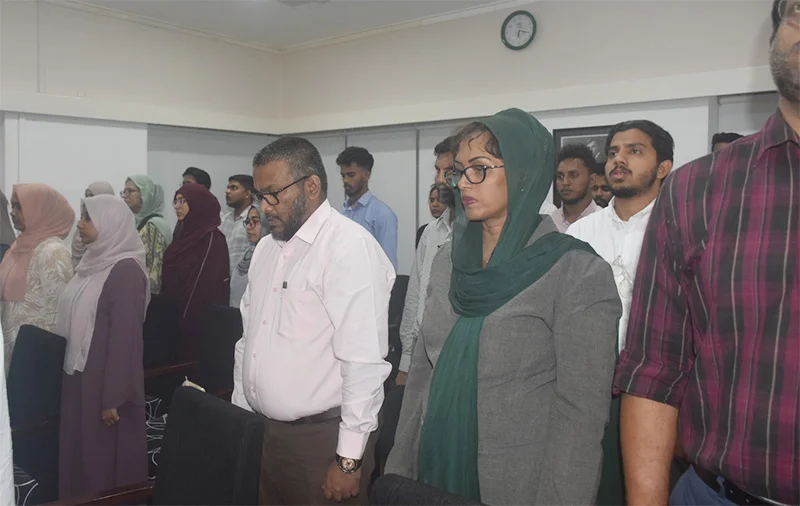
The High Commissioner of Pakistan in Sri Lanka hosted a special reception on Friday (16) for Sri Lankan alumni who have recently returned from their studies in Pakistan. The event, held at the Pakistan High Commission, celebrated the academic achievements of the graduates and reinforced the deep-rooted educational ties between the two nations.
The Allama Iqbal Scholarship Programme, a flagship initiative launched in 2019, has become a vital pillar of bilateral cooperation. The High Commissioner highlighted that Pakistan offers 1,000 fully funded scholarships at graduate, postgraduate, and PhD levels, with over 500 Sri Lankan students currently pursuing their education in Pakistan’s premier universities.
“Sri Lanka and Pakistan share an enduring friendship rooted in a shared history of mutual respect and culture,” the High Commissioner remarked during the address. “Education is the key to unlocking the success of your brilliant futures and creating bonds that extend well beyond the classroom”.
Addressing the alumni as “custodians” of a noble cause, the High Commissioner urged the alumni to act as brand ambassadors by sharing their knowledge to guide deserving students toward academic opportunities in Pakistan.
He emphasised their responsibility to mentor young minds, ensuring no capable student misses the chance for a promising future. Furthermore, the alumni were encouraged to take an active role in organising frequent educational and cultural engagements to inspire and enlighten others while strengthening the ties between the two nations.
The High Commissioner emphasized that each graduate serves as a “bridge” between the two countries, playing a meaningful role in uplifting Sri Lanka while further strengthening Pakistan–Sri Lanka relations. The alumni were invited to remain closely connected with the High Commission to facilitate future initiatives that strengthen people-to-people ties.
The evening concluded with a traditional Pakistani dinner, where the alumni shared stories of their academic growth and cultural experiences in Pakistan in a spirit of friendship and togetherness.

Red-hot Royal Challengers Bengaluru stay perfect ain 20nd march into playoffs

Zadran, Rasooli power Afghanistan to commanding win over West Indies

Italian fashion designer Valentino dies aged 93

U – 19 World Cup: Sri Lanka beat Ireland by 106 runs

U – 19 World Cup: Rowles, Bulbulia star in South Africa’s big win over Tanzania

U – 19 World Cup: Raza, Usman steer Pakistan to victory over Scotland

‘Dates have the highest sugar content to fight Coronavirus’

Sunday Island 27 December – Headlines

#SundayIsland 17th December – Headlines

Sunday Island – 28th March

Sunday Island Headlines – 21 March

Sunday Island – 21st February – Headlines
-

 Editorial3 days ago
Illusory rule of law
-
 News4 days ago
UNDP’s assessment confirms widespread economic fallout from Cyclone Ditwah
-

 Business6 days ago
Koaloo.Fi and Stredge forge strategic partnership to offer businesses sustainable supply chain solutions
-

 Editorial4 days ago
Crime and cops
-
 Features3 days ago
Daydreams on a winter’s day
-

 Editorial5 days ago
The Chakka Clash
-
 Features3 days ago
Surprise move of both the Minister and myself from Agriculture to Education
-

 Features2 days ago
Extended mind thesis:A Buddhist perspective