
Editorial
Contempt then and now


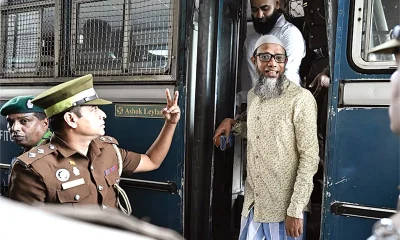
Dr. Asanga Welikala, legal academic and constitutional lawyer, has gone on record saying that while imprisonment over contempt of court is legal, it is increasingly seen as inappropriate and disproportionate. This observation has been made in the context of the jailing last week of Parliamentarian and film star Ranjan Ramanayake to four years rigorous imprisonment on contempt charges. Thanks to television, the country was able to see the actor, screaming and shouting that he had neither robbed, killed nor engaged in drug trafficking and will not apologize, being dragged into a prison vehicle to be taken away to serve his term. He was clearly playing to the cameras as he would have on a film set and put up quite a show.
Readers would remember the highly respected Prof. Carlo Fonseka, Ramanayake’s uncle, accompanying him to court every day at the early stages of the trial which began three years ago. This was before the late professor, frail even then, was physically unable to go to court. This case, as most of them do, dragged on for a long time as is common, or even inevitable, in this country. Most people know that contempt of court is a serious offence and refrain from trifling with the judicial system for fear of punishment. While the courts are not infallible, as demonstrated by higher courts sometimes overturning judgments from lower down, there is no bar on the criticism of judicial decisions. But this must be done, as the text books say, in “chaste language” without scandalizing the court.
It was decades ago that Mr. Herbert Hulugalle, then editor of the “Ceylon Daily News,” was convicted of a contempt offence by a three judge bench of the Supreme Court headed by Sir. Sydney Abrahams, then Chief Justice, who later became a Privy Councillor. On the bench with the British CJ were two Ceylonese judges, Justice Akbar and Justice Koch. A fine of thousand rupees – not chicken feed at that time – and imprisonment till the rising of court was imposed on the editor over an editorial titled “Justice on Holiday” which Hulugalle did not write. But as editor, he had to take responsibility for what appeared in his paper. The editorial was written at the instance of D.R. Wijewardene, the legendary Lake House founder. Hulugalle, himself an advocate, sat with the lawyers in the courtroom after his conviction and spent the lunch adjournment with his friend, the Registrar of the court, in the latter’s chambers. Sir Sydney, ostensibly for Hulugalle’s benefit, adjourned court for the day earlier than usual. Wijewardene, no doubt at great expense, took the case right up to the Privy Council in a vain attempt to overturn the judgment.
More recently, Editor Fred Silva, also of the “Daily News” was imprisoned for six months for a newspaper column titled “Dress Sense” that appeared in his paper. This was a comment on different requirements of different courts on how persons appearing before them should be clad – a jacket and tie or national dress as the case may be. It was said there that while one court upbraided someone wearing trousers and an open neck shirt for not appearing in what we Lankans are fond of calling a “full suit,” a witness in another court was giving evidence neatly clad in a white shirt and pair of trousers. Although Silva was convicted and served his sentence, a reporter (subsequently editor) present in the courtroom said he clearly heard Justice Jaya Pathirana telling his brother judges “let him go” over the court public address system.
It was only a few months ago that Ven. Galagoda Aththe Gnanasara, the leader of the Bodu Bala Sena, was convicted of what appeared to be a blatant act of contempt by making a fiery speech in a courtroom at Homagama where a case in which he was interested was being heard. The complainant in this matter was the judge himself. The monk was convicted on several counts preferred against him and sentenced to six years in jail. But he was pardoned by President Sirisena after serving a fraction of his sentence and subsequently ran for Parliament. Although there was a report that Ramanayake, speaking on the telephone to UNP leader Ranil Wickremesinghe after his conviction had said that he would seek a pardon, this was said to be “in lighter vein”. Given the hellholes that our prisons are, whether ‘One Shot’ as the MP was styled in one of his movies, will ask for a pardon remains to be seen. He will continue to be an MP for six months after which his seat will be vacated. Opposition Leader Sajith Premadasa, under whose Samagi Jana Balavegaya ticket Ramanayake returned to parliament for his second term, said last week that “we will stand by him;” but what that means in practical terms is not clear. Whether the actor is made of similar stuff as General (now Field Marshal) Sarath Fonseka, who steadfastly refused to seek a pardon but soldiered through a part of his prison term until he was granted an unasked pardon, is debatable. Ramanayake stands to be disqualified from standing for election for seven years if he serves four years in jail. That can end his political career.
All things are impermanent as the Buddha said. How this particular drama will pan out remains to be seen.


Tuesday 6th October, 2026
The US has been doing everything in its power to force Iran into submission, but without success. Its no-holds-barred methods of warfare remind us of some ruthless warriors of yore, who even weaponised hunger to achieve their military goals. Many were the instances where Genghis Khan’s army laid siege to fortified cities and cut off supplies to force its enemies to surrender. During the American Civil War, General Philip Sheridan’s scorched-earth campaign in Virginia’s Shenandoah Valley was so thorough that he reportedly boasted that even a crow flying across the Valley would have to carry its own provisions.
A recent Wall Street Journal report has revealed that Sri Lanka is under US pressure over 20 Iranian oil tankers stranded in international waters off the island. It has been reported that some of those oil carriers, anchored about 15 miles (24 km) off Sri Lanka’s south-western coast, are running short of food, fuel and fresh water. However, Foreign Affairs Minister Vijitha Herath has claimed that the US has not asked Sri Lanka not to provide food and water to the Iranian vessels.
In 04 March 2026, a US submarine sank an Iranian frigate, IRIS Dena, in an unprovoked torpedo attack, which claimed 104 lives off the southern coast of Sri Lanka. Seven months on, the US stands accused of trying to starve an undisclosed number of Iranian sailors on board about 20 oil tankers. Strangely, the powerful nations that pontificate to the Global South about the virtues of human rights and humanitarian assistance are looking the other way. The stranded Iranian sailors must be provided with food, water and medical care. Powerful nations and the UN ought to step in to ensure that the Iranian tanker crews receive lift-sustaining supplies of food and water and medical care urgently.
We believe that the international maritime and seafarers’ law imposes obligations on states to ensure the safety and basic welfare of seafarers, including access to essential supplies and medical assistance. There is a strong humanitarian precedent that the world must follow. One may recall that during the early stages of the Ukraine conflict, the Maritime Safety Committee of the International Maritime Organization expressed serious concerns over the Ukrainian seafarers lacking access to fresh food, water and medical supplies, and called for humanitarian assistance to reprovision the stranded ships. It also stressed that civilian seafarers should not become collateral victims of political or military conflicts. This principle must apply to the stranded Iranian seafarers as well.
The civilised world must not look on while the crew members of the Iranian oil tankers are reportedly languishing without access to essential supplies. There have been some instances of radical humanitarian interventions in support of the Palestinians trapped in Gaza. The Global Sumud Flotilla, the largest maritime mobilisation for Palestine in history, is a case in point. Israel thwarted an attempt by the courageous Global Sumud Flotilla activists on a peaceful solidarity mission to break Israel’s blockade of the Gaza Strip and deliver medical aid and supplies to the Palestinians facing a catastrophic humanitarian crisis. If a large number of boats from different countries set sail simultaneously carrying provisions for the trapped Iranian tanker crews, will the US be able to stop them?
It may be recalled that the US was among the western nations that forced Sri Lanka to continue to send food and medical supplies to the LTTE-held areas during the Eelam war although it was obvious that the LTTE seized most of them. They were right in insisting that Sri Lanka was duty bound to ensure that civilians in the conflict zone had access to food, water and medicines among other things. But why aren’t the US and its allies equally considerate towards the Iranian sailors trapped between the Scylla of US military aggression and the Charybdis of enforced global submission?
Foreign Minister Herath has said the Sri Lankan government has not supplied goods to vessels subjected to US sanction, and private sector individuals providing goods and services to ships have a responsibility to understand the prevailing circumstances and act responsibly. Minister Herath has only obfuscated the issue. If his claim that the government is not under US pressure is true, then Sri Lanka can reprovision the Iranian vessels urgently, can’t it?


Monday 5th October, 2026
The Federation of University Teachers’ Associations (FUTA) has held several media briefings during the past several months to highlight a host of unresolved issues affecting the university system, but the government seems to be unconcerned. Addressing the media, over the weekend, the FUTA raised those problems once again, pointing out that all state universities had been left with only about 5,000 teachers because a large number of academics had already left the country, mostly for economic reasons. The situation was taking a turn for the worse, it warned.
University teachers are among the professionals who played a pivotal role in enabling the JVP-led NPP’s meteoric rise to power, but today they are shouting themselves hoarse in a bid to draw the government’s attention to the problems besetting the university system, but in vain. The same holds true for the state-sector doctors, who have got short shrift from the government, which rides roughshod over the GMOA (Government Medical Officers’ Association) as well as the BASL (Bar Association of Sri Lanka), whose members also campaigned hard for the NPP.
The incumbent government, just like its predecessors, has apparently prioritised a plan to increase the number of universities in keeping with what looks like a politically determined agenda over resourcing and staffing the existing universities adequately. President Anura Kumara Dissanayake, in his wisdom, has promised to establish 50 new universities across the country while almost all state universities are experiencing severe resource constraints, with many academics voting with their feet.
A quality university system cannot be created simply by increasing the number of universities or admitting more students. The need is for a combination of capable academics, adequate resources, institutional autonomy, rigorous standards and a system of accountability. There are certain other conditions that need to be fulfilled for a country to create a vibrant university system that conforms to international standards. First of all, there should be a clear national higher education strategy to establish a diversified, future-oriented tertiary education system that is adequately resourced and staffed.
Universities cannot function properly, much less achieve academic excellence, without enough qualified teachers and appropriate student-to-staff ratios. Adequate and sustained funding, strong research capacity, academic freedom, institutional freedom and rigorous, independent quality assurance, industrial and international links are among the other factors that help ensure the robustness of a university system.
The World Bank’s recent assessment of Sri Lanka’s higher education sector has identified scarcity of qualified academic staff, inadequate research and innovation output and passive student learning among the challenges facing the sector.
FUTA members have told the media that foreign research grants have to be approved by the Cabinet of Ministers; the approval process is frustratingly slow, and therefore universities are without enough funds for research. There are arguments for and against government oversight on research grants, but the real issue is why the government cannot expedite the approval process. Teaching and research are traditionally regarded as inseparable functions of a university. Besides, universities need sufficient freedom to determine curricula, conduct research, appoint staff and make academic decisions without inappropriate political or bureaucratic interference. UNESCO regards academic freedom and institutional autonomy as important conditions for universities to fulfil their teaching and research functions.
It is doubtful whether Sri Lankan governments have learnt from history how other countries achieved their development goals. The OECD (Organisation for Economic Co-operation and Development) has revealed that universities played a central role in the development of the Global North by producing the educated workforce, scientists, engineers, doctors, teachers, administrators and other professionals needed to build modern economies and strong public institutions. They also became major centres of basic and applied research, generating knowledge that helped drive industrialisation, technological innovation and productivity. The OECD notes that universities in most developed economies remain major providers of research and important contributors to the development of new technologies. The rise of strong university systems was not merely a result of development in the Global North; universities themselves helped usher in progress. It is hoped that Sri Lankan policymakers, particularly politicians, will take cognisance of this simple fact.
The incumbent government has raised the retirement ages of judges. It even went to the extent of amending the Constitution amidst protests from national and international organisations, claiming that it had to do so to clear a backlog of cases. It has also launched a substantial programme to recruit and train thousands of police personnel. Why can’t it take similar action urgently to resolve the shortage of university teachers? It should heed the university teachers’ warning; students who qualify for university admission may have to wait for several years before the commencement of their academic programmes, and universities might end up being empty shells.

A private company has complained to the police, alleging that Kaduwela Mayor Ranjan Jayalal and NPP MP Asitha Niroshana forcibly took over a block of land belonging to it in Athurugiriya for a Metro bus stand. Lawyers representing the company have told the media that the police have not acted on their complaint due to political pressure. The NPP politicians remain defiant, insisting that the new bus stand will not be shifted under any circumstances.
Sri Lanka politicians take leave of their senses when power goes to their heads. During previous governments, there were widespread allegations that some politicians got their supporters to encroach on privately owned estates in the Colombo suburbs and then demanded money from hapless owners to remove the squatters, while others openly grabbed houses and land with impunity. These allegations have gone uninvestigated. The 2024 regime change was expected to bring such illegal practices to an end. But in 2025, a group of JVP activists, led by a deputy minister, stormed a party office belonging to their rival faction, the Frontline Socialist Party (FSP), in Yakkala, and forcibly occupied it after assaulting and driving away a group of FSP members. They even showed the police a document, claiming that it was a court order vesting the ownership of the building in the JVP, and the police promptly cordoned off the area and set up a checkpoint to ensure the safety of the JVPers. But in April 2026, the Gampaha District Court ordered the JVP to return the office to the FSP.
The alleged land grab in Athurugiriya is different from the previous ones in that it is not intended to benefit any political party or any private individual as such, but it cannot be countenanced on any grounds. There should certainly be a place for the Metro buses to be parked in Kaduwela, but the government must not bulldoze its way through to acquire private property. It should negotiate with the company concerned and explore the possibility of purchasing the land at the prevailing commercial rate or taking it on lease. If the owner is unwilling to sell or lease the property, the government will have to look for an alternative location. There is no other way out. That is the way such disputes should be settled in the civilised world. The police must be made to explain why they have not instituted legal action against the Kaduwela Mayor and the NPP MP.
The government’s efforts to develop the Metro service deserve praise, encouragement and public support. The state-owned bus service has to be revitalised. However, the development of the Metro bus service cannot be cited in extenuation of high-handed actions, such as the alleged land grab.
It is high time the JVP/NPP politicians and their supporters realised that a popular mandate is not tantamount to a carte blanche and they cannot act according to their whims and fancies. The alleged land grab is bound to have an unsettling effect on investors, particularly foreign investors, given the JVP’s original ideological programme, which bore the imprimatur of its founder-leader Rohana Wijeweera, and the continuing influence of the party’s old guard over the present government. The JVP’s early programme called for far-reaching socialist economic measures, including the abolition of private ownership in several sectors and revolutionary land reform. The forcible land takeover in Athurugiriya not only smacks of statism but also conjures up the failed communist spectres of the past.
The government should take cognisance of what the US says, in its 2026 Investment Climate Statements: Sri Lanka, about land tenure here. Noting that Sri Lanka has made important progress since the 2022 economic crisis, the report says the investment environment remains difficult and unpredictable. It is not simply a negative report: it acknowledges political stability under the NPP government, commitment to the IMF programme. However, it makes specific mention of “tenure insecurity” in the context of weaknesses in Sri Lanka’s land sector. The report lists it alongside land scarcity, fragmented land administration, land degradation, encroachment and land disputes. Tenure insecurity generally means that a person or business does not have sufficiently certain, legally enforceable and transferable rights over the land they occupy or use. But it also means vulnerability to illegal occupation, land grabbing, encroachment or other involuntary loss of land. The World Bank’s definition of ‘tenure insecurity’ is noteworthy. It says tenure security involves protection against the involuntary loss of land, and notes that insecurity can arise from disputes within families or communities, or from the actions of governments or private claimants.
The US investment report provides an important reference to the foreign investors assessing Sri Lanka’s investment climate. The JVP-NPP government therefore should not send the wrong message to investors. In this day and age, news travels almost at subatomic speed, reaching millions of people across the globe within seconds. The government would do well to be mindful of the repercussions of its actions.

Establishment of an Institutional Framework to Inagurate Upper Hydro Catchment Areas Management Authority
Introduction of Flora and Fauna (Regulation of actions of the Indigenous Community within the nominated areas) Regulations
M. M. D. J. Senarathne, appointed Director General of the Department of National Botanical Gardens

Harmanpreet Kaur steps down as India captain

Turkiye, Pakistan agree Saudi Arabia military deployment under Mecca pact

Rumesh Tharanga among nominees announced for World Athlete of the Year 2026

‘Dates have the highest sugar content to fight Coronavirus’

Sunday Island 27 December – Headlines

#SundayIsland 17th December – Headlines

Sunday Island – 28th March

Sunday Island Headlines – 21 March

Sunday Island – 21st February – Headlines
-

 Latest News7 days ago
Gold winner Tharanga gets brand-new Honda Vezel from SLAAJ
-

 News6 days ago
US-assisted ‘Ice’ detection: NPC to examine IGP’s move to transfer drug-busting team
-

 Features7 days ago
Why Sri Lanka needs an Inclusive Civic Nationalism – urgently
-

 Editorial5 days ago
Colombo Port drug bust: The plot thickens
-

 News7 days ago
Civil society activist accuses govt. of favouring Ven. Gnanasara
-
 Midweek Review7 days ago
Dappula’s Easter Sunday ‘grand conspiracy’ claim demolished
-

 Editorial7 days ago
When crime bosses rise above law and shrines
-
Editorial6 days ago
Drug busting, transfers and trust deficit