
Latest News
Conclave to elect new pope to begin on 7 May, Vatican says


Cardinals will meet next month in a secret conclave to elect the next pope, the Vatican has said.
The closed-door meeting will start inside the Sistine Chapel on 7 May and will involve some 135 cardinals from across the world.
It follows the death of Pope Francis who died at the age of 88 on Easter Monday and whose funeral was held on Saturday.
There is no timescale as to how long it will take to elect the next pope, but the previous two conclaves, held in 2005 and 2013, lasted just two days.
Vatican spokesman Matteo Bruni said cardinals will take part in a solemn mass at St Peter’s Basilica, after which those eligible to vote will gather in the Sistine Chapel for the secretive ballot.
Once they enter the Sistine Chapel, cardinals must have no communication with the outside world until a new Pope is elected.
There is only one round of voting on the first afternoon of the conclave, but the cardinals will vote up to four times every day afterwards.
A new pope requires a two-thirds majority – and that can take time.
Each cardinal casts his vote on a simple card that says, in Latin: “I elect as Supreme Pontiff” to which they add the name of their chosen candidate.
If the conclave completes its third day without reaching a decision, the cardinals may pause for a day of prayer.
Outside the Sistine Chapel the world will be watching for the smoke from the chimney.
If the smoke is black, there will be another round of voting. White smoke signals that a new pope has been chosen.
[BBC]

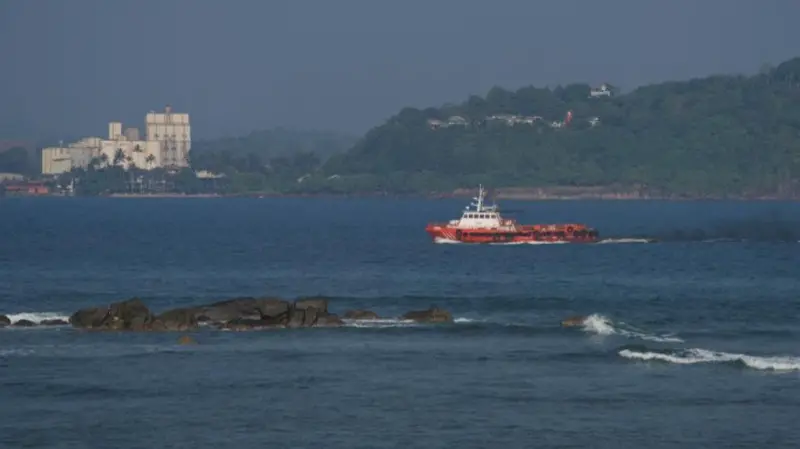
Around 140 people are missing after an Iranian navy ship sank off the coast of Sri Lanka.
The Sri Lankan navy says around 180 people were on board, with 32 rescued. A spokesman tells the BBC the cause of the sinking is not known
Sri Lanka’s navy has confirmed that it’s rescued 32 people after it received a distress call from Iranian navy ship ‘IRIS Dena’ early this morning.
Budhika Sampath, the spokesman of Sri Lanka’s navy says: “Though it was beyond our waters, it was within our search and rescue region. So we were obliged to respond as per international obligations.”
He adds: “We found people floating on the water, rescued them, and later when we inquired we found that those people are from an Iranian ship.”
He also says that according to the documentation of the ship 180 people are believed to have been on board, although the exact number of missing is unknown.
The spokesman says at the time of launching the rescue operations they did not see the vessel but saw oil patches on the water and floating life rafts.
He also tells the BBC that he rejects the reports of a submarine attack causing the sinking, and that the cause is unknown.
Earlier the secretary of the country’s defence ministry Air Vice Marshal Sampath Thuiyakontha told BBC Sinhala that around 140 people are thought to be missing.
So far, Sri Lanka’s military has not been able to confirm what might have caused the ship to sink.
[BBC]
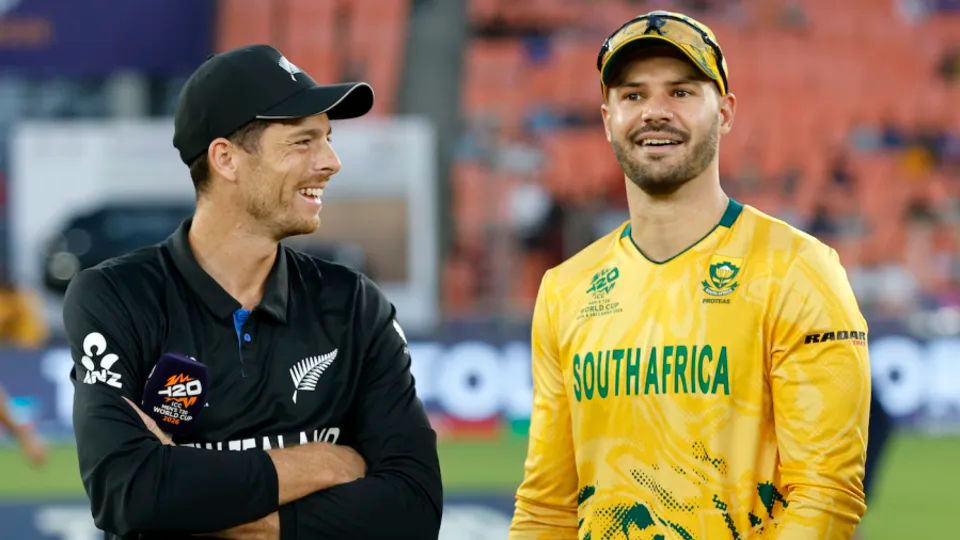
The good thing about South Africa – New Zealand semi-finals is it gives neutrals at least one team to cheer for in the final. Two generally likeable sides who have – somehow – yet to lift an ICC white-ball trophy between them since 2000 vie for yet one more crack at it, as they look to edge each other out. South Afria’s heartache c in these tournaments is well-documented, but New Zealand make semi finals more consistently than any other side over the past two decades, and are yet to string the two matches together from this stage onwards that would propel them to glory.
There is, often, little to choose between these two but, this time around, a clear favourite has emerged. South Africa are unbeaten this tournament, and that includes a trouncing, of New Zealand in the group stages. They have played all their games in India, which has allowed them to make full use of their fast bowlers without needing to turn to spin in any extensive way, which plays into their strengths.
With 268 runs at a strike rate of 175, captain Aiden Markram has been arguably the best opener in the tournament, while a middle- and lower-order comprising Dewald Brevis, David Miller, Tristan Stubbs and Marco Jansen is the envy of any side in the competition. In Jansen, Corbin Bosch, Kagiso Rabada and Lungi Ngidi – the highest wicket-taker remaining in the tournament – they have high pace as well as great variety, with Keshav Maharaj getting through the spin overs. It is hard to imagine how South Africa could have covered all bases more comprehensively.
New Zealand’s campaign has proved much less straightforward, and it is harder to gauge the true nature of their quality and their ability to contend for this title. They beat Afghanistan, Canada and the UAE through the group stages, before a washout against Pakistan and defeat to England left them relying on an external result to qualify. They owe their place in the last four to a commanding win over Sri Lanka, one which had its own hiccups along the way.
They have had to adjust, though, playing their group matches in India before going off to Sri Lanka for the Super Eight. They are back in India again, with Kolkata the venue for the semi-final, which will likely see them pull back their use of spin and turn to the quicker bowlers again. Their strength is a gun top-order, with Finn Allen and Tim Seifert in consistently explosive form, and great flexibility with the ball thanks to a surfeit of allrounders, a deep batting order, and fast bowlers than can neatly blend back into the side for spinners without disrupting the balance of the line-up.
Both sides have been knocking on the door for silverware for long enough. Once more, they chip away at it in the hope that this time, their efforts will be enough to blow the house down.
Rachin Ravindra was the stand out player in Lahore last year, the last time these two sides met in an ICC semi-final at the 2025 Champions Trophy. He scored a century that set New Zealand on its way before keeping things tight with the ball. At this tournament, he played a central two-in-one role for New Zealand in the Super Eight in Colombo where the ball gripped and stopped, but on the flatter strips of Eden Gardens it is with the bat that he will be more important to New Zealand. Ravindra has a phenomenally good ICC record, but at this tournament, his batting hasn’t quite clicked in the same way. All that can be put to rest facing a team against whom he has enjoyed big-match success.
Aiden Markram has towered over almost any other batter at this tournament, and is the highest run-scorer among sides still alive. He saved his best innings for the game against New Zealand in the groups, pulverising an unbeaten 86 off 44 to seal a comfortable win. It is one of three destructive half-centuries he has scored at this World Cup. His clean aerial hitting through the powerplay has proven almost impossible to counter for bowlers when in this kind of form, especially if he cannot be snared early, as India and Zimbabwe recently managed. Markram has also demonstrated his ability to rise to the biggest of occasions, as evidenced by his fourth innings hundred in the World Test Championship final against Australia last year. A semi-final here is unlikely to overawe him.
Matt Henry arrives in Kolkata tonight after returning home for the birth of his second child. He will not train, but is likely to line up in the XI on Wednesday. With New Zealand returning to the less spin-friendly India, Ish Sodhi might make way for Jimmy Neesham.
New Zealand: Tim Seifert (wk), Finn Allen, Rachin Ravindra, Glenn Phillips, Mark Chapman, Daryl Mitchell, Mitchell Santner (capt), Cole McConchie/Jacob Duffy, Jimmy Neesham, Matt Henry, Lockie Ferguson
South Africa’s top seven is set in stone. On a pitch as flat as Kolkata’s, they are unlikely to go with any more than one spinner.
South Africa: Quinton de Kock (wk), Aiden Markram (capt), Ryan Rickelton, Dewald Brevis, David Miller, Tristan Stubbs, Marco Jansen, Corbin Bosch, Kagiso Rabada, Keshav Maharaj, Lungi Ngidi
[Cricinfo]

Russia and China have criticised the US and Israeli attacks on Iran, with Moscow saying it had seen no evidence that Tehran was developing nuclear weapons, and Beijing demanding an immediate halt to the joint attacks.
Chinese Minister of Foreign Affairs Wang Yi told his Israeli counterpart, Gideon Saar, on Tuesday that the attack on Iran came as negotiations between Washington and Tehran had “made significant progress, including addressing Israel’s security concerns”, China’s Foreign Ministry said in a statement.
“Regrettably, this process has been interrupted by military action. China opposes any military strikes launched by Israel and the US against Iran,” Wang told the Israeli foreign minister during a phone call, according to the ministry.
“China calls for an immediate cessation of military operations to prevent the further escalation and loss of control of the conflict,” Wang said.
“Force cannot truly solve problems; instead, it will bring new problems and serious long-term consequences,” he added.
According to the Chinese Foreign Ministry, Saar agreed to a request from Wang to take “concrete measures to ensure the safety of Chinese personnel and institutions” in Iran.
The call on Tuesday with Israel and Beijing’s apparent efforts to stabilise the spiralling regional situation followed calls Wang made on Monday to discuss the conflict with the foreign ministers of Iran, Oman and France.
Russian Foreign Minister Sergey Lavrov also criticised the US and Israel on Tuesday, saying their war on Iran could lead to the very outcome they claimed they wanted to prevent: nuclear proliferation.
Lavrov told a news conference that the logical consequence of the US and Israel’s actions could be that “forces will emerge in Iran… in favour of doing exactly what the Americans want to avoid – acquiring a nuclear bomb”.
“Because the US doesn’t attack those who have nuclear bombs,” Lavrov said.
Lavrov also said that Arab countries could now join the race to acquire nuclear weapons, given the experience of recent days and “the nuclear proliferation problem will begin to spiral out of control”.
Israel is widely seen as the Middle East region’s only nuclear-armed state, which it neither confirms nor denies.
“The seemingly paradoxical declared noble goal of starting a war to prevent the proliferation of nuclear weapons could stimulate completely opposite trends,” he said.
Lavrov, who said that Moscow had still seen no evidence that Iran was developing nuclear weapons, spoke with his Iranian counterpart, Abbas Araghchi, on Tuesday, and said that Russia stood ready to help find a diplomatic solution to the conflict, while rejecting the US and Israel’s use of “unprovoked military aggression” in the region.
As the US and Israel launched their first strikes on Iran on Saturday, Russia’s Foreign Ministry accused the close allies of carrying out a “premeditated and unprovoked act of armed aggression against a sovereign and independent UN member state”.
The two countries had hidden their true intention of regime change in Tehran “under the cover” of negotiations to normalise relations with Iran, the ministry said.
The US and Israel were “swiftly pushing the region toward a humanitarian, economic, and potentially even radiological disaster”, the ministry warned.
“Responsibility for the negative consequences of this manmade crisis, including an unpredictable chain reaction and spiralling violence, lies entirely with them,” the statement added.
Russia has faced its own accusations of aggression against a sovereign state after it launched a full-scale invasion of Ukraine, a war now in its fifth year.
[Aljazeera]

Cabinet approves import of Maize to meet shortfall

Cabinet nod for the removal of Cess tax imposed on imported good

Around 140 people missing after Iranian navy ship sinks off coast of Sri Lanka

South Africa strong favourites as quest for elusive silverware hots up

Australian girl, 8, killed in snowmobile accident in Japan

Russia, China raise diplomatic voices against US-Israeli attacks on Iran

‘Dates have the highest sugar content to fight Coronavirus’

Sunday Island 27 December – Headlines

#SundayIsland 17th December – Headlines

Sunday Island – 28th March

Sunday Island Headlines – 21 March

Sunday Island – 21st February – Headlines
-

 Opinion6 days ago
Jamming and re-setting the world: What is the role of Donald Trump?
-

 Features3 days ago
Brilliant Navy officer no more
-
 Features6 days ago
An innocent bystander or a passive onlooker?
-
 Features7 days ago
Ratmalana Airport: The Truth, The Whole Truth, And Nothing But The Truth
-

 Opinion3 days ago
Sri Lanka – world’s worst facilities for cricket fans
-
 Business7 days ago
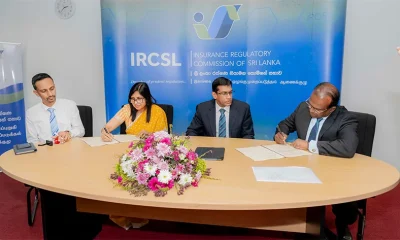
IRCSL transforms Sri Lanka’s insurance industry with first-ever Centralized Insurance Data Repository
-

 Business6 days ago
An efficacious strategy to boost exports of Sri Lanka in medium term
-

 Features4 days ago
Overseas visits to drum up foreign assistance for Sri Lanka