
News
Colombo asks India to send six bisons to reintroduce them in Lanka after 3 centuries

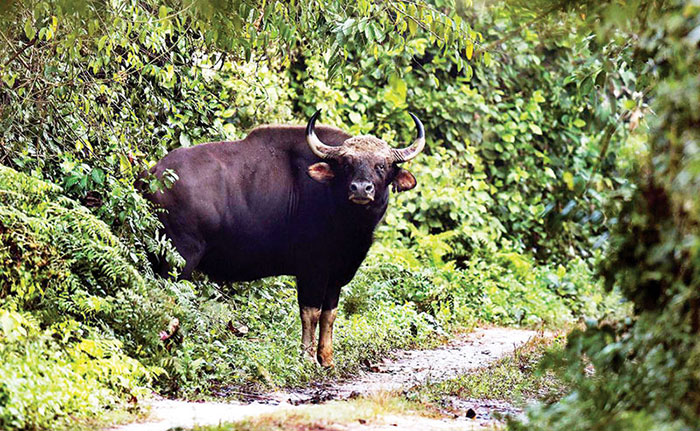
As wildlife diplomacy takes wing, government considers Lankan proposal for translocating gaurs
By Suhasini Haidar
and Jacob Koshy
New Delhi October 15, 2022: Close on the heels of the project that translocated cheetahs from Namibia, the Indian government is considering a proposal from Colombo to export a number of gaurs, or Indian bisons, to Sri Lanka to revive the population of gavaras that have been extinct in the island since the end of the 17th century. If the project is cleared, it would be the first such agreement between India and Sri Lanka, and part of a global trend of “wildlife or zoological diplomacy”, say experts.
Sources said the Ministry of External Affairs (MEA), which received the request in August, has now forwarded it to the Ministry of Environment and Forests (MoEF), “seeking comments” on the proposal to transport at least six specimens, including a bull and three to five cows. According to the written proposal, the Sri Lankan Department of Zoological Gardens would then carry out “captive breeding a herd of about a dozen specimens over a five-year period before trial reintroduction to the wild could take place in accordance with [internationally mandated] guidelines for reintroductions”.
S.P. Yadav, Director, National Tiger Conservation Authority, said the proposal was being studied. “We’ll have to evaluate if the conditions for translocation are right, such that the animal can sustainably thrive over there,” he told The Hindu, estimating the evaluation could take a few months.The suggestion for the proposal came from world-renowned Sri Lankan conservationist Rohan Pethiyagoda, who was awarded the Linnean medal 2022 (U.K. -based equivalent of the Nobel prize for zoology) for his work on restoring fresh water and forest biodiversity.
“As a scientific and cultural collaboration between our two countries, I felt this could be an immensely valuable initiative. But I know it is fraught with difficulties,” said Sri Lankan High Commissioner to India Milinda Moragoda who handed over the preliminary request on the basis of Mr. Pethiyagoda’s suggestion. “India is without a doubt Sri Lanka’s closest friend, supporter and trading partner. We have a shared history, shared cultural identity, and shared gene. We even got Buddhism, on whose traditions we derive our national values, from India,” he added.
Experts say that while “zoological diplomacy” had been practised worldwide, they draw a distinction between “gifts or loans” of animals in captivity to translocation and reintroduction of a species, particularly between neighbouring countries with similar eco-systems. For example, American bison herds were supplemented with animals from Canada after the U.S. herds were almost all wiped out, The U.K. has recently introduced the European bison (Wisent) after an estimated 10,000 years in June 2022(its extinct relative the Steppe Bison was believed to have lived there many centuries ago).
Israel has for decades pursued reintroductions, including of Persian fallow deer. Arabian oryx and other species have been released into the Negev desert, and South Africa has recently used the export of cheetahs to other African countries as a diplomatic tool during the post-apartheid era. More recently, Cambodia has requested translocating tigers from India, which is under consideration.
“Much depends on whether the conditions that caused the extinction have been removed, but reintroduction is known and has frequently been taken up between countries where the range is contiguous,” explained Mahesh Rangaran, Professor of History and Environmental Studies at Ashoka University who has studied conservation history, including such attempts. “In that sense, the animal plays a role as a zoological ambassador between nation states,” he added.
Sri Lankan officials say the gaur, called the gavara in Sinhala, was once widespread and archaeological remains in ancient caves in the island included the remains of the animal. By the end of the 17th century, however, the species appears to have been extirpated in Sri Lanka, although they remain prominent in iconography and mythological stories.The Indian gaur, a reclusive beast that lives in the wild, is the largest wild bovine that is a protected species and included in Schedule I of the Wild Life Protection Act, 1972 and listed as vulnerable in the International Union for Conservation of Nature (IUCN) Red List. There are about 13,000 to 30,000 gaurs in the world with approximately 85% of the population present in India. It is also found in Burma and Thailand.
The first-ever population estimation exercise of the Indian gaur carried out in the Nilgiris Forest Division in February 2020 estimated around 2,000 Indian gaurs to be inhabiting the division. This came after instances of people being attacked or injured by the bison primarily in and around plantations came to light. In 2019, for which the most recent numbers are available, three people were killed and seven injured in attacks by gaurs.
(The Hindu)








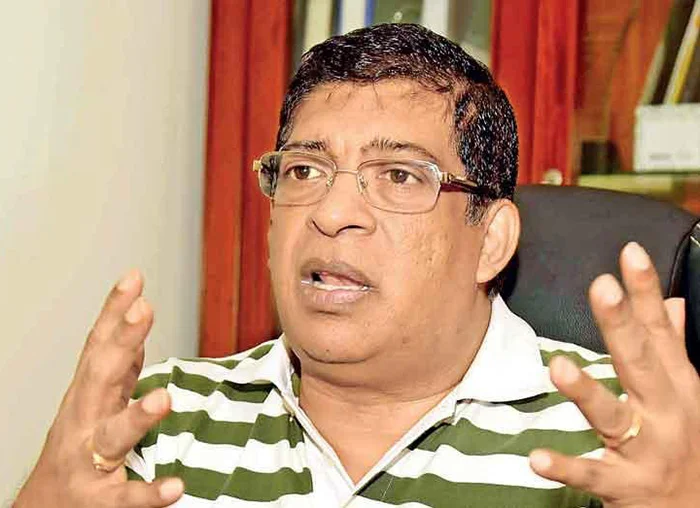
NDF MP Ravi Karunanayake, on Tuesday, raised concerns over, what he described as, a widening disconnect between record tourist arrivals and a weak foreign exchange inflow, warning that headline arrival figures were masking deep structural failures in Sri Lanka’s tourism sector.
Raising the issue under Standing Order 27(2) (20), Karunanayake noted that Sri Lanka recorded more than 2.36 million tourist arrivals in 2025, yet total tourism earnings had increased only marginally to about USD 3.22 billion. He said average spending per tourist had declined by nearly 12 percent year-on-year, while tourism-related foreign exchange inflows, reflected in the Central Bank’s reserves, had not grown in proportion to arrivals.
“This raises serious concerns about revenue quality, offshore settlements, informality and weak enforcement,” the MP said, pointing out that an estimated 40,000 hotel and accommodation entities were operating without registration.
Karunanayake sought clarification from the government on the structural reasons behind declining per capita tourism earnings, including changes in source markets, length of stay and pricing practices. He also asked for details of the actual volume of tourism-related foreign exchange converted through licensed commercial banks in 2025 and reflected in Central Bank reserves, and how this compared with earnings figures reported by the Sri Lanka Tourism Development Authority.
MP Karunanayake further asked whether the government had assessed foreign exchange leakages arising from offshore settlement by online booking platforms and the extent of tourism activity conducted by unregistered accommodation providers and informal operators outside the banking system. “Does the Government accept that a material share of tourism-generated foreign exchange is bypassing the domestic financial system and, therefore, not strengthening official reserves?” he asked.
The NDF MP also criticised weak enforcement of mandatory registration, banking channel settlements and foreign exchange repatriation requirements, despite existing legal powers. He urged the Government to present a tourism policy explicitly linked to earnings, foreign exchange inflows and reserve accumulation, rather than relying on headline arrival numbers.
Karunanayake additionally warned that overseas credit cards were widely used for tourism payments in Sri Lanka, with invoicing and settlement taking place outside the country, thereby avoiding domestic taxation. He said international booking platforms similarly processed payments offshore, depriving Sri Lanka of full taxable revenue, and asked what corrective action was being taken to address the issue.
The government requested time to respond to the queries raised by the Opposition MP.
By Saman Indrajith
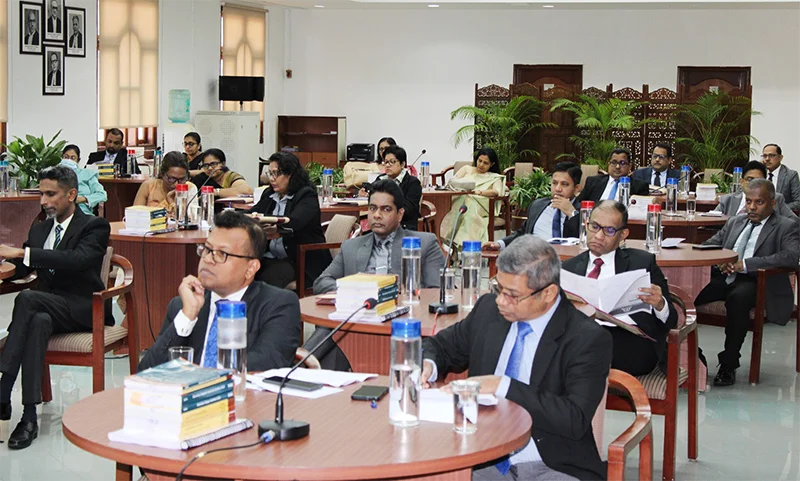
At the request of the Supreme Court of Sri Lanka and Sri Lanka Judges’ Institute, a special capacity-building programme for 30 District Court Judges from Sri Lanka was organised at the Indian National Judicial Academy, Bhopal, from 12 to 16 January 2026, the Indian HC said.
IHC statement: “The week-long programme encompassed eleven sessions covering key themes such as court and case management for efficient judicial systems; juvenile justice; judicial interventions to combat money laundering; sentencing procedures and related challenges; environmental law jurisprudence; electronic evidence and cybercrime; the use of forensic evidence in civil and criminal trials; judicial stress management and wellness; among others. In addition, the programme featured educational visits, including a field visit to Sanchi, aimed at providing cultural exposure.
The programme was organised under the enhanced capacity building framework announced by Indian Prime Minister Narendra Modi during his State Visit to Sri Lanka in April 2025, whereby 700 customised slots annually for Sri Lankan professionals were added over and above all existing schemes such as ITEC. With around 300 Sri Lanka civil service officers being trained annually under a MoU between the National Centre for Good Governance of India and the Sri Lanka Institute of Development Administration, the enhanced capacity-building endeavour of India thus now benefits 1000 Sri Lankans annually.”
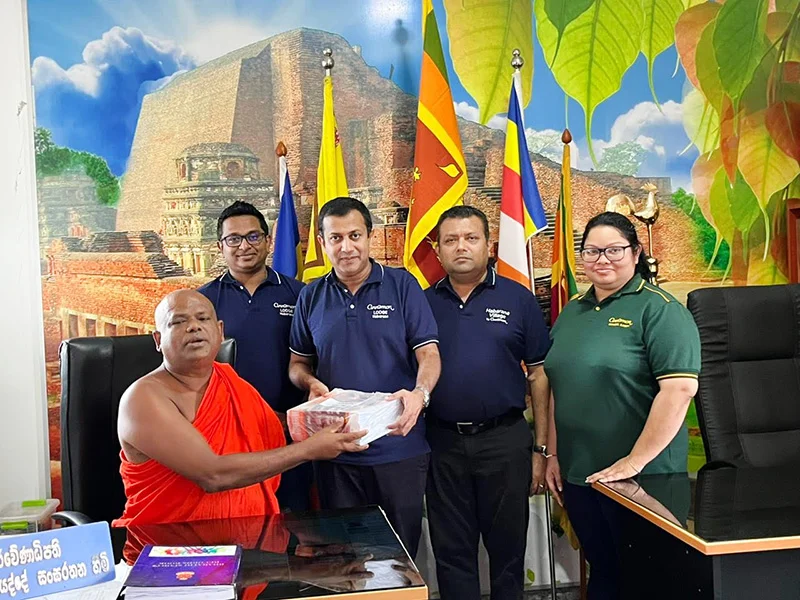
Cinnamon Lodge Habarana and Habarana Village by Cinnamon distributed essential school supplies to students affected by the recent floods following Cyclone Ditwah. The distribution was focussed on schools in the Peradeniya and Gampola areas that suffered significant damage.
The project was a collective effort supported by the staff and welfare associations of several properties, including Trinco Blu by Cinnamon (represented by Lahiru Rathnayake), Cinnamon Citadel Kandy, and Kandy Mist (represented by HR Manager Chandran Solkar).
The primary recipient was Sri Bharathi Buddhist College in Peradeniya, where books and other educational equipment were handed over. Additionally, relief items were distributed on the same day to students at Peradeniya Junior School, Atabage Rajananda Vidyalaya, and Atabage Udugama Maha Vidyalaya.
By S.K. Samaranayake

U – 19 World Cup: Afghanistan’s Nooristani Omarzai blows Tanzania away

U – 19 World Cup: Mayes’ 191 helps England crush Scotland

Abhishek and Rinku fireworks help India start series in style

Dry weather will prevail in the most parts of the island

Ravi: foreign exchange inflow does not reflect increased tourist arrivals

India arranges capacity building programme for District Court judges on SC’s request

‘Dates have the highest sugar content to fight Coronavirus’

Sunday Island 27 December – Headlines

#SundayIsland 17th December – Headlines

Sunday Island – 28th March

Sunday Island Headlines – 21 March

Sunday Island – 21st February – Headlines
-

 Editorial4 days ago
Illusory rule of law
-
 News5 days ago
UNDP’s assessment confirms widespread economic fallout from Cyclone Ditwah
-

 Editorial5 days ago
Crime and cops
-
 Features4 days ago
Daydreams on a winter’s day
-

 Editorial6 days ago
The Chakka Clash
-
 Features4 days ago
Surprise move of both the Minister and myself from Agriculture to Education
-

 Features3 days ago
Extended mind thesis:A Buddhist perspective
-
 Features4 days ago
The Story of Furniture in Sri Lanka