
Features
Coconuts


Who would have thought the coconut would be ludicrously measured round its middle and its price decided thereupon. Who would have imagined the day would come when coconuts were heaped and VIP politicians stood in rows taking turns to dash them with curses upon tongue against enemies or opponents. All this done to that much respected nut!
These miseries came upon the coconut in the recent past, proving that we live so different from peaceful times when coconut was an integral part of the good life, with its kernel used to enrich our curries, its water drunk to slake thirst and for good health. Oil was extracted and used for a number of purposes: to fry and temper, to keep hair tidy and unblown, to light pahanas in the midula, and in temples with the deeply meaningful messages of the impermanence of life and the light of the Dhamma dispelling the darkness of ignorance . We used its leaves as a covering ; its fibre as strong coir and is dried ekels for sweeping. What didn’t we use of that tree, all for free? Thus the Sinhala name of appreciation for it: thura suva meaning ‘heavenly tree’ with its implied connotation of ‘tree of the gods’.
Coconut is an ingredient of our staple diet and that of farm animals too including elephants – its leaves, its pith, and poonac made from the kernel. Thus a large proportion of coconut yields is used for home consumption. Coconut is also a cash crop with its oil and desiccated kernel exported. In 2009, FAO noted that Sri Lanka was the fifth largest exporter of coconut products. Statistics show that the annual production of nuts is between 2,500 million to 3,000 million nuts. To ensure a steady supply for export and to sustain home consumption the annual amount should rise much closer to 4,000 million nuts. (Internet)
The coconut palm was almost a sacred tree as every part of it was used, more so in the days of long ago. Never to be forgotten is the chore of writing essays as junior school kids on ‘The Coconut Palm’. The tender leaves and inflorescence were used as auspicious decoration, particularly for the pirit mandapaya and marriage poruwa. The spathe of the leaf was cut and made plates of in my grandparents’ house for the padu caste workers. We also used it as a plaything – pulled along as we sat clinging to its stem. The plaited leaf was used in various ways, most remembered is the play houses made for us with walls and roof of the leaves, and the temporary dining room put up in the front midula for a village wedding. And of course coconut toddy and arrack which I remember was favoured if it was ‘pol’. Treacle too which is second to kitul peni. And thus the fame of the coir rope walkers in coastal areas from tree to tree, who collect the sap from incised inflorescence .
History
 Gleaned from an article in a 2017 Daily News by J S Kaviratne, and other internet articles, is that a Greek ambassador in 300 BC mentions coconuts from Ceylon in a missive to an Indian rajah. The Great Chronicle Mahawamsa refers to King Aggabodhi I decreeing coconut cultivation between Dondra and Weligama on the Southern coast of Sri Lanka in 589 A.D. King Parakramabahu II of Dambadeniya (1234-1269) encouraged coconut growing in Bentota and Kalutara proving that royal patronage was given to coconut cultivation in the country. Quoting Dr P G Punchihewa, Kaviratne writes that the first milling process for coir and desiccated coconut was started by the British in 1830 in Dematagoda. The 5th century traveler Fa Hien mentioned coconut in his description of his sojourn in our island.
Answering my query about the origin of coconut in our island, one time Director/ Coconut Research Institute, Dr Upatissa Pethiyagoda said much. Yes, coconut is not indigenous to the country, but nuts floated across seas from eastern countries like Indonesia to take root along the coastline. He added that coconut offers 310 uses, of which we, having so much under cultivation, use it for just a few purposes. Coconut plantations according to him are the best and least injurious to soil and environment. He added that tea is the worst and should be thrown out! He had made this suggestion to Dr Rohan Pethiyagoda, ex-Chairman Sri Lanka Tea Board (2015 -2018) with a father, who was a long serving manager of upcountry tea plantations. Being a nephew to Upatissa, Rohan had respectfully refrained from strong argument!
Distant memories
Remembered is the fact that my maternal grandparents who lived in a village in Peradeniya were almost self sufficient in their food requirements, buying from Kandy only mutton (cooked in an outhouse for Grandfather and uncles), fish, salt, dried fish and sprats. Coconut trees grew well all over the godabima which were sufficient for the Mahagedera and many village homes. I remember with affection how Grandmother, sleeping proximate to the warm kitchen with its eternally smouldering hearth, would suddenly cry out loud: “Kelle, pol gediyak vetuna” and she would pinpoint its exact location through her extra perceptive hearing.
Many sweets made for afternoon tea of then had scraped coconut as an ingredient – aggala, pani pol in vellavahun or narang kavun. Oil for cooking, lighting the pahanas and anointing the head was made in-house. A thambaheliya (large brass pot) was half filled with kernel scrapings of several coconuts, for which a village woman was specially employed. This was ‘cooked’ over the hearth for several hours. Finally the kernel reduced itself to oil and a deposit called thelkaha which was heavenly delicious, more so as it was forbidden eating. Oil for grooming the hair was from tambili kernel and had many roots immersed in it, one being savandara.
The present
And so to now. Scarcity of coconuts and one costing a hundred rupees! Again the question why to the ex Director/CRI. Upatissa mentioned the fact that coconut takes long to develop to full maturity and weather conditions impinge much on produce. I remember the heartache I used to develop on seeing coconut land with palms savagely cut and the land divided into allotments by housing project developers along the flat areas of the Colombo Kandy road.
Owners of coconut lands moan the dearth of pluckers. Living for a few years on a coconut estate near Ahangama I remember the pluckers used kekkers – very long poles with knives attached as the trees were very tall. Maybe the solution would be coir rope walkways from one treetop to another. We saw the admittedly ludicrous sight of the State Minister of Coconut etc being hauled up an invented motorized seat for reaching the tops of palms. He got stuck in it, while the young inventor, slim and agile, proved the utility of his invention.
Ban the ritual of coconut smashing at devales, we plead. It’s a Hindu rite isn’t it, so why do Buddhists waste coconuts thus? Nan


By Milinda Moragoda
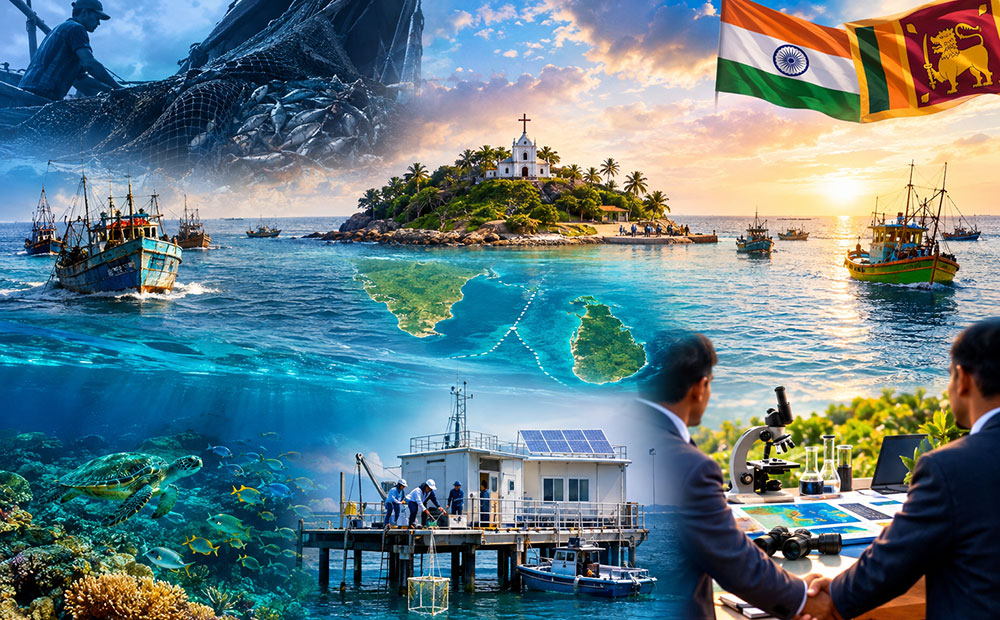
The latest proceedings before the Supreme Court of India offer an opportunity to move the Katchatheevu island debate beyond the familiar question of sovereignty. While hearing petitions challenging the 1974 and 1976 India-Sri Lanka maritime agreements, the court urged the central and Tamil Nadu governments to sensitise fishermen about the consequences of crossing the international maritime boundary and entering Sri Lankan waters. The Indian government, meanwhile, has made clear that it does not intend to reopen the agreements and is pursuing concerns relating to Indian fishermen through diplomatic channels.
More significantly, the Attorney General pointed to the depletion of fish stocks in Indian waters as one reason fishermen venture into Sri Lankan waters. The court also raised questions about fishing practices and the condition of Indian coastal waters during the hearing.
These observations point towards a more fundamental question: is the continuing focus on Katchatheevu distracting both India and Sri Lanka from the real crisis—the depletion of the Palk Bay’s marine resources and the persistence of destructive fishing practices?
A problem larger than an island
Over 50 years ago, Sri Lanka and India signed two maritime boundary agreements—one in 1974 and the other in 1976—defining the International Maritime Boundary Line and establishing the respective maritime jurisdictions of the two countries, including Sri Lanka’s sovereignty over Katchatheevu. The agreements did not grant Indian fishermen traditional fishing rights in Sri Lankan waters, nor did they provide reciprocal rights to Sri Lankan fishermen in Indian waters.
The constitutional and legal challenges to those agreements remain before the Indian Supreme Court. The court has not adjudicated their constitutional validity, and the matter remains pending. At the bilateral level, however, successive governments have treated the maritime boundary established by the agreements as the basis for managing relations between the two countries.
The concerns of Tamil Nadu’s fishing communities are genuine. Indian fishermen and their families face economic hardship when boats are detained and fishermen are arrested after crossing the maritime boundary. Tamil Nadu Chief Minister C Joseph Vijay has recently urged the Indian government to intervene to secure the release of detained fishermen and seized boats and called for renewed dialogue.
But these immediate concerns point towards a larger question: why are fish stocks being depleted, and what can be done to restore them?
The problem cannot be addressed simply through repeated diplomatic representations, arrests, releases and demands for the return of fishing boats. Nor can it be resolved by continually reopening the political debate over Katchatheevu.
The Palk Bay is a shared ecological system whose resources are finite. Its health ultimately determines whether fishing communities, on either side of the maritime boundary, can continue to make a living from it.
The ecological toll
Bottom trawling is at the heart of the problem. Dragging heavy nets across the seabed destroys marine habitats, captures juvenile fish and generates substantial bycatch. Its effects are cumulative and potentially long-lasting.
The issue is, therefore, not simply whether fishermen cross an international maritime boundary. It is also the impact on the marine ecosystem of continued large-scale, destructive fishing.
Sri Lanka’s Northern Province, once home to a thriving fishing industry, has experienced a sharp decline in fish catches, from 35,000 metric tonnes in 1995 to 17,000 metric tonnes in 2023. Multiple factors have contributed to this decline, including the legacy of decades of conflict and displacement. But pressure from large-scale trawling in the Palk Bay has added to the difficulties faced by northern fishing communities.
For fishermen on both sides, the long-term interest should, therefore, be the same: preserving the marine resource on which their livelihoods depend.
A consistent but passive response
Sri Lanka has maintained a consistent and restrained position on Katchatheevu for five decades, working within established legal and diplomatic frameworks. The island has also remained a symbol of the longstanding links between the two countries, particularly through St Anthony’s Church and the annual pilgrimage attended by devotees from both sides.
But Sri Lanka has done little to give Katchatheevu a constructive contemporary role. That should change.
Years ago, the Pathfinder Foundation proposed the establishment of a marine research station on Katchatheevu, led by the Department of Fisheries, the National Aquatic Resources Agency (NARA), and Sri Lankan universities.
The proposal deserves renewed consideration.
Turning Katchatheevu into a platform for science.
A marine research station would give Sri Lanka a practical means of exercising responsible stewardship while contributing to the preservation of the wider Palk Bay ecosystem.
It could monitor marine biodiversity and ecological degradation, assess the long-term impact of bottom trawling, track migratory patterns and spawning cycles, and provide scientific data for fisheries policy. It could also serve as a platform for marine diplomacy and dialogue between India and Sri Lanka.
India already possesses substantial marine research capabilities. Sri Lanka should develop a complementary capability on its side of the maritime boundary.
Advances in solar power, desalination and modular construction have also reduced the logistical obstacles that might once have made such a facility difficult to establish. A low-impact, high-value research station is now a feasible proposition.
From dispute to cooperation
The current debate offers an opportunity to change the nature of the conversation.
Tamil Nadu’s concern for its fishermen is legitimate. Sri Lanka’s concern about illegal fishing and the degradation of its marine resources is equally legitimate. Treating one concern as valid and the other as an obstacle will not produce a durable solution.
Nor will repeatedly returning to the sovereignty question.
Instead, India and Sri Lanka should focus on the management of the Palk Bay as a shared ecological system. Joint scientific monitoring, conservation programmes and discussions on regulated and sustainable fishing could provide the basis for practical arrangements that protect livelihoods while phasing out destructive practices, such as bottom trawling.
Such cooperation would not require either country to compromise its sovereignty or its legal position.
It would require both to recognise that marine ecosystems do not respect political boundaries.
Science over sentiment
The Katchatheevu debate has continued for decades. The immediate concerns of detained fishermen and fishing communities must be addressed through established diplomatic and legal channels. But those measures cannot substitute for a long-term solution.
The real challenge is not simply who possesses Katchatheevu. It is whether the waters surrounding the island will continue to support the communities that depend on them.
For Sri Lanka, the answer should be neither rhetorical confrontation nor passive diplomacy. It should be science, responsible stewardship and constructive regional cooperation.
Katchatheevu need not remain a symbol of contention. Properly used, it could become a platform for marine research, environmental stewardship and sustainable cooperation between India and Sri Lanka.
(Milinda Moragoda is a founder of the Pathfinder Foundation, a strategic affairs think tank. tweets @MilindaMoragoda. email@milinda.org, courtesy of The Print)

(Excerpted from “Madam-Sir,” by Manel Abeysekera career and dilemmas of Ceylon’s first woman diplomat)
After the training in London I was assigned to our Embassy in Rome as Attache as I was still a probationer in the sense we needed to pass the First Efficiency Bar Examination plus acquire proficiency in the assigned foreign language within a period of three years before being designated Third Secretary. The Italians simply could not understand the meaning of “probationer” in my passport [which I do not think should have been in our passports] and always looked askance at me thinking I was out of jail on probation!
My Ambassador, Sir Arthur Ranasinha, much to my embarrassment [probably to his too], was my brother Lakshman’s father-in-law whom I used to address at home as “Uncle” and now had to address as “Excellency” in public. To my surprise, I made the transition quite easily and never made a faux pas. Sir Arthur and Lady Ranasinha insisted that I stay with them rather than at a hotel till I found an apartment. It was extremely kind of them, but I insisted, after the first few days, that I not travel with him in the official car but find my own way to the Embassy as I did not want the staff to think that I was being favoured by the Ambassador which would have been bad for both of us.
Little did I know that I would have only 10 months in Rome. I was grateful to Methodist College for my knowledge of Latin and Roman history as I wandered around the city having a closer look at places and monuments, some of which I had already seen on our family tour of Europe in 1950 ten years before. Once again I was able to treat myself to Grand Opera both in the magnificent Opera House as well as in the spectacular Baths of Caracalla. Art and architecture of such munificence was there for me to savour.
I think Rome is one of the most beautiful cities in the world and unique in the way that the old and the new blend naturally. Italy is the place to boost any woman’s ego especially if she were a foreigner because of the fun loving, romantic and gallant Italians to whom the chase was the thing rather than the capture! They seem to be able to spot a foreigner a mile off as happened to my English friend and flat mate from New Hall, Mary Anne Pritchard whom I had arranged to meet at the Memorial of Vittorio Emmanuele [the first King of Garibaldi’s united Italy], popularly known as “the wedding cake” as it had some tiers and was white in colour.
She had been a little ahead of time and, when I arrived on the scene, she was surrounded by a number of Romeos – wasn’t she glad to see me and be “rescued”! As I have observed, Italians have a nose for foreigners, whatever be their colour! I found it great fun as I had got used to it and as the Romeos were never dangerous and one could extricate oneself from them! On one occasion, when I was walking to the Embassy, two Romeos on a motor bike were insisting on giving me a ride when the Indian Ambassador drove past with flag flying and, seeing a woman in saree, put his head out of the car window and, in a flash the Romeos disappeared and I was able to proceed!
I feel that keeping up their reputation of being handsome Latin lovers was a cult with them! This seemed to be extended beyond belief as when I went to the telecommunication authority to pay the private portion of my telephone bill the officer who dealt with me who looked quite professional though young naturally came to know my telephone number. The next evening my delightful “daily” maid Maria asked me who was telephoning my apartment and asking for the “the princess” to whom she had firmly replied that there was no princess living there!
Subsequently when I answered such a call, I realized it was the official who had attended to my telephone bill! He professed a keen interest in the history and culture of Ceylon and wanted to come and learn all about it from me! I promptly told him that it was my male colleague in the Embassy that dealt with it – which was not really true – and that he was most welcome to meet him! As I expected, that cooled his ardour!
My senior colleague [he and I were the only diplomatic officers], Melville Fernando and his wife Shelagh took me under their wing and really looked after me. I fondly called him “Unkie” as he was quite avuncular to me and Shelagh “Agh Agh” and he called me Manuel Gomez! [shades of my Oxford tutor!]. Three Ceylonese who were in and out of the Embassy and who were sharing an apartment with Nada [A. Nadarajah] our Chief Clerk, were Lakdasa Hulugalle who was with FAO, a son of the former Ambassador – with whom I had stayed one night en route to Maratea to visit Maria my Italian friend from Cambridge — Mahinda Pethiyagoda [Peththa to his friends] and S.K Charles, both of whom were students.
They told me that they had seen me in my sitting-room through their sitting-room window. I simply did not believe them as they were great teasers, but when they described the saree I was wearing the previous day, it seemed convincing as I had not met them that day. So, when I went home, I looked out of the two windows of my apartment – the sitting-room one and my bedroom one and realized to my horror that it was in my bedroom that they had actually seen me and thanked my lucky stars that I had been fully clothed at the time. My bedroom window was directly below their sitting-room window as mine was on the ground floor and theirs on the first floor next door!
I had taken the first apartment I had seen within my rent ceiling as I was keen on moving out of the Ambassador’s residence, without bothering about who my neighbours were. After my discovery, I kept my bedroom window shuttered whenever I was in it. Soon after, my neighbours invited Melville, Shelagh and me to dinner and as I was only going next door, I did not bother to carry a handbag but put my set of keys and a handkerchief in my coat pocket. After dinner Melville and Shelagh insisted on seeing me home and luckily, before they left, I discovered that I did not have my key case and, thinking that the boys had taken it from my coat pocket after I had taken it off and hidden it, we went back to their apartment and demanded it.
They looked the picture of innocence and denied having hidden it and, fumbling in my coat pocket I realized that there was a hole in it through which the case could have dropped. Though we retraced our steps, with the boys joining in the search, we could not find it. The key case was an Indian one with a design on it and a zip and it may well have happened that someone could have picked it up thinking that it was a purse. I was able to get into my apartment with the Portiera’s [female porter] front door key.
Next day Melville organized the changing of the front door lock and that of my bedroom. Italians are rather like us: they are wont to do a job in fits and starts! So, when I got home that evening, I did not realize that though the front door lock had been changed, the bedroom one had one handle – only on the outside. After a shower and having had my dinner, I went into my room and having unwittingly allowed the door to close, I found that I could not open it from inside! As it was late, all I could do was to laugh myself to sleep!
Melville would always call for me on his way to the Embassy, and I woke up early and called him about my plight and asked him to come a little early so that I could throw him the key of my apartment door through my bedroom window so that he could enter and open my bedroom door where I was marooned! The good soul he was, he did so and got into the Portiera’s courtyard below my window from which I threw him the key. He made up his own funny version of it that he had to serenade me before I threw down the key, nor did he let me forget the episode!
Melville liked to take the mickey out of me and advised me to buy a Fiat Panic car. Knowing Latin I did not fall for it, but when he suggested that I buy a Super Cortomaggiore, I fell for it as I did not know that it was the Italian term for super petrol!
My Ambassador very thoughtfully let me handle FAO work and it was a great thrill for me to sit behind the Ceylon name board at meetings. The experience of getting to know the workings of a UN Specialised Agency stood me in good stead when I was accredited to ECAFE when I served in Bangkok. It also gave me entre to Dr. B.R. Sen, the Indian Director General of FAO. He even suggested that I join FAO but wisely advised that I should wait until I was more senior in my own Service so that I could join at a higher level.
An amusing incident involving Dr. and Mrs Sen comes to mind when I was back in Ceylon after Rome, and they visited as the guests of their friend, the Governor General Sir Oliver Goonetilleke. Since they knew me I was assigned the task of taking them to Kandy and Nuwara Eliya where we stayed at the Governor General’s Residence. Sir Oliver was a close friend of our family and as he considered Mother a lucky person, he used to come on the first of the year to partake of kiribath.
Needless to say, his recollection of me was as a young woman lacking in experience to handle the duty of looking after his illustrious friends. So he called the Manager of King’s Pavilion, Kandy to enquire after his friends and to advise me to make sure that they were offered drinks before dinner and the like. In Nuwara Eliya, H.M. Queen Elizabeth II and Prince Philip had stayed at Queen’s Cottage where we were to stay and while the Sens were accommodated in the room that had been used by the Queen, I was accommodated in the one next door which had been used by the Prince.
Before dinner I thought I would have a bath in the refurbished attached bathroom. Although it was December and quite cold, the warm water made me feel great but, as I was finishing my bath, I heard the telephone ring in the room; there was no time to dry myself and put on my dressing gown and so I wrapped a bath towel round me and, dripping wet and shivering, I dashed to the telephone and answered it. To my surprise it was Sir Oliver on the line, to enquire after his friends.
While Sir Oliver had a natural stammer, I too must have been stuttering because of the cold! As soon as the call ended, I buzzed the operator and asked from whom the call had been as I thought that perhaps my brother was pulling my leg! But the operator’s shocked reply was that it was the “Uthumanan” and had I not recognized his voice! Wasn’t I glad and relieved that I had responded correctly! My brother, who when told the tale, assured me he would never have pulled my leg when I was on official duty!
My first experience of a cocktail reception was in Rome and so was my introduction to the popular Italian aperatif Campari. It was popular as a long drink with soda or orange juice or as a cocktail called negroni mixed with vodka. The deep crimson colour of the negroni made me reach for it, but one sip of it and I never tasted it again – so bitter was it on my tongue. Campari was one of the few drinks I was unfamiliar with as Father was a connoisseur of both liquors as well as liqueurs and taught me much of what I know; however, it was in Rome that I became acquainted with Italian aperitifs like Campari and the finer points of wines, their vintages and “bouquet”.
I must say that I enjoyed every moment of my stay in Italy and everyone in the Embassy was most kind and helpful and, apart from the Ambassador and his wife, Melville and Shelagh, there were others like Ornella Gulmanelli, a secretary who was always so caring and with whom I am in touch and see whenever I go to Rome, as well as others outside the Embassy like Nelson Fernando, Director of the Ceylon Tea Centre, who was great fun and had a lovely tenor voice, and whom we called Nelsone and his Italian wife.
My young girl friend Nelun de Silva whose step father Mr. Williams was with FAO and whose mother would allow her only to spend a night or week end with me in my apartment and, of course, both of us became and still are good friends as also with her husband Selvan Mather.
We had a lot of fun together but I had a problem of keeping the Italian Romeos away from her as she was and still is beautiful! We took a photograph together and titled it “Manel Nelun ha!” as in the famous “Danno Budunge”! One of my treats was to have been taken by Nelun’s parents to the Verdi Opera “Aida” staged at the Baths of Caracalla, where the Triumphal March was depicted with horses and chariots on stage – a most spectacular scene.
During my term in Rome, I had the joy of being in Venice to organize our stall at the Venice Biennale of Art, and taking time to visit the old Palace and St. Mark’s Cathedral. While in Rome, I sat for the First Efficiency Bar Examination and passed it – two years ahead of time – which resulted in my becoming a “passed Probationer” with the promoted rank of Third Secretary. This meant that as the Mission had no financial cadre provision to have more than one Third Secretary it could not pay my salary and I had to be transferred out.
I was extremely sad to end my “Roman Holiday” as it were. My Ambassador told me that he felt this would happen but that he did not tell me so as he thought that I might postpone sitting the Examination and as he felt it was not good for my career since he believed that young officers should get over examinations as soon as possible. I was given a farewell by the Embassy and I recall that the cork of the Champagne bottle popped, flew out and landed on my head! This I was assured was a lucky omen! I was given not surprisingly a cocktail shaker as a parting gift!
The only reason that I was glad to get home was that Mother had had a stroke. Yet Father advised me to accept New Delhi if offered as he thought it would be a good experience and, in any case, I would not be far from home. But that was not fulfilled as the Government was economising on foreign exchange and, alas, I never had the chance of serving in India which I have always considered is the cornerstone of our foreign policy.
So I took the sea route to Colombo from Naples, where Melville and Nada took me. A lasting, appropriate memory of the Italian character and of my departure was the lunch we had of very good fish, with Melville ordering three portions of the same for each of us. However, when the bill was brought, he noticed that he had been overcharged as it was not divisible by three; when questioned, the waiter smiled disarmingly and asked Melville whether he had not noticed that the lady had been served a “beeg fish”!

by Samudra Ratwatte
Madulsima creeps often to my mind even 60 years after I began my married life on a plantation there with my husband, Newell Ratwatte. It was in the year 1957, the heyday of the plantation world. Life was easy, no hardships, no wars and no struggle to live – it was a glorious time.
I often dream of that little known enchanted land, located on the eastern slopes of the central hill country in the Badulla district , 5,000 feet above sea level – one of Lanka’s precious tea lands tucked away in the Uva hills. The area was well known for its endless stretches of lush green tea, dotted with factories and bungalows; waterfalls like silver thread trickling down the hills.
One of the wondrous sights is the view of the Amparai basin and the Senanayake Samudraya at a distance of 250 miles as the crow flies. At dusk when the sky is a pinky glow one sees the lights of Amparai twinkling like a thousand stars. This is one of Lanka’s rare sights, a beauty that keeps you enchanted forever.
The tea estates of Madulsima were close to the jungles where there were leopard, wild boar and other animals. It was their domain, but humans intruded into their territory and hunted and killed them for their meat of ‘sport.’ It was a paradise for the hunter. Every now and then a stray leopard would come out of the jungle, losing its way, or looking for prey. They were seldom harmed in those days.
Madulsima is ten miles from Passara, passing the famous Patnas. These Patnas are manna grass, and shrubs, isolated and desolate. Planters and residents of Madulsima are careful when driving past the Patnas because of the thick mist that suddenly descends on you. One can be trapped for hours. There is also a precipice which is treacherous especially at night. There have been many fatal accidents there.
That stretch of road was ideal for robbers and gangsters then. On pay day planters are careful to travel in a convoy of about five jeeps armed with guns and escorted by a few trusted labourers. These are trying times for planters and their families. Passing the Patnas one suddenly comes upon a range of gum trees, the beginning of Madulsima, endless stretches of green tea dotted with factories, bungalows and waterfalls. It is a beautiful sight.
There are 10,000 acres of tea in Madulsima, and eight productive estates; a planting district cut off from the rest of the world, a hidden jewel back of beyond.
The first estate is Mahaduwa, a large Scottish Tea and Lands property then. The PD (Peria Dorai or big boss) was Budge Birkett who had been a Major General in the Indian army. He was a very senior planter in 1957, perhaps a little arrogant and reserved, a strict disciplinarian and a living legend in the planting world who later became our good friend.
His wife was Mary, a charming and friendly woman. At that time the PDs were European. The SDs (Sinna Dorai or small boss) here were Laksha Niyalgoda, Neil Ranawaka and Ranjit Samarasinghe.
The adjoining estate was Veralapotana whose PD was Tony Boyd, and his wife was Hazel. We became good friends. The SD was Tissa Bandaranayake. Then came Uvakellie estate where we were – Newell was Senior SD. Galoola estate was managed by John Leard whose wife was Belle. Then came Battawatta estate where the club stood. The PD was Gavin Torrance a war veteran who flew across the Baltic Sea. Nan was his wife. Cocagala estate was run by Alvin Richardson and his SD Lionel Pilamatalawa. The end of Madulsima was Roeberry estate where the PD was John Richardson with Jess Koch, Travis Holsinger and Vernon Vandesmagt as SDs.
The Madulsima club played an important part in the lives of the planters. It was a home away from home for the Europeans where SDs and PDs mingled and forgot their status and enjoyed themselves. A good game of tennis and a delicious tea afterwards. Once a week on club day and the planters took turns to host the gathering. Tea was traditional – fresh bread, butter, jam and savoury paste, chocolate cake, pastries and sandwiches, and scalding cups of delicious tea. Tennis goes on till late and afterwards drinks and chatter in the Bar room. It was a close planting community.
Pay day is a good day for the labourers and an anxious time for the planter. Also it is a day of enjoyment. The labourers are happily drunk after pay, there is much to enjoy. It is like carnival time for them. The women in colourful sarees all dolled up. The vendors are out there with their wares. Colourful clothes, sweetmeats, the most attractive pots and pans that would grace any kitchen. A happy day for the bungalow staff. Cook appu’s dinner is best on this day after his tot. So we excuse him for being drunk.
I was very young when I went to Madulsima and felt so terrified. I was in awe of the European planting community and was the only Sri Lankan woman at that time. The other SDs were Lankan but bachelors.
I met the ladies first at the club when Nowell took me there. At first the women were were very curious about me. They were fascinated by my sari. Soon they put me at ease. The men were polite and gallant. After a few meetings Budge and Mary became my friends and took me under their wing. They gently showed me life on estates and very soon I felt a part of that community.
Madulsima taught me to appreciate many things. The beauty of a rare land, the niceness of people, their way of living. My happiest days with Newell, my husband, were in this beautiful part of Sri Lanka and its unforgettable people. We were there for seven glorious years.
Madulsima I will remember with nostalgia and yearning as the land of my dreams.
At bottom say: (This article was written some years ago by the author who is no longer alive)

The glittering gala in Male was enlivened by the rhythm of music and hospitality

Vietnam cultural exhibition held in Kandy

KOICA Fellows, volunteers promote AI awareness among Lankan students

Sampath Bank wins regional award for AI banking

India and Sri Lanka must move beyond Katchatheevu to save the Palk Bay

Kandy blood donors go beyond target

‘Dates have the highest sugar content to fight Coronavirus’

Sunday Island 27 December – Headlines

#SundayIsland 17th December – Headlines

Sunday Island – 28th March

Sunday Island Headlines – 21 March

Sunday Island – 21st February – Headlines
-

 News7 days ago
Sri Lanka escalates anti-graft drive with Shiranthi’s jailing
-
 News7 days ago
Iranian ships stranded, Lanka fears US sanctions
-

 Latest News6 days ago
Farhan and Sadaqat help Pakistan seal series in style
-

 Latest News5 days ago
Nissanka’s return headlines Sri Lanka’s Test squad against Pakistan
-
 Features6 days ago
Intake 16: 45 years of duty and honour
-
 News6 days ago
Malwathu Chapter issues statement on talks with President over Gnanasara Thera’s robes
-
 News7 days ago
Navi Pillay’s Lankan affairs in focus as she wins 2026 Nobel Peace Prize
-
 News6 days ago
CP alleges NPP has taken the blame for illegal US sanctions on Iranian vessels