
Business
Climate resilience now central to Sri Lanka’s economic future, investors told


Climate resilience is no longer an environmental concern on the periphery of policymaking but a critical economic imperative that will determine Sri Lanka’s future competitiveness, export performance, investment attractiveness and long-term growth prospects, leading development agencies and private-sector leaders warned at a high-level forum titled Sri Lanka Climate Summit in Colombo recently.
With climate shocks becoming increasingly frequent and costly, experts said that Sri Lanka must urgently strengthen climate-resilient infrastructure, reform key utility sectors, modernise its data systems and improve access to global climate financing if it hopes to sustain economic recovery and attract investment.
The discussion brought together representatives from multilateral institutions, development agencies and the private sector, who argued that climate adaptation should be viewed not as a financial burden but as one of the largest economic opportunities available to emerging economies.
Addressing the forum, Asian Development Bank (ADB) Country Director for Sri Lanka, Shannon Cowlin, said countries with stronger economic fundamentals are better positioned to absorb climate shocks and recover faster.
“Climate resilience is not only about infrastructure. It is also about macroeconomic resilience. Countries that maintain sound economic management can respond more effectively when disasters occur,” she said.
Referring to Sri Lanka’s recent response to Cyclone Ditwa, Cowlin noted that the country’s economic reforms and recovery programme had significantly improved its ability to manage the disaster compared with previous years.
The ADB highlighted the importance of ongoing reforms in the energy and water sectors, particularly efforts to establish cost-reflective tariffs that would enable utilities to maintain and upgrade critical infrastructure.
“We cannot expect financially distressed utilities to invest adequately in resilience,” she cautioned.
The bank is currently preparing emergency assistance financing to support post-cyclone recovery efforts while embedding internationally recognised “Build Back Better” principles into reconstruction programmes.
Rather than merely restoring damaged assets, future investments will focus on strengthening roads, drainage systems and other public infrastructure to withstand increasingly severe weather events.
Dilmah chairman and Chief Executive Officer Dilhan Fernando warned that climate change represents a direct threat to Sri Lanka’s export competitiveness, especially for premium products such as Ceylon Tea and Ceylon Cinnamon.
“Adaptation is simply another word for survival,” Fernando said.
He observed that rising temperatures, changing rainfall patterns and increasingly unpredictable weather events are beginning to challenge the environmental conditions that have historically given Sri Lankan agricultural products their global reputation.
“The planet has already warmed by more than 1.3 degrees Celsius. Scientists project warming levels approaching three degrees, which would create environmental conditions not experienced for millions of years, he said.
Fernando warned that climate pressures could significantly affect both production volumes and product quality in the tea sector.
“We speak about achieving 400 million kilograms of tea production. Given the climate extremes we are witnessing today, we need to question whether such targets remain realistic in the long term,” he said.
He also highlighted a growing commercial challenge emerging from international markets.
The European Union’s new sustainability and supply-chain regulations are expected to impose stricter environmental compliance requirements on exporters, potentially affecting market access for companies unable to demonstrate sustainable production practices.
“These developments are not simply regulatory requirements. They represent a structural transformation in global trade and consumer expectations,” Fernando said.
However, he argued that businesses should approach climate adaptation as a strategic growth opportunity rather than a compliance exercise.
By Ifham Nizam


By Sanath Nanayakkare
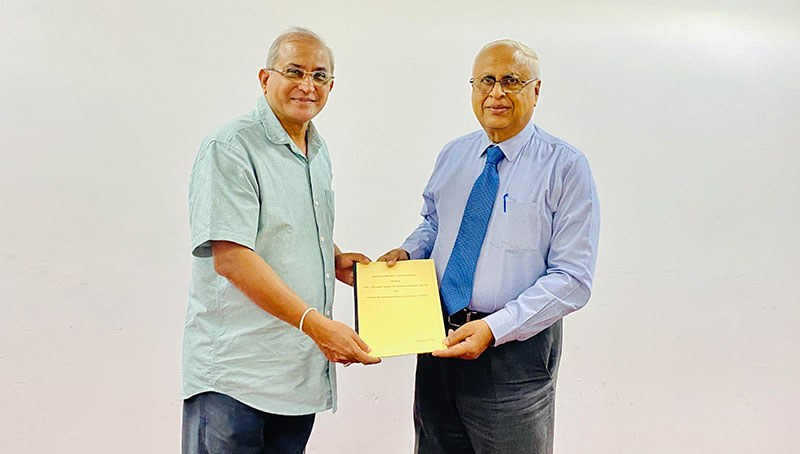
In a major boost to bilateral economic ties, the Chamber of Construction Industry of Sri Lanka (CCISL) and the Indo–Sri Lanka Chamber of Commerce & Industry (ISCCI) have signed a strategic Memorandum of Understanding (MoU) to deepen cooperation in real estate, infrastructure, and urban development.
The agreement establishes a formal framework for both institutions to drive collaborative initiatives, including business delegations, high-level conferences, workshops, B2B matchmaking sessions, and technical site visits. Designed to bridge businesses, government institutions, and project stakeholders across the Palk Strait, the partnership aims to unlock new avenues for cross-border joint ventures and technology transfers.
A focal point of this newly minted partnership is the facilitation of an upcoming trade delegation from the National Real Estate Development Council (NAREDCO) of India. Comprising major Indian players in the real estate and infrastructure sectors, the visiting delegation will engage in targeted business meetings, workshops, and inspection tours of prominent construction projects in Sri Lanka.
Under the terms of the MoU, CCISL will serve as the principal host coordinator in Sri Lanka. In close consultation with ISCCI, the apex construction body will curate itineraries, identify viable projects for engagement, and facilitate high-level dialogues with key government agencies, regulatory bodies, and industry leaders.
With both nations prioritizing sustainable urban growth, modern construction technologies, and infrastructure expansion, industry leaders view the partnership as a timely catalyst for economic rejuvenation. The collaboration is anticipated to accelerate market access, knowledge exchange, and foreign direct investment into Sri Lanka’s burgeoning property and development sectors.
To ensure the success of the upcoming NAREDCO delegation, CCISL has issued an urgent appeal to statutory authorities and relevant project owners to come forward with viable investment proposals. Stakeholders holding projects seeking foreign investment or technical partnerships are invited to submit comprehensive details to the Secretary General and CEO of CCISL via email at secyces@gmail.com.
Both chambers emphasize that translating this foundational agreement into tangible partnerships and robust capital flows will significantly strengthen bilateral connectivity between the construction and real estate sectors of India and Sri Lanka.

Hettich, the globally renowned German manufacturer of furniture fittings and architectural hardware known for its state-of-the-art manufacturing plants and magical interior solutions across the world celebrated a significant milestone in Sri Lanka, marking 10 years of presence in the country with its inaugural Partner Meet in Colombo.
The landmark event brought together Hettich’s key partners, stakeholders and industry leaders to celebrate a decade of growth, collaboration and shared success, while reaffirming the company’s long-term commitment to the Sri Lankan market.
Over the past decade, Hettich has strengthened its presence in Sri Lanka through its focus on German engineering, innovation, quality and functionality, contributing to the creation of contemporary and intelligently designed living and working spaces across the country.
The gala evening was graced by a distinguished delegation of senior leaders, including Dr. Andreas Hettich, Chairman, Hettich Group Advisory Board; S. K. Poddar, Chairman, Hettich India & Adventz Group; Mr. Akshay Poddar, Director, Hettich India; Andre Eckholt, Managing Director, Hettich India, SAARC, Middle East & Africa; Rahul Thakkar, Director – Sales, Hettich India & SAARC; and Dinusha Bhaskaran, Managing Director, Vallibel One PLC.

GS Evo Motors Limited, the authorized distributor of JMEV electric vehicles in Sri Lanka, has officially launched the JMEV EWIND, a next-generation compact electric SUV. The vehicle is designed to offer strong performance, intelligent technology, premium comfort, and high safety standards, marking another milestone in Sri Lanka’s growing electric mobility sector.
The EWIND features a sleek, aerodynamic exterior with penetrating LED daytime running lights, trapezoidal chain-inspired LED tail lamps, 19-inch alloy wheels, and a bold silhouette. Inside, it offers a spacious cabin with a panoramic moonroof and retractable curtain, an ultra-thin suspended instrument panel, a D-shaped multifunction steering wheel, multi-colour ambient lighting, premium finishes, and electrically adjustable front seats.
The SUV is available in single-motor front-wheel drive configurations, producing up to 108 kW and 210 Nm, with 0–100 km/h acceleration in 8.9 seconds.

Fast Attack Craft P 4447 recovered in successful salvage operation

Showers above 100 mm are likely at some places in the Western, Central, Sabaragamuwa, Southern, North-central and North-western provinces

Shafali, Mandhana power India to eighth Asia Cup title

Tharanga wins Ultimate Javelin title

CIABOC member’s appointment: Controversy over Speaker under probe heading selection process

GMOA: Countrywide cadre revision not done since 2015

‘Dates have the highest sugar content to fight Coronavirus’

Sunday Island 27 December – Headlines

#SundayIsland 17th December – Headlines

Sunday Island – 28th March

Sunday Island Headlines – 21 March

Sunday Island – 21st February – Headlines
-

 Sports4 days ago
DDS set to lose Test captaincy
-

 News7 days ago
Thailand shuts door on undesirables from Sri Lanka
-

 News4 days ago
Sri Lanka faces new grid challenge as rooftop solar surges: former CEB GM
-

 Latest News4 days ago
Shafali, Deepti power India into sixth T20 Asia Cup final
-

 Business7 days ago
CEB successor company breaks into top three in competitive BESS tender
-

 Opinion6 days ago
Navigating Sri Lanka’s Israeli Dilemma
-

 Latest News3 days ago
Sri Lanka thwart Fatima Sana challenge to secure Asia Cup final spot
-

 Features5 days ago
Lost for 90 years: Rare Goby resurfaces in Jaffna