
News
Chinese envoy warns ‘democracy’ and ‘human rights’ have been frequently manipulated by some countries to interfere and cause chaos

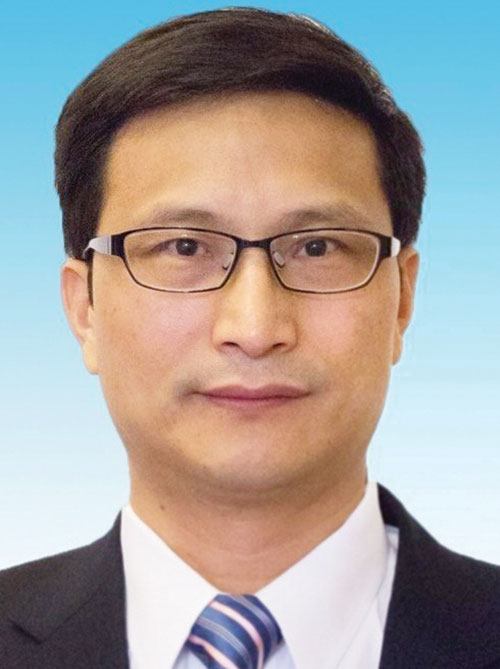
China would like to work with Sri Lanka and other countries to build democratic and political systems based on their own national conditions Qi Zhenhong, Chinese Ambassador to Sri Lanka said yesterday issuing a statement.
He said that Sri Lanka is the oldest democracy in Asia and that while democracy is universal, it is also specific. He added that democratic practices have developed under specific conditions. To examine the rich and diverse democratic institutions and practices of humanity from a monotonous Western perspective itself is undemocratic, the Chinese Ambassador emphasised.
“Sri Lanka is the oldest democracy in Asia while China is developing its socialist democracy with own characteristics. To foster broad-minded tolerance toward the understanding of democracy by different civilizations, and respect the explorations of different peoples to turn their understanding of democracy into reality, China would like to further exchange with Sri Lanka and other countries to build democratic and political systems based on their own national conditions. By doing so, the common values of humanity will be translated into the practice of individual countries to serve the interests of their own people in a concrete and realistic way,” he said.
Given below is the rest of his statement: “What is a true democracy? How can it be achieved? “Democracy” and “human rights” have been frequently manipulated by a few countries to exercise interference and hegemony, disturbing and disordering the world.
I would like to take this opportunity to share some of my thoughts on these questions. Democracy and freedom are shared value of humanity. Due to differences among countries in history, culture, institution and level of development, their peoples have naturally different understandings of democracy and various methods of achieving it. This determines that democracy is not Coca-Cola, which could be produced with one formula and taste exactly alike across the world. Democracy should be flowers blooming in the garden, all beautiful but different with their individual own features.
Roads to democracy are different too. It is not a privilege reserved to a small minority of countries, but the people’s legitimate right to choose their own road and decide how to walk towards the common destination. Democracy is not an ornament only to be used for decoration, but a way to solve the problems that the people are facing. Whether a country is a democracy or not depends on whether its people are really the masters of the country. If the people are awakened only for voting but have no say after the election, such a democracy is not a true democracy.
How to evaluate whether a country’s political system is democratic and effective or not? We believe in some important indicators: Will the country’s leadership be replaced in an orderly manner according to law? Are the people of the country able to manage state, social, economic, and cultural affairs in accordance with law? Do they have unimpeded channels to express appeals and complaints? Whether all people could participate in national political life effectively and the country make scientific and democratic decisions? Is it possible for talents to enter the national leadership and management system through fair competition? Whether the ruling party comply with the Constitution and laws to lead the country and their power be effectively restricted and supervised?
More importantly, the judgment on whether a country is a democracy or not should be made by their people, not be authenticated by the handful of others. Whether a member of the international community is democratic or not should be judged together by the international community, not by a self-righteous minority “lecturer of democracy”.
After the founding of the People’s Republic of China, under the leadership of the Communist Party of China (CPC), the Chinese people continues to explore and enrich the practices of people’s democracy. Since the 18th National Congress of the CPC, China has put forward the major approach of “whole-process people’s democracy”.
The “whole-process people’s democracy” in China not only has a complete set of institutions and procedures, but also full participation and practices. It exists in all steps of democratic election, consultation, decision-making, management, and supervision. It covers the practices of democratic exercise of state power, legislation, administration, supervision, justice, law-abiding, governance, and democratic autonomy. This approach enables unity of process and results, procedure and substance, direct and indirect democracy, as well as people’s democracy and the will of the state. It is the broadest, most genuine, and most effective socialist democracy. Based on people’s congress system, the deputies elected by people go deep among the masses, to observe their real life, listen to their suggestions, and promptly reflect the people’s concerns to the authorities through appropriate channels, so as to solve their problems. By doing so, the people can manage state, economic, cultural, and social affairs according to law and truly be the masters of the country.”



Warning that “agents of the devil who wish to hide the truth behind a wall of political posturing” were attempting to obstruct investigations into the Easter Sunday terror attacks, the Catholic Church has called for intensified public support and prayer to ensure justice for victims.
In a message issued ahead of the seventh anniversary of the April 21, 2019 bombings, Colombo Archbishop Cardinal Malcolm Ranjith said there were ongoing efforts by various forces to derail credible inquiries into the coordinated attacks that claimed 278 lives and left nearly 500 injured.
The statement noted that many of those killed had been attending Easter Sunday Mass when suicide bombers struck churches, including St. Anthony’s Shrine, Kochchikade, St. Sebastian’s Church, Katuwapitiya, and Zion Church, Batticaloa, causing widespread devastation and long-term suffering among survivors.
Seven years on, the Caridnal said, critical questions remain unanswered, including who masterminded the attacks, their motives, and why places of worship were targeted on Christianity’s most sacred day.
Full text of Cardinal Malcolm Ranjith’s message: On 21st April 2026, the Church in Sri Lanka will be commemorating the 7th Anniversary of the Easter Sunday bomb blasts, which killed 278 of our fellow human beings and brethren in the faith in the most brutal fashion. Most of these people had come to our Churches for Easter Sunday Masses and prayer services. Many families were rendered destitute. Nearly 500 people were injured and some of them carry life long disabilities, suffering from the after effects of these blasts. St. Anthony’s Church Kochchikade and St. Sebastian’s Church Katuwapitiya of the Catholic community and the Zion Church in Batticaloa were, quasi totally destroyed. The economy of the country suffered immensely with untold problems affecting many families, ever since then. However much we try to console the families of these victims, it is something that we humans are unable to achieve as only the Lord can truly console them.
Besides, we still do not know who murdered these people and caused so much of suffering to many others, and why and for what purpose they chose our Churches on a day that was most sacred to us to organize these attacks. After repeated pleas by the Catholic Church, now at last, the incumbent government and the security establishment, seem to be holding a credible inquiry into this episode of mass murder in order to find out who was really behind it.
And there are many forces actively seeking to obstruct these inquiries and divert the direction of the inquiry in an aimless fashion in order to hide the truth behind these attacks. They are nothing but the agents of the devil who wish to hide the truth behind a wall of political posturing. We need to storm Heaven and ask the Lord to strengthen the hands of the investigators to find out what really happened and who was behind this mass murder as well as why it was done to innocent people who had nothing to do with politics.
Hence, I call upon all of you to kindly storm Heaven with your prayers calling upon the Lord to help us find out what really happened that most tragic day. And so, I am declaring Sunday, the 19th of April 2026, as a special day of prayer for this purpose. I shall be most grateful to every one of you, beloved brethren, if you could recite special prayers in all the parishes of the Archdiocese at Sunday Mass on that day and offer prayers at home too for the success of these investigations. The special prayer for truth and justice for the victims of the bomb attacks, already approved by the Catholic Bishops’ Conference, could also be recited. I call upon all our Catholic devotees to join us in this effort.
Let us stand together firmly behind the efforts to find out the truth. Let us not be deceived by attempts of different people to hide the truth or divert attention in all kinds of directions in order to confuse the public.
May the Blessed Mother, our Lady of Lanka, intercede for us in this most important matter.
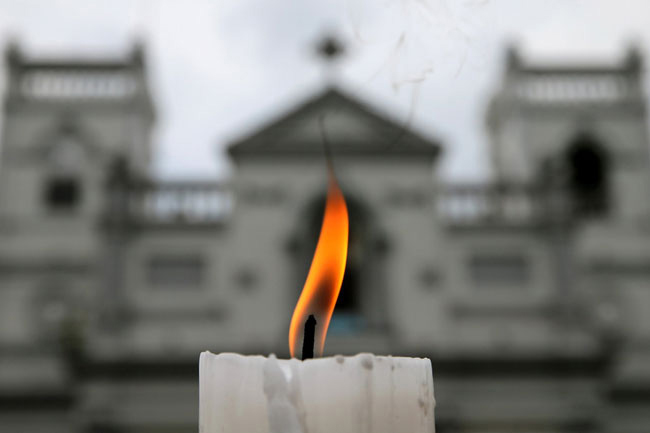
A series of solemn religious observances and commemorative events will be held on Tuesday, April 21, to mark the seventh anniversary of the Easter Sunday terror attacks, with ceremonies planned across the island and a public march for justice in Negombo.
The programme will begin with a coordinated observance in churches nationwide. At 8:45 a.m., funeral bells will toll, followed by a two-minute silence in memory of the victims. At 8:47 a.m., bells will toll again as the faithful light candles or oil lamps, with the morning observance concluding in a special prayer service at 8:50 a.m.
Major ceremonies are to be held at key locations affected by the 2019 attacks.
At St. Anthony’s Shrine, Kochchikade, the commemoration will be led by Malcolm Cardinal Ranjith and Bishop Anton Ranjith. Proceedings will commence at 8:15 a.m. with the arrival of ambassadors and dignitaries. Following the national moment of silence and prayer at 8:45 a.m., invitees will participate in a candle-lighting ceremony at 8:47 a.m. The programme from 9:10 a.m. will include interfaith reflections and addresses by the Apostolic Nuncio, a representative of the United Nations, and Cardinal Ranjith.
At St. Sebastian’s Church, Katuwapitiya, religious observances will be conducted under the guidance of Bishop Maxwell Silva and Bishop J. D. Anthony. Holy Mass is scheduled for 7:30 a.m., followed by the tolling of bells, a two-minute silence, and the lighting of candles at the memorial monument at 8:45 a.m.
The day’s commemorations will culminate in a Prayer March for Justice in Negombo. The march is set to begin at 4:00 p.m. from the Maris Stella grounds, with clergy and lay participants proceeding to St. Sebastian’s Church, where bishops and priests will conduct a Benediction service.The events are expected to draw large numbers of clergy, devotees, diplomats and members of the public, as the nation continues to remember the victims and call for truth and accountability.

The Sri Lankan delegation, led by Central Bank Governor Dr. Nandalal Weerasinghe, held a series of high-level discussions with senior officials of the International Monetary Fund (IMF) and the World Bank (WB) on the sidelines of the IMF–World Bank Spring Meetings 2026, alongside engagements with credit rating agencies and international investors.
During the talks, IMF Managing Director Dr. Kristalina Georgieva congratulated Sri Lanka on reaching a staff-level agreement on the combined fifth and sixth reviews under the Extended Fund Facility (EFF), and reaffirmed the Fund’s continued support for the country’s recovery and reform programme.
IMF Deputy Managing Director Dr. Kenji Okamura commended the progress achieved by Sri Lankan authorities despite global headwinds and domestic constraints. He noted that the ongoing conflict in the Middle East had generated uneven impacts across economies, stressing that support measures introduced in response should remain targeted and time-bound.
Okamura also emphasised the need for the timely restoration of cost-reflective energy pricing, urging Sri Lanka to sustain reforms and maintain policy discipline in order to strengthen macroeconomic resilience and support long-term growth.
Governor Weerasinghe, in response, expressed appreciation for the IMF’s flexibility in programme parameters, particularly in light of the recent cyclone damage and evolving geopolitical developments affecting Sri Lanka’s economic outlook.

‘Agents of the devil’ seeking to block Easter probe, Cardinal warns

Nation to mark Easter Sunday attacks with countrywide observances, march for justice

IMF hails Lanka’s progress, signals ongoing support at Spring Meetings

Lankan-origin gymnast Tiana Sumanasekera shines with Bollywood-inspired NCAA floor routine

Bloodied roads

Viktor Orban, Benjamin Netanyahu and Donald Trump: The Terrible Threes of the 21st Century

‘Dates have the highest sugar content to fight Coronavirus’

Sunday Island 27 December – Headlines

#SundayIsland 17th December – Headlines

Sunday Island – 28th March

Sunday Island Headlines – 21 March

Sunday Island – 21st February – Headlines
-
 Latest News6 days ago
PNS TAIMUR & ASLAT arrive in Colombo
-

 Latest News6 days ago
Prasidh, Buttler set up comfortable win for Gujarat Titans
-

 News3 days ago
PNS TAIMUR & ASLAT set sail from Colombo
-

 Latest News5 days ago
“I extend my heartfelt wishes to all Sri Lankans for a peaceful and joyous Sinhala and Tamil New Year!” – President
-

 Latest News7 days ago
Sanju Samson and Jamie Overton deliver first points for Chennai Super Kings
-
 Latest News6 days ago
Heat Index at Caution level’ in the Northern, North-central, North-western, Western and Southern provinces and in Trincomalee district.
-
 Latest News5 days ago
US blockade of Iran would worsen global energy crisis, analysts say
-

 Latest News6 days ago
Salt and Patidar power RCB past Mumbai Indians