
Latest News
China’s Xi stands with Putin at Russia’s Victory Day parade


Vladimir Putin has led Russia’s Victory Day commemorations with a parade in Red Square and heightened security after days of Ukrainian strikes targeting the capital.
China’s Xi Jinping joined Putin as he told thousands of soldiers and more than 20 international leaders that Russia remembered the lessons of World War Two.
Putin used his speech to tie the war to today’s full-scale invasion of Ukraine, and said all of Russia was behind what he called the “special military operation” – now well into its fourth year.
For the first time, a column of trucks carrying various combat drones took part in the Victory Day parade, apparently because of their widescale use in Ukraine.
A unilateral, three-day ceasefire was announced by Russia to coincide with the lavish 80th anniversary event, which Ukraine rejected as a “theatrical show”.
Kyiv has labelled the truce as a farce, accusing Russia of launching thousands of attacks since it came into force at midnight on Wednesday. Russia says it has observed the ceasefire and accuses Ukraine of hundreds of violations.
In the hours before the ceasefire, Ukrainian drone strikes prompted airport closures and disruption for thousands of air passengers in Russia.
Heavy security and restrictions were in place in the centre of Moscow on Friday as Russia marked the Soviet Union’s victory over Nazi Germany.
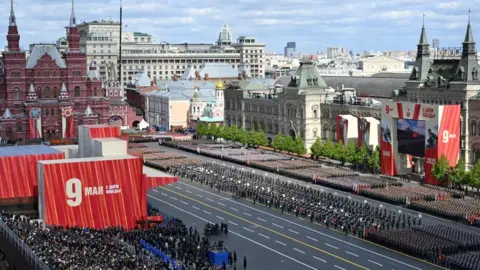
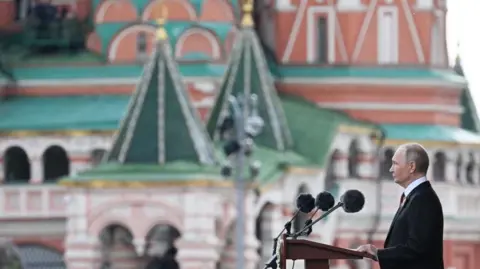
Putin insisted that Russia “was and will be an indestructible barrier against Nazism, Russophobia, antisemitism”. The Russian leader has repeatedly and falsely referred to Ukraine’s leadership as Nazis.
“Truth and justice are on our side,” he said, insisting that “the “entire country, society and people support the participants” of the Ukraine war.
Russia said 27 world leaders were attending the event.
China’s Xi Jinping had pride of place, sitting alongside Vladimir Putin on the platform in Red Square, and sporting an orange and black St George ribbon, which Russia sees as a symbol of military glory but which has been banned by several neighbouring countries.
Among the soldiers joining the parade were more than 100 Chinese troops as well as contingents from North Korea, Vietnam and Mongolia. Thousands of North Koreans have fought in Ukraine and Putin later made a point of personally greeting some of the soldiers on Red Square.
Brazil’s Luiz Inácio Lula da Silva and Venezuelan President Nicolas Maduro were among the assembled guests, along with Serbian President Aleksandar Vucic and Robert Fico, Slovakia’s prime minister who is the only European Union leader to travel to Moscow.
EU foreign policy chief Kaja Kallas had earlier made clear that leaders of EU member states and countries aspiring to join the union should not take part in the event because of Russia’s war in Ukraine. Serbia is an EU candidate country and Vucic said he expected he would face consequences because of his decision to go.
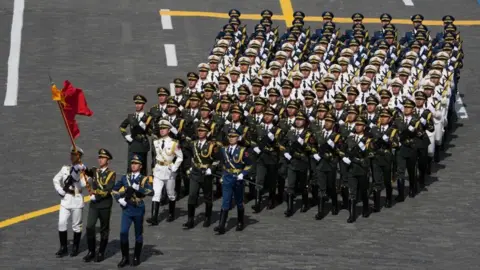
For Putin, the attendance of China’s Xi on Victory Day is seen as a significant achievement, and he praised the “courageous people of China” as he paid tribute to Russia’s allies in World War Two.
Putin and Xi held two rounds of talks before the parade as well as an informal chat on the war in Ukraine, Chinese reports said.
Joining the parade was a wide variety of Russian military hardware, including Yars missile systems, tanks and armoured personnel carriers. Six Su-25 military jets then flew over Red Square to complete the parade.
Ukraine’s Volodymyr Zelensky had earlier warned that he could not guarantee the safety of anyone attending the event and has urged heads of state not to travel to Moscow.
Mykhailo Samus, a Ukrainian military analyst and director of the New Geopolitics Research Network, told the BBC he believed that Ukraine would forego attacking the parade, largely because of the presence of foreign leaders.
But should Ukraine choose to do so, it would constitute a legitimate military target, Samus said.
During his evening address on Thursday, Zelensky said that Ukraine was “ready for a full ceasefire starting right now”.
“But it must be real,” he said in a video on X. “No missile or drone strikes, no hundreds of assaults on the front.”
He called on Russia to support the ceasefire and “prove their willingness to end the war”.
Ukraine has accused Russia of violating its own truce thousands of times since it was supposed to come into effect on Wednesday night.
On the second day of the truce, Ukraine said there had been nearly 200 clashes along the front line, eighteen Russian air strikes and almost four thousand instances of shelling by Russian troops.
In Prymorske, a village in the Zaporizhzhia region, a woman was reportedly killed after a Russian drone struck her car.
Russia’s defence ministry has said that all groups of Russian forces in Ukraine “completely ceased combat operations and remained on the previously occupied lines and positions”. However, they were reacting in a “mirror-like manner” to violations by Ukrainian forces.
Zelensky has repeatedly dismissed Putin’s proposal as a “game” and called for a longer truce of at least 30 days, something that is supported by Ukraine’s allies in Europe and the US.
He said he had spoken with US President Donald Trump to reiterate his readiness for a “long and lasting peace” and talks “in any format”. He said he had told Trump that a 30-day ceasefire was a “real indicator” of moving towards peace.
Writing on Truth Social on Thursday, the US president reiterated the call for an unconditional ceasefire and warned of further sanctions for any party failing to sign up to it.
(BBC)

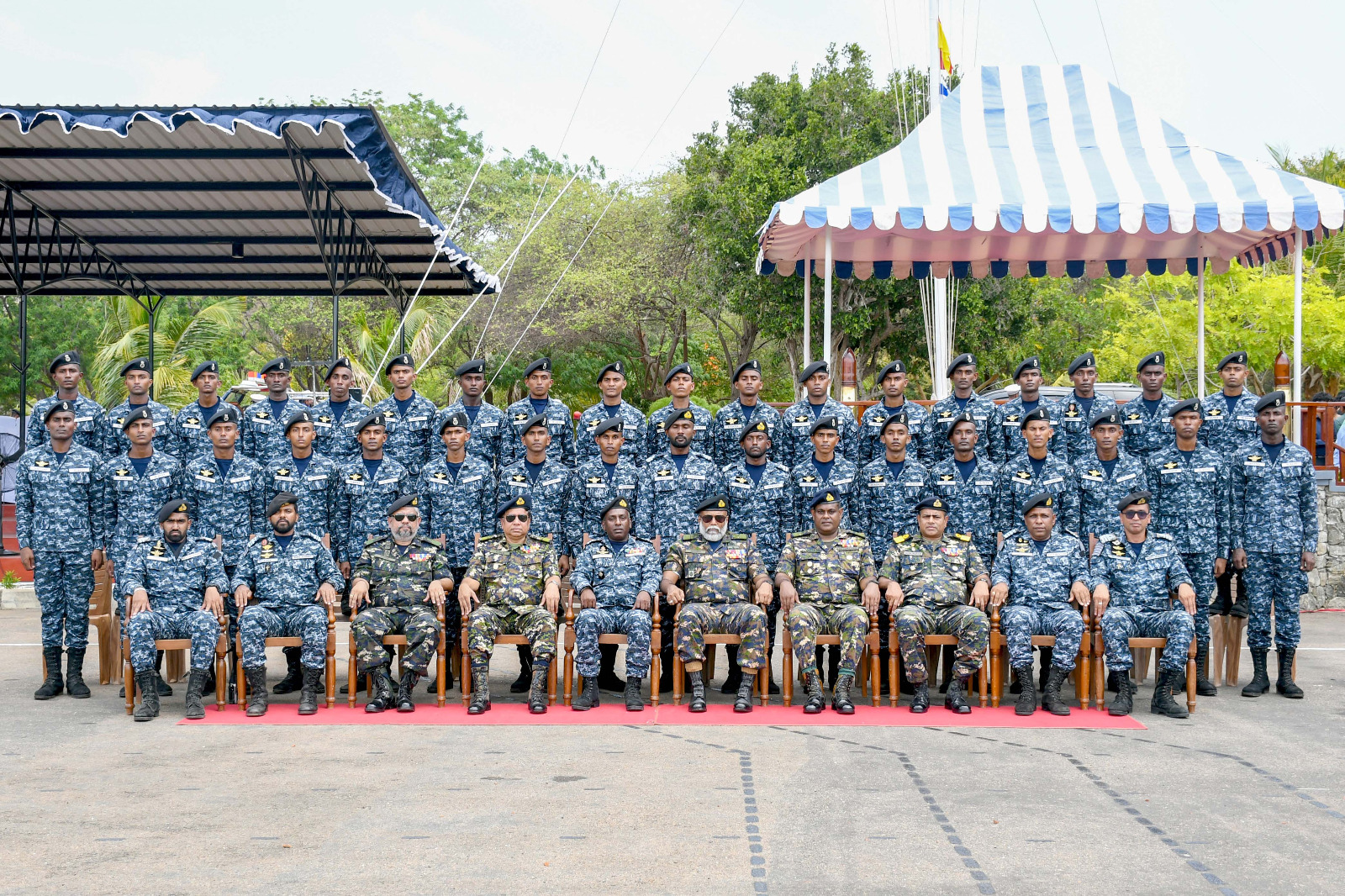
Thirty-six (36) naval personnel completed an eight-month Basic Marine Qualification Course and received their Marine insignia at the main parade ground of SLNS Vidura in Sampur, Trincomalee today, (29 August 2026).
At the invitation of Commandant SLNS Vidura, Captain Ravindu Harischandra, the ceremony was graced by Rear Admiral Buddhika Liyanagamage, Deputy Chief of Staff of the Navy and Commander Eastern Naval Area.
The group, comprising 3 officers and 33 sailors, completed the 10th intake of the Basic Marine Qualification Course, after volunteering for the demanding training programme.
In recognition of exceptional performance during the training, trophies were presented to outstanding personnel. Lieutenant (S) VPA Sasanka was awarded trophies for Best Marine of the Course, Highest Aggregate in Overall Subjects, and Best Marksman.
Physical Training Instructor WMGDP Bandara received the trophy for Best Physical Fitness. Addressing the newly qualified personnel,
Rear Admiral Liyanagamage congratulated them on successfully completing the course. He urged them to use the skills and experience gained through their training to contribute to safeguarding the country’s sovereignty and territorial integrity.
He also called on them to apply the courage and determination developed during the course both in their professional and personal lives, and to remain prepared to meet any challenge faced by the country.
He stressed the importance of keeping their knowledge and training up to date and maintaining constant vigilance while carrying out their duties.
Rear Admiral Liyanagamage also expressed his appreciation to
the Commanding Officer of SLNS Vidura and the directing staff for their contribution to the successful completion of the course.
The insignia ceremony also included a demonstration showcasing the capabilities and skills of the Sri Lanka Navy Marine.
Rear Admiral Achala Silva, Director General Logistics; Rear Admiral Kusal Dissanayake, Commandant Naval Infantry; Commodore Sanjeewa Kodikara, Director Marine; officers
from Navy Headquarters and the Eastern Naval Area; senior officers from the Army, Air Force and Police; and parents of the newly passed out marine personnel attended the ceremony.
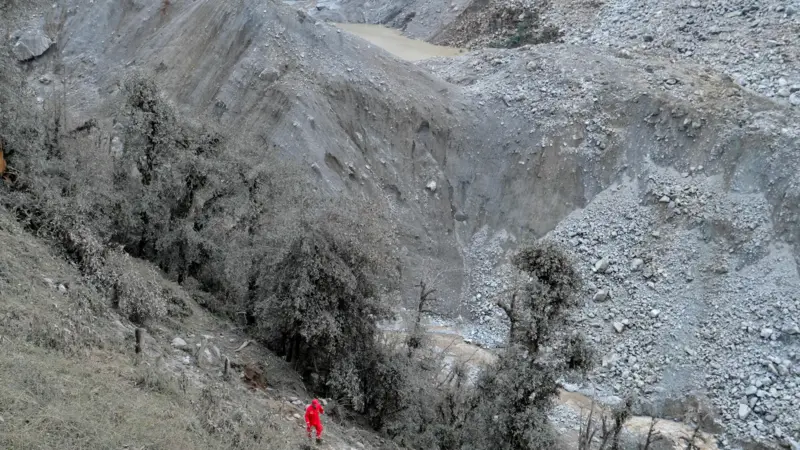
Water levels in the lake which formed amid the debris of the landslide in Tibet are rising once again, according to Chinese state media.
There is a continued risk of secondary mudslides or landslides, the report adds.
The command team in charge of rescue efforts around Gyirong port, the main land border between Nepal and Tibet, have launched drones and set up observations posts to monitor the slopes and provide an early warning system to rescuers working nearby.
Search teams are making the most of a short weather window to try to find survivors.
Work is also underway to try to re-open the road.
(Aljazeera)
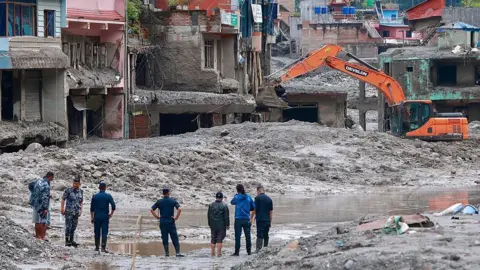
More than 600 people have died following Wednesday’s devastating flash flood in Nepal.
An update from Nepal’s National Disaster Risk Reduction & Management Authority (NDRRMA) confirms the figure as 626 and the number of people missing as 2,426, as rescue operations continue for the fourth day
Emergency teams are warning that rain is making it difficult to reach some of the worst affected areas, our correspondent in Trishuli writes
Families of the missing – including at least 517 foreign nationals – are waiting for news on the whereabouts of their loved ones
(Aljazeera)

Thirty-six naval personnel pass out on successful completion of Marine training

Ex-White House teleprompter operator ordered to pay $172,000 for Trump speech bets

Rescuers on high alert for signs of secondary landslides

More than 600 killed in Nepal flood as search for survivors enters fourth day

Norway mourns King Harald as Haakon VIII ascends throne

Trump announces ‘biggest oil deal in world history’ with Venezuela

‘Dates have the highest sugar content to fight Coronavirus’

Sunday Island 27 December – Headlines

#SundayIsland 17th December – Headlines

Sunday Island – 28th March

Sunday Island Headlines – 21 March

Sunday Island – 21st February – Headlines
-
 Features7 days ago
My secondary schooling after Royal Primary
-
 Features7 days ago
From the First to the 22nd: A short history of Amendment Politics and Reform Frustrations
-

 News5 days ago
Missing doctor’s body found in Mahiyanganaya
-
 Features7 days ago
How Shelton Kodikara became first Professor of International Relations
-
 Features7 days ago
How St. John’s College Shaped Panadura for 150 Years
-
 News5 days ago
Australia declines to release Finance Secy Suriyapperuma’s citizenship details
-
 News7 days ago
Ex- Atamasthanadhipathi uses Magistrate’s gate to enter court
-
 News5 days ago
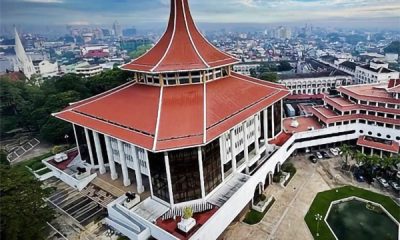
22A: BASL suggests CJ recuse himself from hearing petitions