
Latest News
China’s Xi oversees massive military parade with Putin, Kim in attendance

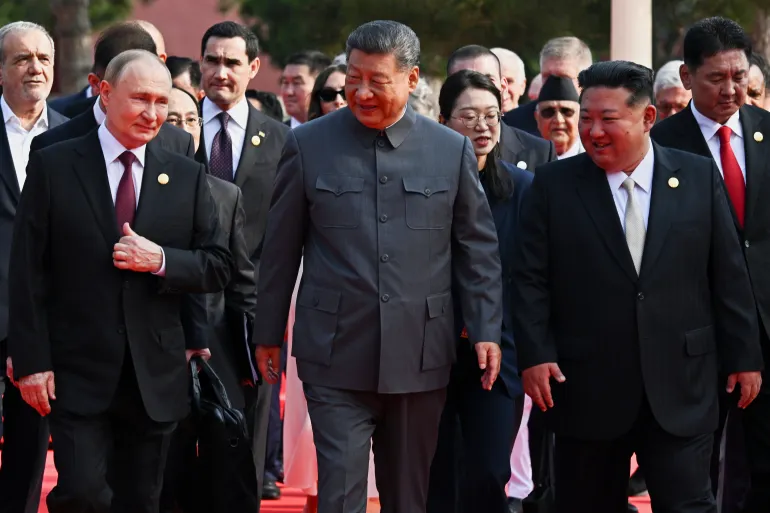
China flexed its military muscle at a huge military parade in Beijing to mark 80 years since the end of World War II, displaying its latest generation of stealth fighters, tanks and ballistic missiles amid a highly choreographed cast of thousands.
The parade through Tiananmen Square on Wednesday morning was overseen by Chinese President Xi Jinping, who is also the head of the country’s military and the Chinese Communist Party.
After greeting foreign leaders, including Russian President Vladimir Putin and North Korean leader Kim Jong Un, Xi moved on to welcome Chinese military veterans before taking his place at the centre of the event.
Putin and Kim were just some of the 26 world leaders who attended the parade, in a group that was drawn from mostly non-Western countries.
Xi watched the parade from the Gate of Heavenly Peace, before making a speech to the 10,000 assembled members of the People’s Liberation Army (PLA), Navy and Air Force, stating that China would continue to “adhere to a path of peaceful development”.
As he spoke of China’s victory over “Japanese aggression” in the “world anti-fascist war”, he thanked foreign governments for their help. Xi did not mention the United States by name, despite the country’s prominent role in ending World War II.
The Chinese leader said that lessons from the war were as relevant now as ever.
“Humanity is again faced with a choice of peace or war, dialogue or confrontation, and win-win outcomes or zero-sum games,” Xi said, according to an official readout of his speech.
![Members of Chinese People's Liberation Army (PLA) Air Force march during a military parade to mark the 80th anniversary of the end of World War Two, in Beijing, China, September 3, 2025. [Maxim Shemetov/REUTERS]](https://www.aljazeera.com/wp-content/uploads/2025/09/2025-09-03T015825Z_191172246_RC21KGAXLXGI_RTRMADP_3_WW2-ANNIVERSARY-CHINA-1756867370.jpg?w=770&resize=770%2C514&quality=80)
“The Chinese people will stand firmly on the right side of history and on the side of human progress, adhere to the path of peaceful development, and join hands with the rest of the world to build a community with a shared future for humanity,” he said.
He also stressed that the military continues to play a vital role in China’s national rejuvenation – one of the ideological pillars of the Chinese Communist Party and Xi’s official doctrine and worldview
“It really is difficult to understate how much of this is a part of the national psyche, the psyche of the Communist Party that, in the previous 100 years [before World War II], China was repressed, invaded and humiliated by foreign forces,” Al Jazeera’s correspondent Katrina Yu said from Beijing.
“I think Xi Jinping is making a point there that that will never happen again,” Yu said.
Dressed in a grey Mao suit, Xi then toured Tiananmen Square, standing in a vehicle and greeting troops with salutations, before the parade finally commenced down Beijing’s Chang’an Avenue, a major thoroughfare in the Chinese capital.

China’s most advanced weaponry took front and centre in the parade, including a new generation of hypersonic missiles, ballistic missiles, fighter jets, early warning aircraft and aircraft jamming systems.
Long-range intercontinental missiles – capable of delivering nuclear warheads – were also given a prominent position in the parade alongside tight formations of military personnel marching in unison before an audience of 50,000 observers.
“For Xi, the point is to reinforce the impression that the [People’s Republic of China, PRC] has arrived as a great power under his leadership,” said Ian Chong, a political scientist at the National University of Singapore.
“Another is the array of leaders at the parade, which suggests that the PRC cannot be isolated, and is unafraid of pressure and bullying, particularly from the United States,” he said.
Above the parade, the Chinese air force staged a flyover, including helicopters with banners declaring, “Justice will prevail”, “Peace will prevail”, and “The people will win”.
Responding to the military parade on social media, as it got underway US President Donald Trump questioned whether Xi would acknowledge the role the US played in World War II, before wishing him well.
“The big question to be answered is whether or not President Xi of China will mention the massive amount of support and ‘blood’ that The United States of America gave to China in order to help it to secure its FREEDOM from a very unfriendly foreign invader,” Trump wrote.
“Many Americans died in China’s quest for Victory and Glory… May President Xi and the wonderful people of China have a great and lasting day of celebration.”
Trump also added: “Please give my warmest regards to Vladimir Putin, and Kim Jong Un, as you conspire against The United States of America.”
[Aljazeera]


France’s National Assembly has taken a first step towards banning social media access for under-15s, a proposal backed by President Emmanuel Macron.
Lawmakers in the lower house on Monday agreed key elements of the bill, and are now expected to vote on the full text. The bill still needs to be approved by the upper house, the Senate.
If the legislation is passed, young teenagers would not be able to use networks such as Snapchat, Instagram and TikTok.
The French move is part of a worldwide trend towards restricting social networks for children, triggered by growing evidence of the damage they can cause to mental health. A similar law was passed in Australia late last year.
“With this law we will set down a clear limit in society,” said Laure Miller, a lawmaker behind the bill, as quoted by Le Monde.
“We are saying something very simple: social networks are not harmless,” she added. “These networks promised to bring people together. They pulled them apart. They promised to inform. They saturated us with information. They promised to entertain. They shut people away.”
Macron has said he wants the ban in place by the start of the school year in September. “We cannot leave the mental and emotional health of our children in the hands of people whose sole purpose is to make money out of them,” he said last month.
Under the new text, the state media regulator would draw up a list of social media networks that are deemed harmful. These would be simply banned for under 15-year-olds.
A separate list of supposedly less harmful sites would be accessible, but only with explicit parental approval.
The bill is believed to have a good chance of passing, with pro-Macron parties likely to be joined by the centre-right Republicans (LR) as well as the populist right-wing National Rally (RN).
Another clause would ban the use of mobile telephones in senior schools (lycées). The ban is already in effect in junior and middle schools.
If the law is passed, France will need to agree on the mechanism for age-verification. A system is already in place that requires over 18 year-olds to prove their age when accessing online pornography.
In Europe, Denmark, Greece, Spain and Ireland are also considering following the Australian example. Earlier this month, the UK government launched a consultation on banning social media for under 16s.
The basis of the proposed French law is a text drawn up late last year by deputy Laure Miller, who chaired a parliamentary committee enquiry into the psychological effects of TikTok and other networks.
Separately, the government was told to draw up its own legislation, after Macron decided to make the issue a centrepiece of his last year in office.
The president has been sidelined from domestic politics since the Assembly elections which he called in 2024 resulted in a hung parliament, and the social media ban has been a rare chance to court public favour.
For a time the cause risked falling victim to bickering between Macron and his one-time prime minister Gabriel Attal (Miller is an MP from Attal’s party). But in the end the government appears to have rallied behind the Miller bill.
If the text is approved, it will pass before the upper house, the Senate, in the next month. Macron said he had asked the government of Prime Minister Sébastien Lecornu to use a fast-track procedure to get the legislation on the books by September.
Without resort to the fast-track (which permits a single reading as opposed to two in each of the two houses), the law would have little chance of getting past the legislative backlog created by Lecornu’s difficulties in passing a budget.
The bill has already had to be redrafted to take account of questions raised by the Council of State, the body which previews draft legislation to ensure it conforms with French and European law.
A 2023 law which proposed a similar ban on social media for young teenagers proved inoperable after courts decided it broke European law.
[BBC]
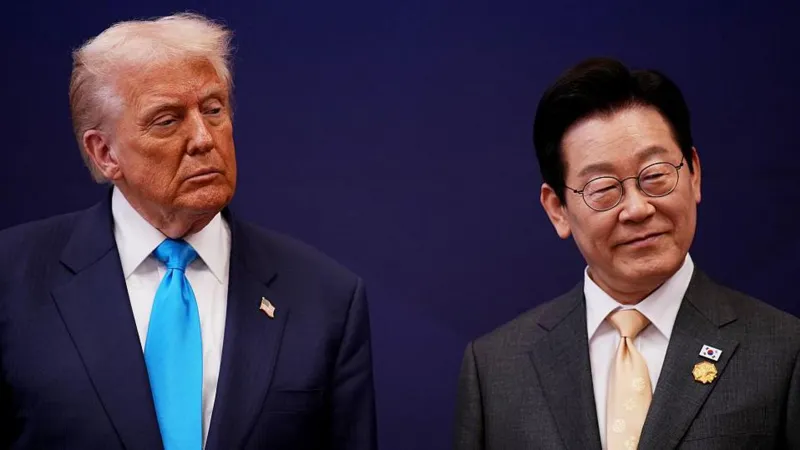
US President Donald Trump has announced he is raising tariffs on South Korean imports to 25% after accusing Seoul of “not living up” to a trade deal reached last year.
In a post on social media, Trump said he would increase levies on South Korea from 15% across a range of products including automobiles, lumber, pharmaceuticals and “all other Reciprocal TARIFFS”.
Trump said South Korean lawmakers have been slow to approve the deal while “we have acted swiftly to reduce our TARIFFS in line with the Transaction agreed to”.
South Korea says it had not been given official notice of the decision to raise tariffs on some of its goods, and wanted urgent talks with Washington over the issue.
It added that South Korea’s Industry Minister Kim Jung-kwan, who is currently in Canada, will visit Washington as soon as possible to meet US Commerce Secretary Howard Lutnick.
Shares in some South Korean exporters fell on Tuesday morning, with car maker Hyundai down about 2.5%. Stocks related to pharmaceuticals and timber were also lower.
Seoul and Washington reached a deal last October, which included a pledge from South Korea to invest $350bn (£256bn) in the US, some of which would go to shipbuilding.
The following month, the two countries agreed that the US would reduce tariffs on some products once South Korea started the process to approve the deal.
The agreement was submitted to South Korea’s National Assembly on 26 November and is currently being reviewed. It is likely to be passed in February, according to local media.
Tariffs are paid by companies who import products. In this case, US firms will pay a 25% tax on goods they buy from South Korea.
Trump has frequently used tariffs as leverage to enact foreign policy during his second term in the White House.
On Saturday, he threatened Canada with a 100% tariff if it struck a trade deal with China.
On Monday, Chinese officials said its “strategic partnership” agreement with Canada is not meant to undercut other countries.
Canadian Prime Minister Mark Carney has said his country was not pursuing a free trade deal with China and has “never” considered it.
He added that Canadian officials have made their position clear to their American counterparts.
Before that, Trump said he would impose import taxes on eight countries – including the UK – who opposed US plans to seize Greenland, an autonomous territory in the Kingdom of Denmark which is a member of Nato.
He later backed down from the tariff threat over Greenland citing progress towards a “future deal” over the island, but the episode strained US relations with Denmark and other Nato allies.
[BBC]

The most prolific batter of the WPL and the ever-so reliable Nat Sciver Brunt has finally broken the century drought in the tournament, 1059 days and 82 matches since the league started in 2023. Even though the conditions continued to be slow in Vadodara, Sciver-Brunt switched gears after the powerplay with a 32-ball half-century to pick the gaps and middle the ball in unparalleled fashion.
She powered Mumbai Indians (MI) to 199, the highest total on this ground this season, and the scoreboard pressure told on the Royal Challengers Bengaluru (RCB) batters who collapsed to 35 for 5. They were given a late lift by Richa Ghosh’s bludgeoning 90 off just 50 balls that tried to rescue a sinking ship but the asking rate and lack of partners kept the task too stiff and they went down by only 15 runs in the end after her stunning assault.
Sciver-Brunt’s maiden T20 century could have hardly come at a better time for MI; they were fourth on the table after losing their last three games and needed to win this game to keep their knockouts fate in their own hands. They did it by taking down the table-toppers to go second and RCB have now lost two in a row after kicking off the season with five wins on the bounce that had taken them to the knockouts.
MI’s powerplay woes continued as S Sajana fell early to Lauren Bell’s swing for 7, and they trudged along against the moving ball to reach 38 for 1 in the powerplay, with just four fours and no sixes.
The experienced duo of Sciver-Brunt and Hayley Matthews then lifted MI with a rapid partnership that raced from 50 to 100 in just 21 balls. Sciver-Brunt was the first to cut loose when she made room against Nadine de Klerk to smash her down the ground. As the pitch again lacked pace, Sciver-Brunt and Matthews rocked onto the back foot to collect boundaries. Sciver-Brunt slapped two through the covers off Shreyanka Patil in the eighth over, Matthews went behind square off Arundhati Reddy for two more fours in the next, and the fifty stand was up.
Soon after she topped the run charts for this WPL, Sciver-Brunt increased RCB’s headaches by piercing the gaps all around the park. After smacking de Klerk for a six, she punished Shreyanka for three consecutive fours – the first two off sweeps that brought up her 32-ball fifty, her fourth of the season. Matthews ended the 18-run over with another boundary before Sciver-Brunt carved Radha Yadav for three fours in the next, bringing up their century stand off just 61 balls.
Matthews soon got to her 35-ball fifty – her first of this WPL – and the dominating partnership ended only when Bell returned and rattled Matthews’ stumps after the ball ricocheted off both pads. Harmanpreet Kaur lasted 12 balls for 20 runs before holing out to long-off, and Sciver-Brunt ended the 19th over by carving a wide yorker for four to move to 99, the highest individual score in the WPL until Monday.
She went past the barrier after holding the record for the most runs (8,883) and fifties (57) without a hundred in women’s T20s, across 348 innings. Shreyanka bowled a tidy last over for just five runs, keeping MI just short of 200.
After she missed the first few games with a shoulder niggle and then struggled for rhythm with both bat and ball, Matthews turned the tide against the best side of this WPL. Her offspin match-up worked instantly against Smriti Mandhana, who top-edged to backward square leg for 6, not long after Grace Harris had edged Shabnim Ismail behind. No. 3 Georgia Voll also handed a catch to the wicketkeeper when Matthews erred with her line down leg and Rahila Firdous took a sharp catch off the bottom edge.
Two balls later, Ismail hit the stumps off an almost-frozen Gautami Naik to reduce RCB to 31 for 4, which soon became 35 for 5 in the last over of the powerplay when Radha Yadav found long-on off Matthews.
Ghosh was the only bright spot for RCB, who had been bundled out for their lowest WPL score in their previous match. She made the most of getting two lives: the first was a tough chance for the keeper off a spinner, while the second was a sitter for Matthews, who put down a skier running in from long-off and covered her mouth in disbelief.
Ghosh also lost de Klerk in the 12th over but started to hit out even as RCB needed 120 from 48 with six wickets down. She dispatched anything with width or length and went after anyone who came her way. The big charge came in the 16th over when she clobbered three consecutive fours off Amelia Kerr. Amanjot Kaur fought back with a wicket in a six-run over next, but she was at the receiving end of a stunning assault in the 19th.
RCB needed 59 from 12, and Ghosh went 6, 6 and 6, starting by putting away a full toss before relying on brute force. When she managed only a single on the fourth ball, Shreyanka carved two fours to keep RCB in the game, with 32 needed from six.
Ghosh started the final over with a four, but Kerr bowled a dot next that virtually sealed MI’s victory unless there was an illegal delivery. Ghosh, however, executed an unbelievable six off the next ball when Kerr looped it well outside off; Ghosh came down the track, reached out, and sent it sailing over the covers before ending up flat on the ground. She miscued the last ball of the game and was finally caught, as MI breathed a sigh of relief.
Brief scores:
Mumbai Indians Women 199 for 4 in 20 overs (Nat Sciver-Brunt 100*, Hayley Matthews 56, Harmanpreet Kaur 20; Lauren Bell 2-21, Nadine de Klerk 1-40, Shreyanka Patil 1-34) beat Royal Challengers Bengaluru Women 184 for 9 in 20 overs (Grace Harris 15, Richa Ghosh 90, Nadine de Klerk 2, Arundhati Reddy 14, Shreyanka Patil 12*; Shabnim Ismail 2-25, Hayley Matthews 3-10, Amanjot Kaur 1-51, Amelia Kerr 2-37) by 15 runs
[Cricinfo]

French MPs take first step to ban social media for under-15s

Trump raises US tariffs on South Korea imports to 25%

Sciver-Brunt’s maiden WPL ton lifts Mumbai Indians to second despite Ghosh heroics

Showers may occur in the North-central. Sabaragamuwa and Eastern provinces and Galle and Matara districts

U19 World Cup: Adnit ton powers USA to seven wicket win

U19 World Cup: Sri Lanka keep semifinal aspirations alive with four wicket win

‘Dates have the highest sugar content to fight Coronavirus’

Sunday Island 27 December – Headlines

#SundayIsland 17th December – Headlines

Sunday Island – 28th March

Sunday Island Headlines – 21 March

Sunday Island – 21st February – Headlines
-
 Business1 day ago
ComBank, UnionPay launch SplendorPlus Card for travelers to China
-

 Business2 days ago
ComBank advances ForwardTogether agenda with event on sustainable business transformation
-

 Opinion5 days ago
Remembering Cedric, who helped neutralise LTTE terrorism
-

 Business5 days ago
CORALL Conservation Trust Fund – a historic first for SL
-
 Opinion2 days ago
Conference “Microfinance and Credit Regulatory Authority Bill: Neither Here, Nor There”
-
 Opinion4 days ago
A puppet show?
-

 Opinion1 day ago
Luck knocks at your door every day
-

 Features6 days ago
The middle-class money trap: Why looking rich keeps Sri Lankans poor