
News
China says its new land border law will not affect existing border treaties


BY S VENKAT NARAYAN Our Special Correspondent
NEW DELHI: China said on Thursday that its new land border law will not affect the implementation of existing border treaties, and urged relevant countries to avoid making “undue speculation” about a “normal legislation”.
China’s national legislature — the National People’s Congress (NPC) — on October 23 adopted the new law on the protection and exploitation of the land border areas. This drew sharp reaction from India as it was passed amid the protracted military standoff between the two sides in eastern Ladakh region.
On Wednesday, India hit out at China for bringinmg out the new land border law, and said it expects China to avoid taking any action under the “pretext” of the legislation that could “unilaterally” alter the situation in the border areas.
External Affairs Ministry Spokesperson Arindam Bagchi described China’s decision to bring out the law as a matter of “concern” as it can have implications on the existing bilateral pacts on the management of the border and the overall boundary question.
“China’s unilateral decision to bring about a legislation which can have implication on our existing bilateral arrangements on border management as well as on the boundary question is of concern to us,” he said.
“Such unilateral move will have no bearing on the arrangements that both sides have already reached earlier, whether it is on the boundary question or for maintaining peace and tranquillity along the Line of Actual Control (LAC) in India-China border areas,” he said.
Responding to questions on the Land Border Law, Chinese Foreign Ministry spokesman Wang Wenbin said: “It is a normal domestic legislation that serves our realistic needs and also confirms to international practice”.
“This law has clear stipulations on China’s cooperation with its neighbouring countries and the handling of the land border issues,” he said at a regular foreign ministry briefing in Beijing.
In an apparent response to India’s concerns, Wang said: “It will not affect China’s implementation of existing border treaties. Nor will it change existing practice in our cooperation with neighbouring countries. It does not mean that there is a change in our position on the border development issue.”
To a specific question about India’s criticism of the law, Wang said: “I just briefed you on the considerations behind the law. We hope relevant countries can avoid making undue speculation about the normal legislation in China.”
Earlier, elaborating on the provisions of the new law adopted by the NPC last week, Wang said President Xi Jinping signed decree No. 99 on the same day announcing that the law will come into effect from January 1, 2022.
“The Article 62 of the law identifies the leading mechanism and duties of departments of military and localities in implementing the law. It sets the rules for the demarcation procedures and also covers the areas of defence and management of borders as far as international cooperation,” he said.
“China has 22,000 kms of land borders. It has 14 land neighbours. The promulgation of the law is to coordinate and have unified standards for strengthening border management and advance relevant cooperation,” he said.
“This is an important measure in advancing the rule of law. It is a normal domestic legislation that serves our realistic needs and also confirms to international practice,” Wang said.
India and Bhutan are the two countries with which China is yet to finalise the border agreements, while Beijing resolved the boundary disputes with 12 other neighbours.
While India-China border disputes cover 3,488-km along the Line of Actual Control, the China-Bhutan dispute covers about 400 km.
India and China have already held over 20 rounds of border talks under the framework of the Special Representatives dialogue which was set up to find an early solution to the border dispute.
Both sides have been maintaining that pending the final resolution of the boundary issue, it is necessary to maintain peace and tranquillity in the border areas.
The eastern Ladakh border standoff between the Indian and Chinese militaries erupted on May 5 last year following a violent clash in the Pangong lake areas and both sides gradually enhanced their deployment by rushing in tens of thousands of soldiers as well as heavy weaponry.
The tension escalated following a deadly clash in Galwan Valley on June 15 last year. As a result of a series of military and diplomatic talks, the two sides completed the disengagement process in the north and south banks of the Pangong lake in February and in the Gogra area in August.
The last round of military talks on October 10 ended in a stalemate following which both sides blamed each other for the impasse.



India are through to the semi-finals of the Asian Games men’s tournament, with persistent rain and a damp outfield in Nisshin forcing the abandonment of their quarter-final against Afghanistan 16 minutes before the scheduled toss. India’s higher seeding – determined by the ICC T20I team rankings – ensured they went through at Afghanistan’s expense.
India will next face the winners of Tuesday’s quarter-final between Nepal and Sri Lanka in Thursday’s second semi-final. As one of the four seeded teams – India, Pakistan and Bangladesh are the others – to qualify directly for the quarter-finals, Sri Lanka will progress to the semi-finals if their match against Nepal is washed out too.

By Shamindra Ferdinando
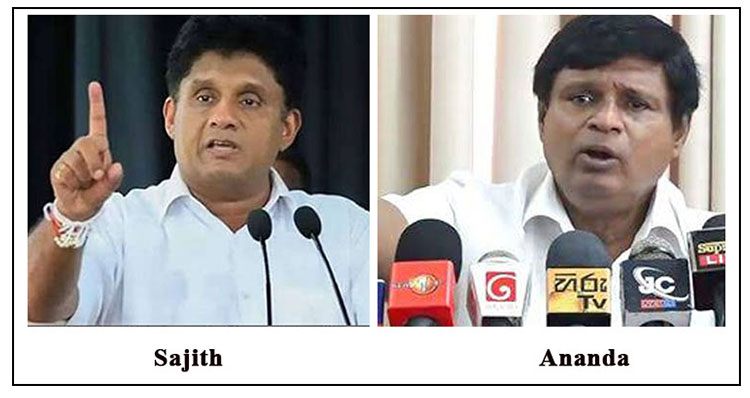
Alleging that the Samagi Jana Balawegaya (SJB) had betrayed the joint protest campaign, planned on 24 Sept., at Polduwa junction, against the enactment of the 22nd Amendment without securing public approval at a referendum, SJB trade union leader Ananda Palitha emphasised that SJB and Opposition Leader Sajith Premadasa should take remedial measures to restore the alliance against the NPP government.
Responding to The Island queries, the trade union activist said that he spoke on behalf of the vast majority of the SJBers who felt betrayed by the sudden declaration made by Colombo District SJB lawmaker S.M. Marikkar that they didn’t expect Opposition political parties’ participation, except that of the UNP.
Pointing out that at the behest of Premadasa, MP Marikkar belittled those who had pledged on 17 Sept. to join the SJB-led protest, Palitha emphasised the Opposition leader should be held responsible for restoring the shattered alliance. Palitha warned that the NPP, which was rapidly moving on a dictatorial path, would be the beneficiary of such treacherous actions.
When The Island raised the allegations pertaining to the 24 Sept. protest, Colombo District MP Premadasa said there was no basis for such claims. MP Premadasa called the accusations directed at him ‘rubbish.’
Palitha said that the pathetic failure on the part of the Opposition to genuinely challenge the authoritarian NPP should be examined, taking into consideration the government following an agenda almost 100 percent against the election pledges. Except the much touted anti-corruption campaign, the NPP reneged on all its election promises.
Recalling massive rice imports after having promised to stop the same in the run up to the national elections in 2024, Palitha alleged that the utterly corrupt NPP created an artificial shortage to enable import of large stocks of salt for their benefit. Massive earnings were made through commissions, Palitha said, urging the SJB to reiterate its commitment to the 17 Sept. pledge. According to him, the SJB’s irresponsible action sabotaged the joint Opposition agreement reached on the eve of President Anura Kumara Dissanayake completing two years in Office.
Palitha said that the disruption of a genuinely joint protest, at the last moment, caused irreparable harm to the Opposition. The unexpected eleventh hour declaration made by the SJB upset their efforts to organise a large scale two-day protest on 24 and 25 Sept. Palitha emphasised the responsibility on the part of the SJB leadership and its top management to spearhead an all-out campaign against the government. The former petroleum sector employee said that a strong and transparent campaign could undermine the NPP within as a section of its parliamentary group was deeply dismayed by the current policies and strategies.
Palitha, in his capacity as the trade union leader, invited the Bar Association of Sri Lanka (BASL) to join the trade unions’ protest on 25 Sept. to intensify pressure on the government. BASL President Rajeev Amarasuriya told The Island that they didn’t accept that invitation.
Former SLPP Kalutara District MP Sanjeewa Edirimanna said that the SJB was far more keen to organise a large-scale protest to counter the SLPP’s highly successful Anuradhapura rally held on 12 September than a genuine joint protest against the 22nd Amendment or the government. Edirimanna said that they realised that the SJB would probably join a joint protest campaign only after organising a gathering to counter the SLPP. According to him, the SJB hadn’t been honestly interested in a joint protest campaign. Instead, it sought to resist possible challenges from rival political parties, he said.
An aide to UNP leader and former President Ranil Wickremesinghe said that though the SJB announced they were welcome to join the 24 Sept. protest, the party never received an invitation. The official said that some UNPers joined the protest on their own though the party neither directed supporters to join or boycott the event. As the Janathawadi Joint Opposition decided against participating for want of formal invitations, the UNP, as part of that group, decided not to join the 24 Sept. protest.
By Norman Palihawadane
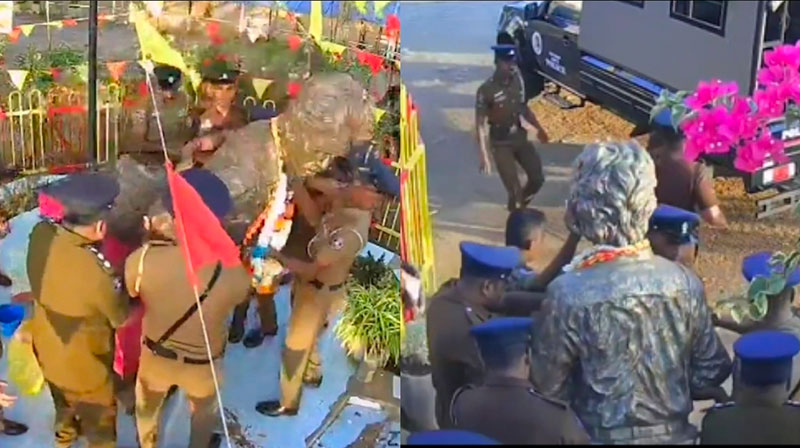
Police have removed a memorial statue of former LTTE member Rasaiah Parthipan, alias Thileepan, from the Thileepan Memorial Square in Nallur, Jaffna, following the conclusion of commemorative events, marking the 39th anniversary of his death.
The statue was removed in the early hours of yesterday (27), a day after the final day of the commemoration was held at the site.
CCTV footage from the memorial reportedly shows police officers removing the statue and taking it away in a vehicle.
Tamil National People’s Front (TNPF) Secretary and MP Selvarasa Gajendran alleged that more than 15 police officers arrived at the site, without prior notice, entered the premises wearing footwear, and forcibly removed the statue.
The reason for the removal and the legal basis for the police action had not been officially announced as of yesterday.
Thileepan, a former political wing leader of the LTTE, died in September 1987, after undertaking a hunger strike in Nallur, while making several demands of the Indian Government.
The memorial events, marking the 39th anniversary of his death, were held at the site on Saturday (26). A statue had been erected at the location in connection with the commemoration.

Mexico’s Pacific coast braces for Hurricane Polo

Washout against Afghanistan sends India into semi-finals

‘Still a lockdown’: Deadly floods hit Nepal tourism as peak season begins

Tharanga wins highly anticipated Asian Games gold

Tharanga on cusp of Asian Games Gold

Rain threat looms over lopsided India vs Afghanistan quarter-final

‘Dates have the highest sugar content to fight Coronavirus’

Sunday Island 27 December – Headlines

#SundayIsland 17th December – Headlines

Sunday Island – 28th March

Sunday Island Headlines – 21 March

Sunday Island – 21st February – Headlines
-

 News6 days ago
Mastermind Naufer Moulavi among 15 found guilty
-

 Midweek Review6 days ago
Thileepan’s fast unto death: An authentic narrative that many missed
-
 News7 days ago
Protest against setting up of cement factory in highly populated area near BIA
-

 Editorial7 days ago
Trouble beginning in earnest
-

 Latest News5 days ago
Showers above 100 mm are likely at some places in the Western, Sabaragamuwa, Central and North-western provinces and in Galle and Matara Districts
-
Editorial6 days ago
Big Bad Bills
-
 News7 days ago
Police may seek clarification from US
-
 News7 days ago
Govt. confident of 2/3 majority despite NPP split speculation