
Latest News
China says it is ready for ‘any type of war’ with US

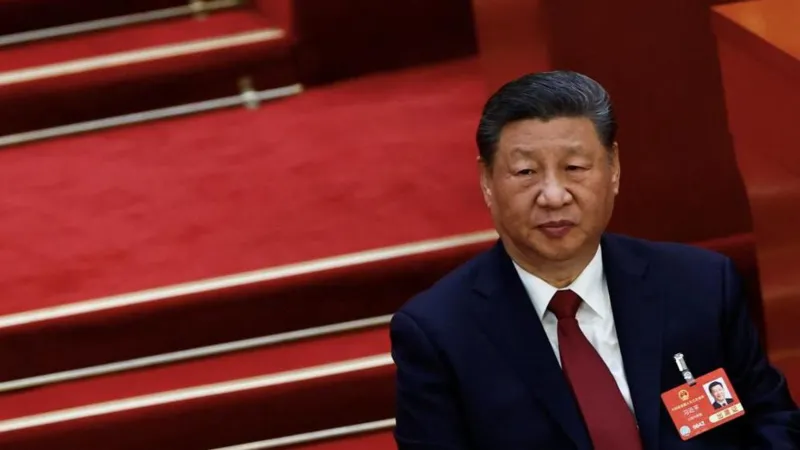
China has warned the US it is ready to fight “any type” of war after hitting back against President Donald Trump’s mounting trade tariffs.
The world’s top two economies have edged closer to a trade war after Trump slapped more tariffs on all Chinese goods. China quickly retaliated imposing 10-15% tariffs on US farm products.
“If war is what the US wants, be it a tariff war, a trade war or any other type of war, we’re ready to fight till the end,” China’s embassy said on X, reposting a line from a government statement on Tuesday.
It is some of the strongest rhetoric so far from China since Trump became president and comes as leaders gathered in Beijing for the annual National People’s Congress.
On Wednesday, China’s Premier Li Qiang announced that China would again boost its defence spending by 7.2% this year and warned that “changes unseen in a century were unfolding across the world at a faster pace.” This increase was expected and matches the figure announced last year.
Leaders in Beijing are trying to send a message to people in China that they are confident the country’s economy can grow, even with the threat of a trade war.
China has been keen to portray an image of being a stable, peaceful country in contrast to the US, which Beijing accuses of being embroiled in wars in the Middle East and Ukraine.
China may also hope to capitalise on Trump’s actions relating to US allies such as Canada and Mexico, which have also been hit by tariffs, and will not want to ramp up the rhetoric too far to scare off potential new global partners.
The Premier’s speech in Beijing on Tuesday emphasised that China would continue to open up and hoped to attract more foreign investment.
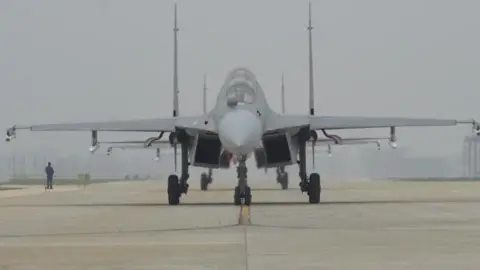
China has, in the past emphasised that it is ready to go to war. Last October, President Xi called for troops to strengthen their preparedness for war as they held military drills around the self-governing island of Taiwan. But there is a difference between military preparedness and a readiness to go to war.
The Chinese embassy in Washington’s post quoted a foreign ministry statement in English from the previous day, which also accused the US of blaming China for the influx of the drug fentanyl
“The fentanyl issue is a flimsy excuse to raise US tariffs on Chinese imports,” the foreign ministry spokesperson said.
“Intimidation does not scare us. Bullying does not work on us. Pressuring, coercion or threats are not the right way of dealing with China,” he added.
The US-China relationship is always one of the most contentious in the world. This post on X has been widely shared and could be used by the China hawks in Trump’s cabinet as evidence that Beijing is Washington’s biggest foreign policy and economic threat.
Officials in Beijing had been hopeful that US–China relations under Trump could get off to a more cordial start after he invited Xi to his inauguration. Trump also said the two leaders had “a great phone call” just a few days before he entered the White House.
There were reports that the two leaders were due to have another call last month. That did not happen.
Xi had already been battling persistently low consumption, a property crisis and unemployment.
China has pledged to pump billions of dollars into its ailing economy and its leaders unveiled the plan as thousands of delegates attend the National People’s Congress, a rubber-stamp parliament, which passes decisions already made behind closed doors.
China has the world’s second-largest military budget at $245bn but it is far smaller than that of the US. Beijing spends 1.6% of GDP on its military, far less than the US or Russia, according to the Stockholm International Peace Research Institute.
However, analysts believe China downplays how much it spends on defence.
[BBC]

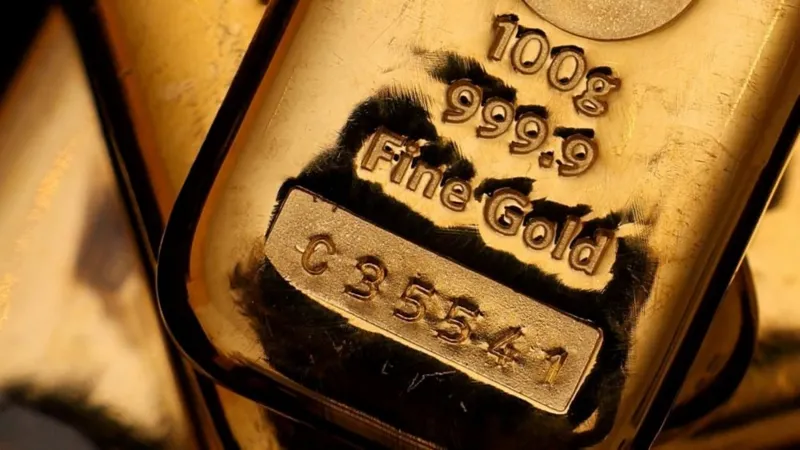
The price of gold has risen above $5,000 (£3,659) an ounce for the first time, extending a historic rally that saw the precious metal jump by more than 60% in 2025.
It comes as tensions between the US and NATO over Greenland have added to growing concerns about financial and geopolitical uncertainty.
US President Donald Trump’s trade policies have also worried markets. On Saturday he threatened to impose a 100% tariff on Canada if it strikes a trade deal with China.
Gold and other precious metals are seen as a so-called safe-haven assets that investors buy in times of uncertainty.
Demand for gold has also been driven by a range of other factors including higher-than-usual inflation, the weak US dollar, buying by central banks around the world and as the US Federal Reserve is expected to cut interest rates again this year.
Wars in Ukraine and Gaza, as well as Washington seizing Venezuelan President Nicolás Maduro, have also helped push up the price of gold.
On Friday, silver topped $100 an ounce for the first time, building on its almost 150% rise last year.
[BBC]
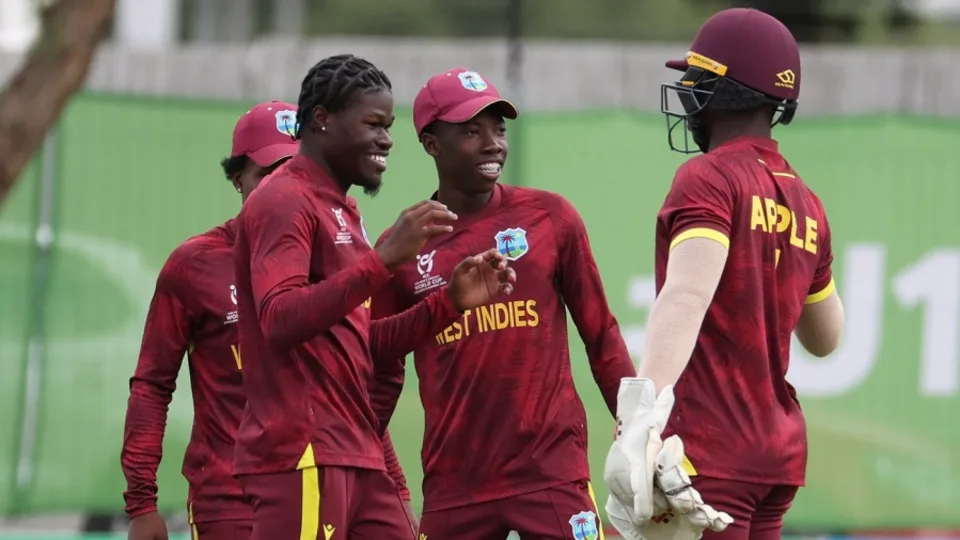
West Indies wristspinners, Micah McKenzie and Vitel Lawes, combined to take six wickets on a surface that had plenty of turn and bite to close out a rain shortned contest against Ireland. Opting to bat first, the West Indies innings had earlier been held together by keeper-batter Jewel Andrew at No. 3 – his 66 off 82 consisted of four fours and four sixes, the majority of which came in the company of Jonathan van Lange,, during their fourth-wicket partnership of 67.
Jewel departed just six overs after van Lange, in the 33rd, and the rest of the batters struggled. No one besides him managed to cross the 30-run mark. Reuben Wilson scalped up van Lange, before returning to take out two lower-order batters to finish with figures of 3 for 50, closing out the innings with West Indies bowled out for 226.
His effort, complemented by James West’s economical 2 for 24 off seven overs, gave Ireland a realistic chance at chasing down the total. West also opened the batting for Ireland and top-scored for them, hitting a 55-ball 45 that was littered with eight boundaries. By the time he was Lawes’ first victim of the innings, in the 18th over, Ireland sat at a comfortable 82 for 2.
However, the going just got worse from there: Ireland lost four wickets to McKenzie, who spun his way through the middle order. Lawes held back his best over for his final one of the match, fizzing out Oliver Riley with its first ball, and then turning the ball prodigiously against Wilson and Bruce Whaley.
Ireland were on 164 for 7 by the time they played out Lawes’ over, needing an unlikely 62 off the final ten overs. The rain had the final say when it interrupted the match and delivered the final blow to Ireland’s hopes. The DLS par score had shot way past Ireland’s total, and when no further play was possible, West Indies walked away with a convincing spin display and a 25-run win to boost their chances in the Super Sixes.
Brief scores:
West Indies Under 19s 226 in 46.5 overs (Jewel Andrew 66; Reuben Wilson 3-50, Luke Murray 2-37, James West 2-24) beat Ireland Under 19s 164 for 7 in 40 overs (James West 45; Mica McKenzie 4-36, Vitel Lawes 2-41)by 25 runs (DLS method)
[Cricinfo]
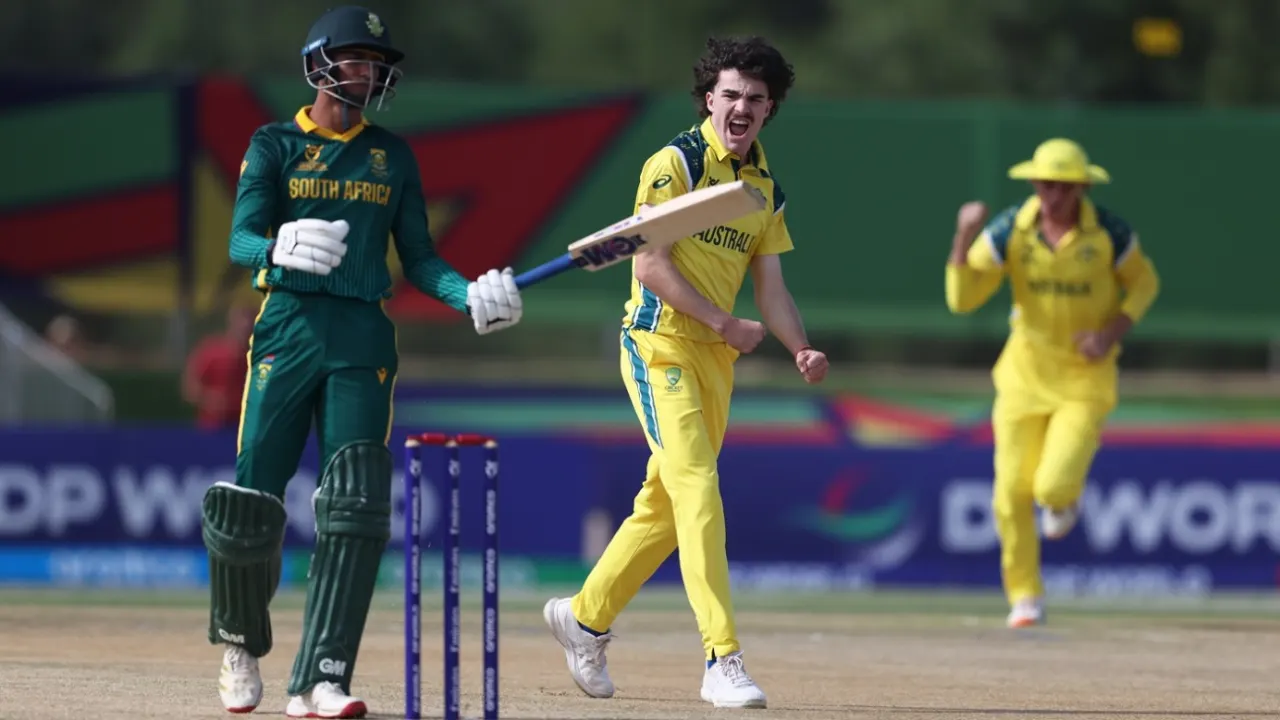
It took Australia U19s 32.5 overs, going at just around 3.5 runs an over for the majority of a belaboured chase against an excellent South Africa U-19 bowling effort. But they had that liberty after Charles Lachmond’s 3 for 29, and two wickets each from Will Byrom and Aryan Sharma, had bowled South Africa out for 118 all but ensuring the result of the match was in little doubt even at the halfway stage.
South Africa had been reduced to 37 for 4 inside the powerplay, failing to find answers against the raw pace and movement that Lachmund and Byrom found off the surface. Opener Jorich Van Schalkwyk was the sole bright spot for them, battling his way through this period and putting together a 30-run stand with Paul James, even as he was pinged on the helmet off a brutal Kasey Barton delivery.
Spinner Aryan proved to be particularly troublesome to face, as he kept spinning the ball away from the outside edge of the right-handers. He dropped two catches at point before coming into the attack, but made up for his fielding by scalping up two wickets of his own.
James kept one end steady once Schalkwyk was run out for a 26 off 55, but wickets kept falling at the other. He would eventually be the last batter out, for a 60-ball 34 .
In response, JJ Basson led a South Africa bowling attack that was incisive and economical. His spell of 3 for 41 was the highlight of a bowling effort that kept the Australia batters defensive, and also ensured that the Australia line-up lost three wickets for the first time in this tournament – in their fourth match of the tournament.
Steven Hogan never looked comfortable during his 73-ball 43, but timed short deliveries well while cutting late, and mowed down more than a third of the target by himself. He was the last Australian wicket to fall, as Basson’s third wicket. Alex Lee Young and Jayden Draper got together at the crease, and the latter smacked two fours in the 33rd over of the contest to bring it to a close.
Brief scores:
Australia 122 for 4 in 32.5 overs (Steven Hogan 43, Jayden Draper 21*, Alex Lee Young 21*; JJ Basson 3-41) beat South Africa Under 19s 118 in 32.1 overs (Paul James 34; Charles Lachmund 3-29, Will Byrom 2-16, Aryan Sharma 2-27) by six wickets
[Cricinfo]

Royal Navy of Oman Ship ‘AL SEEB’ leaves island

Gold tops $5,000 for first time ever, adding to historic rally

Showers will occur in the Northern, North-central, Eastern, North-western, Western, Sabaragamuwa and Uva provinces and in Matale, Matara, Galle and Nuwara-Eliya districts

U – 19 World Cup: Andrew, McKenzie deliver West Indies comfortable win

U – 19 World Cup: Bowlers, Hogan help Australia breeze past South Africa

Abhishek blasts 14-ball fifty to hand India unassailable 3-0 lead against New Zealand

‘Dates have the highest sugar content to fight Coronavirus’

Sunday Island 27 December – Headlines

#SundayIsland 17th December – Headlines

Sunday Island – 28th March

Sunday Island Headlines – 21 March

Sunday Island – 21st February – Headlines
-
 Business16 hours ago
ComBank, UnionPay launch SplendorPlus Card for travelers to China
-

 Business2 days ago
ComBank advances ForwardTogether agenda with event on sustainable business transformation
-
 Opinion7 days ago
American rulers’ hatred for Venezuela and its leaders
-
 Opinion5 days ago
Remembering Cedric, who helped neutralise LTTE terrorism
-

 Business5 days ago
CORALL Conservation Trust Fund – a historic first for SL
-
 Opinion4 days ago
A puppet show?
-

 Opinion2 days ago
Conference “Microfinance and Credit Regulatory Authority Bill: Neither Here, Nor There”
-

 Opinion7 days ago
History of St. Sebastian’s National Shrine Kandana